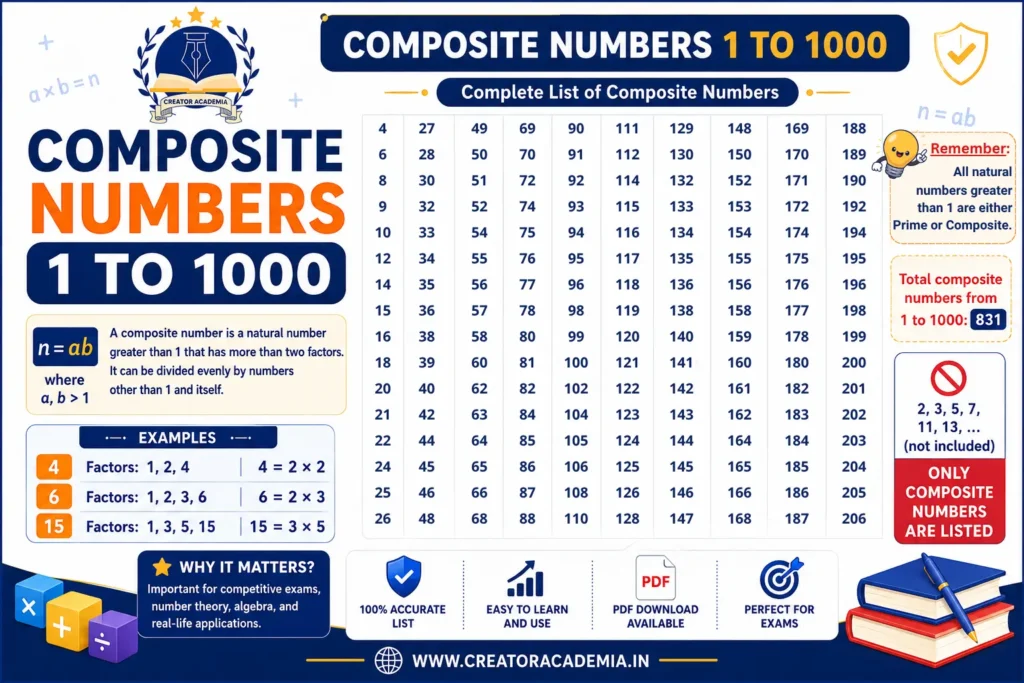
Composite Numbers 1 to 1000
In mathematics, while prime numbers get a lot of attention, composite numbers make up the vast majority of the number system. Understanding composite numbers is crucial for mastering factors, multiples, and prime factorization.
For example:
- 4 (Factors: 1, 2, 4)
- 15 (Factors: 1, 3, 5, 15)
- 100 (Factors: 1, 2, 4, 5, 10, 20, 25, 50, 100)
In this post, we provide a complete guide to composite numbers from 1 to 1000, including a list, classification, and a downloadable PDF for your exam preparation.
What is a Composite Number?
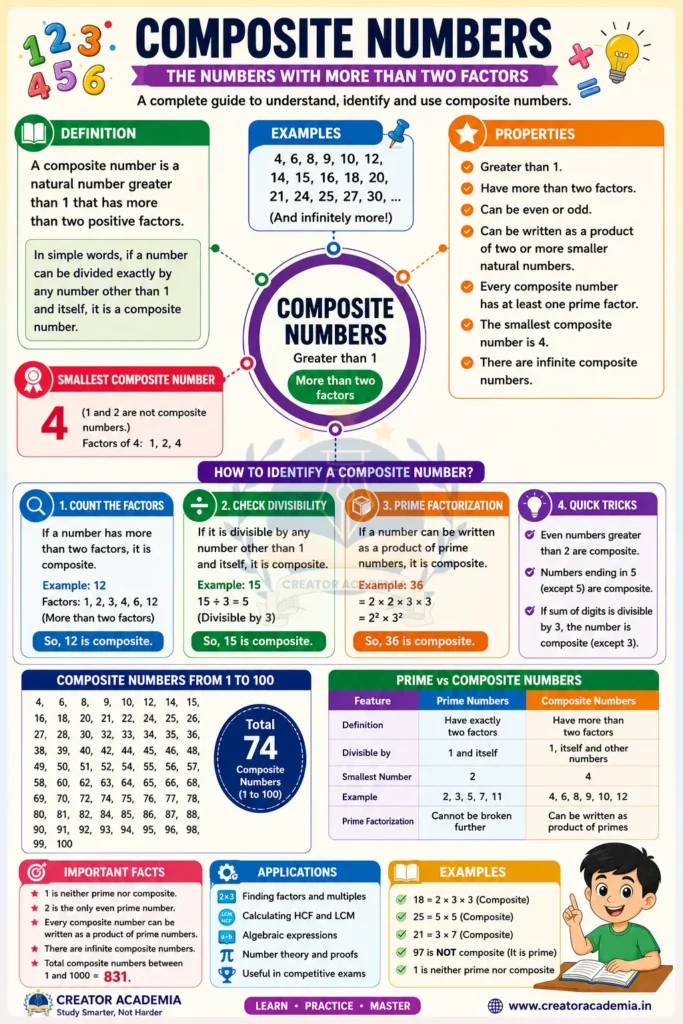
A composite number is a positive integer greater than 1 that has more than two factors. Unlike prime numbers (which only have 1 and themselves), composite numbers can be divided by other smaller integers.
In short: Composite Number = A number that has at least one factor other than 1 and itself.
Example:
- 6 is composite because its factors are 1, 2, 3, and 6.
- 9 is composite because its factors are 1, 3, and 9.
- 2 is NOT composite because it only has two factors (1 and 2).
Note: The number 1 is unique—it is neither prime nor composite.
List of Composite Numbers from 1 to 100
There are 74 composite numbers between 1 and 100:
4, 6, 8, 9, 10, 12, 14, 15, 16, 18, 20, 21, 22, 24, 25, 26, 27, 28, 30, 32, 33, 34, 35, 36, 38, 39, 40, 42, 44, 45, 46, 48, 49, 50, 51, 52, 54, 55, 56, 57, 58, 60, 62, 63, 64, 65, 66, 68, 69, 70, 72, 74, 75, 76, 77, 78, 80, 81, 82, 84, 85, 86, 87, 88, 90, 91, 92, 93, 94, 95, 96, 98, 99, 100.
1 to 1000 Composite Numbers List
This table lists the composite numbers from 1 to 1000.
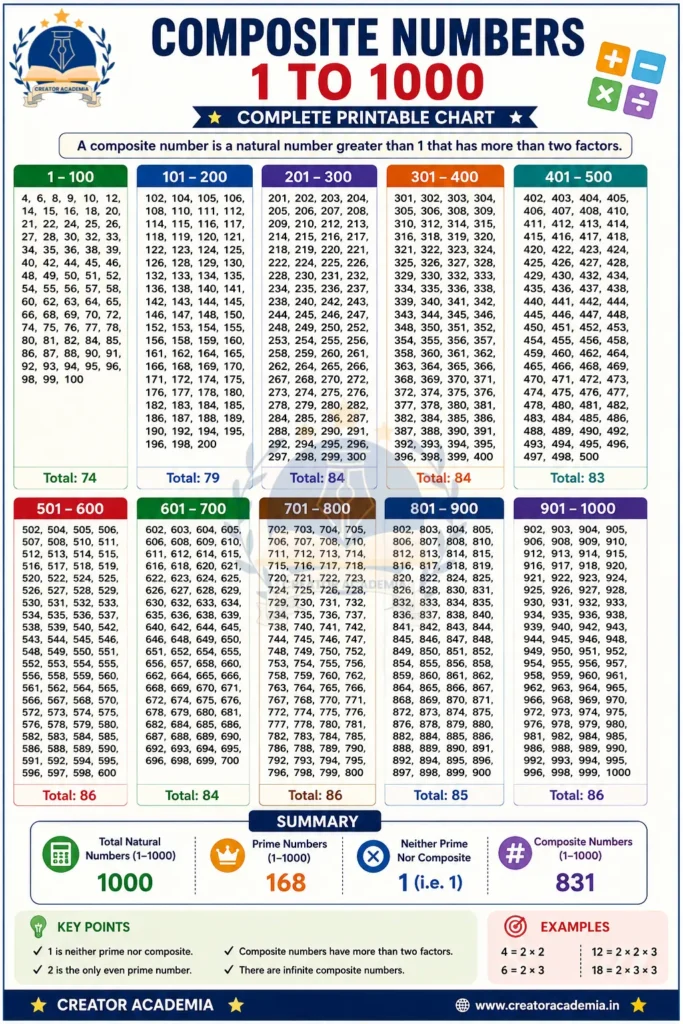
Download the PDF of Composite Numbers 1 to 1000 from the link given below.
Composite Numbers 1 to 1000 Chart
Out of the first 1000 natural numbers, here is how they are distributed:
| Category | Total Count |
| Prime Numbers (1–1000) | 168 |
| The Number 1 (Neither) | 1 |
| Composite Numbers (1–1000) | 831 |
| First Composite Number (1-1000) | 4 |
| Last Composite Number (1-1000) | 1000 |
Why Should You Learn Composite Numbers 1 to 1000?
If you are preparing for SSC, Bank, Railways, or CSAT, composite numbers are the foundation of many quantitative aptitude topics.
Benefits of Learning Composite Numbers:
- Prime Factorization: Knowing if a number is composite is the first step to breaking it down into prime factors.
- Divisibility Speed: Helps you quickly identify which numbers can be simplified in fractions.
- L.C.M. & H.C.F.: These concepts rely entirely on understanding the factors of composite numbers.
- Identifying Patterns: Many logical reasoning questions use the property of composite numbers.
Tips to Identify Composite Numbers Easily
- All Even Numbers > 2: Every even number ending in 0, 2, 4, 6, or 8 (except for 2 itself) is composite.
- Numbers Ending in 5: Any number greater than 5 that ends in 5 is composite.
- Divisibility Rules: Use rules for 3, 7, and 11 to quickly check if a large odd number has factors.
- Square Numbers: Every perfect square (4, 9, 16, 25…) is a composite number.
Short Tricks to Remember Composite Numbers
Here are a few tricks to help you identify them:
1. The Smallest Composite
👉 Trick: Remember that 4 is the smallest composite number. People often mistake 1 or 2, but 4 is the first number with three factors (1, 2, 4).
2. The Odd Composite Trick
👉 Trick: Not all composite numbers are even. Numbers like 9, 15, 21, 25, 27, and 33 are common odd composite numbers. Always check divisibility by 3 or 7 for odd numbers.
3. Quick Factor Check
👉 Trick: To see if a number is composite, try to find just one divisor other than 1 and itself. If you find even one (like 3 dividing into 51), it is composite!
Example:
- Is 51 composite? 5 + 1 = 6. Since 6 is divisible by 3, 51 is divisible by 3 (17 × 3). 51 is composite.
- Is 91 composite? It looks prime, but 13 × 7 = 91. 91 is composite.
Some Fun Facts About Composite Numbers
- Abundant Numbers: Many composite numbers are “abundant,” meaning the sum of their factors is greater than the number itself (e.g., 12).
- Highly Composite Numbers: Some numbers have more factors than any smaller number (e.g., 12, 24, 36, 48, 60).
- The Number 1: Always remember, 1 is the “lonely” number—it doesn’t fit into the prime or composite groups.
Difference Between Prime Numbers and Composite Numbers
| Prime Numbers | Composite Numbers |
|---|---|
| Exactly two factors | More than two factors |
| Divisible only by 1 and itself | Divisible by other numbers also |
| Cannot be factorized further | Can be factorized into prime numbers |
| Smallest is 2 | Smallest is 4 |
| Examples: 2, 3, 5, 7 | Examples: 4, 6, 8, 9 |
Uses of Composite Numbers in Real Life
- Packaging: Most items are sold in composite number quantities (dozens/12, packs of 6 or 24) because they are easily divisible into smaller groups.
- Timekeeping: Our clocks use 12 and 60 (both highly composite) because they can be divided by 2, 3, 4, 5, 6, 10, 12, 15, 20, and 30.
- Construction: Dimensions are often kept in composite numbers to allow for easier cutting and symmetrical division.
Common Mistakes Students Make
Mistake 1: Thinking 1 is Composite
This is incorrect.
1 is neither prime nor composite.
Mistake 2: Thinking Every Even Number is Composite
The number 2 is the only exception.
2 is a prime number.
Mistake 3: Thinking Every Odd Number is Prime
Many odd numbers are composite.
Examples:
- 9
- 15
- 21
- 25
- 27
- 35
Mistake 4: Forgetting Prime Factorization
Every composite number can always be broken into prime factors.
Example:
84 = 2 × 2 × 3 × 7
Final Tips
- Don’t Guess: If a number is large and ends in an odd digit (1, 3, 7, 9), quickly check if it’s a multiple of 3 or 7 before assuming it’s prime.
- Practice Sets: Try to categorize numbers from 1 to 50 into Prime and Composite once a week.
- Group Study: Quiz your friends on “Is this number composite?” to build mental speed.
Conclusion
Composite numbers are the “workhorses” of the math world. By learning the list from 1 to 1000 and understanding their factors, you will find arithmetic and algebra much easier to handle. Start with the smaller numbers and move your way up to 1000!
Quick Facts About Composite Numbers
| Question | Answer |
|---|---|
| Smallest Composite Number | 4 |
| Largest Composite Number (1-1000) | 1000 |
| Total Composite Numbers (1–1000) | 831 |
| Is 1 Composite? | No |
| Is 2 Composite? | No |
| Can Composite Numbers be Odd? | Yes |
| Can Composite Numbers be Even? | Yes |
| Infinite Composite Numbers? | Yes |
| Some Important Links | |
| Download Composite Numbers 1 to 1000 PDF | Click Here |
| Download Prime Numbers 1 to 1000 PDF | Click Here |
| Download 1 to 30 Cube Roots List (Perfect Cubes) PDF | Click Here |
| Download 1 to 30 Square Roots List (Perfect Squares) PDF | Click Here |