What is History? Meaning, Origin, Definitions and Sources of History
Introduction
History is much more than the study of kings, wars, and dates. It is the systematic study of past human life and the events that have shaped societies, civilizations, cultures, economies, religions, and political systems. By examining evidence left behind by earlier generations, historians reconstruct the past to understand how the present has evolved and what lessons can be learned for the future.
History connects us with our roots, preserves cultural heritage, and helps explain the reasons behind social, political, and economic changes. It enables us to understand the achievements and mistakes of previous generations, making it an essential subject for students, researchers, policymakers, and competitive examination aspirants.
Whether preparing for UPSC, SSC, PCS, State PSC or other competitive examinations, understanding the meaning, origin, definitions, and sources of history forms the foundation of historical studies.
Meaning of History
History refers to the systematic study and interpretation of past human events based on authentic evidence. It is not simply a collection of facts or dates but an analytical discipline that explains how societies developed over time.
The primary objective of history is to discover, record, interpret, and preserve the events of the past so that future generations can understand their significance.
Simple Definition
History is the systematic and evidence-based study of the human past.
Unlike myths or legends, history relies on facts supported by archaeological discoveries, inscriptions, manuscripts, coins, monuments, and other reliable sources.
Origin of the Word “History”
The word History originates from the Greek word Historia, which means:
- Inquiry
- Investigation
- Knowledge acquired through research
- Learning by inquiry
The term became widely known through the Greek historian Herodotus, whose famous work The Histories is regarded as one of the earliest systematic historical writings.
Because of his pioneering contribution, Herodotus is popularly known as the Father of History.
Later, another Greek historian, Thucydides, introduced a more scientific and analytical approach to historical writing. Therefore, he is often called the Father of Scientific History.
Definitions of History
Different historians have interpreted history according to their perspectives.
1. Herodotus
“History is the record of human events.”
Herodotus emphasized collecting and narrating events that shaped human societies.
2. Thucydides
History should be based on facts, evidence, and critical analysis rather than myths or legends.
3. E. H. Carr
“History is an unending dialogue between the past and the present.”
According to Carr, historians continuously reinterpret the past in light of present knowledge.
4. R. G. Collingwood
“History is the re-enactment of past thought in the historian’s mind.”
He believed that historians should understand the thoughts and motives behind historical actions.
5. Lord Acton
“History is the unfolding story of human freedom.”
He viewed history as the gradual progress of civilization and liberty.
6. Arnold J. Toynbee
History is the study of the rise and fall of civilizations and their responses to challenges.
7. Jawaharlal Nehru
History helps us understand the journey of humanity and the evolution of civilizations.
In Simple Words
History is the scientific study of past human life based on evidence, interpretation, and critical analysis.
Nature and Characteristics of History
History possesses several unique characteristics that distinguish it from other disciplines.
- 1. History is Evidence-Based
- Every historical conclusion is supported by reliable evidence such as inscriptions, coins, monuments, manuscripts, or archaeological remains.
- 2. History Studies Human Activities
- History mainly focuses on human beings—their societies, governments, economies, religions, cultures, and achievements.
- 3. History is Both a Science and an Art
- It is considered a science because it follows systematic methods of collecting and verifying evidence.
- It is considered an art because historians present facts in an organized, meaningful, and engaging narrative.
- 4. History is Dynamic
- New archaeological discoveries and historical evidence continuously reshape our understanding of the past.
- 5. History is Interdisciplinary
- It is closely related to:
- Archaeology
- Geography
- Economics
- Sociology
- Anthropology
- Political Science
- Literature
- It is closely related to:
- 6. History Explains Change and Continuity
- It helps explain:
- Why societies changed
- Why some traditions survived
- How civilizations developed over time
- It helps explain:
Importance of History
History plays an essential role in understanding both the past and the present.
- Preserves Human Heritage
- History protects the traditions, culture, language, literature, and achievements of civilizations.
- Helps Understand the Present
- Many present-day political boundaries, social customs, and economic systems are the result of historical developments.
- Develops Critical Thinking
- History teaches students to analyze evidence, compare viewpoints, identify causes, and evaluate consequences.
- Prevents Repetition of Mistakes
- Studying past conflicts, disasters, and policy failures enables societies to make better decisions in the future.
- Strengthens National Identity
- History promotes awareness of a nation’s heritage, freedom struggle, constitutional development, and cultural diversity.
Sources of History
Historical sources are the evidence that helps historians reconstruct the past. Without reliable sources, history cannot be written accurately.
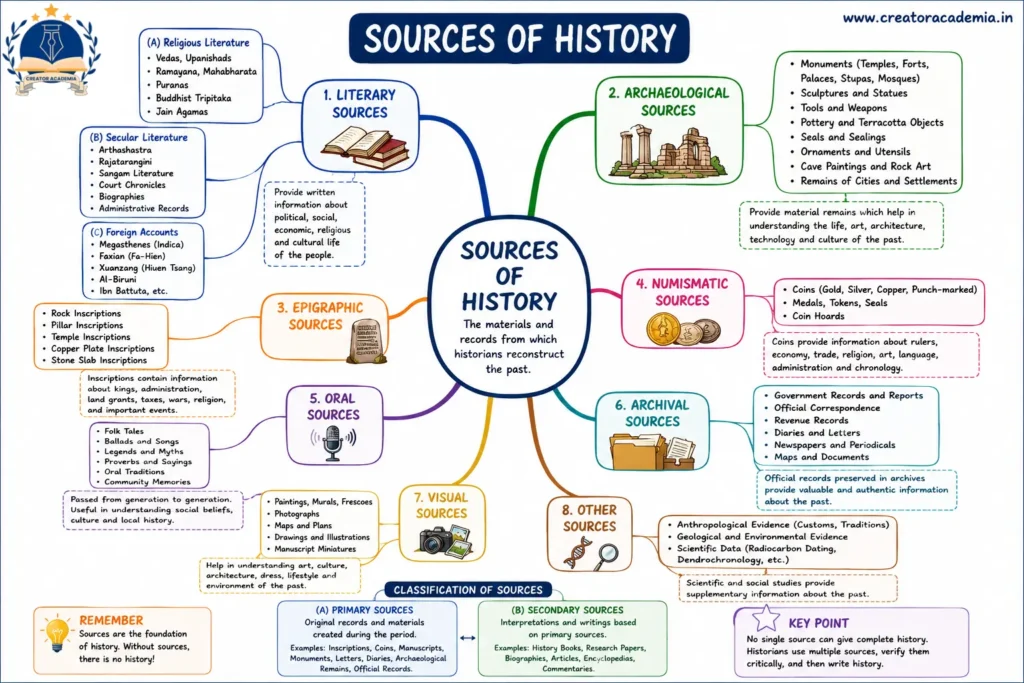
The major sources of history are explained below:
1. Literary Sources
These are written records created in different historical periods.
- Religious Literature
- Vedas
- Upanishads
- Ramayana
- Mahabharata
- Puranas
- Buddhist Tripitaka
- Jain Agamas
- Secular Literature
- Arthashastra
- Rajatarangini
- Sangam Literature
- Court chronicles
- Administrative records
- Biographies
- Foreign Accounts
- The writings of foreign travellers provide valuable information about India.
- Examples include:
- Megasthenes
- Faxian (Fa-Hien)
- Xuanzang (Hiuen Tsang)
- Al-Biruni
- Ibn Battuta
2. Archaeological Sources
These are physical remains of past civilizations.
They include:
- Monuments
- Temples
- Forts
- Palaces
- Stupas
- Sculptures
- Pottery
- Tools
- Seals
- Terracotta objects
- Cave paintings
Archaeological discoveries provide direct evidence about ancient life, technology, architecture, and culture.
3. Epigraphic Sources
Epigraphy is the study of inscriptions.
Inscriptions are found on:
- Rocks
- Pillars
- Temple walls
- Copper plates
- Stone slabs
These records provide information about kings, administration, taxation, religious activities, land grants, and important historical events.
4. Numismatic Sources
Numismatics is the study of coins.
Coins reveal information about:
- Rulers
- Economy
- Trade
- Religion
- Art
- Administration
- Chronology
Ancient coins often bear the names, portraits, and symbols of rulers, making them valuable historical evidence.
5. Oral Sources
Many societies preserved their history through oral traditions.
These include:
- Folk songs
- Ballads
- Legends
- Myths
- Traditional stories
- Community memories
Although oral sources require careful verification, they help preserve local history and cultural traditions.
6. Primary and Secondary Sources
- Primary Sources
- Primary sources are original records created during the historical period.
- Examples:
- Inscriptions
- Coins
- Manuscripts
- Government documents
- Letters
- Diaries
- Archaeological remains
- Secondary Sources
- Secondary sources are written after studying primary evidence.
- Examples:
- History textbooks
- Research papers
- Biographies
- Encyclopedias
- Scholarly articles
Quick Examination Facts
| Topic | Important Fact |
|---|---|
| Meaning of History | Systematic study of the human past based on evidence |
| Father of History | Herodotus |
| Father of Scientific History | Thucydides |
| Origin | Greek word Historia |
| Meaning of Historia | Inquiry / Investigation |
| Study of Inscriptions | Epigraphy |
| Study of Coins | Numismatics |
| Study of Material Remains | Archaeology |
| Main Types of Sources | Literary and Archaeological |
| Original Evidence | Primary Sources |
| Interpretation of Original Evidence | Secondary Sources |
Conclusion
History is the systematic and evidence-based study of the human past. It enables us to understand how civilizations developed, how societies evolved, and how historical events continue to influence the modern world. Through literary records, archaeological discoveries, inscriptions, coins, and oral traditions, historians reconstruct the past with accuracy and objectivity. A strong understanding of the meaning, origin, definitions, nature, importance, and sources of history not only builds a solid foundation for historical studies but also helps students excel in competitive examinations and develop a deeper appreciation of humanity’s shared heritage.
What is History? Meaning, Origin, Definitions and Sources of History
Practice Quiz
| Some Important Links | |
| Download “History – Meaning, Origin, Definitions & Sources” PDF | Click Here |