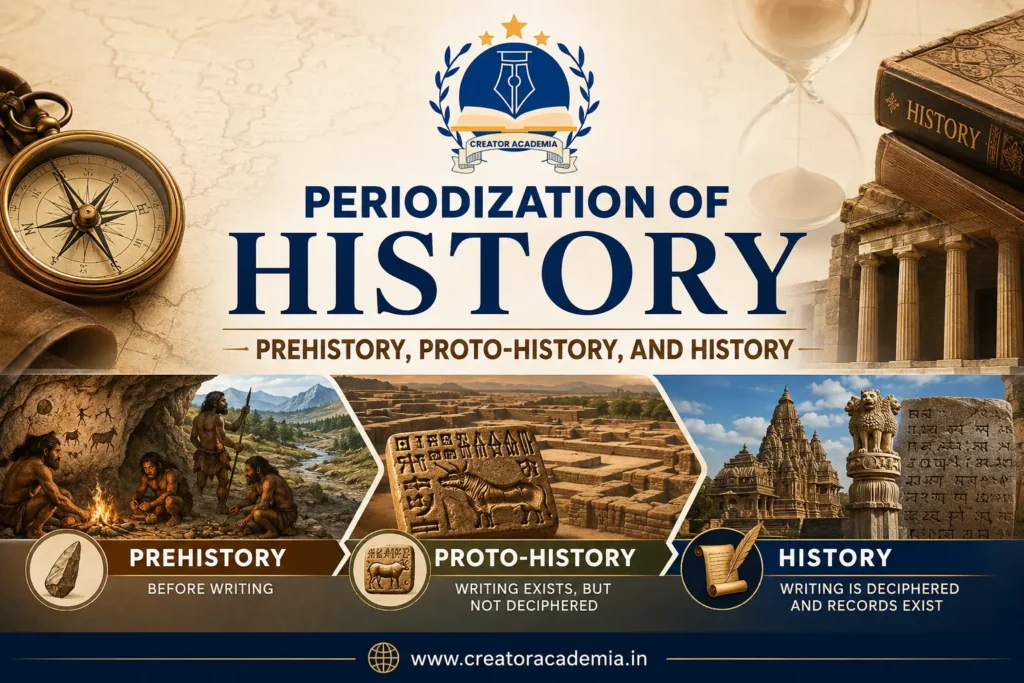
Periodization of History: Prehistory, Proto-History, and History
Introduction
History is not just a collection of random dates and events; it is a systematic study of the human past. However, human existence spans millions of years, making it impossible to study as a single, continuous narrative. To solve this problem, historians divide the massive timeline of mankind into distinct blocks of time. This systematic process of dividing the past into specific chronological eras is known as the Periodization of History.
In the context of Indian history, this division is primarily based on two critical factors: the evolution of human scripts (written records) and the technological materials used by humans (like stone, copper, bronze, or iron). Understanding this periodization is the absolute first step for any competitive exam aspirant. In this comprehensive guide, we will explore the three main pillars of history—Prehistory, Proto-History, and History—along with historical classification theories and modern time-dating techniques.
What is Periodization of History?
Periodization of History is the process of dividing the long course of human history into different periods based on important historical developments and changes.
Instead of studying all historical events together, historians organize them into separate periods that share common characteristics. This makes history easier to understand, teach, and analyze.
Simple Definition
Periodization of History is the systematic division of history into different periods based on major political, social, economic, cultural, and technological changes.
Meaning of Periodization
The word Periodization is derived from the word “Period,” meaning a specific span of time.
Therefore, periodization refers to dividing history into different chronological periods for systematic study.
Why is Periodization Necessary?
History extends from the earliest human existence to the present day. Without dividing it into periods, studying and understanding historical developments would become difficult.
Periodization helps us:
- Study history in a logical sequence.
- Understand the development of human civilization.
- Identify major historical changes.
- Compare different periods.
- Recognize continuity and change.
- Improve teaching and learning.
- Simplify preparation for competitive examinations.
Basis of Periodization
Historians classify history according to major transformations in society.
Some common bases include:
- Political developments
- Social changes
- Economic systems
- Religious movements
- Cultural achievements
- Scientific discoveries
- Technological advancements
- Administrative changes
- Important wars and revolutions
Different historians may choose different criteria; therefore, historical dates may vary slightly.
The Three Main Pillars of Historical Classification
Historians classify the entire human past into three major categories based on chronological, technological, and script evidence:
1. Prehistory (Prehistoric Period)
This is the era of human history for which no written records exist. Humans during this time had not invented any script, language, or system of writing.
- Sources: Our entire knowledge of this period depends on archaeological discoveries, such as stone tools, fossils, structural ruins, pottery, and cave paintings.
- Human Evolution: This period tracks the biological evolution of early hominids to modern Homo sapiens.
- Examples in India: The entire Stone Age—which includes the Paleolithic (Old Stone Age), Mesolithic (Middle Stone Age), and Neolithic (New Stone Age) periods—falls under Prehistory.
2. Proto-History (Proto-Historic Period)
This is a fascinating transitional phase between Prehistory and History. It refers to the period for which written records are available, but they cannot be read or deciphered by modern scholars. It also includes cultures that didn’t leave behind scripts but were actively mentioned in the contemporary written records of other literate civilizations.
- Sources: A mix of advanced archaeological artifacts (like seals, urban ruins) and oral traditions.
- Examples in India:
- The Indus Valley Civilization (IVC): They had a highly advanced pictographic script (found on seals), but it remains un-deciphered to this day.
- The Vedic Period: The Vedas were composed during this time but were transmitted orally as Shruti (hearing) for centuries before being written down in the historic era.
3. History (Historic Period)
The historic period begins when written records become easily available, readable, and deciphered. This marks the time when humans systematically recorded laws, royal decrees, religious texts, and daily accounts on materials like clay tablets, birch bark, palm leaves, and pillars.
- Sources: Epigraphic data (inscriptions), numismatic data (coins with scripts), manuscripts, foreign traveler journals, and secular literature.
- Examples in India: The period starting from the 6th Century BCE (the Mahajanapadas era, the rise of Magadha, Buddhism, Jainism, and the subsequent Maurya Empire) marks the true beginning of the historic period in India.
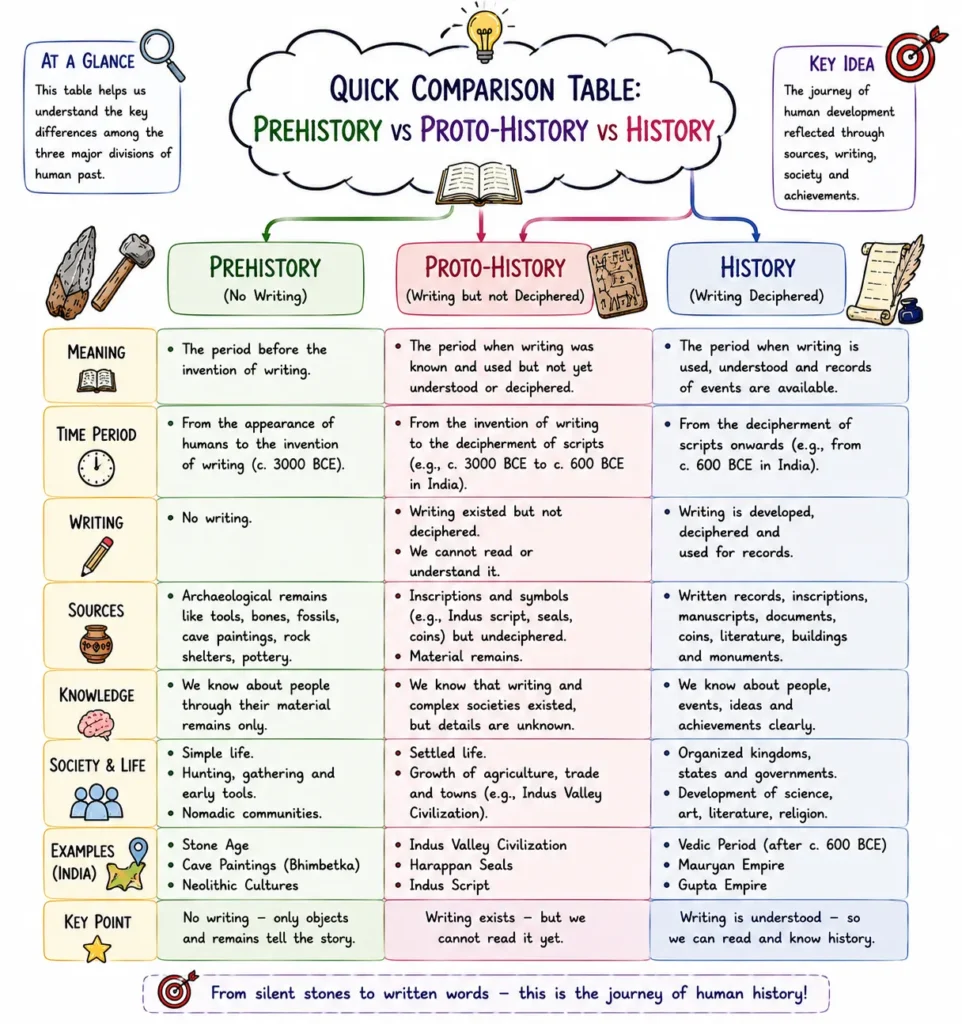
Quick Comparison Table: Prehistory vs Proto-History vs History
| Historical Period | Written Records / Script | Primary Sources | Indian Context Examples |
| Prehistory | ❌ Completely Absent | Stone Tools, Fossils, Cave Art | Paleolithic, Mesolithic, Neolithic Age |
| Proto-History | ⚠️ Available but Not Deciphered | Seals, Pottery, Oral Traditions | Indus Valley Civilization, Vedic Age |
| History | Available and Deciphered | Inscriptions, Manuscripts, Books | Mahajanapadas, Maurya Empire onwards |
James Mill’s Classification of Indian History & The Modern Critique
When studying the periodization of Indian history, it is crucial to understand how early colonial historians viewed our past. In 1817, a Scottish economist and political philosopher named James Mill published a massive three-volume work titled “A History of British India”.
In this book, Mill divided Indian history into three distinct periods based on the religion of the rulers:
- Hindu Period: Referring to ancient India ruled by Hindu kings.
- Muslim Period: Referring to medieval India dominated by Islamic sultanates and empires.
- British Period: Referring to the colonial modern era under British rule.
The Modern Critique:
Modern historians completely reject James Mill’s classification due to severe flaws:
- Communal Bias: It is wrong to characterize an entire historical age by the religion of the rulers, as millions of people practicing different faiths lived simultaneously.
- Ignoring Diversity: Even during the so-called “Hindu Period”, prominent Buddhist and Jain rulers existed, and during the “Muslim Period”, powerful Hindu empires like the Vijayanagara Empire flourished.
- The Modern Standard: Consequently, modern historians use a neutral, secular periodization model: Ancient India, Medieval India, and Modern India.
Understanding Time in History: BC, AD, BCE, and CE
Apart from structural blocks, understanding timeline tags is highly important for students because historical dates count downward and upward around a single focal point.
- BC (Before Christ): Refers to the years before the estimated birth of Jesus Christ. These dates are always counted backward. For example, 500 BC comes before 250 BC.
- AD (Anno Domini): A Latin phrase meaning “in the year of our Lord.” It tracks the years after the birth of Christ. These dates move forward normally.
- BCE & CE (The Modern Standard): Today, secular historians prefer using BCE (Before Common Era) instead of BC, and CE (Common Era) instead of AD. The timeline and calculations remain exactly the same; only the terminology has changed to make it globally neutral and inclusive.
How Do Historians Fix Dates? (Scientific Time-Dating Methods)
Since Prehistoric and Proto-historic eras lack readable documents, how do scientists know an object is 5,000 or 50,000 years old? They use advanced scientific dating methods:
- Radiocarbon Dating (Carbon-14 Dating): All living organisms absorb Carbon-14 (C14) from the atmosphere. When they die, the C14 begins to decay at a fixed rate (its half-life is approximately 5,730 years). By measuring the remaining C14 in bones, wood, or charcoal, scientists calculate the exact age of the artifact.
- Dendrochronology: This method calculates the age of wooden structures by analyzing and counting the annual growth rings inside the tree trunks.
- Stratigraphy: Based on the geological principle that lower layers of earth contain older artifacts, while upper layers contain newer materials.
Quick Examination Facts
| Topic | Important Fact |
| Periodization Basis | Script presence (written records) and technology used by humans. |
| Prehistory Definition | The era with zero written records; completely dependent on archaeological tools/fossils. |
| Proto-History Definition | Written script is available but remains un-deciphered by modern scholars. |
| True History Starting Point | From 6th Century BCE onwards (deciphered inscriptions and manuscripts available). |
| Proto-History Core Examples | Indus Valley Civilization (script un-deciphered) and the early Vedic Age. |
| James Mill’s 1817 Book | A History of British India (Introduced communal periodization). |
| James Mill’s Classification | Hindu Period, Muslim Period, and British Period. |
| Modern Tripartite Standard | Ancient India, Medieval India, and Modern India (Neutral classification). |
| BCE Full Form | Before Common Era (Secular equivalent to BC). |
| CE Full Form | Common Era (Secular equivalent to AD). |
| BCE Date Calculation Rule | Dates are always counted backward toward year zero. |
| Carbon-14 (C-14) Half-life | Approximately 5,730 years (Scientific baseline for organic material dating). |
| Dendrochronology Target | Calculating exact wood age by counting growth rings inside tree trunks. |
| Stratigraphy Principle | Deepest, lowest underground soil layers contain the oldest archaeological artifacts. |
Conclusion
The periodization of history gives us a structural roadmap of human progress. It shows how mankind traveled from the absolute silence of the Prehistoric Stone Age, passed through the mysterious scripts of the Proto-historic Indus Valley, and finally arrived at the deeply recorded pages of the Historic Era. By mastering this fundamental blueprint, timelines become incredibly logical, making future historical studies smooth and rewarding.
Periodization of History: Prehistory, Proto-History, and History Explained
Practice Quiz
| Some Important Links | |
| Download “Periodization of History: Prehistory, Proto-History, and History” PDF | Click Here |