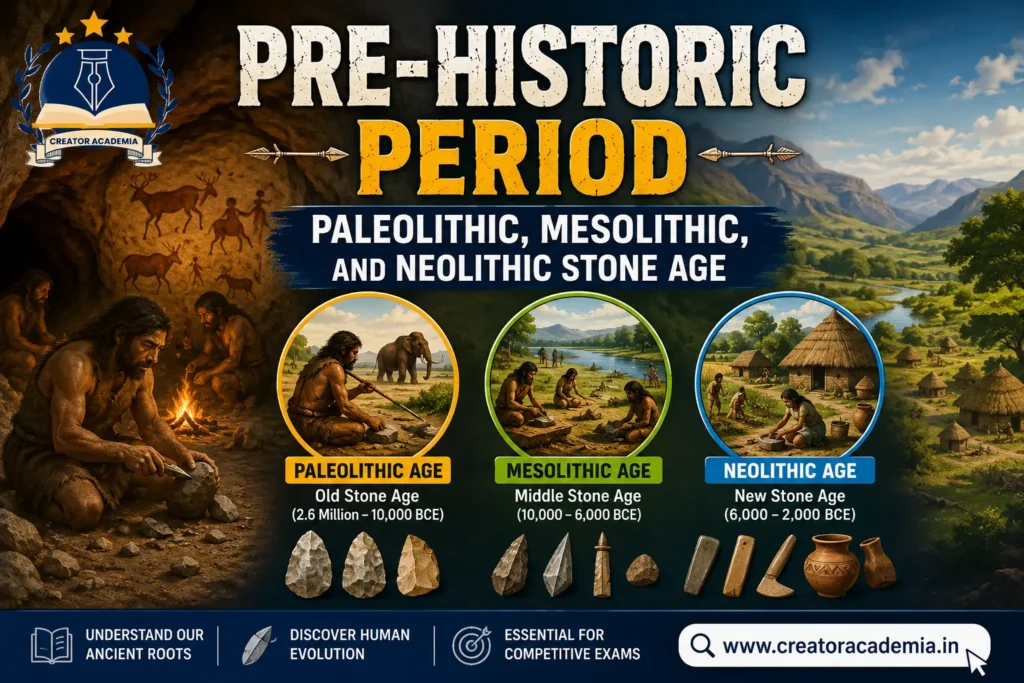
Pre-Historic Period: Paleolithic, Mesolithic, and Neolithic Stone Age
Introduction
The story of human civilization in the Indian subcontinent spans hundreds of thousands of years. Before the era of written records, grand empires, or advanced metal tools, early humans survived by adapting to nature using the most abundant resource available to them—stone. This vast timeline, where scripts and written documents did not exist, is universally classified as the Pre-Historic Period.
To reconstruct the pre-historic period, historians and archaeologists cannot rely on texts. Instead, they completely depend on tangible archaeological discoveries, such as stone tools, fossils, structural ruins, and ancient cave art. Based on the types of stone tools used, environmental variations, and shifts in human lifestyle, the Stone Age is broadly divided into three major phases: the Paleolithic Age (Old Stone Age), the Mesolithic Age (Middle Stone Age), and the Neolithic Age (New Stone Age), followed by the metal-using Chalcolithic Age.
Meaning and Scope of Pre-history
Meaning of Pre-history
Pre-history refers to the period of the human past for which there are no written records. The term implies the phase of human development prior to the invention of reading and writing. Consequently, the boundary between pre-history and the historic period varies globally, depending on when a particular society developed a written script.
Nature of Sources
In the absence of literary records, prehistory is studied exclusively through archaeological data. The primary sources of information include:
- Stone Implements: Stone tools serve as the primary indicator of the physical capabilities, mental development, and functional skills of early humans.
- Faunal and Floral Remains: Animal bones and fossilized plant remains (charred seeds and pollen grains) provide data regarding contemporary environmental conditions and dietary habits.
- Stratigraphy: The study of geological and soil layers enables archaeologists to establish relative dates, operating on the principle that lower undisturbed soil layers are older than the upper layers.
The Three-Age Classification
In 1836, the Danish scholar Christian Jürgensen Thomsen formulated a chronological framework that classifies prehistoric antiquity into successive stages based on the primary raw materials utilized for tool manufacture:
- The Stone Age: The earliest period characterized by the exclusive use of stone, bone, and wooden implements.
- The Bronze Age: The stage marked by the introduction of metallurgy, specifically the mixing of copper and tin to produce bronze.
- The Iron Age: The phase distinguished by the widespread mining and smelting of iron, which facilitated advanced agricultural production.
Division of Pre-historic Period
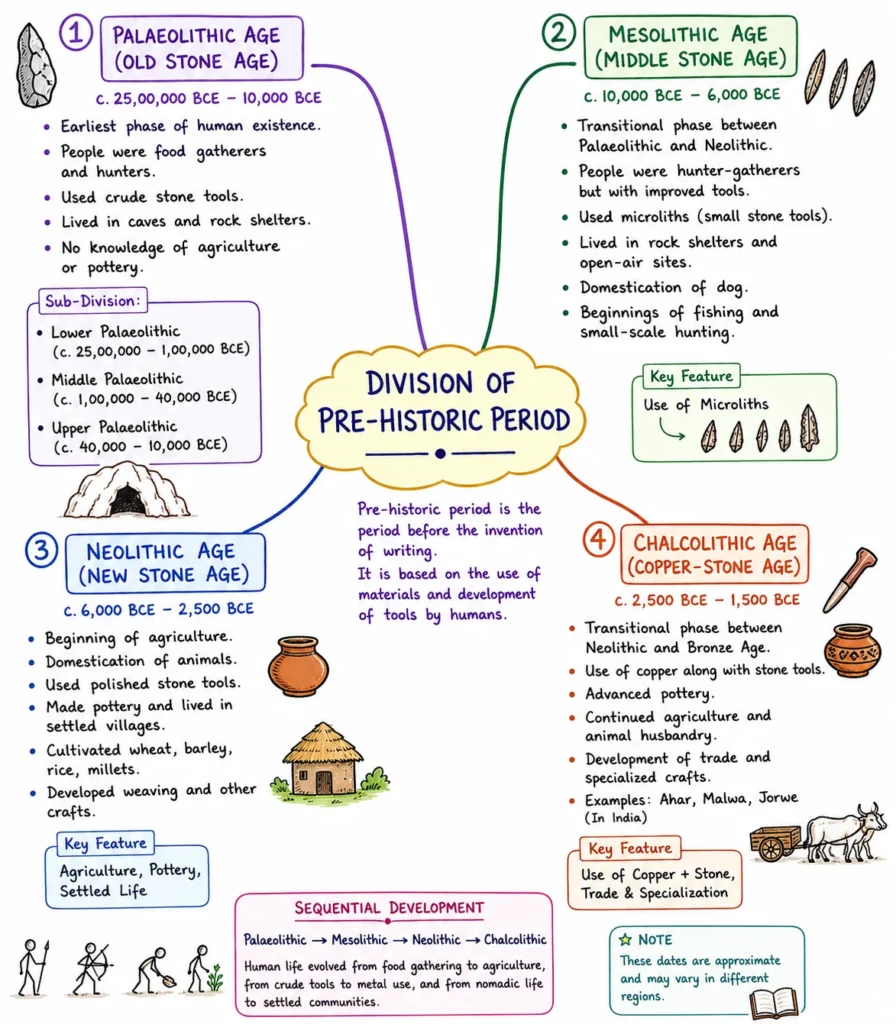
🪨 1. The Paleolithic Age (Old Stone Age)
Timeline: c. 5,00,000 BCE – 10,000 BCE
The word ‘Paleolithic’ is derived from the Greek words Palaios (old) and Lithos (stone). This is the earliest and longest phase of human history in India, covering the Pleistocene geological era (Ice Age).
- Lifestyle: Early humans during this phase were nomadic hunters and food gatherers. They did not know how to cultivate crops or build houses. They lived in natural rock shelters, caves, and near river valleys.
- Tools: They used crude, unpolished heavy stone tools made of Quartzite (hence, Paleolithic men in India are also called “Quartzite Men”). Their primary tools were hand-axes, cleavers, scrapers, and choppers.
- Important Sites:
- Bhimbetka (Madhya Pradesh): Famous for rock shelters and continuous habitation paintings.
- Sohan Valley (now in Pakistan): A primary source for early Paleolithic tools.
- Arambakkam (Tamil Nadu): One of the oldest hand-axe sites in Southern India.
Subdivisions of the Paleolithic Age:
The Paleolithic period is divided into three distinct chronological phases based on stratigraphic distributions:
A. Lower Paleolithic Age
- Climatic Context: Corresponds to the greater part of the Ice Age, marked by intense cold.
- Tools: Dominated by heavy core tools manufactured by removing flakes from a stone until the desired shape was achieved. This phase features the Acheulian tradition, characterized by hand-axes and cleavers used for butchering and digging.
- Important Sites: Sohan River Valley (Pakistan), Attirampakkam (Tamil Nadu), and Bori (Maharashtra).
B. Middle Paleolithic Age
- Climatic Context: Characterized by a marginal stabilization of temperatures, though cold conditions persisted.
- Tools: Marked by the emergence of Flake Tools. Smaller, sharper, and thinner implements were produced from the flakes detached from a prepared core rock. The main tools include specialized scrapers, borers, and points made of minerals like chert and jasper.
- Important Sites: Nevasa on the Pravara River (Maharashtra) and Didwana (Rajasthan).
C. Upper Paleolithic Age
- Climatic Context: Coincides with the terminal phase of the Ice Age, where environmental temperatures rose gradually.
- Biological Milestone: This phase marks the appearance and expansion of anatomically modern humans, Homo sapiens.
- Tools: Distinguished by Blade and Bone Tools. Implements became parallel-sided, elongated, and sharp. Bone tools, including needles and harpoons made from animal antlers, became common.
- Important Sites: Kurnool Caves (Andhra Pradesh), which yielded evidence of ancient ash indicating the controlled use of fire; Bhimbetka Rock Shelters (Madhya Pradesh); and the Belan Valley (Uttar Pradesh), famous for a bone figurine of a mother goddess.
🏹 2. The Mesolithic Age (Middle Stone Age)
Timeline: c. 10,000 BCE – 6,000 BCE
The Mesolithic phase marks a transitional period between the Old Stone Age and the New Stone Age. With the end of the Ice Age, the climate became warm and dry, leading to shifts in flora and fauna.
- Lifestyle: Hunting and gathering continued, but humans also started fishing and domesticating animals (like dogs and cattle) toward the end of this period.
- Tools (Microliths): This age is characterized by Microliths—tiny, sharp, and highly sophisticated stone tools ranging from 1 to 5 cm in length. These were pointed, geometric stones fixed onto wooden or bone handles to make arrows, spears, and sickles.
- Art: This era witnessed a massive boom in rock art. The cave paintings of Bhimbetka vividly depict birds, animals, hunting scenes, and community dances belonging to this era.
- Important Sites:
- Bagor (Rajasthan): One of the largest and best-documented Mesolithic sites, showing early evidence of animal domestication.
- Langhnaj (Gujarat): Provided evidence of human burials and microlith production.
- Adamgarh (Madhya Pradesh): Showed earliest traces of animal taming along with Bagor.
- Sarai Nahar Rai (Uttar Pradesh): Provides early evidence of human conflict through skeletal remains.
🌾 3. The Neolithic Age (New Stone Age)
Timeline: c. 6,000 BCE – 1,000 BCE
Often termed the “Neolithic Revolution” by historians, this phase brought about a complete transformation in human history as humans transitioned from food consumers to food producers.
- Lifestyle: Humans invented agriculture (cultivating wheat, barley, and rice) and settled down in permanent mud-brick houses. This gave birth to village communities. The invention of the potter’s wheel allowed them to store surplus grain and cook food.
- Polished Tools: Tools became highly polished, polished, and functionally advanced. Celts, axes, chisels, and adzes were ground beautifully to cut down trees for farming.
- Important Indian Sites:
- Mehrgarh (now in Pakistan): Located near the Bolan Pass, it is the oldest Neolithic site in the subcontinent, showing the earliest evidence of wheat and barley cultivation (c. 7000 BCE).
- Burzahom & Gufkral (Jammu & Kashmir): Famous for pit-dwelling (houses dug underground to protect from severe cold) and unique domestic dog burials along with their masters.
- Chirand (Bihar): Remarkable for finding a large number of tools made of animal bones and deer antlers.
- Koldihwa (Uttar Pradesh): Located in the Belan Valley, this site provides some of the earliest evidence of rice cultivation in the world.
Comparative Analysis of the Stone Age
| Feature | Paleolithic Age (Old Stone Age) | Mesolithic Age (Middle Stone Age) | Neolithic Age (New Stone Age) |
| Main Occupation | Hunting & Wild Food Gathering | Hunting, Fishing, Animal Taming | Agriculture & Animal Husbandry |
| Tool Type | Crude, heavy Quartzite tools (Hand-axes, Cleavers) | Tiny, sharp geometric tools (Microliths) | Highly polished, ground stone tools (Celts) |
| Settlement | Highly Nomadic (Natural caves & river valleys) | Semi-Nomadic (Temporary seasonal shelters) | Sedentary (Permanent mud-brick houses) |
| Key Inventions | Traces of fire discovery | Bow and arrow, Domestication | Potter’s Wheel, Agriculture, Weaving |
| Major Indian Site | Sohan Valley, Bhimbetka, Attirampakkam | Bagor, Adamgarh, Langhnaj | Mehrgarh, Burzahom, Koldihwa |
🪙 4. The Chalcolithic Age (Stone-Copper Age)
Timeline: c. 2,100 BCE – 700 BCE
The terminal phase of the Neolithic period witnessed a major technological transition marked by the introduction of metallurgy. The Chalcolithic Age (derived from the Greek Chalkos meaning copper and Lithic meaning stone) defines the period during which human groups utilized copper implements alongside traditional stone tools.
- Lifestyle and Culture
- Copper was the first metal systematically smelted and processed by humans. Although Chalcolithic societies were predominantly rural farming communities characterized by distinct ceramic traditions—most notably Painted Black and Red Ware—their mastery of metal usage laid the essential material foundation for the subsequent development of urban bronze and iron age civilizations.
- Prominent Regional Complexes
- Jorwe Culture: A highly standardized culture distributed widely across Maharashtra, with major settlements at Daimabad (famous for a massive bronze hoard including a solid metal chariot) and Inamgaon.
- Ahar Culture: Located in the Banas Valley, Rajasthan. The site of Ahar was historically referred to as Tambavati (the place of abundant copper) due to the presence of specialized copper-smelting hearths and a near-complete absence of microliths.
Quick Examination Facts
| Topic | Important Fact |
| Meaning of Pre-history | Period before the invention of written scripts |
| Three-Age System Creator | Christian Jürgensen Thomsen (1836) |
| Study of Tree Rings | Dendrochronology |
| Study of Soil Layers | Stratigraphy |
| Isotope for Organic Dating | Carbon-14 |
| Half-Life of Carbon-14 | Approximately 5,730 years |
| Paleolithic Geological Era | Pleistocene epoch (Ice Age) |
| Paleolithic Nickname | “Quartzite Men” |
| Lower Paleolithic Culture | Acheulian tradition (Hand-axes and Cleavers) |
| Middle Paleolithic Phase | Flake tool industry (Scrapers and Borers) |
| Upper Paleolithic Human Type | Homo sapiens (Modern humans) |
| Controlled Use of Fire Site | Kurnool Caves (Ash deposits) |
| Prehistoric Mother Goddess Site | Belan Valley (Bone figurine) |
| Mesolithic Geological Era | Holocene epoch |
| Mesolithic Core Feature | Microliths (Miniature geometric stone tools) |
| Earliest Animal Domestication | Bagor (Rajasthan) and Adamgarh (Madhya Pradesh) |
| Earliest Human Conflict Evidence | Sarai Nahar Rai (Embedded microliths in skeletons) |
| Neolithic Core Transformation | Neolithic Revolution (Food gathering to food production) |
| Earliest Farming Village | Mehrgarh (Wheat and barley cultivation around 7000 BCE) |
| Pit-dwelling Sites | Burzahom and Gufkral (Kashmir) |
| Oldest Rice Cultivation Site | Koldihwa (Belan Valley) |
| Extensive Bone Tool Site | Chirand (Bihar) |
| Neolithic Tool Finish | Highly ground, smoothed, and polished Celts |
| First Smelted Metal | Copper |
| Meaning of Chalcolithic | Copper-Stone Age |
| Chalcolithic Ceramic Tradition | Painted Black and Red Ware |
| Ahar Culture Alternate Name | Tambavati (Place of copper) |
| Bronze Hoard Site (Jorwe Culture) | Daimabad (Solid copper chariot) |
Conclusion
The Pre-Historic period stands as the foundational bedrock of human evolution in India. From raw survival as wandering hunters in the Ice Age to creating vibrant farming villages, early humans systematically mastered tool-making, art, and community living. Understanding the milestones of the Stone Age gives us the exact context needed to appreciate the dramatic rise of India’s first urban wonder—the Indus Valley Civilization.
Pre-Historic Period: Paleolithic, Mesolithic, and Neolithic Stone Age
Practice Quiz
| Some Important Links | |
| Download “Pre-Historic Period” PDF | Click Here |