Introduction to Geography: Definition, Branches & Approaches
It bridges the gap between natural sciences (like geology and climatology) and social sciences (like economics and sociology), explaining how physical surroundings shape human lives and how humans, in turn, modify the planet.
1. Definition and Etymology of Geography
The systematic study of the Earth’s surface, its physical features, and the spatial distribution of human phenomena forms the core of geographical science.
The term Geography was first coined by the ancient Greek scholar Eratosthenes in the third century BCE. He was among the first to calculate the Earth’s circumference with remarkable precision using basic geometric angles of sunlight.
- Geo: Meaning “The Earth”
- Graphos: Meaning “To Write” or “To Describe”
- Literal Meaning: Translated literally, geography means “the description of the Earth.” However, modern geography goes far beyond simple description. It is a spatial science that looks at variations across different places, how features are distributed, and why specific patterns emerge where they do.
- The Interdisciplinary Bridge: Geography does not exist in isolation. It acts as an essential bridge linking the Natural Sciences (like geology, hydrology, pedology, and meteorology) with the Social Sciences (like economics, political science, sociology, and history).
- Core Spatial Questions: Whenever geographers analyze any feature or event, they break it down into three simple yet crucial questions:
- What is the feature? (Identification of physical or cultural landforms)
- Where is it located? (Spatial pattern and mapping)
- Why is it located there? (Causal processes and driving factors)
2. The Core Branches of Geography
Because the scope of our planet and human life is so vast, geography is organized into two primary pillars: Physical Geography and Human Geography, each branching into specialized fields.
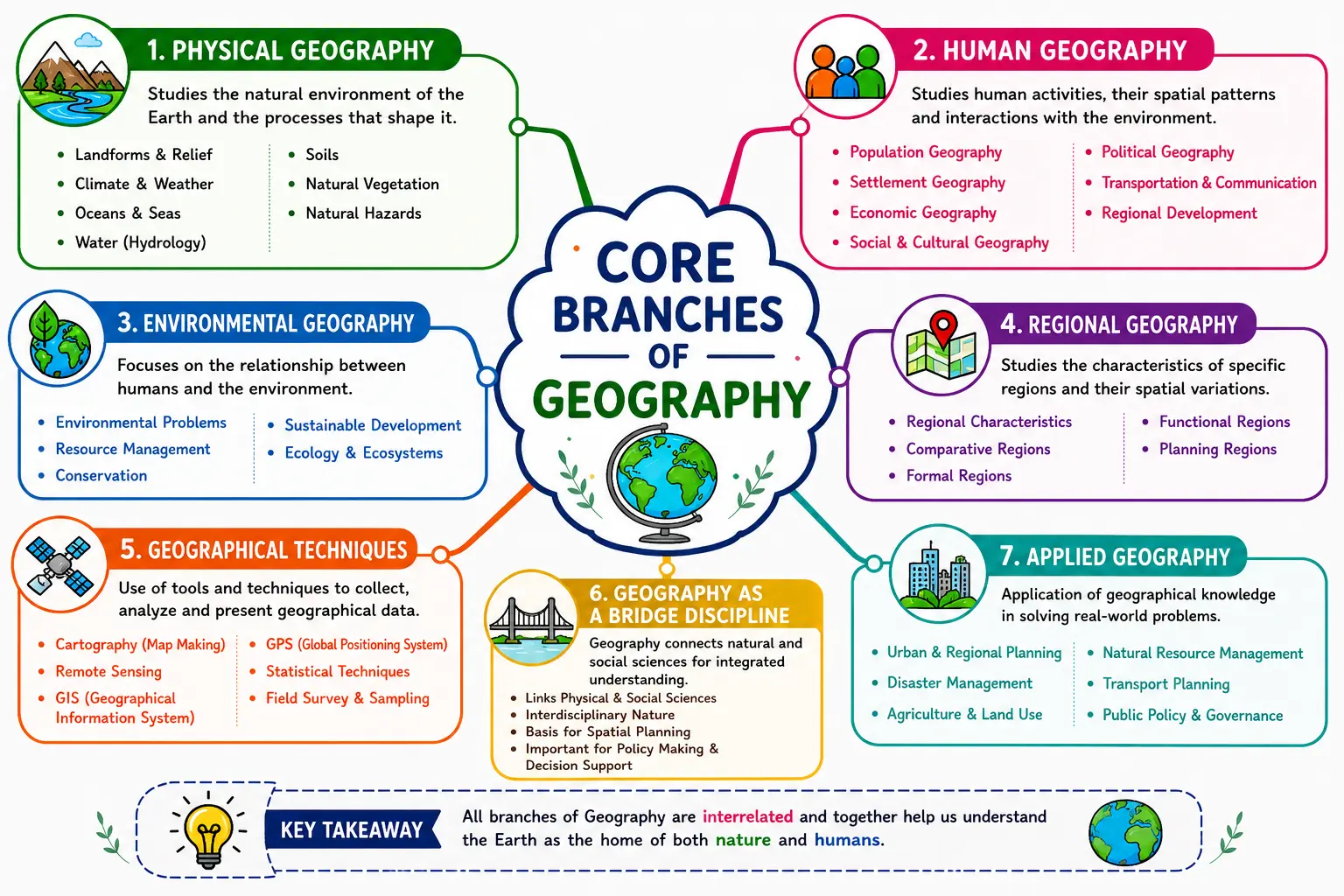
A. Physical Geography
Physical Geography explores the natural world—the physical environment, climate, oceans, and living organisms. Its core sub-fields include:
- Geomorphology: This deals with landforms and landscapes—mountains, valleys, plateaus, and plains. It examines how they formed and how they change over time through two types of forces:
- Endogenic Forces (Internal): Earthquakes, volcanic activity, and plate tectonics that build up relief.
- Exogenic Forces (External): Weathering, mass wasting, and erosion driven by running water, wind, glaciers, and waves that wear down the surface.
- Climatology: Focuses on the structure of the atmosphere, heat budget, weather elements, planetary winds, and regional climatic zones, along with long-term climate changes.
- Oceanography (Hydrology): Studies the vast oceans and seas covering over 70% of the Earth. It analyzes ocean floor topography (shelves, trenches, ridges), seawater properties (temperature and salinity), and oceanic movements like tides, currents, and waves.
- Biogeography: Positioned at the intersection of geography and biology, this branch maps the distribution of life across space. It includes Plant Geography (flora), Zoo-geography (fauna), and Pedology (the study of soil formation, horizon profiles, and soil types).
B. Human Geography
Human Geography investigates how human communities live, work, build infrastructure, and interact with their surroundings. Key divisions include:
- Population and Settlement Geography: Tracks demographic patterns—population growth, density, sex ratio, and migration trends. It also studies how rural villages and urban cities develop, function, and expand over time.
- Economic Geography: Explores how people make a living by extracting and utilizing resources. It maps agricultural regions, heavy manufacturing belts, trade routes, transport corridors, and modern service sectors.
- Cultural and Social Geography: Analyzes spatial differences in language, religion, societal customs, and traditions, showing how communities create distinctive cultural landscapes.
- Political Geography: Focuses on administrative divisions, state boundaries, geopolitical relationships between nations, resource disputes, and voting trends.
3. Methodological Approaches in Geography
To analyze the wide variety of natural and cultural phenomena on our planet, geographers organize their investigations through two primary methodologies. Each approach provides a distinct perspective on spatial patterns:
-
1. Systematic Approach (General Geography):
- Historical Origin: This methodology was introduced and championed by the renowned German geographer and polymath Alexander von Humboldt (1769–1859), who laid the groundwork for modern physical geography and climatology.
- Core Concept: In this approach, a single specific geographic phenomenon or topic is selected and investigated uniformly across the entire world, rather than focusing on one specific territory.
- Analytical Method: The scholar looks for global patterns, spatial laws, and underlying causes. For example, instead of studying just one country’s weather, a geographer might map the worldwide distribution of tropical rainforests, global atmospheric wind systems, or the international patterns of the automobile manufacturing industry.
- Key Advantage: It helps establish broad principles, classifications, and universal laws that explain how natural and human systems operate across the globe.
-
2. Regional Approach:
- Historical Origin: This method was introduced by another foundational German geographer, Carl Ritter (1779–1859), who emphasized studying Earth’s diverse landscapes as living homes for human societies.
- Core Concept: Instead of taking one isolated topic globally, the Earth’s surface is first divided into distinct spatial units of varying scales, called regions. A region can be a macro-unit (like a whole continent), a meso-unit (like a river basin or natural climatic belt), or a micro-unit (like a specific administrative district or valley).
- Analytical Method: Once the geographical boundaries of a region are demarcated, all of its components—relief, rocks, local climate, rivers, soils, natural vegetation, agriculture, mineral wealth, industries, and human populations—are studied together as an integrated, interdependent whole.
- Key Advantage: It provides a deep, comprehensive understanding of how different physical and human factors interact within a specific area to give that region its unique identity.
4. Perspectives on Human-Environment Interaction
One of the central debates in geographical thought focuses on the relationship between human beings and their natural environment. Over time, three major philosophical schools of thought developed to explain this interaction:
-
1. Environmental Determinism (Nature Dominates Man):
- Major Proponents: Friedrich Ratzel, Ellen Churchill Semple, and Ellsworth Huntington.
- Core Idea: In the initial stages of human history, when technological tools were primitive, human societies were heavily constrained by nature. Determinism states that physical factors—such as local climate, land relief, soil fertility, and natural resources—directly control, shape, and dictate human culture, physical appearance, mental outlook, lifestyle, and societal progress.
- Perspective: Under this view, human beings are considered passive recipients who must conform completely to nature’s laws and environmental commands.
-
2. Possibilism (Man Modifies Nature):
- Major Proponents: French geographer Paul Vidal de la Blache and historian Lucien Febvre.
- Core Idea: As human societies advanced, accumulated knowledge, and developed sophisticated tools and technology, they began to overcome physical barriers. Possibilism argues that nature never dictates absolute paths; instead, it sets general physical boundaries and offers a wide range of possibilities and opportunities.
- Perspective: Humans act as active agents. Through their intellect, cultural practices, and engineering skills, human beings choose from these natural possibilities and actively modify the physical environment—such as building canals in arid deserts, terracing mountain slopes for agriculture, or heating homes in freezing sub-polar regions.
-
3. Neo-Determinism or Stop-and-Go Determinism (The Middle Path):
- Major Proponent: Australian geographer Griffith Taylor (1920s).
- Core Idea: Taylor introduced a practical middle ground between pure Environmental Determinism and unrestricted Possibilism. He used the analogy of a traffic controller in a city: a traffic controller can guide, accelerate, slow down, or temporarily stop the flow of traffic, but cannot change the ultimate direction of the city’s flow.
- Perspective: Similarly, humans can develop, innovate, and modify nature, but they can only succeed if they obey nature’s fundamental ecological rules. Recklessly pushing past natural limits without respecting environmental carrying capacity leads to environmental crises, such as desertification, deforestation, global warming, and resource depletion. Sustainable progress is only possible when development works in harmony with natural laws.
5. Quick Examination Facts
| Topic | Important Fact |
|---|---|
| Coiner of the word Geography | Eratosthenes (3rd Century BCE) |
| Literal Meaning of Geography | Description of the Earth |
| Systematic Approach Pioneer | Alexander von Humboldt |
| Regional Approach Pioneer | Carl Ritter |
| Father of Regional Geography | Hecataeus |
| Core Branches | Physical Geography and Human Geography |
| Environmental Determinism Theory | Nature dictates human actions and societal trajectories |
| Possibilism Theory | Nature provides options; humans modify constraints through technology |
| Study of Landforms | Geomorphology |
| Study of Weather and Climate | Climatology |
| Study of Soil Formation | Pedology (Soil Geography) |
| Endogenic Forces | Internal Earth forces (Volcanism, Earthquakes) |
| Exogenic Forces | External Earth forces (Weathering, Erosion) |
Introduction to Geography
Practice Quiz • 15 MCQs