Origin and Evolution of the Earth
Introduction
The physical origins of the universe, the solar system, and the planet Earth form the foundational framework of physical geography. Understanding how our planet transformed from a cloud of gas and dust into a dynamic, life-sustaining world requires analyzing astronomical theories and geological processes. Scientific thought on this subject is divided into classical early hypotheses concerning the solar system, modern theories explaining the universe, and the multi-stage structural evolution of the Earth itself.
Early Hypotheses on the Solar System
Early scientific ideas focused specifically on explaining how the Sun and the surrounding planets were formed. These classical frameworks are classified based on the number of stars involved in the process:
1. Monistic Hypotheses (Single Star Origin)
These concepts suggest that the entire solar system condensed out of a single, rotating celestial mass of matter.
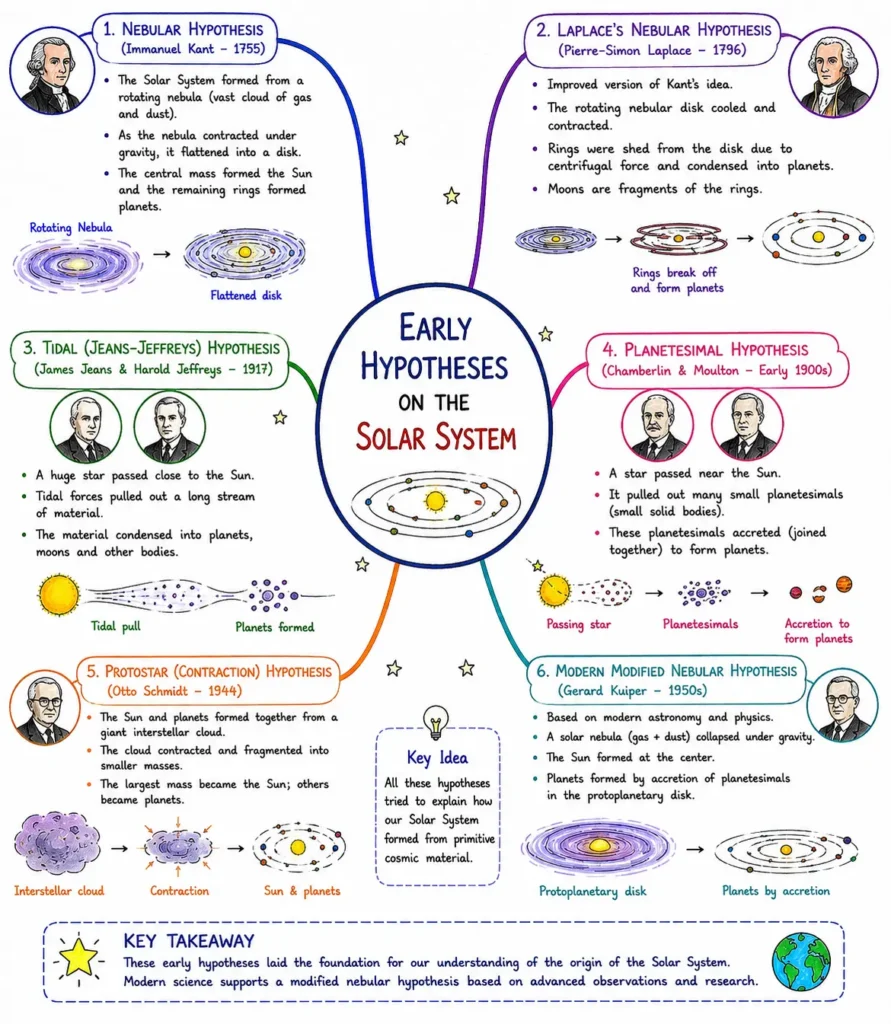
- Gaseous Hypothesis of Kant (1755): Proposed by the German philosopher Immanuel Kant. He argued that a cold, motionless primeval cloud of particles collapsed under gravity. This collapse created friction and heat, causing the cloud to spin and throw off rings of matter that eventually condensed into planets.
- Nebular Hypothesis of Laplace (1796): Revised by the French mathematician Pierre-Simon Laplace. He corrected Kant’s mechanical flaws by starting with a pre-existing, hot, rotating gaseous cloud called a nebula. As the nebula cooled and contracted, its rotational speed naturally increased. This caused a ring of matter to separate from its equator due to centrifugal force. This process repeated, creating multiple rings that cooled into planets, while the central core remained as the Sun.
2. Dualistic Hypotheses (Two Star Origin)
These concepts argue that the formation of the planets required the close gravitational interaction between two distinct celestial bodies.
- Planetesimal Hypothesis of Chamberlin and Moulton (1900): Suggested that a massive wandering star approached the primitive Sun. The intense gravitational pull of this passing star pulled out a large amount of solar material. As the star receded, this separated material broke into small solid particles called planetesimals, which gradually accreted through collisions to form the planets.
- Tidal Hypothesis of Jeans and Jeffreys (1919): Refined the concept by stating that a passing star created a massive tidal wave on the liquid surface of the primitive Sun. A long, filament-shaped mass of hot gas was pulled out from the Sun. As the companion star moved away, this gaseous filament detached completely, broke apart, and condensed into the individual planets.
Modern Theories: The Origin of the Universe
Modern scientific inquiry shifted from just explaining our localized solar system to decoding the origin of the entire cosmos.
1. The Big Bang Theory
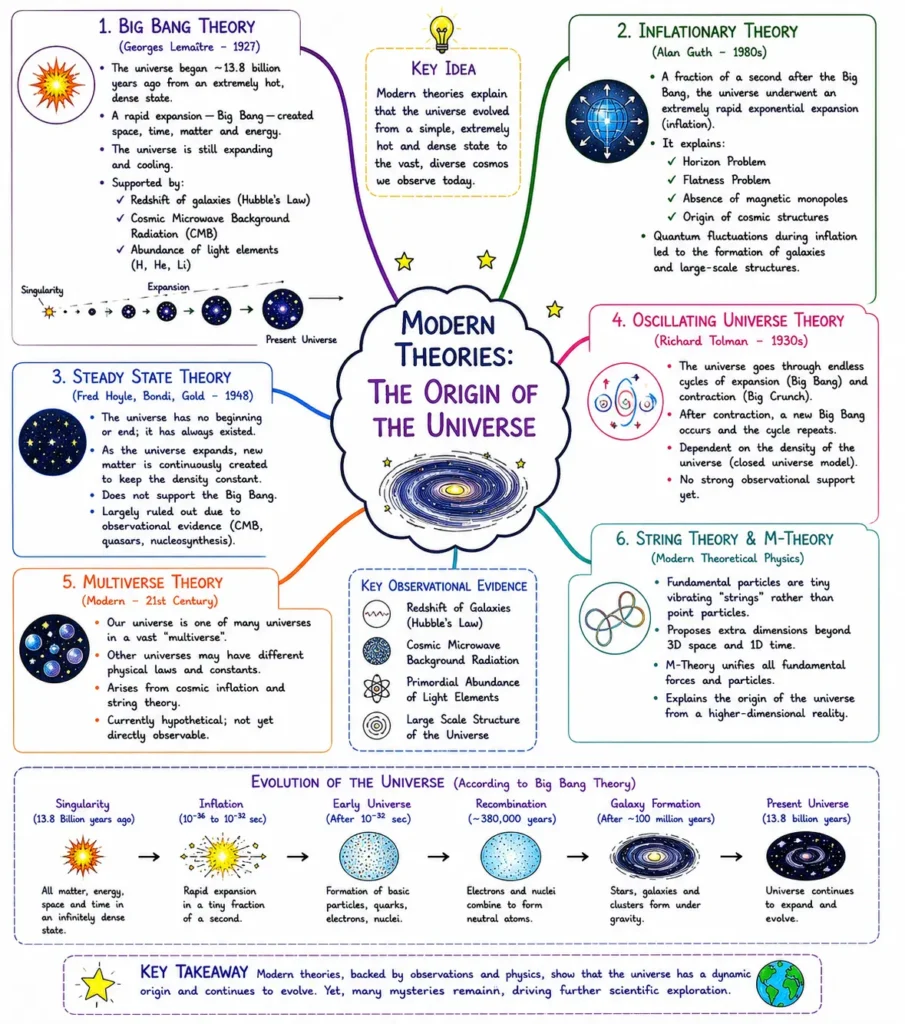
Also known as the Expanding Universe Hypothesis, this theory is the most universally accepted scientific explanation for the universe. It was formally introduced by Georges Lemaître and supported by the observational evidence of Edwin Hubble in 1920, who proved that galaxies are actively moving away from one another.
According to this model, the creation and evolution of the universe took place in distinct stages:
- The Singularity: In the beginning, all matter composing the universe existed in a single, microscopic point called a “singular atom” or singularity. This point possessed infinite density, infinite temperature, and an infinitesimally small volume.
- The Explosion: Approximately 13.8 billion years ago, this singularity exploded violently. This marked the initiation of a rapid expansion process that continues to the present day.
- Cooling and Atomic Formation: Within the first three minutes following the explosion, the universe expanded exponentially, and the first basic subatomic particles and atoms began to form. Within 300,000 years of the event, temperatures dropped drastically to about 4,500 Kelvin, making the universe transparent to light.
2. Alternative and Supplementary Cosmic Theories
- Inflation Theory: Explains that a fraction of a second after the Big Bang, the universe underwent an exponential expansion. This theory resolves key issues of the basic Big Bang model: the Horizon Problem (why distant regions share properties despite never being in contact), the Flatness Problem (why space appears flat with great precision), and the Monopole Problem (explaining why magnetic monopoles are not observed).
- Steady State Theory (1948): Proposed by Bondi, Gold, and Hoyle, this model claims the universe is eternal, with no beginning and no end. As it expands, new matter is continuously created to keep the overall density constant; however, this theory does not agree with the discovery of cosmic microwave background radiation.
- Quasi-Steady State Theory (1990): A modified version of the Steady State model attempting to support both Big Bang and traditional Steady State ideas. It states the universe expands, but the rate of matter creation decreases over time.
- Oscillating (Cyclic) Universe Theory: Asserts the universe goes through endless cycles of expansion and contraction. Following the Big Bang expansion, gravity eventually slows the process down, pulling matter back together into a “Big Crunch,” after which the cycle repeats.
- Multiverse Theory: Arising from inflation theory and quantum mechanics, it suggests our universe is merely one of many universes, each potentially holding different physical laws, dimensions, or constants.
- Dark Energy & The Expanding Universe: Modern observations confirm that the expansion of the universe is actively accelerating due to a mysterious force called Dark Energy. The composition of the universe is split into roughly 68% Dark Energy, 27% Dark Matter, and only 5% Ordinary Matter.
Evidences Supporting Modern Cosmic Theories: Universal models are backed by the discovery of Cosmic Microwave Background Radiation (discovered in 1965), the observed Red Shift of Galaxies proving spatial expansion, the abundance of light elements (H, He, Li) formed early on, and a consistent large-scale cosmic structure.
The Structural Evolution of the Earth
Structural evolution refers to the gradual changes in the internal structure and external layers of the Earth over geological time, driven by cooling, solidification, differentiation, and tectonic processes.
1. Planetary Accretion and Molten State
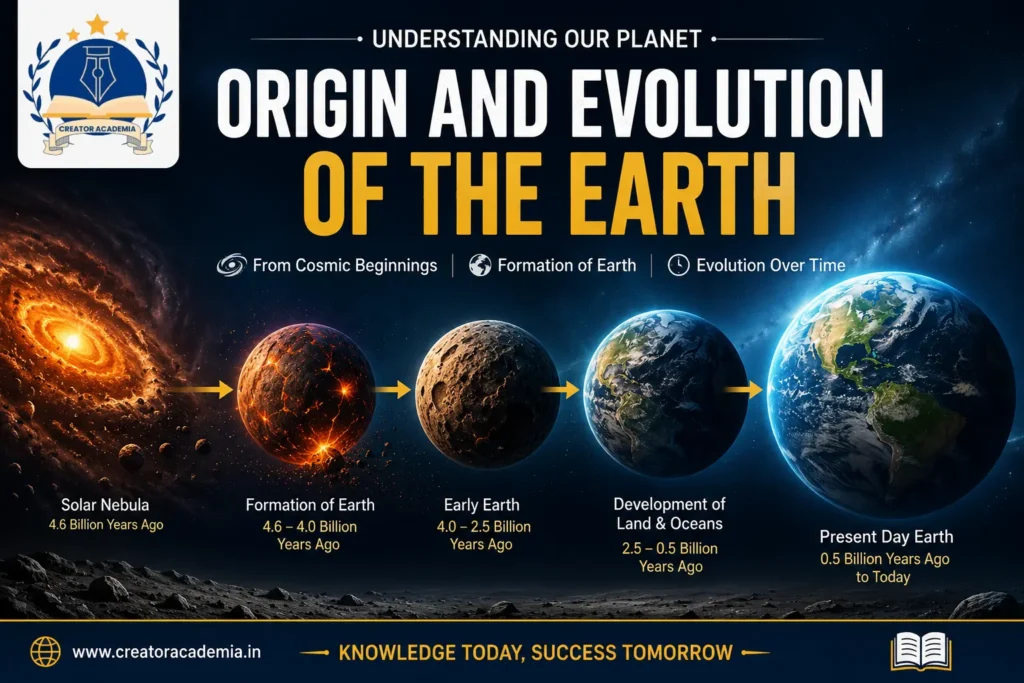
The Earth originated approximately 4.54 billion years ago from the solar nebula, a giant cloud of gas and dust. Accretion of planetesimals clumped together to form a Proto-Earth. Due to intense heat generated by constant kinetic collisions and radioactive decay, the early Earth was a hot, molten mass. Around this time, a giant impact with a celestial body (Theia hypothesis) led to the formation of the Moon.
2. Lithospheric Differentiation
As the planet began to cool, materials separated cleanly based on their density parameters. High-density, heavier metallic materials (primarily iron and nickel) sank toward the interior center, while lighter materials rose toward the surface. This process created the Earth’s distinct internal layers:
- The Core: The innermost part composed of iron and nickel, divided into a solid inner core (~1220 km radius) and a liquid outer core (2250 km thick). The movement within the liquid outer core generates the Earth’s magnetic field, protecting the planet from solar winds.
- The Mantle: The thickest layer extending up to 2900 km, composed of semi-solid silicate rocks (magma). Convection currents within the mantle drive internal heat and move lithospheric plates.
- The Crust: The thin, solid, outermost layer ranging from 5 to 70 km in thickness, composed of lighter rocks.
3. Crustal Formation and Tectonics
Between 4.0 and 3.8 billion years ago, the outer layer cooled sufficiently to solidify into a thin, unstable crust, which was constantly modified by volcanism and meteor impacts. Two distinct types of crust formed: a thicker, less dense Continental Crust and a thinner, denser Oceanic Crust.
By about 3.0 billion years ago, the lithosphere broke into pieces, and Plate Tectonics began shaping the surface via continental drift, seafloor spreading, subduction, and mountain building. Over geological time, these movements collected landmasses into temporary supercontinents, such as Pangaea, which existed about 250 million years ago.
4. Development of the Atmosphere, Oceans, and Life
- Atmosphere: The primitive atmosphere was formed through volcanic degassing, which released internal gases like H2O, CO2, N2, SO2, and CH4. There was no free oxygen at this stage, making the atmosphere primitive and unable to support complex life.
- Oceans: As the planet cooled, atmospheric water vapor condensed and fell as torrential rain, collecting in basins to form the oceans between 4.0 and 3.5 billion years ago.
- Life: First life appeared in the oceans about 3.5 to 3.8 billion years ago as simple, microscopic forms. Life remained simple for billions of years until biological milestones, like the Great Oxygenation Event, introduced free oxygen into the atmosphere. Subsequent evolution was shaped by climate shifts, ice ages, and mass extinction events.
The Geological Time Scale
The history of the Earth is chronologically cataloged into broad geological time divisions based on structural rock records and fossil markers:
- Hadean Eon (4.6 – 4.0 billion years ago): The initial formation era marked by a molten surface, heavy meteor bombardment, and the eventual cooling of the crust.
- Archaean Eon (4.0 – 2.5 billion years ago): Characterized by the formation of the oldest surviving rocks, crustal stabilization, outgassing of the oceans, and the emergence of the first single-celled microscopic life.
- Proterozoic Eon (2.5 billion – 541 million years ago): Marked by plate tectonic development, the Great Oxygenation Event, repeated ice ages, and the evolution of primitive eukaryotic life.
- Phanerozoic Eon (541 million years ago – Present): The current eon, marked by visible, complex life forms, the diversification of plants and animals, the formation and breakup of Pangaea, and distinct mass extinction events.
Quick Examination Facts
| Topic | Important Fact |
| Age of the Earth | 4.54 billion years |
| Primordial Origin | Solar Nebula Theory (Kant-Laplace Hypothesis) |
| Material Accretion | Formed by clumping of dust, gas, and planetesimals |
| Internal Stratification | Density Differentiation (Crust, Mantle, Outer Core, Inner Core) |
| Liquid Outer Core | Generates the Earth’s magnetic field via liquid iron and nickel |
| Thickest Interior Layer | Mantle (Magma extending up to 2900 km) |
| Primitive Atmosphere Composition |
H2O, CO2, N2, CH4, NH3, SO2 (No free oxygen) |
| Ocean Formation | Condensation and rain gathering in crustal depressions (~4.0 – 3.5 billion years ago) |
| Moon Formation Theory | Giant impact or Theia hypothesis |
| Start of Plate Tectonics | Began about 3.0 billion years ago |
| Oldest Minerals Found | Zircon crystals (~4.4 billion years old) |
| Oldest Extant Rocks | Found to be about 4.0 billion years old |
| First Life Appearance | Simple, microscopic life forms around 3.5 to 3.8 billion years ago |
| Last Supercontinent | Pangaea (Existed about 250 million years ago) |
| Rotational Trend | Length of day gradually increased as Earth’s rotation slowed over time |
Conclusion
Studying the origin and evolution of the Earth explains how our planetary home came to be. The interaction of internal heat engines—driving plate tectonics—alongside external atmospheric cooling provides a vital foundation for geography, geology, and life sciences. It proves that Earth is a dynamic planet that continues to change through geological time.
Origin and Evolution of the Earth
Practice Quiz
| Some Important Links | |
| Download “Origin and Evolution of the Earth” PDF | Click Here |