Introduction to Reasoning: Concepts, Types, and Approach
Introduction
In competitive examinations and academic evaluations, Reasoning is one of the most critical sections used to assess a candidate’s mental agility, problem-solving capability, and decision-making aptitude. Unlike traditional subjects that test memorized facts or mathematical formulas, reasoning tests how systematically you can think, analyze given information, identify underlying patterns, and derive logical conclusions.
What is Logical Reasoning?
Reasoning is the cognitive process of using existing knowledge, observations, and logical rules to draw valid inferences, form judgements, or solve complex problems.
Key Elements of Logical Reasoning:
- Premise / Fact: The statement or information provided as a starting point.
- Logic / Pattern: The underlying rule, sequence, or structural link connecting the premises.
- Conclusion / Output: The final logical deduction derived strictly from the given premises.
Major Classifications of Reasoning
Reasoning is broadly categorized into three main branches based on the medium and structure of the questions:
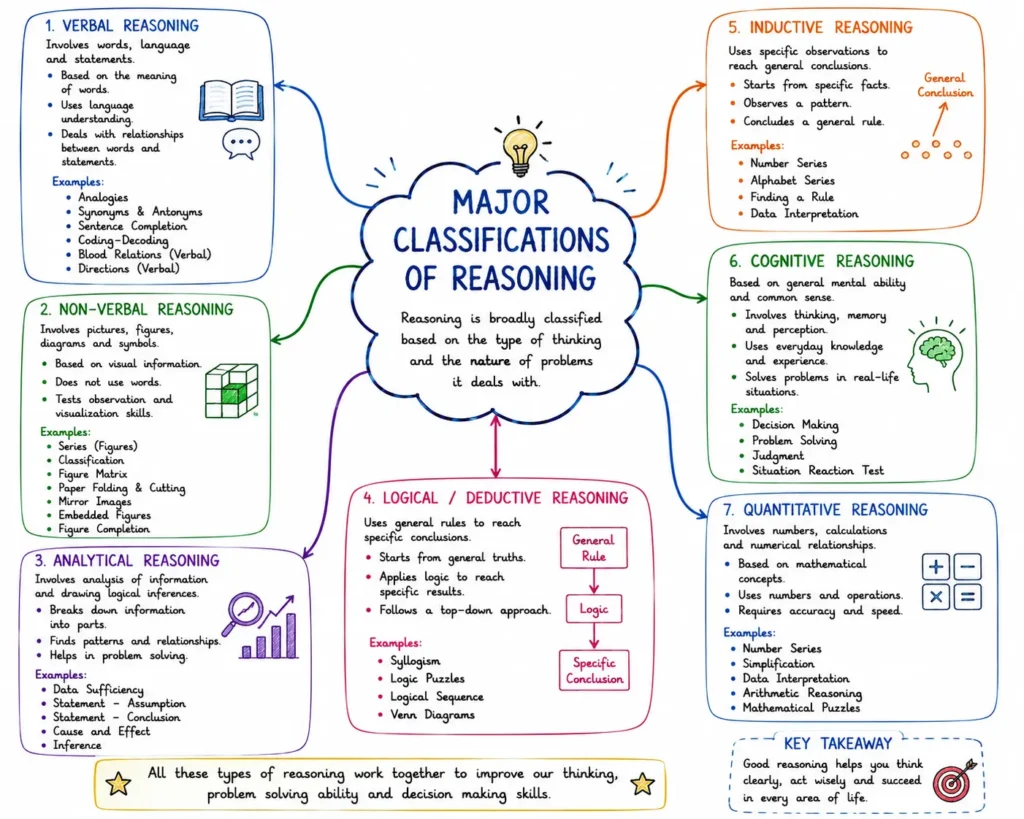
1. Verbal Reasoning
Verbal reasoning evaluates your ability to understand, interpret, and analyze information presented in words, letters, numbers, and symbols.
- Alphabet Test & Letter Series: Analyzing alphabetical positions, forward/reverse rules, and letter sequences.
- Coding-Decoding: Deciphering secret rules used to convert words or numbers into coded symbols.
- Analogy & Classification: Identifying similar relationships between pairs of words or numbers and spotting the “odd one out.”
- Blood Relations & Direction Sense: Mapping family structures and calculating spatial orientations or distances.
- Syllogism & Venn Diagrams: Testing logical validity using set relations (e.g., “All A are B”).
2. Non-Verbal Reasoning
Non-verbal reasoning tests your visual-spatial intelligence, pattern recognition, and abstract thinking without relying on spoken or written language.
- Series & Analogies of Figures: Identifying trends in rotating shapes, added lines, or shifting patterns.
- Paper Folding & Paper Cutting: Predicting how a folded and punched sheet of paper will appear when unfolded.
- Mirror & Water Images: Understanding horizontal and vertical spatial reflections.
- Embedded Figures & Pattern Completion: Finding hidden geometric shapes within complex designs.
3. Analytical / Critical Reasoning
Analytical reasoning measures high-level logical decision-making and critical thinking.
- Statement and Assumptions: Identifying unstated facts assumed by the speaker before making a statement.
- Statement and Arguments: Evaluating whether arguments supporting or opposing a policy are strong or weak.
- Cause and Effect: Determining whether one event directly triggered another event.
- Course of Action: Selecting the most rational, practical, and effective step to address a given problem.
Types of Logical Deduction
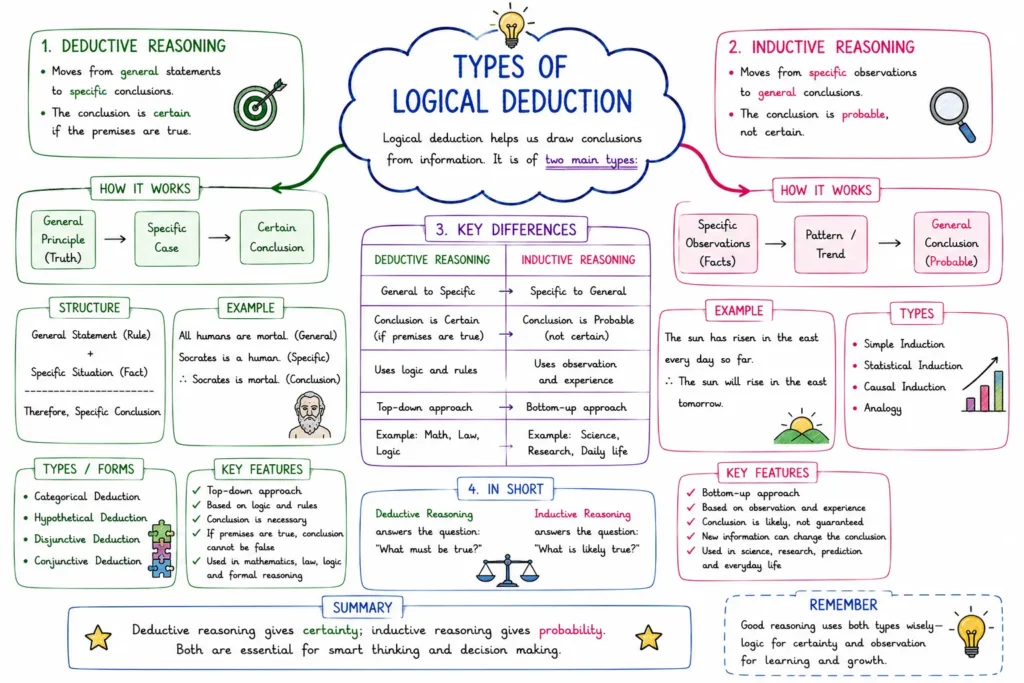
When drawing conclusions in reasoning, two fundamental methods of deduction are applied:
| Deduction Type | Principle | Direction of Thinking | Example |
|---|---|---|---|
| Deductive Reasoning | Deriving specific, guaranteed conclusions from general rules. | General → Specific | All humans are mortal. Socrates is human. Therefore, Socrates is mortal. |
| Inductive Reasoning | Identifying broad patterns or generalizations from specific observations. | Specific → General | Every swan observed so far is white. Therefore, all swans are likely white. |
Universal Strategy to Master Reasoning
- Master the Basics First: Memorize foundational tools like alphabetical positions (1 to 26), EJOTY, opposite pairs, squares up to 30, and cubes up to 15.
- Avoid Assumptions: Rely strictly on the information given in the question. Do not insert real-world biases into logical statements unless explicitly instructed.
- Use Visual Mapping: Draw quick diagrams, family trees, grids, or Venn diagrams for complex problems like seating arrangements, directions, and syllogisms.
- Eliminate Options: Use option elimination to save time during competitive exams.
Quick Examination Facts
| Concept / Fact | Key Exam Fact |
|---|---|
| Primary Branches of Reasoning | Verbal, Non-Verbal, and Analytical Reasoning. |
| Deductive Reasoning | Moves from general premises to specific, definitive conclusions. |
| Inductive Reasoning | Moves from specific observations to general probabilistic patterns. |
| Alphabetical Positional Rule | Total letters = 26. Sum of forward and reverse positions of any letter = 27. |
| Syllogism Method | Solved using Venn Diagrams or Set Theory logic. |
| Non-Verbal Medium | Relies entirely on visual shapes, figures, and spatial patterns. |
| Critical Reasoning Goal | Tests decision-making, argument strength, and problem-solving feasibility. |
Conclusion
Reasoning is the cornerstone of logical thinking and competitive exam preparation. By establishing a strong understanding of its primary branches—Verbal, Non-Verbal, and Analytical—you build the foundation needed to tackle specific topics like Alphabet Tests, Series, Coding-Decoding, and Syllogisms efficiently.
Introduction to Reasoning
Practice Quiz
| Some Important Links | |
| Download “Introduction to Reasoning” PDF | Click Here |