Alphabet Test and Letter Series: Rules, Patterns, and Shortcuts
Introduction
In verbal reasoning, Alphabet Test and Letter Series form the foundation for almost all sequence-based topics, including Coding-Decoding, Analogy, and Classification. This topic tests an individual’s ability to manipulate the English alphabetical sequence, calculate positional shifts rapidly, and identify underlying patterns in letter arrangements.
Mastering alphabetical positions and directional rules allows candidates to solve complex logical problems in seconds without relying on manual counting.
1. Fundamentals of English Alphabetical Sequence
The standard English alphabet consists of 26 letters, ordered from A (1st letter) to Z (26th letter).
The Positional Relationship Formula
For any given letter, the sum of its forward position (from the left end) and its reverse position (from the right end) is always equal to 27.
Forward Position + Reverse Position = 27
Therefore, to calculate the position of a letter from the right end when its position from the left end is known:
Position from Right = 27 – Position from Left
Essential Memory Mnemonics
- The EJOTY Rule: Multiples of 5 in forward order:
- E(5) J(10) O(15) T(20) Y(25)
- The CFILORUX Rule: Multiples of 3 in forward order:
- C(3) F(6) I(9) L(12) O(15) R(18) U(21) X(24)
- Opposite Letter Pairs: Two letters are opposite if their positional sum equals 27:
- A – Z (AZad → 1 + 26 = 27)
- B – Y (BYe → 2 + 25 = 27)
- C – X (CruX → 3 + 24 = 27)
- D – W (Dew → 4 + 23 = 27)
- E – V (EVening → 5 + 22 = 27)
- F – U (FUII → 6 + 21 = 27)
- G – T (GT Road → 7 + 20 = 27)
- H – S (High School → 8 + 19 = 27)
- I – R (Indian Railway → 9 + 18 = 27)
- J – Q (Jungle Queen → 10 + 17 = 27)
- K – P (KanPur → 11 + 16 = 27)
- L – O (LOve → 12 + 15 = 27)
- M – N (MaN → 13 + 14 = 27)
2. Directional Counting Rules (Alphabet Test)
When solving position-based problems involving “Left” and “Right” directions, apply these algebraic reduction shortcuts:
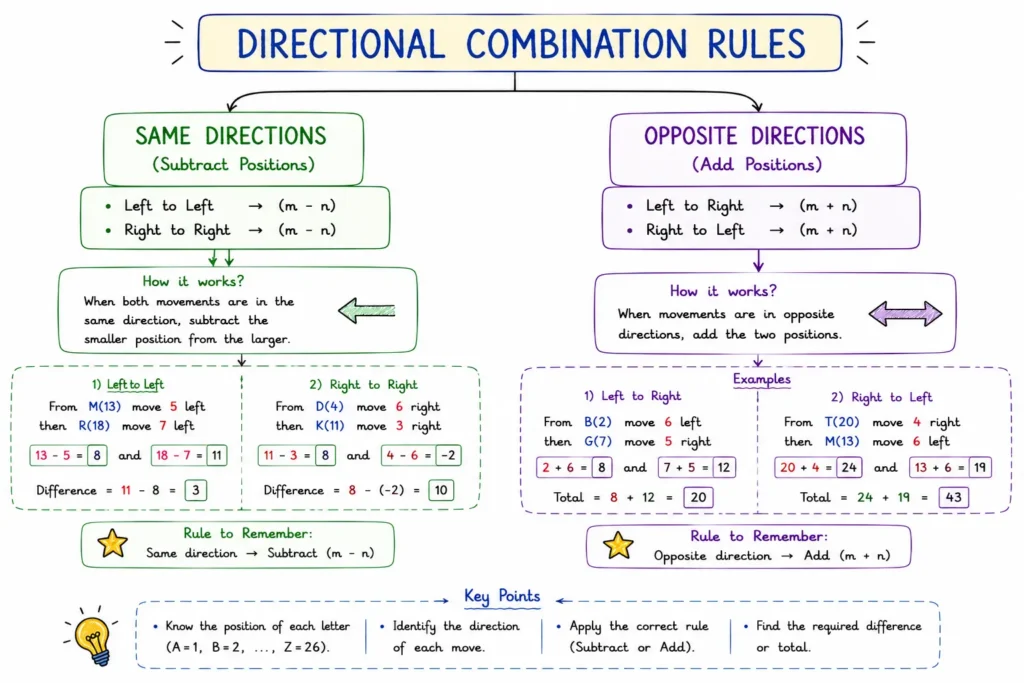
Standard Mathematical Rules:
Solved Example 1:
Which letter is 5th to the right of 7th letter from the left end in the English alphabet?
- Logic: “Right of Left” → Add positions: 7 + 5 = 12th letter from Left.
- 12th letter from Left is L.
- Answer:
L
Solved Example 2:
Which letter is 4th to the left of 15th letter from the right end in the English alphabet?
- Logic: “Left of Right” → Add positions: 15 + 4 = 19th letter from Right.
- Convert to position from Left: 27 – 19 = 8th letter from Left.
- 8th letter from Left is H.
- Answer:
H
3. Major Classifications of Letter Series
A Letter Series consists of a sequence of letters or letter combinations formed according to a specific logical pattern. You must identify the underlying rule to find missing terms.
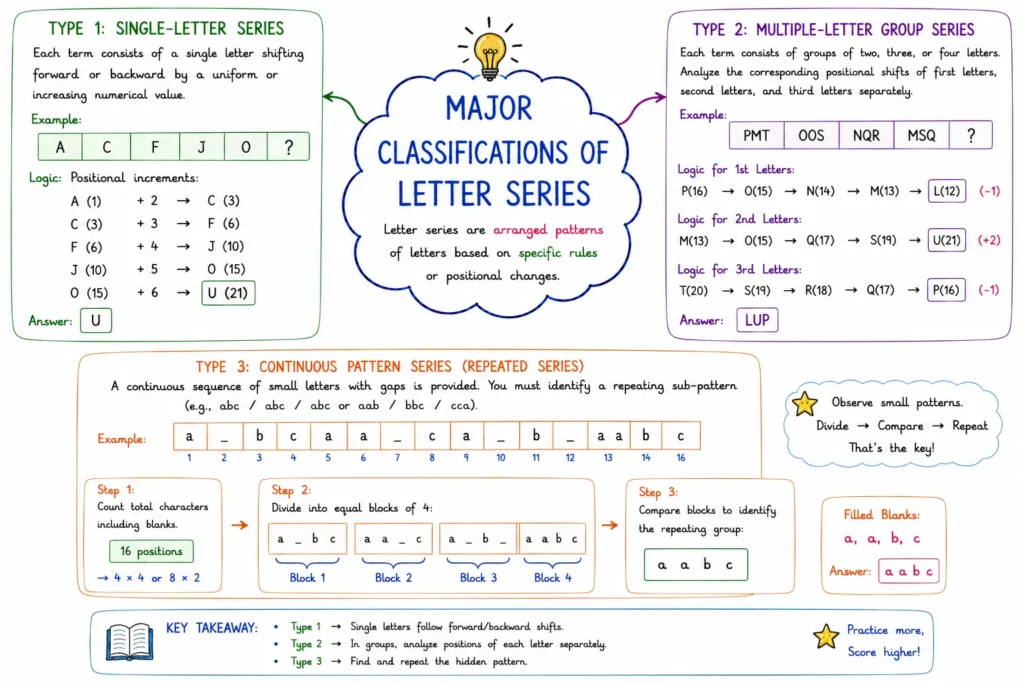
Type 1: Single-Letter Series
Each term consists of a single letter shifting forward or backward by a uniform or increasing numerical value.
- Example:
A, C, F, J, O, ? - Logic: Positional increments:
- A (1) + 2 = C (3)
- C (3) + 3 = F (6)
- F (6) + 4 = J (10)
- J (10) + 5 = O (15)
- O (15) + 6 = U (21)
- Answer:
U
Type 2: Multiple-Letter Group Series
Each term consists of groups of two, three, or four letters. Analyze the corresponding positional shifts of first letters, second letters, and third letters separately.
- Example:
PMT, OOS, NQR, MSQ, ? - Logic for 1st Letters: P(16) → O(15) → N(14) → M(13) → L(12) (–1)
- Logic for 2nd Letters: M(13) → O(15) → Q(17) → S(19) → U(21) (+2)
- Logic for 3rd Letters: T(20) → S(19) → R(18) → Q(17) → P(16) (–1)
- Answer:
LUP
Type 3: Continuous Pattern Series (Repeated Series)
A continuous sequence of small letters with gaps is provided. You must identify a repeating sub-pattern (e.g., abc / abc / abc or aab / bbc / cca).
- Example:
a _ b c a a _ c a _ b _ a a b c - Step 1: Count total characters including blanks (e.g., 16 positions → 4 × 4 or 8 × 2).
- Step 2: Divide into equal blocks of 4:
a _ b c | a a _ c | a _ b _ | a a b c - Step 3: Compare blocks to identify the repeating group:
a a b c - Filled Blanks:
a, a, b, c - Answer:
a a b c
4. Advanced Word-Formation and Alphabetical Order Tasks
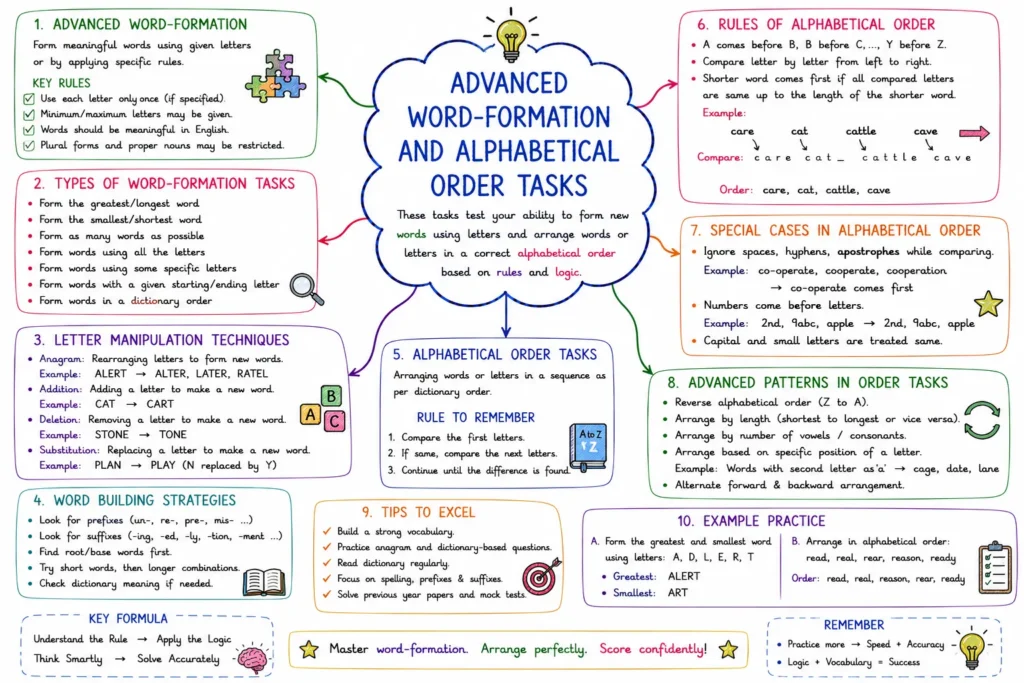
- Alphabetical Sorting (Dictionary Order): Words are arranged based on the sequential order of their letters from left to right (e.g., Brain, Brand, Brass, Brave).
- Letter Pair Formation: Finding pairs of letters in a word that have as many letters between them as in the English alphabet (both forward and backward directions).
Quick Examination Facts
| Rule / Shortcut | Key Exam Fact |
|---|---|
| Total Alphabets | 26 letters (A=1 to Z=26). |
| Reverse Position Formula | Position from Right = 27 – Position from Left. |
| EJOTY Values | E=5, J=10, O=15, T=20, Y=25. |
| CFILORUX Values | Multiples of 3: C=3, F=6, I=9, L=12, O=15, R=18, U=21, X=24. |
| Same Directions Rule | Left to Left (L – L) or Right to Right (R – R) → Subtract. |
| Opposite Directions Rule | Left to Right (L + R) or Right to Left (R + L) → Add. |
| Sum of Opposite Letters | Position of letter + Position of its reverse opposite = 27. |
Conclusion
Alphabet Test and Letter Series serve as the entry point into logical deduction. By committing positional values (EJOTY), reverse pair identities (A–Z, B–Y), and algebraic directional shortcuts (L ± R) to memory, you can solve sequence and alignment questions with speed and precision.
Alphabet Test and Letter Series
Practice Quiz
| Some Important Links | |
| Download “Alphabet Test and Letter Series” PDF | Click Here |