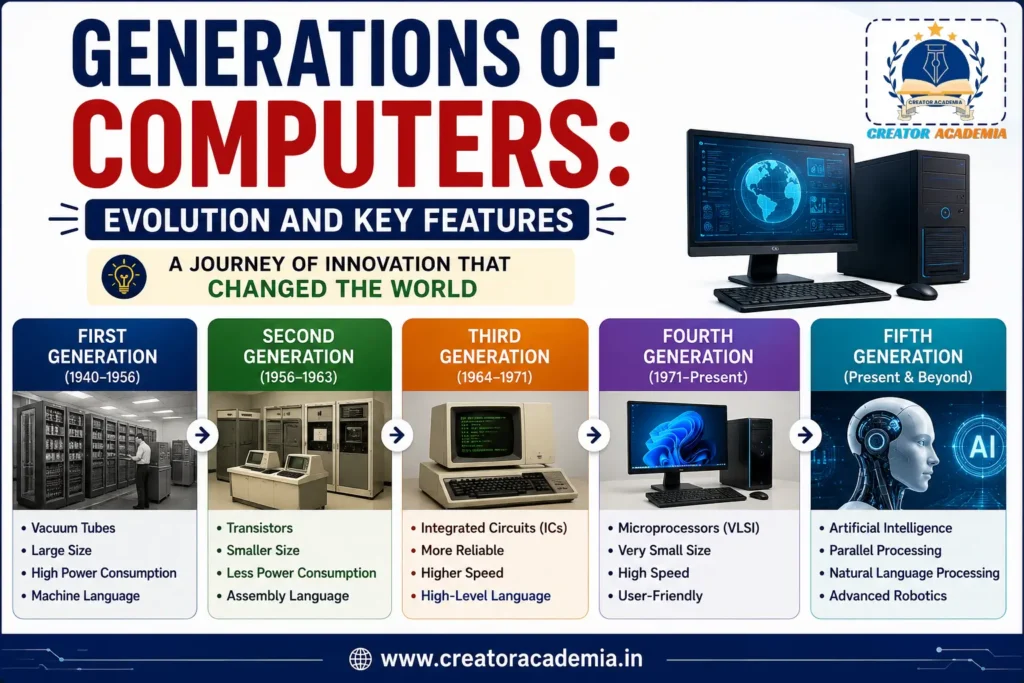
Generations of Computers: Evolution and Key Features
Introduction
The modern computer is not the result of a single invention, but rather an evolutionary process spanning several decades. As technology advanced, electronic components became smaller, faster, cheaper, and more energy-efficient.
In computer science, the term “Generation” refers to the major technological advancements that fundamental hardware components underwent over time, radically changing how computers operate and process data.
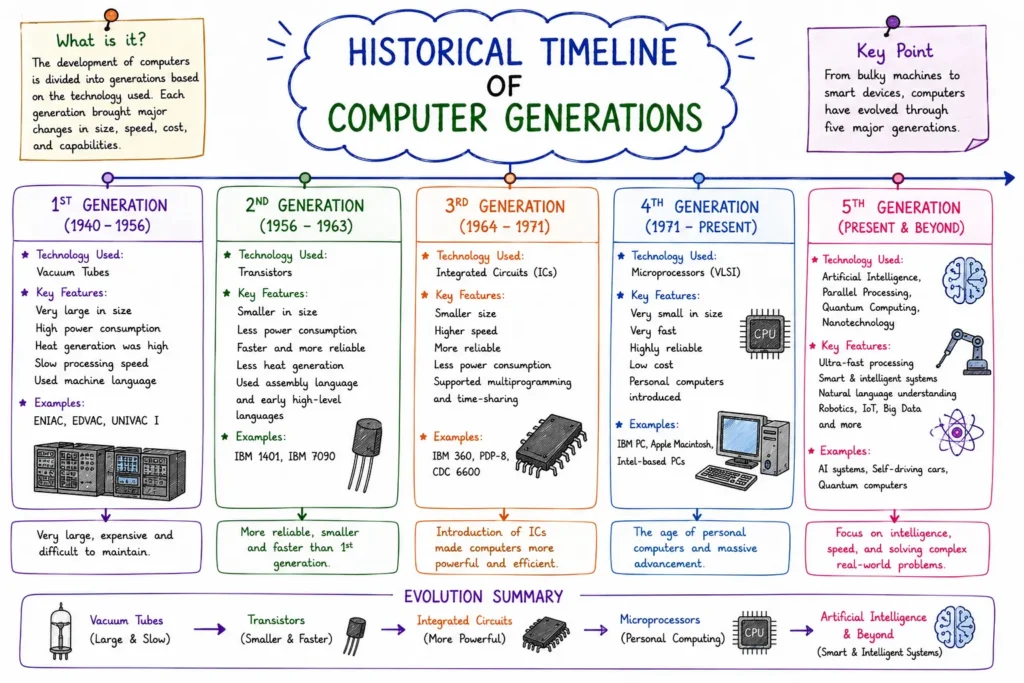
Historical Timeline of Computer Generations
Computer development is broadly categorized into five distinct generations based on the core switching technology used:
First Generation Computers (1940 – 1956): Vacuum Tubes
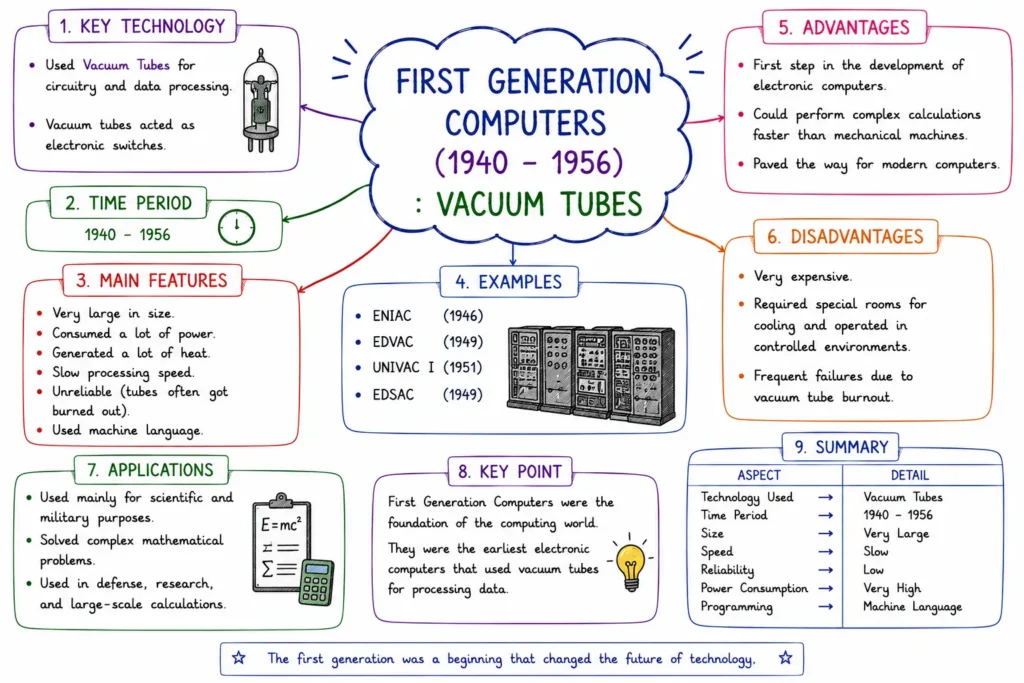
First-generation computers relied on Vacuum Tubes (glass valves) for circuitry and Magnetic Drums for memory. These machines were massive, occupying entire rooms, and consumed vast amounts of electricity.
Key Features:
- Primary Technology: Vacuum Tubes / Thermionic Valves.
- Programming Language: Machine Language (binary 0s and 1s), making them extremely difficult to program.
- Speed & Processing: Operations were calculated in milliseconds (10-3 seconds).
- Heat & Power: Generated tremendous amounts of heat and required continuous air conditioning; prone to frequent hardware breakdowns.
- Cost & Size: Exceedingly expensive, large, and non-portable.
Notable Examples:
- ENIAC (Electronic Numerical Integrator and Computer): The first general-purpose electronic digital computer.
- EDVAC (Electronic Discrete Variable Automatic Computer): Introduced stored-program architecture.
- UNIVAC I (Universal Automatic Computer): The first commercially available electronic computer.
- IBM 701 and IBM 650.
Second Generation Computers (1956 – 1963): Transistors
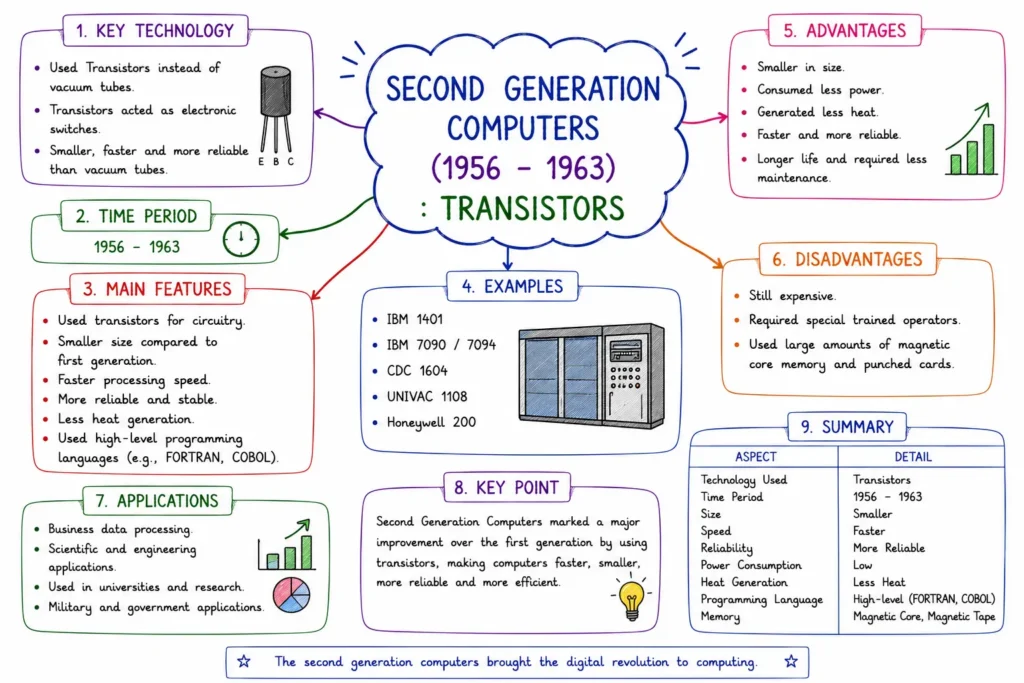
The invention of the Transistor at Bell Labs in 1947 revolutionized computing. Transistors replaced bulky, fragile vacuum tubes, allowing computers to become smaller, faster, cheaper, and more energy-efficient.
Key Features:
- Primary Technology: Transistors (made of semiconductor materials like Germanium and Silicon).
- Programming Language: Assembly Language (using mnemonic codes like
ADD,SUB) and early high-level programming languages like FORTRAN (Formula Translation) and COBOL (Common Business-Oriented Language). - Speed & Processing: Processing speed improved from milliseconds to microseconds (10-6 seconds).
- Efficiency: Consumed less power and generated less heat than vacuum tube systems, though air conditioning was still required.
Notable Examples:
- IBM 1401 (widely popular commercial computer).
- IBM 7094, CDC 1604, and UNIVAC 1107.
Third Generation Computers (1963 – 1971): Integrated Circuits (ICs)
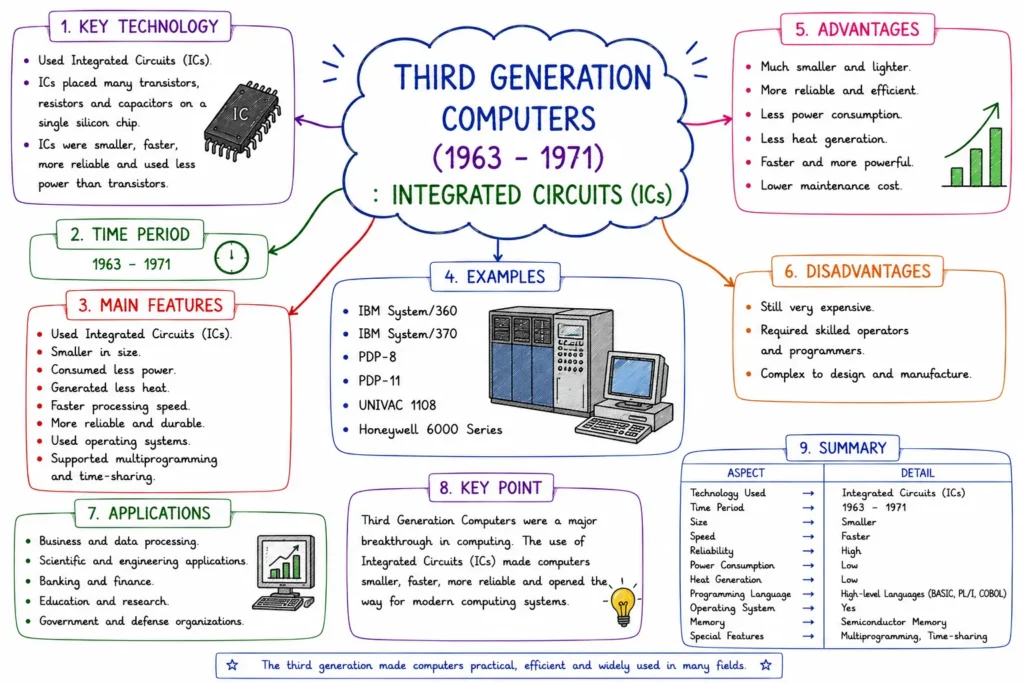
The third generation was marked by the development of the Integrated Circuit (IC) by Jack Kilby and Robert Noyce. An IC combines hundreds of transistors, resistors, and capacitors onto a single small silicon chip (semiconductor wafer).
Key Features:
- Primary Technology: Integrated Circuits (Small Scale Integration – SSI, and Medium Scale Integration – MSI).
- User Interface: Replaced punch cards with Keyboards and Monitors, managed by early Operating Systems (OS).
- Speed & Processing: Speed increased to nanoseconds (10-9 seconds).
- Accessibility: Smaller size, lower cost, and higher reliability made computers accessible to medium-sized organizations.
Notable Examples:
- IBM System/360 series.
- DEC PDP-8 (first commercially successful minicomputer).
- Honeywell 6000 series.
Fourth Generation Computers (1971 – Present): Microprocessors
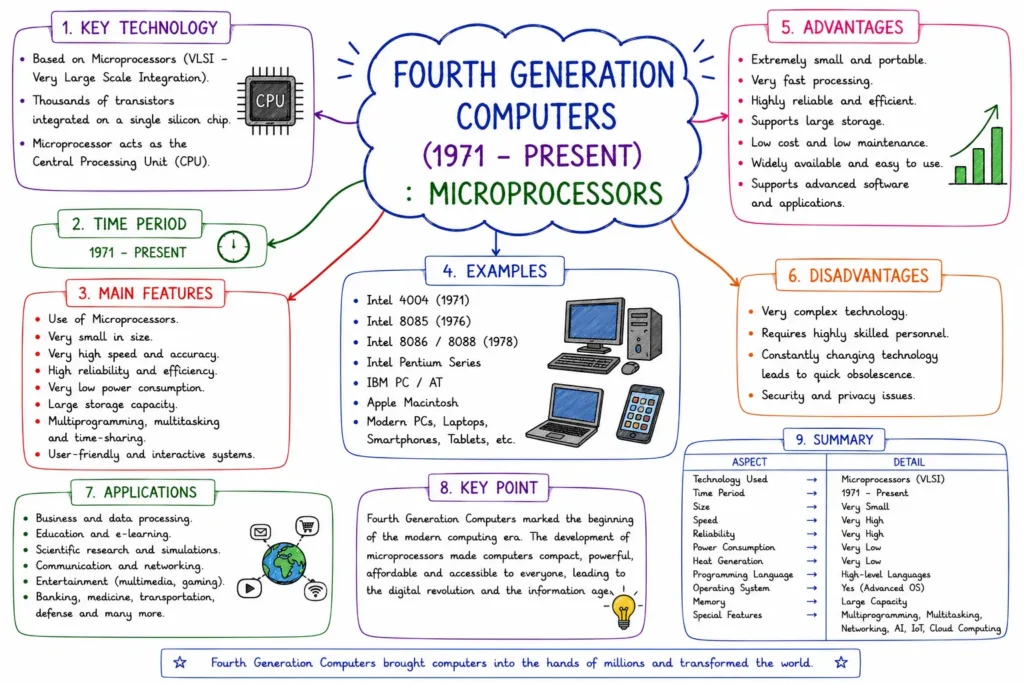
The fourth generation emerged with Very Large Scale Integration (VLSI) technology, which packed millions of transistors onto a single microchip, giving birth to the Microprocessor. The Intel 4004 (introduced in 1971) was the world’s first single-chip microprocessor.
Key Features:
- Primary Technology: Microprocessors using VLSI (Very Large Scale Integration) and ULSI (Ultra Large Scale Integration).
- Personal Computers (PCs): Led to the desktop PC revolution, making computing personal and portable.
- Operating Systems & Interfaces: Widespread adoption of Graphical User Interfaces (GUI) (Windows, macOS) and command-line interfaces (MS-DOS, UNIX).
- Connectivity: Development of computer networks, local area networks (LANs), and the expansion of the Internet.
- Speed & Processing: Processing speeds reached picoseconds (10-12 seconds) and gigahertz (GHz) frequencies.
Notable Examples:
- IBM PC, Apple Macintosh.
- CRAY-1 and CRAY-X-MP (early supercomputers).
Fifth Generation Computers (Present – Beyond): Artificial Intelligence
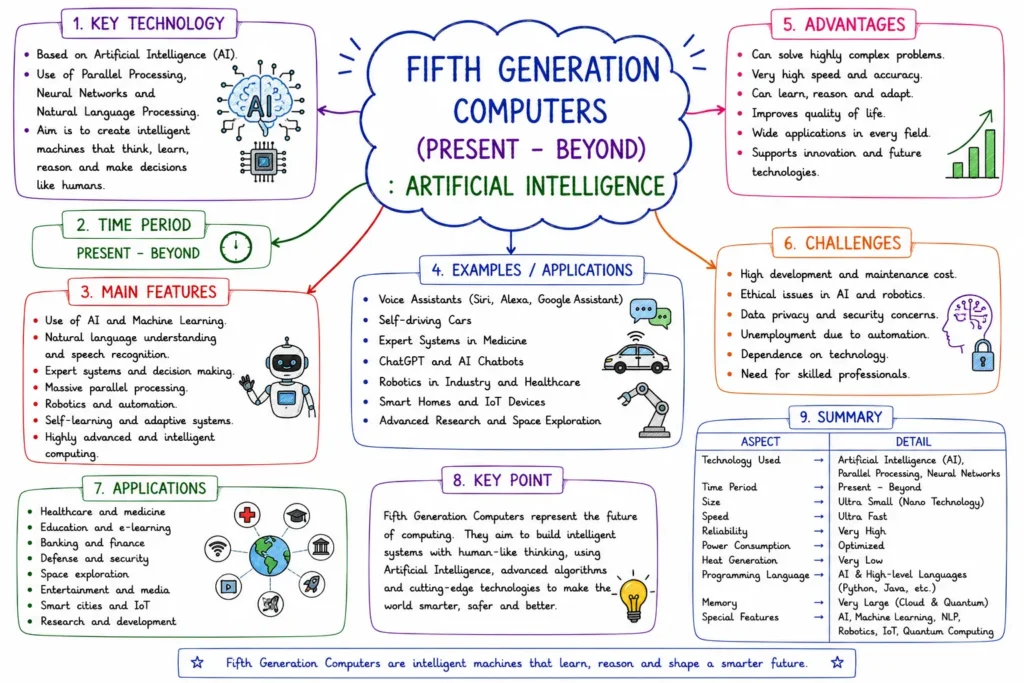
Fifth-generation computing is centered on Artificial Intelligence (AI), high-performance Parallel Processing, and advanced hardware architectures like quantum computing and nanotechnology.
Key Features:
- Primary Technology: Ultra Large Scale Integration (ULSI) chips combined with AI algorithms.
- Core Capabilities:
- Natural Language Processing (NLP): Understanding human speech and voice interaction (e.g., Siri, Alexa, LLMs).
- Machine Learning & Deep Learning: Enabling machines to learn from patterns and make autonomous decisions.
- Parallel & Supercomputing: Multi-core processors working concurrently on complex scientific simulations.
- Future Frontiers: Quantum computing, bio-computing, and neural processing units (NPUs).
Comprehensive Comparison Matrix
| Generation | Primary Component | Operating Speed | Programming Language | Key Examples |
|---|---|---|---|---|
| 1st Gen (1940-1956) | Vacuum Tubes | Milliseconds (10-3 s) | Machine Language | ENIAC, EDVAC, UNIVAC I |
| 2nd Gen (1956-1963) | Transistors | Microseconds (10-6 s) | Assembly, FORTRAN, COBOL | IBM 1401, CDC 1604 |
| 3rd Gen (1963-1971) | Integrated Circuits (ICs) | Nanoseconds (10-9 s) | High-Level (BASIC, C) | IBM 360, PDP-8 |
| 4th Gen (1971-Present) | Microprocessors (VLSI) | Picoseconds (10-12 s) | Object-Oriented, Python, Java | IBM PC, Apple Mac, CRAY-1 |
| 5th Gen (Present-Beyond) | AI / ULSI / Quantum | Parallel / Femtoseconds | Natural Language, AI Frameworks | Robotics, Quantum Computers, AI Systems |
Quick Examination Facts
| Concept / Fact | Key Exam Fact |
|---|---|
| 1st Gen Core Component | Vacuum Tubes / Thermionic Valves. |
| 2nd Gen Core Component | Transistors (Invented by Shockley, Bardeen, and Brattain at Bell Labs). |
| 3rd Gen Core Component | Integrated Circuits (ICs) (Invented by Jack Kilby and Robert Noyce). |
| 4th Gen Core Component | Microprocessors using Very Large Scale Integration (VLSI). |
| 5th Gen Core Feature | Artificial Intelligence (AI) and Ultra Large Scale Integration (ULSI). |
| First General Purpose Electronic Computer | ENIAC (Electronic Numerical Integrator and Computer). |
| First Commercial Computer | UNIVAC I (Universal Automatic Computer). |
| First Single-Chip Microprocessor | Intel 4004 (Introduced in 1971). |
| Speed Metric – 1st Gen | Milliseconds (10-3 s). |
| Speed Metric – 3rd Gen | Nanoseconds (10-9 s). |
Conclusion
The evolution of computer generations demonstrates a continuous trend toward higher processing speeds, smaller physical dimensions, larger storage capacities, and lower production costs. From fragile room-sized vacuum tube machines to portable microprocessors and AI-driven neural engines, understanding these generational shifts provides essential insight into modern hardware architecture and information technology.
Generations of Computers
Practice Quiz
| Some Important Links | |
| Download “Generations of Computers” PDF | Click Here |