Buddhism and Jainism: Origins, Teachings, Sects, and Historical Impact
Introduction
The 6th century BCE was a watershed period in ancient Indian history. Marked by rapid socio-economic transformations, the expansion of agriculture in the Gangetic Plains, and the growth of urban centers (Second Urbanization), this era witnessed a profound intellectual and religious revolt against the rigid, costly, and priest-dominated Later Vedic ritualism.
Out of nearly 62 heterodox sects (Sramana traditions) that emerged during this period, Buddhism and Jainism became the most influential philosophical and religious movements, offering egalitarian alternatives to the established Varna hierarchy.
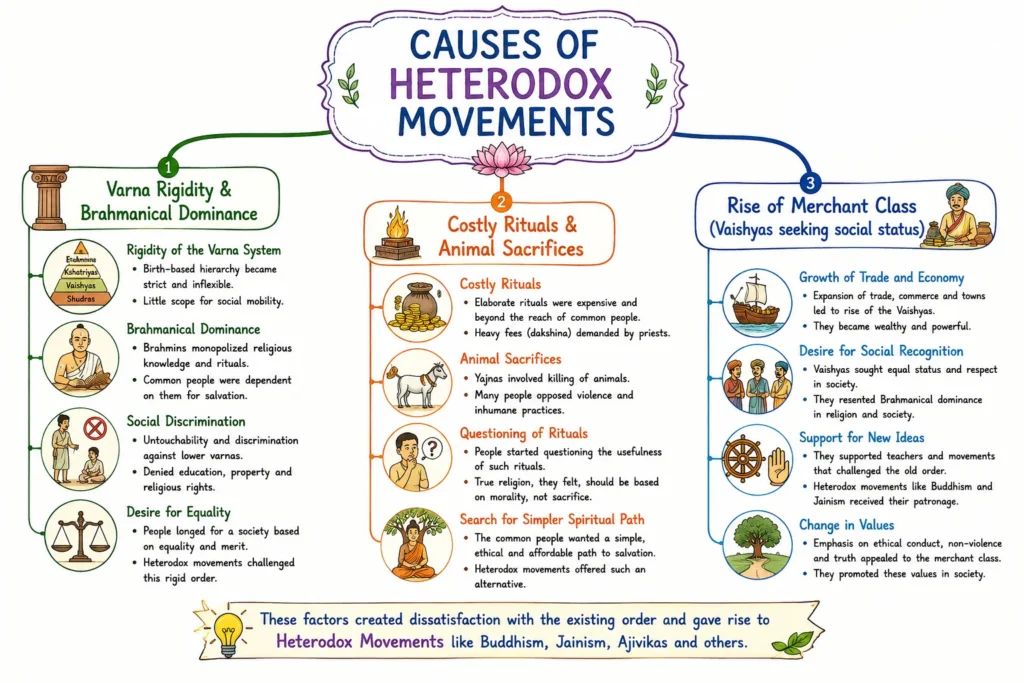
1. Causes for the Rise of Buddhism and Jainism
- Rigidity of the Varna System: The Later Vedic Varna hierarchy restricted social mobility and relegated Shudras and lower groups to subjugation.
- Reaction Against Sacrifices (Yajnas): Elaborate rituals and widespread animal sacrifices (Pashubali) severely harmed the emerging agrarian economy, which depended heavily on cattle for plowing.
- Emergence of the Merchant Class (Vaishyas): The growth of trade, urbanization, and coinage boosted the economic power of Vaishyas. However, Brahmanical texts lowered their social standing and condemned usury (lending money on interest). Vaishyas turned to Buddhism and Jainism, which granted them equal social respect and promoted non-violence (Ahimsa).
- Use of Vernacular Languages: Unlike Vedic scriptures composed in complex Sanskrit accessible only to Brahmans, Buddha and Mahavira preached in common folk languages—Prakrit (Jainism) and Pali (Buddhism).
2. Buddhism: Life of Buddha and Core Doctrines
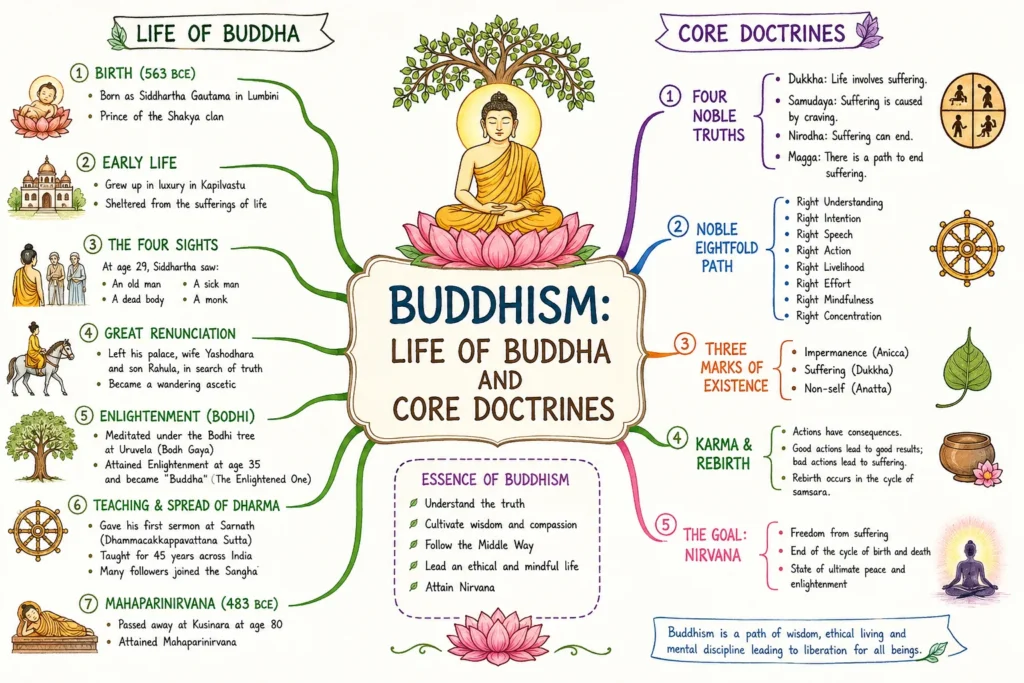
A. Life of Gautama Buddha
- Birth: Born as Siddhartha in c. 563 BCE at Lumbini (near Kapilavastu, Nepal) in the Shakya Kshatriya clan. His father was Suddhodana and mother was Mayadevi (raised by stepmother Gautami Prajapati).
- The Four Great Sights: An old man, a sick man, a dead body, and an ascetic. These sights moved him to renounce worldly life at age 29 (Mahabhinishkramana).
- Enlightenment (Nirvana): Achieved supreme enlightenment at age 35 under a Peepal tree (Bodhi Tree) on the banks of the Niranjana river at Uruvela (Bodh Gaya). He became known as Buddha (“The Awakened One”) or Tathagata.
- First Sermon (Dhammacakkappavattana): Delivered his first sermon to his five former companions at the Deer Park in Sarnath (near Varanasi).
- Death (Mahaparinirvana): Attained Mahaparinirvana at age 80 (c. 483 BCE) at Kushinagar (Uttar Pradesh), the capital of the Malla republic.
B. Core Doctrines of Buddhism
1. The Four Noble Truths (Chatvari Arya Satyani)
- Dukkha: Life is full of suffering.
- Dukkha Samudaya: Suffering has a cause (Desire / Trishna).
- Dukkha Nirodha: Suffering can be eliminated by removing desire.
- Dukkha Nirodha Gamini Pratipat: The path to end suffering is the Eightfold Path (Ashtangika Marga).
2. The Eightfold Path (Ashtangika Marga)
The Eightfold Path represents the Middle Path (Madhyama Pratipada), avoiding both extreme luxury and extreme self-mortification:
- Right View, Right Resolve, Right Speech, Right Action, Right Livelihood, Right Effort, Right Mindfulness, and Right Concentration.
3. Key Philosophical Principles
- Pratityasamutpada: Doctrine of Dependent Origination (“When this exists, that comes to be”).
- Anicca (Impermanence): Everything in the universe is in a constant state of flux.
- Anatta (Non-Self): Rejection of the permanent, immortal soul (Atman).
- Three Jewels (Tri-ratna): Buddha (The Teacher), Dhamma (The Doctrine), and Sangha (The Order of Monks).
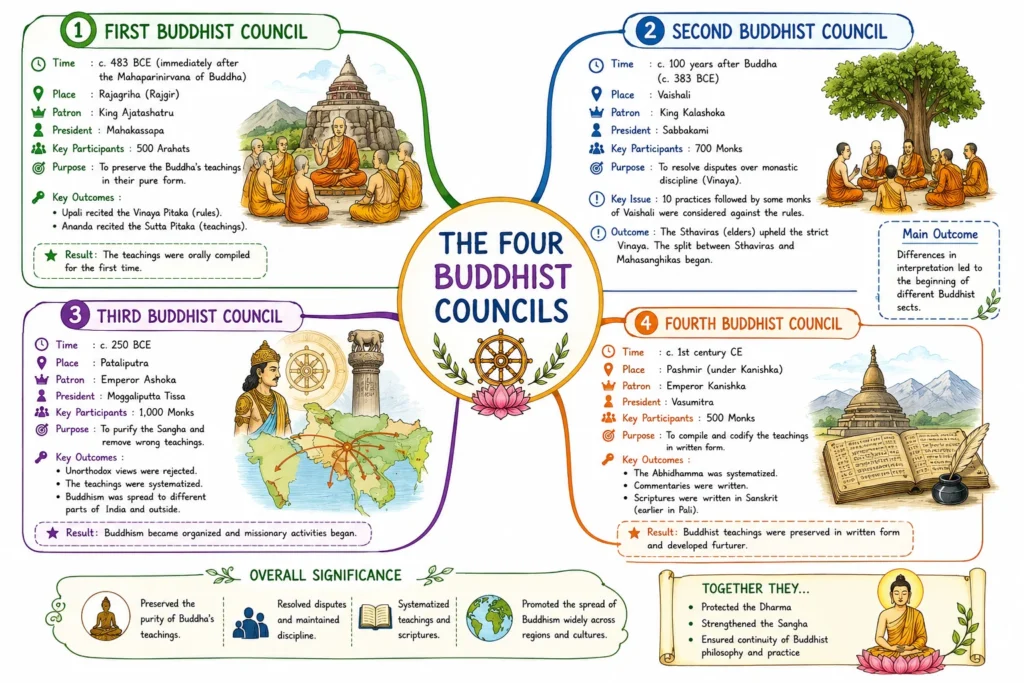
3. The Four Buddhist Councils
| Council | Year & Location | Patron King | President | Key Outcome / Text Compiled |
|---|---|---|---|---|
| 1st Council | 483 BCE Rajagriha (Sattapani Cave) | Ajatashatru (Haryanka Dynasty) | Mahakassapa | Compilation of Sutta Pitaka (Ananda) and Vinaya Pitaka (Upali). |
| 2nd Council | 383 BCE Vaishali | Kalasoka (Shishunaga Dynasty) | Sabakami | First schism into two groups: Sthaviravadins (Theravada) and Mahasanghikas. |
| 3rd Council | 250 BCE Pataliputra | Ashoka (Mauryan Dynasty) | Moggaliputta Tissa | Compilation of Abhidhamma Pitaka; decision to send Buddhist missionaries abroad. |
| 4th Council | 72 CE Kundalavana (Kashmir) | Kanishka (Kushan Dynasty) | Vasumitra (Vice: Asvaghosa) | Final division into Hinayana and Mahayana sects; commentaries written in Sanskrit. |
Major Schools of Buddhism
- Hinayana (“Lesser Vehicle”): Orthodox, traditionalists. Believed Buddha was a human teacher. Emphasized self-salvation through individual monastic effort (Arhat ideal). Used Pali.
- Mahayana (“Greater Vehicle”): Idol worship of Buddha treated as a divine God. Emphasized the Bodhisattva ideal (compassionate beings who delay their own salvation to help others). Used Sanskrit.
- Vajrayana (“Diamond Vehicle”): Emerged around the 8th century CE; incorporated esoteric rituals, mantras, and tantric magic (popular in Bengal, Bihar, and Tibet).
4. Jainism: Tirthankaras, Mahavira, and Philosophy
A. The Tirthankaras and Vardhamana Mahavira
Jainism believes in 24 spiritual teachers called Tirthankaras (“Ford-makers” who cross the river of rebirth):
- 1st Tirthankara: Rishabhanatha (or Adinatha; symbol: Bull). Mentioned in the Rigveda.
- 23rd Tirthankara: Parshvanatha (symbol: Serpent). Introduced four vows (Chaturyama): Ahimsa, Satya, Asteya, Aparigraha.
- 24th Tirthankara: Vardhamana Mahavira (symbol: Lion). Added the 5th vow (Brahmacharya).
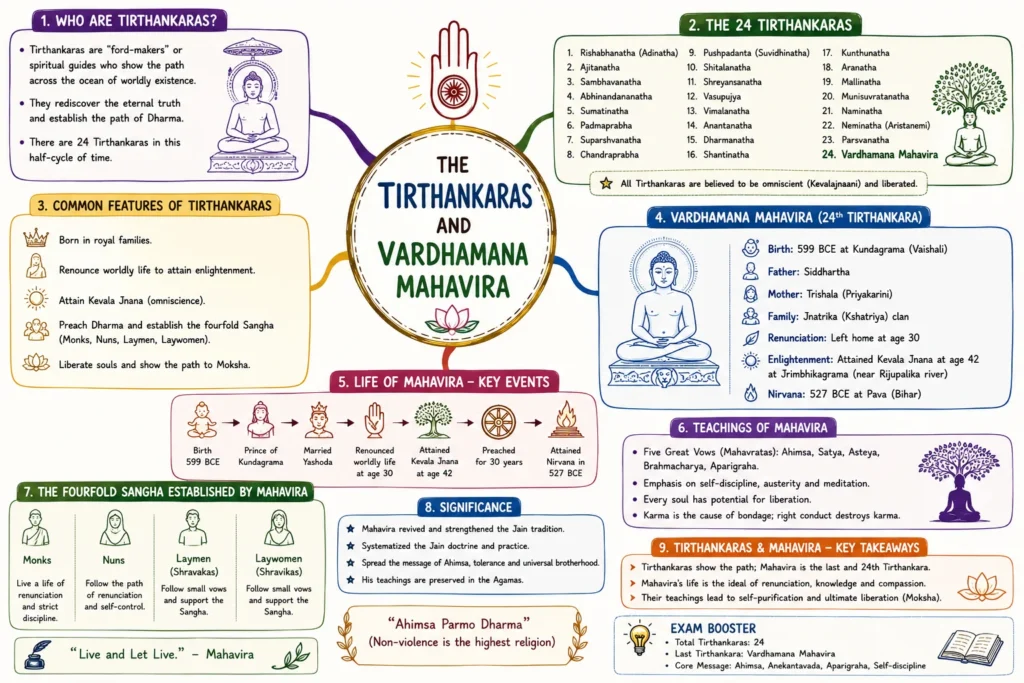
- Life: Born at Kundagrama near Vaishali in c. 540 BCE in the Jnatrika Kshatriya clan. Father was Siddhartha and mother was Trishala.
- Enlightenment (Kevalajnana): Attained supreme knowledge under a Sal tree on the banks of the Rujupalika river near Jrimbhikagrama at age 42. He was named Jina (Conqueror) and Mahavira (Great Hero).
- Moksha: Attained liberation at age 72 (c. 468 BCE) at Pavapuri near Rajgir.
B. Core Doctrines and Vows of Jainism
1. Five Great Vows (Pancha Mahavratas)
- Ahimsa: Non-violence (absolute avoidance of harm to any living entity).
- Satya: Truthfulness.
- Asteya: Non-stealing.
- Aparigraha: Non-possession / Non-attachment.
- Brahmacharya: Celibacy (added by Mahavira).
2. Three Jewels (Tri-ratna)
- Samyak Darshana (Right Faith)
- Samyak Jnana (Right Knowledge)
- Samyak Charitra (Right Conduct)
3. Epistemology: Anekantavada and Syadvada
- Anekantavada: The doctrine of “many-sidedness” or pluralism—truth and reality are complex and have multiple aspects.
- Syadvada: The theory of “conditioned predication” or relativity—every judgment is only relatively true (“Syaad” = Perhaps).
C. Jain Councils and Major Sects
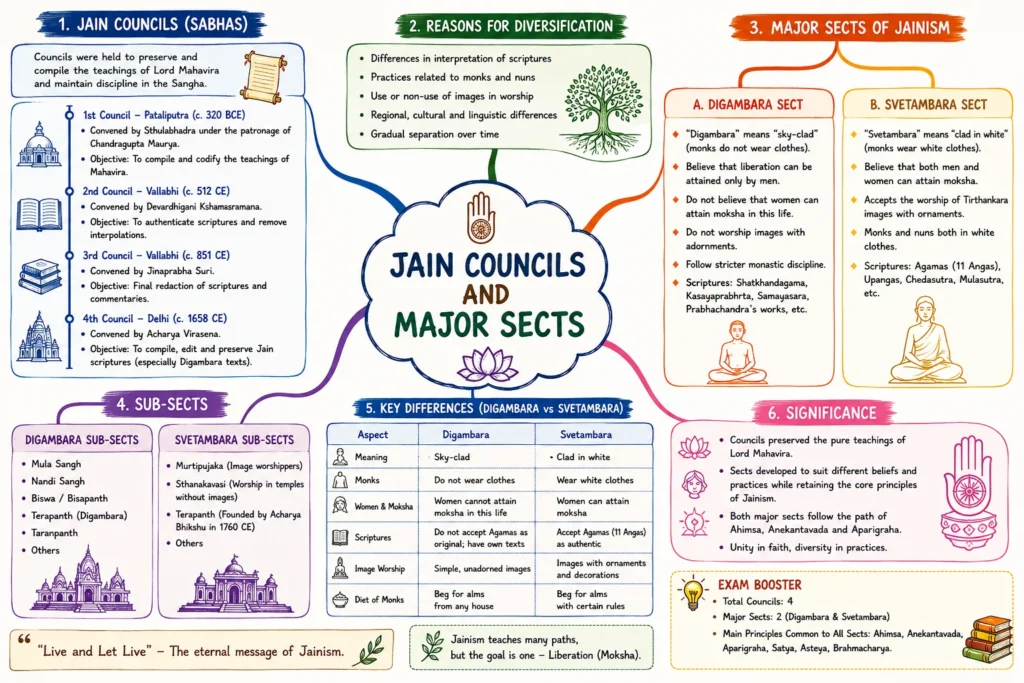
A severe famine in Magadha led to the migration of Bhadrabahu and his followers to South India (Sravanabelagola), while Sthulabhadra stayed in Magadha. This caused a permanent schism:
- 1st Jain Council (300 BCE): Held at Pataliputra, presided over by Sthulabhadra. Compiled 12 Angas.
- 2nd Jain Council (512 CE): Held at Vallabhi (Gujarat), presided over by Devardhi Kshamasramana. Final written compilation of Jain canonical texts (Agamas).
5. Comparative Analysis: Buddhism vs. Jainism
| Parameter | Buddhism | Jainism |
|---|---|---|
| Founder / Reformer | Gautama Buddha | Vardhamana Mahavira (24th Tirthankara) |
| Concept of Soul (Atman) | Denies the existence of a permanent soul (Anatta) | Believes every entity (even inanimate objects) has a soul (Jiva) |
| Attitude to Ahimsa | Moderate non-violence; practical Middle Path | Extreme non-violence; forbids agriculture to protect soil organisms |
| Concept of God | Agnostic/Silent on God’s existence | Rejects God as creator; places Tirthankaras above God |
| Language Used | Pali (Popular folk language) | Prakrit / Ardhamagadhi |
| Penance / Austerity | Rejects extreme penance; advocates Middle Path | Strongly emphasizes severe asceticism and penance (Santhara/Sallekhana) |
| Royal Patronage | Ashoka, Kanishka, Harsha, Pala Rulers | Bimbisara, Chandragupta Maurya, Kharavela |
| Geographical Spread | Spread across East and Southeast Asia | Remained largely confined within India |
Quick Examination Facts
| Feature / Term | Key Exam Fact |
|---|---|
| Buddha’s Birthplace | Lumbini (Nepal) |
| Buddha’s First Sermon Event | Dhammacakkappavattana (Sarnath) |
| Buddha’s Death Event | Mahaparinirvana (Kushinagar) |
| Three Jewels of Buddhism | Buddha, Dhamma, Sangha |
| First Buddhist Council Patron | Ajatashatru (Rajagriha, 483 BCE) |
| Fourth Buddhist Council Patron | Kanishka (Kashmir, 72 CE) |
| First Jain Tirthankara | Rishabhanatha (Adinatha) |
| 23rd Jain Tirthankara | Parshvanatha (Symbol: Serpent) |
| 5th Vow added by Mahavira | Brahmacharya (Celibacy) |
| Mahavira’s Place of Death | Pavapuri (Bihar) |
| Jain Doctrine of Many-Sidedness | Anekantavada |
| Language of Early Buddhist Canon | Pali (Sutta, Vinaya, Abhidhamma Pitakas) |
| Language of Early Jain Texts | Prakrit / Ardhamagadhi |
| Svetambara Leader | Sthulabhadra |
| Digambara Leader | Bhadrabahu |
Conclusion
Buddhism and Jainism fundamentally reshaped the religious, social, and cultural contours of ancient India. By challenging the Varna order, rejecting hereditary ritual privileges, and adopting popular spoken languages, both traditions democratized spiritual access. Buddhism grew into a major global religion under imperial patronage, while Jainism retained its uncompromising commitment to ethical living and Ahimsa. Their principles of non-violence, rationality, and tolerance remain central pillars of Indian philosophy.
Buddhism and Jainism
Practice Quiz
| Some Important Links | |
| Download “Buddhism and Jainism” PDF | Click Here |