Early Medieval India: Tripartite Struggle, Imperial Cholas & Rajput Kingdoms (c. 750 – 1200 CE)
This era was characterized by the political rivalry for control over the central Gangetic plains (the Tripartite Struggle for Kannauj), the maritime and administrative glory of the Imperial Cholas in Peninsular India, the heroic tradition and temple architecture of the Rajput Kingdoms, and early Turkish invasions that transformed the political landscape.
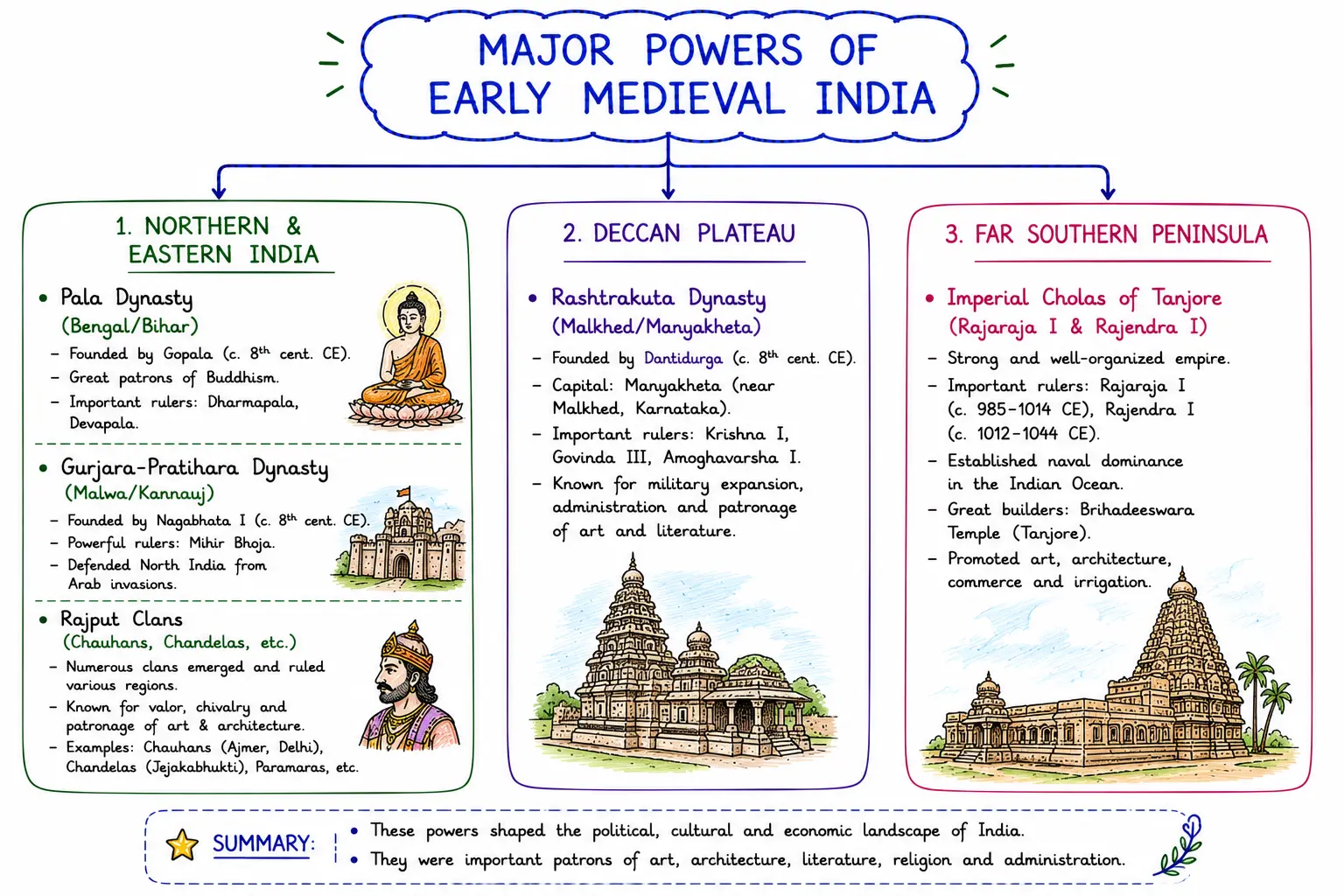
To grasp the broader geopolitical setup of this era, the overview below highlights the major regional powers divided across Northern and Eastern India, the Deccan Plateau, and the far southern peninsula.
1. The Tripartite Struggle for Kannauj (c. 8th – 10th Century CE)
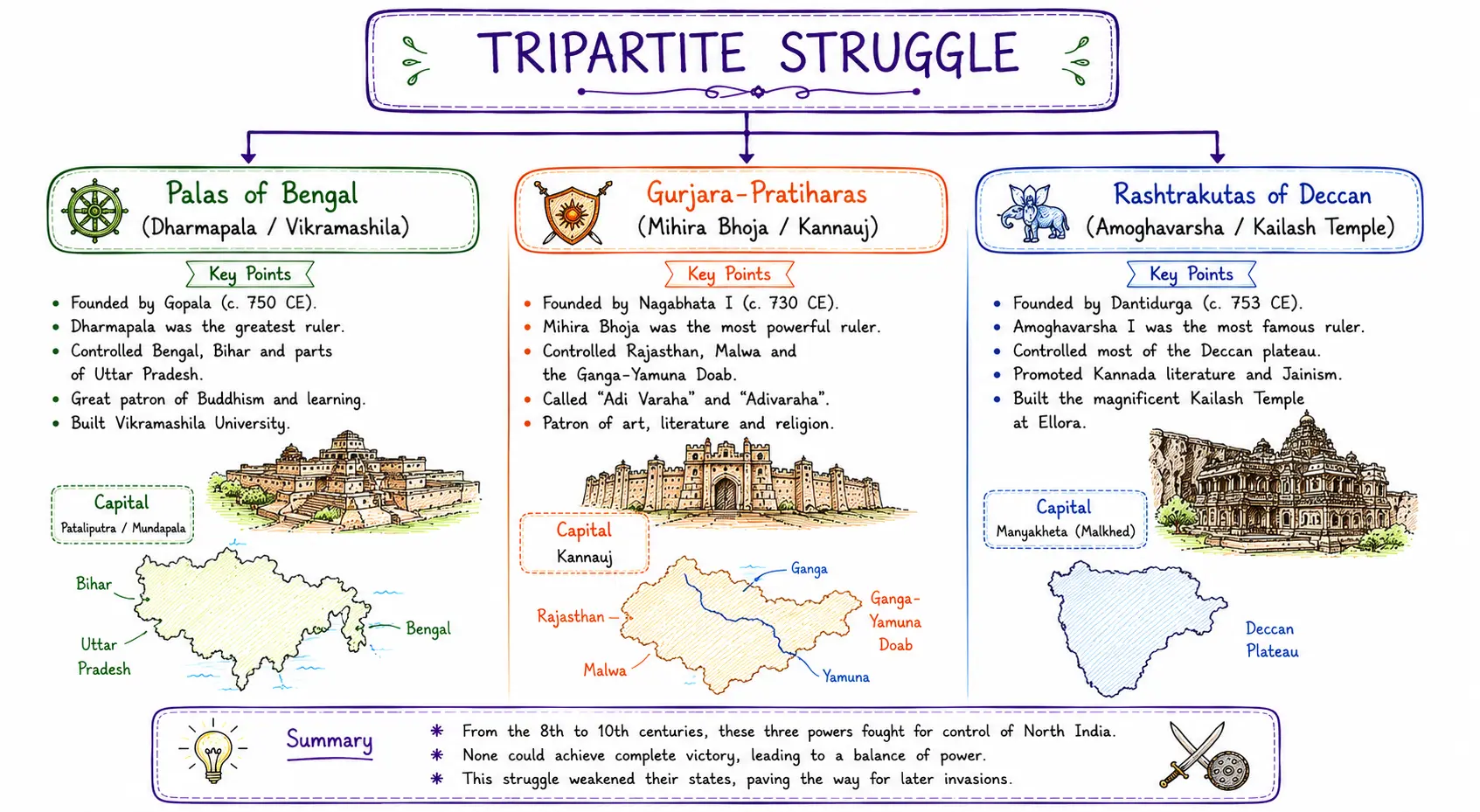
Following the decline of Harsha’s Pushyabhuti empire, Kannauj in the Gangetic plain emerged as the supreme symbol of imperial sovereignty in North India. For nearly two centuries, three major regional powers fought fiercely for its control:
- The Palas of Bengal and Bihar (Eastern India).
- The Gurjara-Pratiharas of Malwa and Rajasthan (Western India).
- The Rashtrakutas of Manyakheta (Deccan Plateau).
A. The Pala Dynasty of Bengal (c. 750 – 1162 CE)
- Founder: Gopala (c. 750 CE) established Pala rule. He was elected by regional chieftains to end political anarchy (Matsyanyaya — “rule of big fish swallowing small fish”).
- Dharmapala (c. 770 – 810 CE): The most powerful Pala monarch.
- Revived Mahayana Buddhism and founded the famous Vikramashila University in Bihar.
- Renovated Nalanda University by granting 200 villages for its maintenance.
- Arab merchant Sulaiman visited his kingdom and referred to the Pala Empire as Ruhmi.
- Devapala (c. 810 – 850 CE): Extended Pala rule over Assam (Kamarupa) and Odisha (Utkala). Granted permission to King Balaputradeva of the Sailendra Dynasty (Sumatra, Indonesia) to build a Buddhist monastery at Nalanda.
B. The Gurjara-Pratihara Dynasty (c. 730 – 1036 CE)
- Founder: Nagabhata I established the dynasty in the Malwa region, famously repulsing early Arab invasions from Sindh.
- Mihira Bhoja (c. 836 – 885 CE): The greatest Pratihara monarch.
- A devout devotee of Lord Vishnu who assumed the title Adivaraha (minted on his silver coins).
- Re-captured and made Kannauj his permanent capital.
- Arab traveler Al-Masudi visited during his era and praised the military strength and horse cavalry of the Pratiharas.
- Rajashekhara: Celebrated court poet who authored classical Sanskrit plays including Kavyamimamsa and Karpuramanjari.
C. The Rashtrakuta Dynasty (c. 753 – 973 CE)
- Founder: Dantidurga established the empire with its capital at Manyakheta (Malkhed, near Kalaburagi, Karnataka).
- Krishna I (c. 756 – 774 CE): Carved the world-famous monolithic rock-cut Kailash Temple (Cave 16) at Ellora (Maharashtra) out of a single basaltic cliff.
- Amoghavarsha I (c. 814 – 878 CE): Known as the “Ashoka of the South.”
- A scholar-king and patron of Jainism who authored Kavirajamarga (earliest surviving Kannada work on poetics).
- Built the new imperial capital at Manyakheta.
2. The Imperial Cholas of Tanjore (c. 850 – 1279 CE)
While North India experienced regional fragmentation, the Imperial Cholas established a grand empire in South India, renowned for administrative centralization, local self-governance, naval expeditions across Southeast Asia, and Dravida temple architecture.
A. Great Rulers of the Chola Dynasty
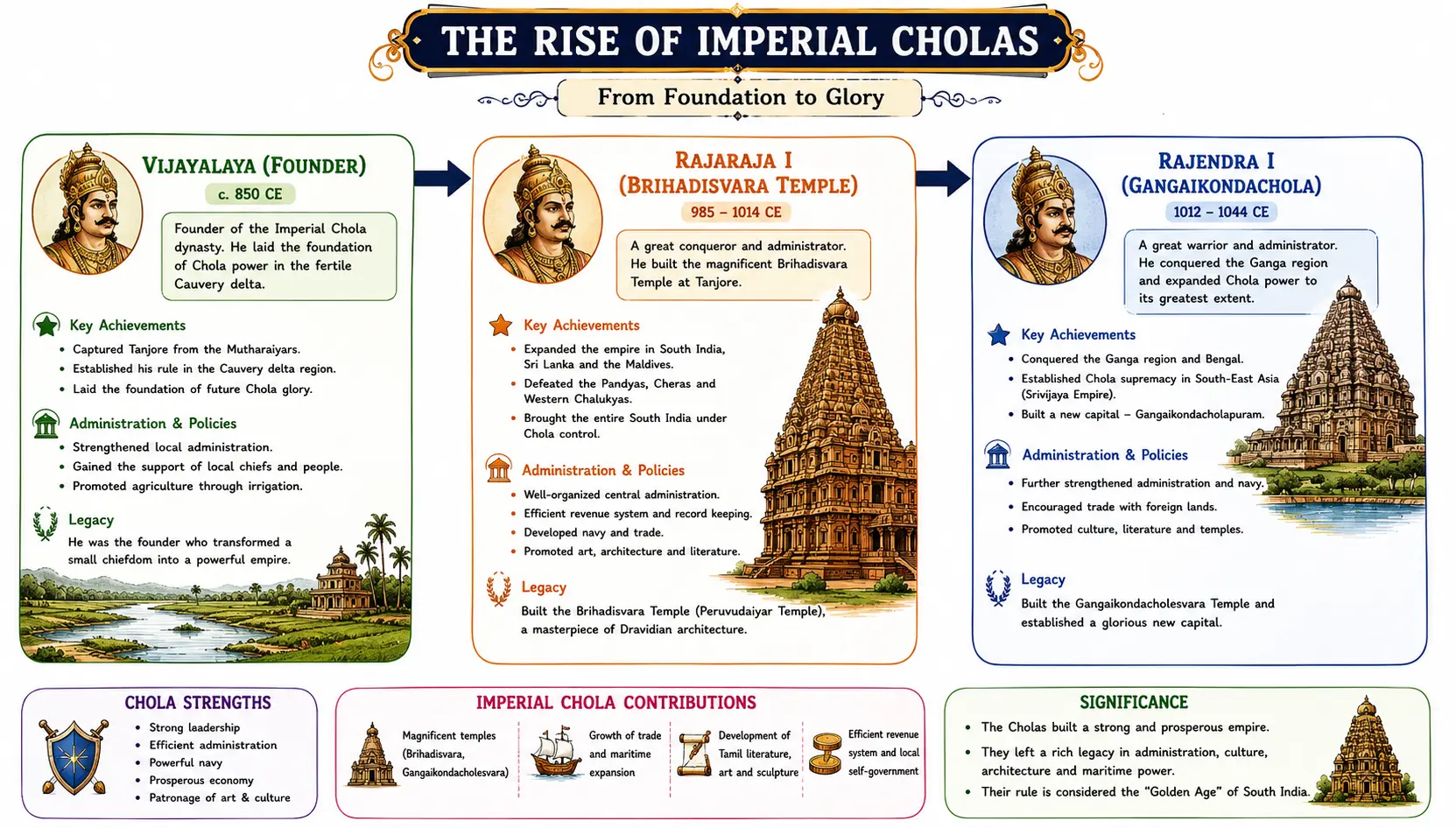
- Vijayalaya (c. 850 CE): Re-established Chola power by capturing Tanjore (Thanjavur) from the Muttarayars.
- Rajaraja I “The Great” (c. 985 – 1014 CE):
- Built the monumental Brihadisvara Temple (Rajarajesvaram) at Thanjavur (1010 CE), a masterpiece of Dravida architecture featuring a 216-foot vimana.
- Conquered Northern Sri Lanka (making Polonnaruwa his provincial capital) and the Maldives islands using his powerful navy.
- Rajendra I (c. 1014 – 1044 CE):
- Completed the conquest of Sri Lanka, capturing King Mahinda V.
- Conducted a victorious northern expedition to the Ganga river, defeating Mahipala of Bengal. To commemorate this, he assumed the title Gangaikondachola (“Conqueror of the Ganga”) and built a new capital: Gangaikondacholapuram.
- Launched a naval expedition against the Srivijaya Empire (Malaya Peninsula, Sumatra, Java) to secure maritime trade routes to China.
B. Chola Administration and Local Self-Governance
The most distinctive contribution of the Cholas was their system of Village Autonomy (Local Self-Government), detailed in the famous Uttiramerur Inscriptions (919 and 921 CE) issued during the reign of Parantaka I.
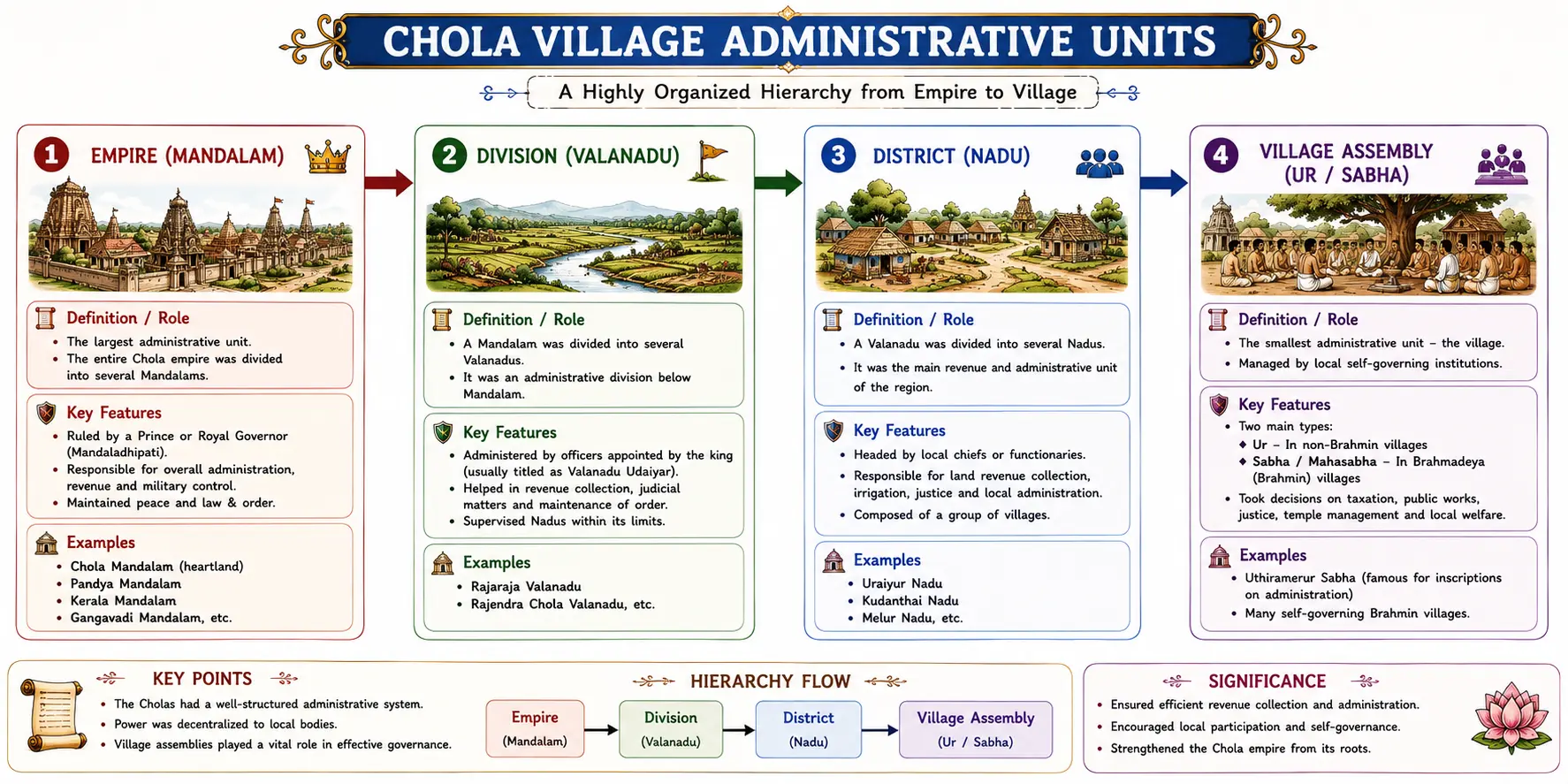
- Mandalam: Empire divided into large provinces ruled by royal governors or princes.
- Valanadu / Nadu: Administrative divisions, districts, and groups of villages supervised by local functionaries.
- Ur: Assembly of general non-Brahmin land-owning villagers.
- Sabha / Mahasabha: Exclusive assembly of Brahmin landowners in tax-free Brahmin villages (Agraharas or Brahmadeyas).
- Kudavolai System: Unique electoral balloting system where executive committee (Variyam) nominees’ names were written on palm leaves, put into an earthen pot (Kudavolai), and drawn by a child.
C. Chola Art and Bronzes
- Dravida Style Zenith: Temples characterized by multi-tiered pyramidal towers (Vimana), spacious courtyards, and grand entrance gateways (Gopurams).
- Nataraja Bronzes: Masterpieces of lost-wax casting (cire perdue). The iconic four-armed Nataraja (Shiva in the cosmic dance pose of Ananda Tandava) signifies creation, preservation, destruction, illusion, and salvation.
3. The Rajput Kingdoms and Northern Dynasties (c. 10th – 12th Century)
The post-Pratihara era saw the rise of several feudal Rajput clans ruling across Western and Central India, noted for warrior chivalry, fort-building, and monumental Nagara temple construction.
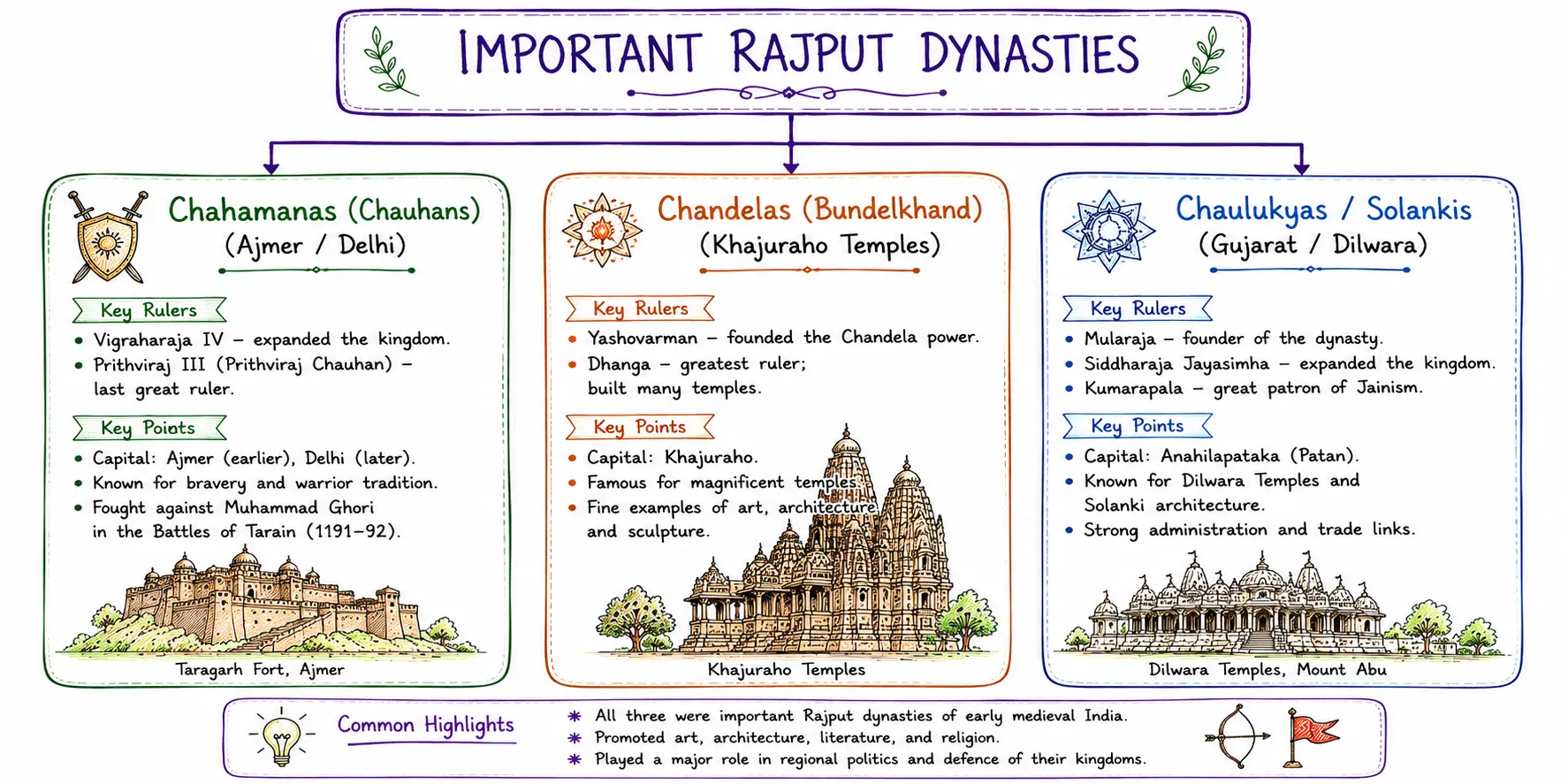
- Chahamanas (Chauhans) of Shakambhari (Ajmer/Delhi):
- Prithviraj Chauhan III (1177 – 1192 CE): Famous hero celebrated in classical folklore (Prithviraj Raso by Chand Bardai).
- First Battle of Tarain (1191 CE): Defeated the Turkish invader Muhammad Ghori.
- Second Battle of Tarain (1192 CE): Defeated and captured by Muhammad Ghori, leading directly to the establishment of Turkish rule in Delhi.
- Chandelas of Jejakabhukti (Bundelkhand):
- Constructed the magnificent Khajuraho Temples in the Nagara style (e.g., Kandariya Mahadeva Temple), celebrated worldwide for intricate erotic sculptures and vertical spires (shikharas).
- Solankis (Chaulukyas) of Gujarat:
- Built the exquisite Sun Temple at Modhera and the Dilwara Jain Temples at Mount Abu (carved in pure white marble).
- King Bhima I ruled when Mahmud of Ghazni raided the Somnath temple complex in 1026 CE.
- Paramaras of Malwa:
- Raja Bhoja (c. 1010 – 1055 CE): Polymath scholar-king who authored treatises on architecture (Samarangana Sutradhara), astronomy, and poetics. Built the city of Bhojpal (modern Bhopal).
4. Early Islamic Invasions and Emergence of the Sultanate
The fragmentation of northern polities left the northwestern frontiers vulnerable, triggering a sequence of campaigns transitioning from exploratory incursions to outright conquest.
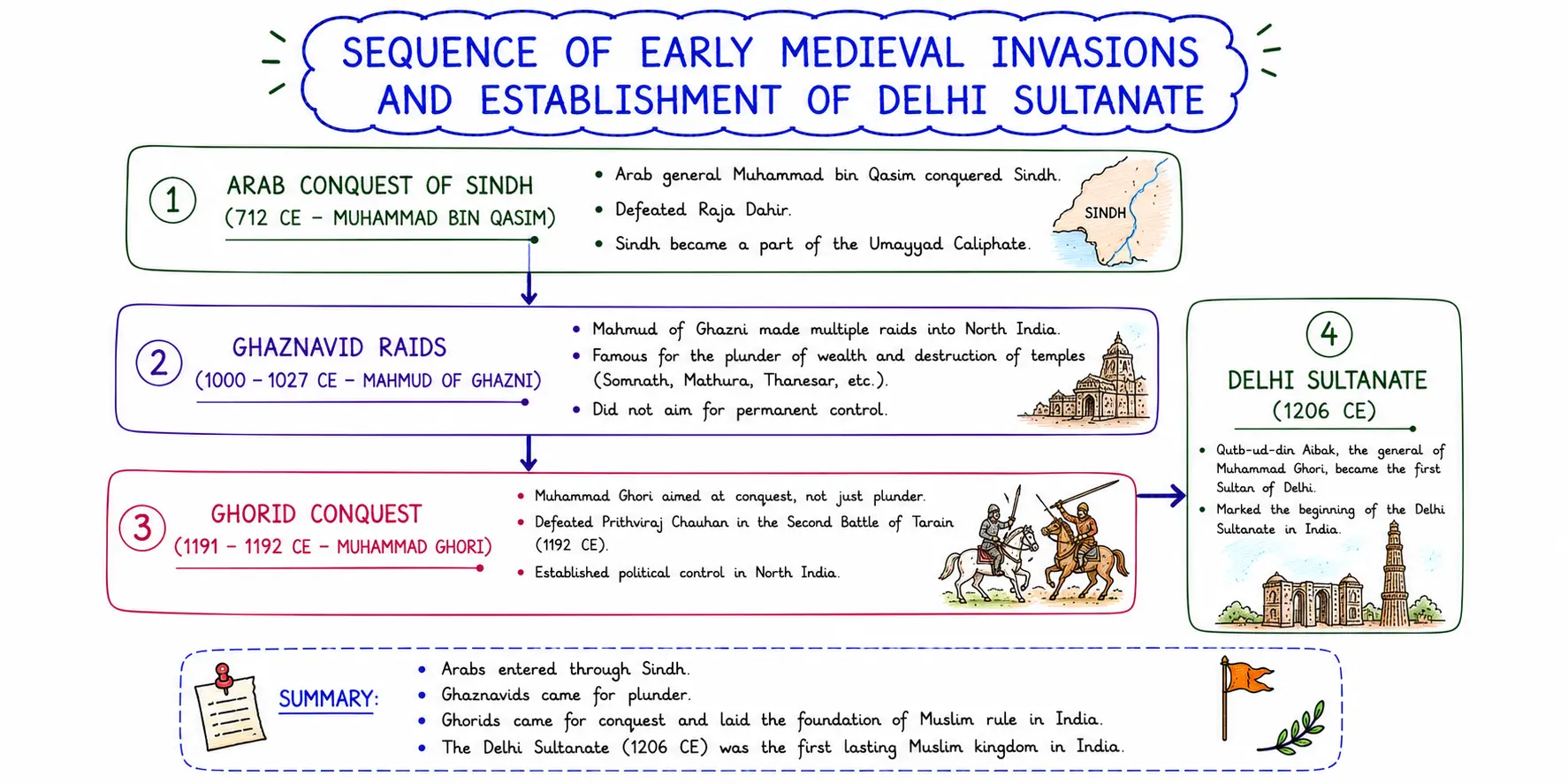
- Arab Conquest of Sindh (712 CE): Muhammad bin Qasim defeated Raja Dahir of Sindh, introducing Islamic political influence to the subcontinent under the Umayyad Caliphate.
- Mahmud of Ghazni (c. 1000 – 1027 CE): Launched 17 plundering raids into North India to loot temple wealth. Famous for sacking the Somnath Temple in Gujarat (1026 CE). Celebrated Persian scholar Al-Biruni accompanied his campaigns and authored Kitab-ul-Hind (Tahqiq-i-Hind).
- Muhammad Ghori: Unlike Ghazni, Ghori aimed to establish a lasting territorial empire. His victory in the Second Battle of Tarain (1192 CE) and the Battle of Chandawar (1194 CE) against Jaichand of Kannauj laid the foundation for the Delhi Sultanate (1206 CE) established by his general Qutbuddin Aibak.
5. Quick Examination Facts
| Feature / Event | Key Exam Fact |
|---|---|
| Pala Dynasty Founder | Gopala (c. 750 CE, elected by public assembly) |
| Founder of Vikramashila University | Dharmapala (Pala King) |
| Pratihara Title ‘Adivaraha’ Assumed By | Mihira Bhoja |
| Author of Kavyamimamsa | Rajashekhara (Court poet of Pratiharas) |
| Builder of Kailash Temple at Ellora | Krishna I (Rashtrakuta King; Cave 16) |
| Author of Kavirajamarga | Amoghavarsha I (Earliest Kannada literary work) |
| Builder of Brihadisvara Temple (Tanjore) | Rajaraja I (1010 CE, Dravida style) |
| Title ‘Gangaikondachola’ Assumed By | Rajendra I (Built Gangaikondacholapuram) |
| Inscriptions Detailing Chola Village Autonomy | Uttiramerur Inscriptions (Parantaka I) |
| Chola Village Balloting System | Kudavolai System |
| Builder of Kandariya Mahadeva Temple | Chandelas of Bundelkhand (Khajuraho, MP) |
| First Battle of Tarain (1191 CE) | Prithviraj Chauhan defeated Muhammad Ghori |
| Second Battle of Tarain (1192 CE) | Muhammad Ghori defeated Prithviraj Chauhan |
| Author of Kitab-ul-Hind | Al-Biruni (Accompanied Mahmud of Ghazni) |
6. Conclusion
The Early Medieval Period was a transformative bridge between classical antiquity and the medieval sultanate era. While the Tripartite Struggle produced a stalemate in North India, it decentralized political power into feudal Rajput principalities. Concurrently, the Cholas established a formidable maritime empire and pioneered local democratic self-governance. The architectural marvels of Khajuraho, Tanjore, and Ellora, alongside classical regional literature, reflect an era of profound cultural brilliance prior to the establishment of the Delhi Sultanate.
Early Medieval India
Practice Quiz