The Maratha Empire, Later Mughals, and 18th-Century Regional States (1674 – 1818 CE)
From the coronation of Chhatrapati Shivaji Maharaj to the era of the Peshwa hegemony and subsequent foreign invasions by Nadir Shah and Ahmad Shah Abdali, this phase redefined the geopolitical landscape and paved the way for colonial expansion in the Indian subcontinent.
To grasp the broader timeline of this transitional phase, the conceptual roadmap below maps out how central imperial control splintered into confederate regional authorities and foreign interventions across the subcontinent.
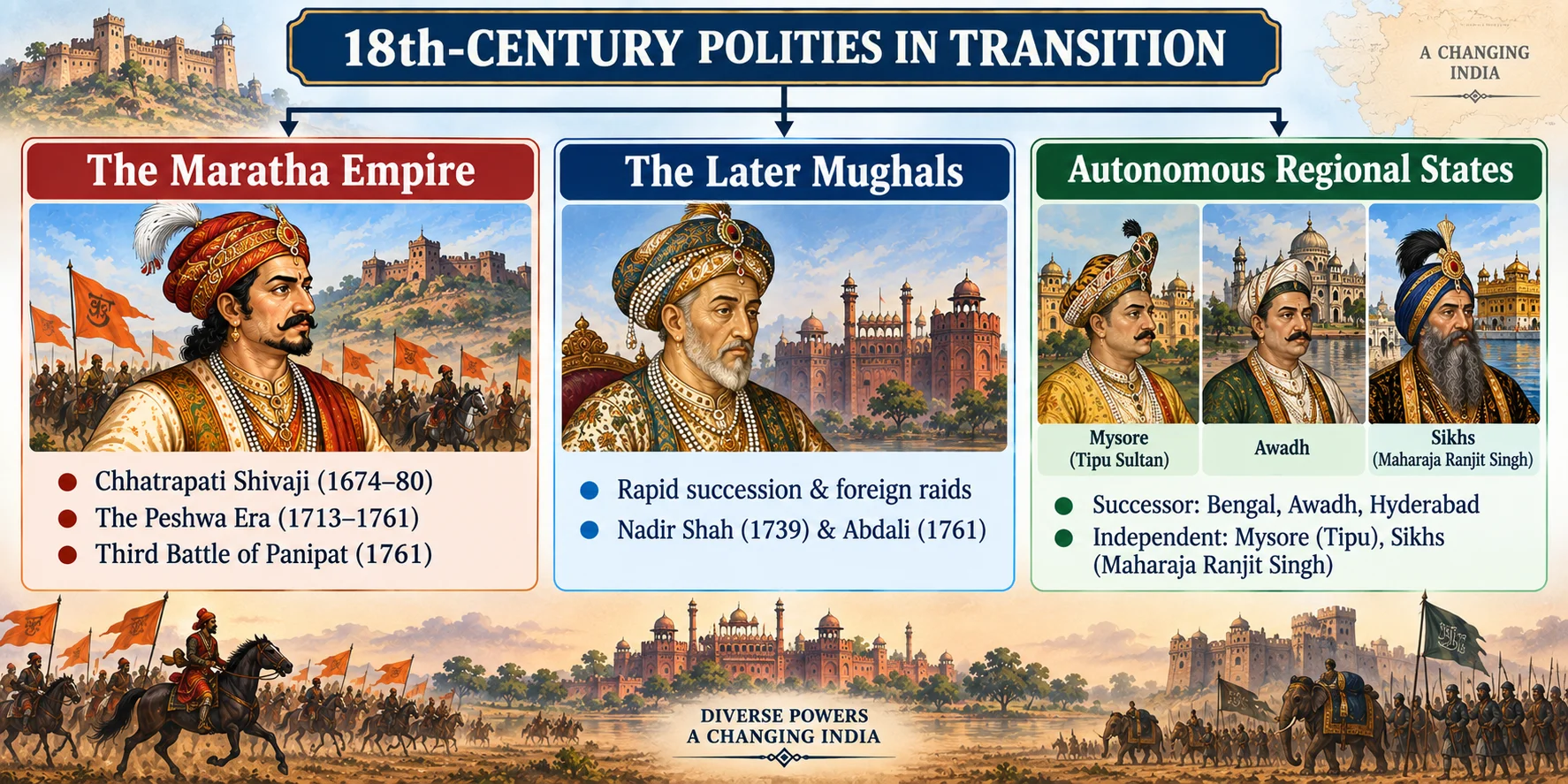
1. The Rise of the Maratha Empire: Chhatrapati Shivaji Maharaj
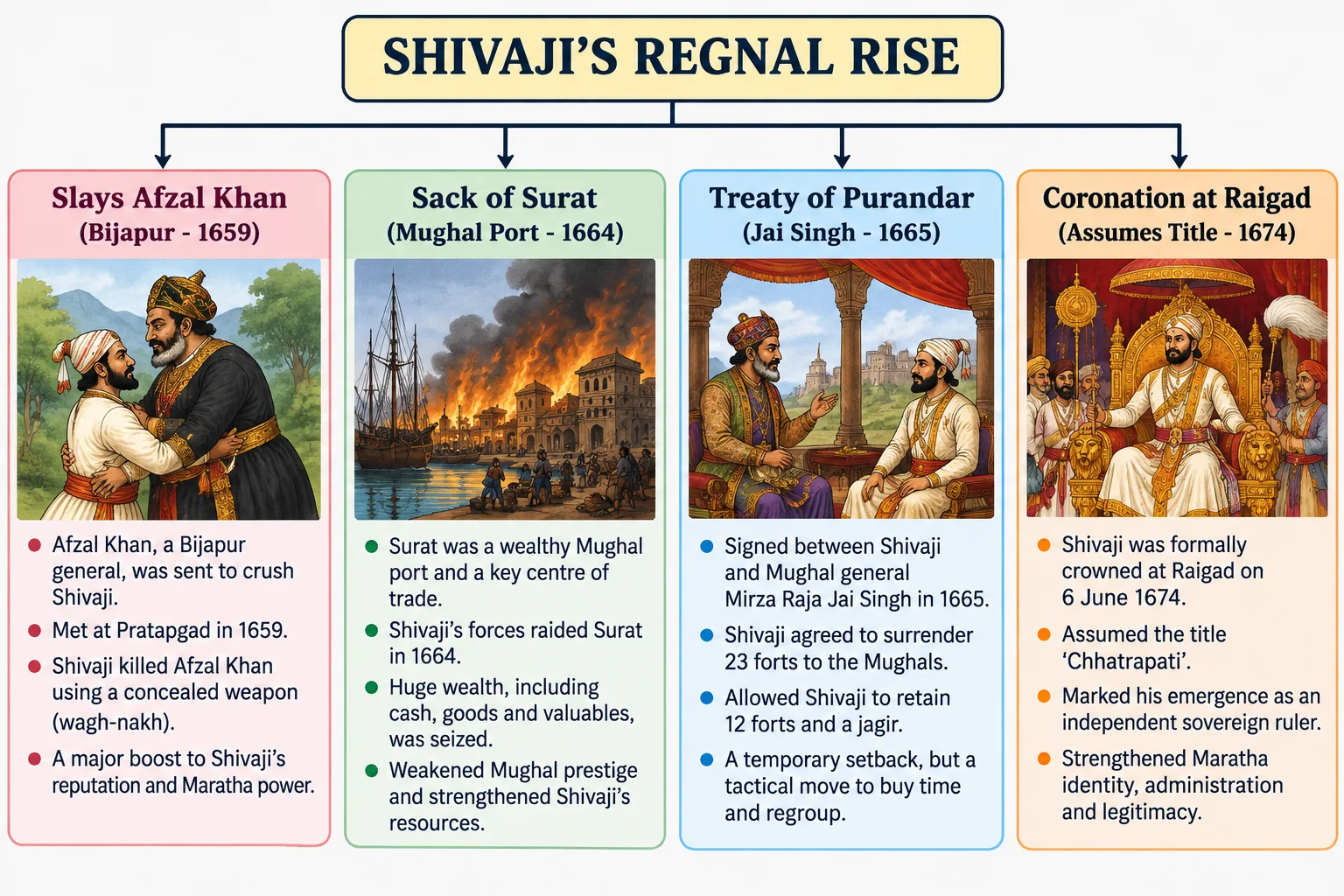
The foundation of Maratha self-rule (Swarajya) was built on strategic hill forts, decisive guerrilla campaigns against Bijapur and the Mughals, and a formal coronation ceremony in 1674 CE. The following mind map summarizes Shivaji Maharaj’s regnal milestones and administrative setup.
A. Military Triumphs and Coronation
- Early Foundations: Born at Shivneri Fort (1630 CE) to Shahaji Bhonsle and Jijabai; mentored in warfare and governance by Dadaji Kondadeo.
- Military Clashes:
- Encounter with Afzal Khan (1659 CE): Slew the Bijapuri general using the iconic tiger claws (Bagh Nakh) at Pratapgad.
- Shaista Khan Campaign (1663 CE): Conducted a daring night raid in Pune against the Mughal governor.
- Sack of Surat (1664 & 1670 CE): Plundered the premier Mughal commercial port to build military funds.
- Treaty of Purandar (1665 CE): Signed between Shivaji Maharaj and Raja Jai Singh I (on behalf of Aurangzeb); surrendered 23 forts and agreed to visit the Mughal imperial court at Agra.
- Coronation (1674 CE): Crowned as Chhatrapati at Raigad Fort by Gagabhatt, adopting the ideals of Hindavi Swarajya.
B. Administration: The Ashta Pradhan Council
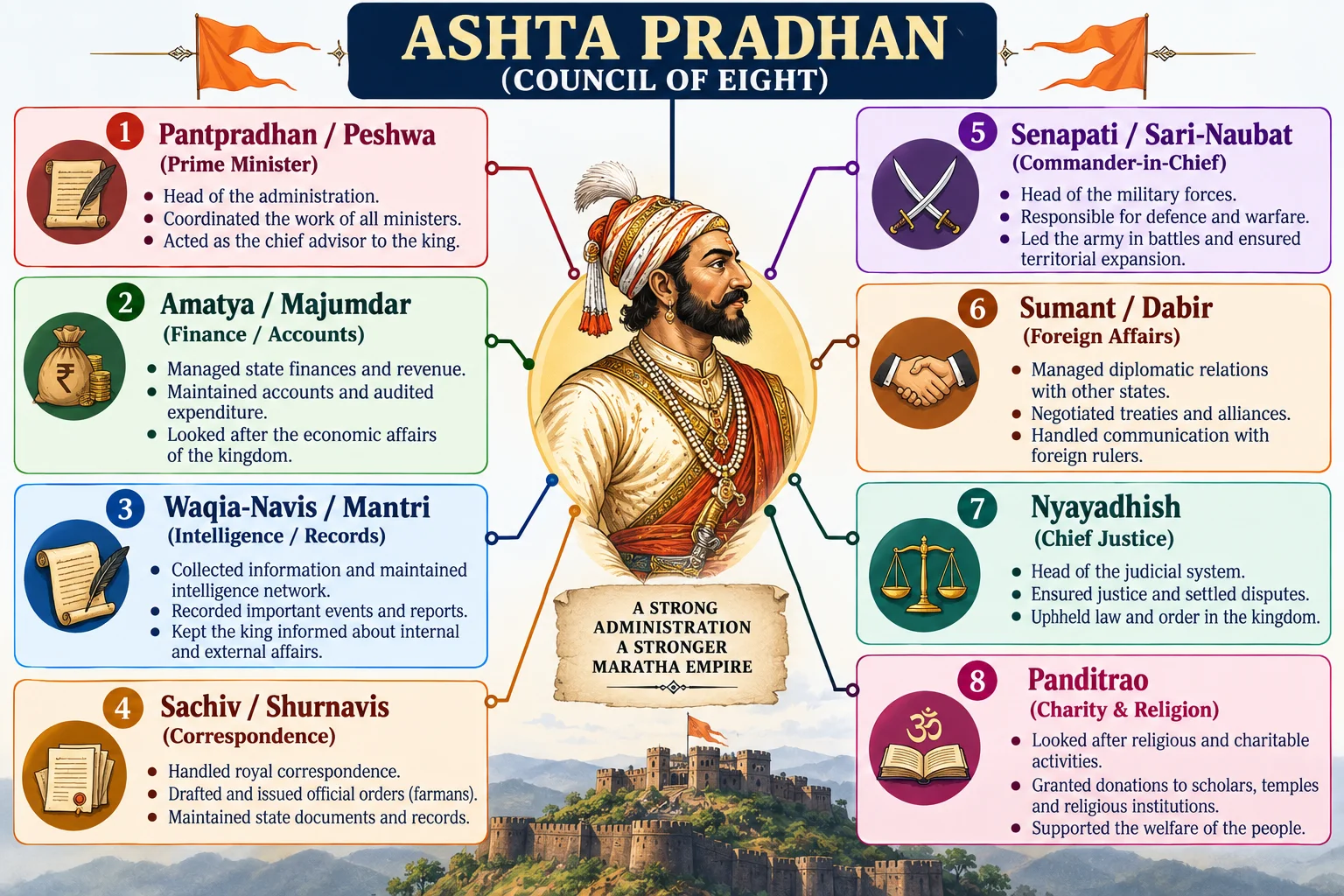
Shivaji established a non-hereditary council of eight ministers who were directly accountable to the monarch, each handling a specialized portfolio ranging from military command to revenue administration.
- Peshwa (Mukhya Pradhan): Prime Minister responsible for general administration.
- Amatya (Majumdar): Finance and Revenue Minister.
- Senapati (Sar-i-Naubat): Commander-in-Chief of the armed forces.
- Waqia-Navis (Mantri): Royal chronicler, intelligence, and home affairs.
- Sachiv (Surnis): Minister in charge of royal correspondence and imperial edicts.
- Sumant (Dabir): Foreign Affairs Minister.
- Nyayadhish: Chief Justice responsible for civil and military law.
- Panditrao (Danadhyaksha): High Priest in charge of religious and charitable grants.
C. Revenue and Military Strategies
- Chauth & Sardeshmukhi:
- Chauth: One-fourth (25%) of standard land revenue collected from non-Maratha neighboring territories in exchange for protection from raids.
- Sardeshmukhi: An additional 10% (one-tenth) levy claimed by Shivaji as the hereditary supreme overlord (Sardeshmukh) of the Deccan.
- Kathi System: Adopted the land measurement unit Kathi formulated by Malik Ambar of Ahmednagar.
- Guerilla Tactics (Ganimi Kava): Pioneered rapid hit-and-run mobile warfare exploiting rugged Western Ghats terrain.
2. The Peshwa Hegemony and Maratha Confederacy
Following the execution of Sambhaji and the civil conflict between Tarabai and Shahu, the real locus of authority shifted from the Chhatrapati of Satara to the hereditary Peshwas operating out of Pune. The genealogical progression below outlines this political transition.
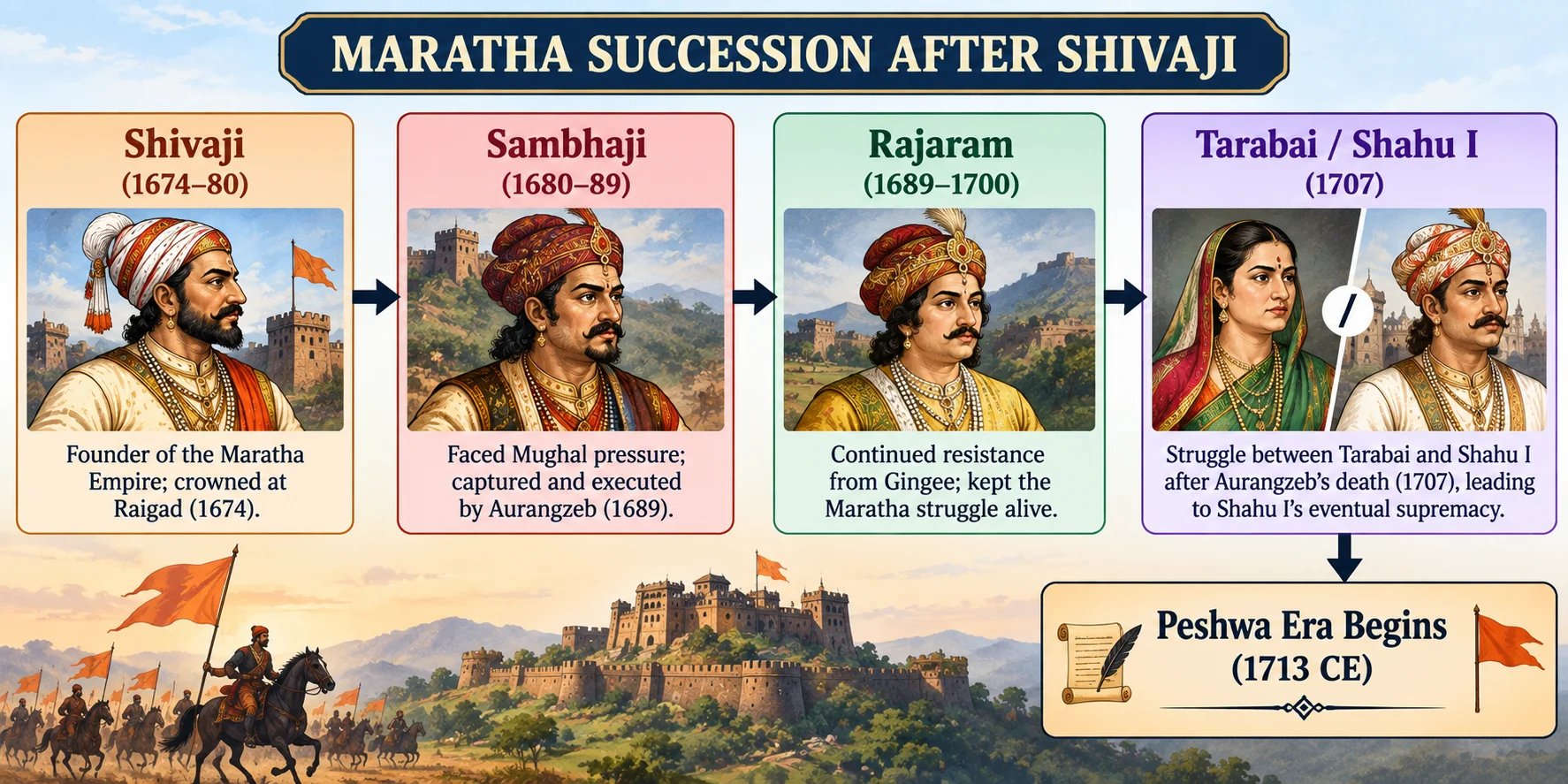
A. Era of the Great Peshwas
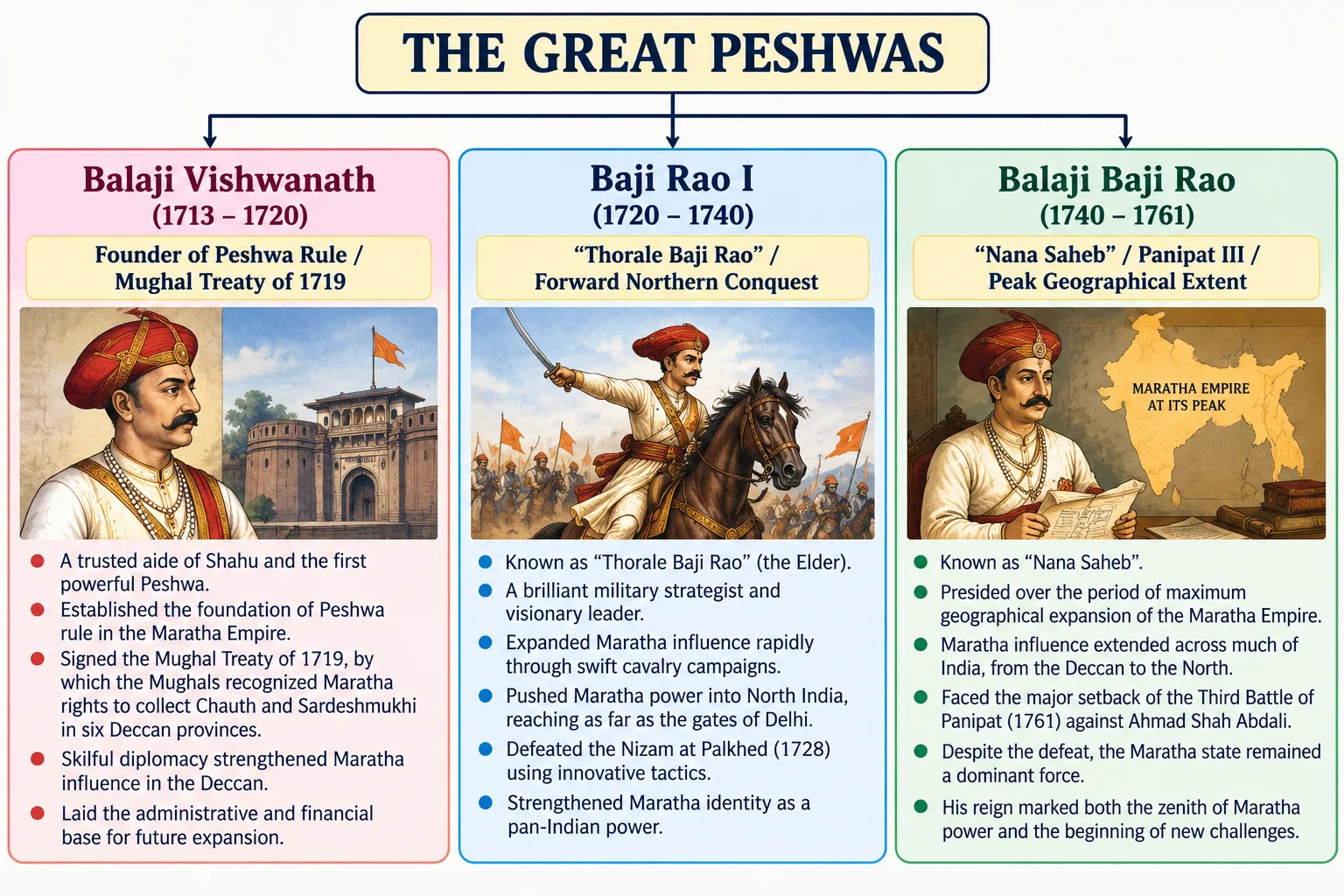
- Balaji Vishwanath (1713 – 1720 CE): Established the hereditary office of the Peshwa. Secured the right of Chauth and Sardeshmukhi across six Deccan provinces via the 1719 Mughal-Maratha Treaty.
- Baji Rao I (1720 – 1740 CE): Championed forward military expansion (Hindu Pad Padshahi), famously declaring: “Let us strike at the trunk of the withering tree, and the branches will fall off themselves.” Defeated Nizam-ul-Mulk at the Battle of Palkhed (1728 CE) and established Maratha supremacy over Malwa and Gujarat.
- Balaji Baji Rao / Nana Saheb (1740 – 1761 CE): Extended Maratha borders to their maximum territorial extent across North India, capturing Delhi and Attock (modern Pakistan).
Under these three statesmen, the Maratha kingdom transformed into an expansive subcontinental empire. The chart below traces the distinct military achievements and geopolitical milestones accomplished under each Peshwa.
B. Third Battle of Panipat (14 January 1761 CE)
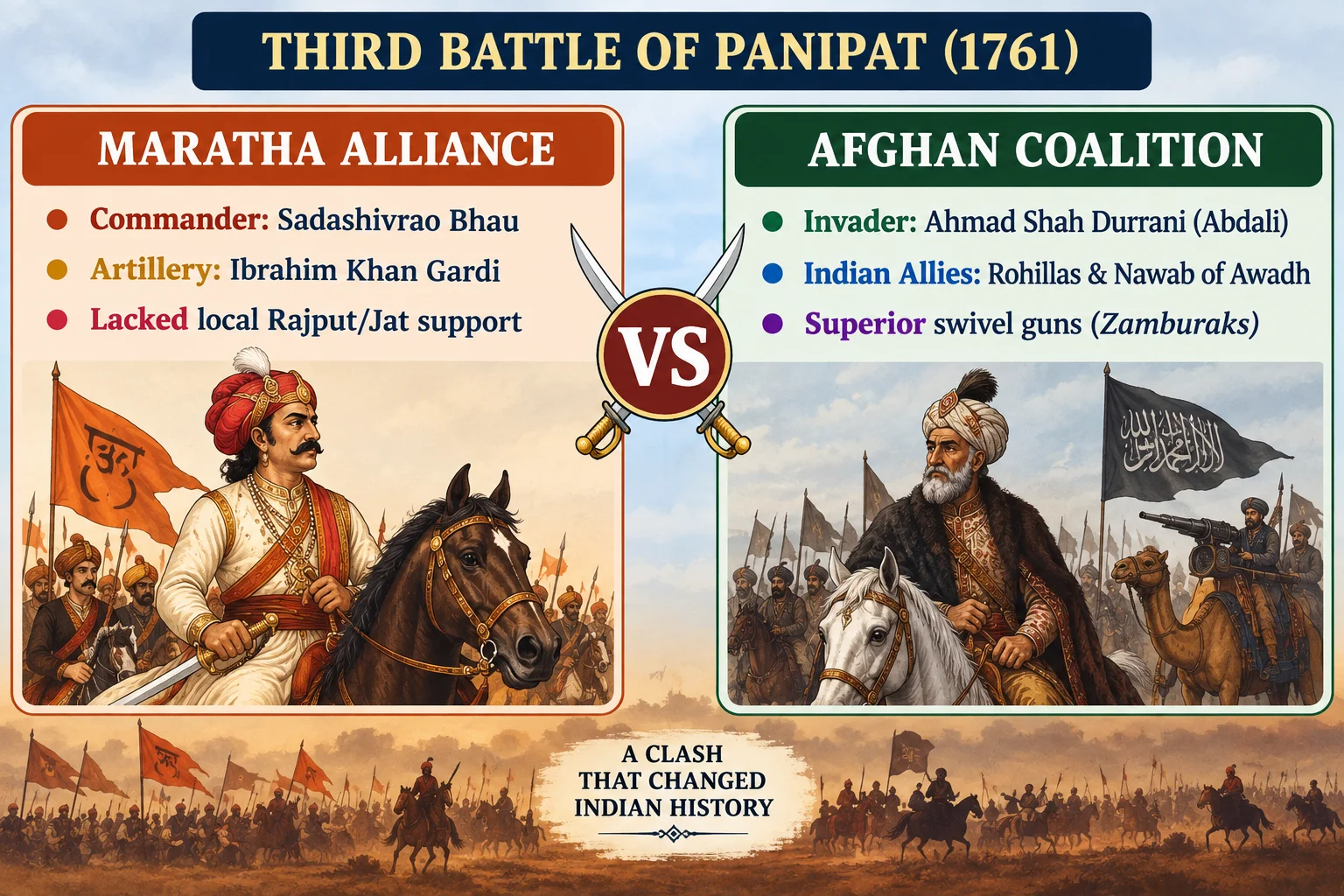
The confrontation at Panipat halted the northward expansion of the Marathas and fundamentally reshaped 18th-century Indian politics. The strategic alignment of rival forces and the fatal tactical missteps are highlighted below.
- Opponents: Maratha forces commanded by Sadashivrao Bhau and Vishwasrao against the combined Afghan-Rohilla-Awadh alliance led by Ahmad Shah Abdali and Najib-ud-Daulah.
- Outcome: Catastrophic defeat for the Marathas; decimated the top tier of Maratha leadership and permanently checked their ambitions of ruling all of India.
C. Prominent Maratha Confederacy Clans
After 1761, Maratha statehood operated as a decentralized confederacy led by five prominent warlord families stationed across western and central India.
| Ruling Clan / Dynasty | Seat of Power / Capital | Prominent Rulers / Architects |
|---|---|---|
| Peshwas | Pune (Maharashtra) | Baji Rao I, Nana Saheb |
| Scindias (Shindes) | Gwalior (Madhya Pradesh) | Mahadji Scindia, Daulat Rao Scindia |
| Holkars | Indore (Madhya Pradesh) | Malhar Rao Holkar, Ahilyabai Holkar |
| Gaekwads | Baroda (Gujarat) | Pilaji Rao Gaekwad, Damaji Rao Gaekwad |
| Bhonsles | Nagpur (Maharashtra) | Raghuji Bhonsle |
3. The Later Mughals and Foreign Invasions (1707 – 1857 CE)
A. Key Later Mughal Monarchs
The post-Aurangzeb period witnessed rapid successions, factional court rivalries, and the reduction of the Mughal Badshah to a mere figurehead. The visual timeline below outlines the chronological order of these rulers.
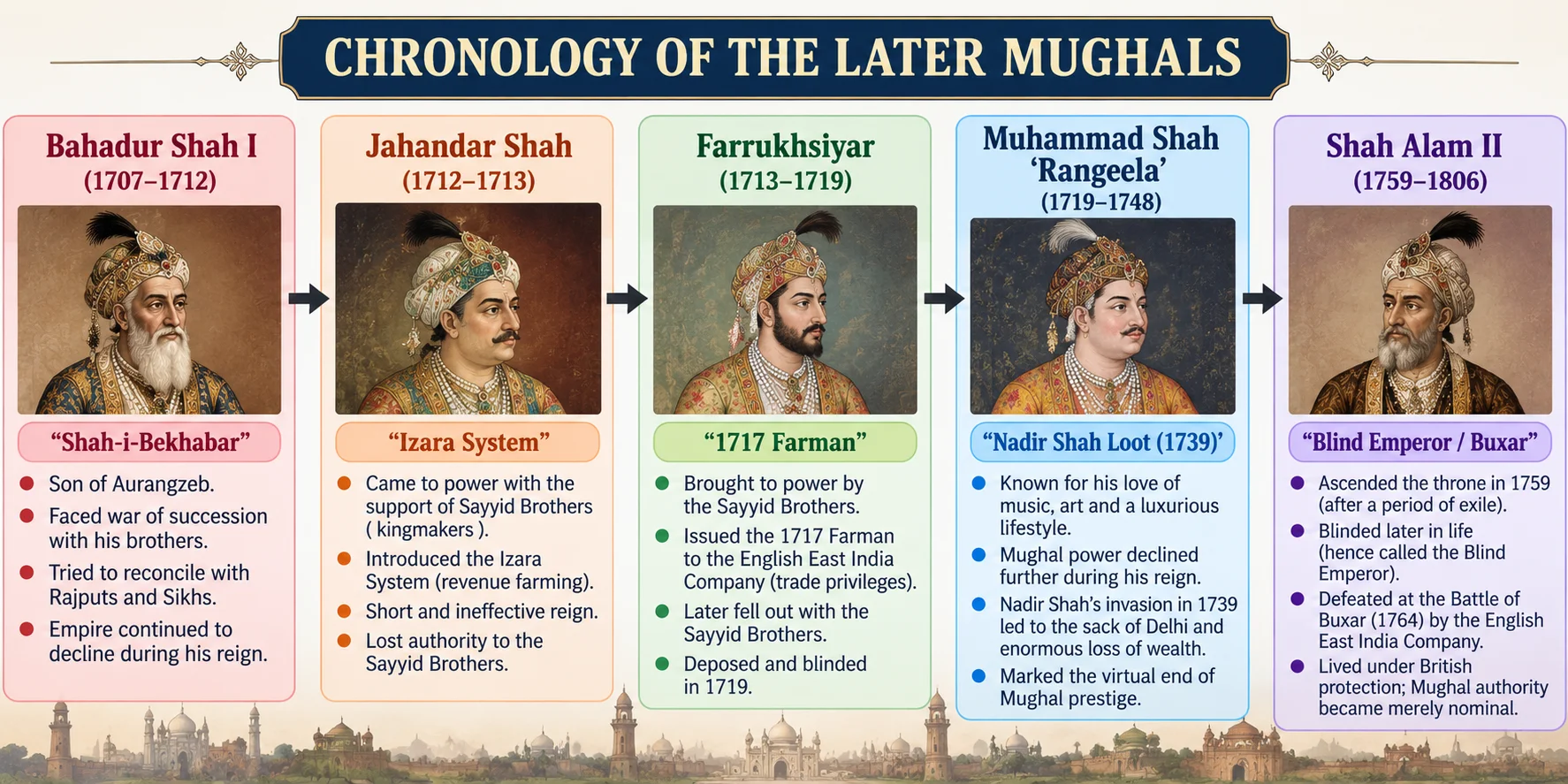
- Bahadur Shah I (1707 – 1712 CE): Followed a policy of conciliation; popularly dubbed Shah-i-Bekhabar (Heedless King) by Khafi Khan.
- Farrukhsiyar (1713 – 1719 CE): Ascended the throne with the backing of the Sayyid Brothers (Abdullah Khan and Hussain Ali Khan, the “Kingmakers”). Issued the famous Imperial Farman of 1717 (Magna Carta of the British East India Company) granting duty-free trade in Bengal.
- Muhammad Shah ‘Rangeela’ (1719 – 1748 CE): His decadent reign witnessed the permanent secession of Bengal, Awadh, and Hyderabad.
- Shah Alam II (1759 – 1806 CE): Defeated at the Battle of Buxar (1764 CE); signed the Treaty of Allahabad (1765 CE), granting the Diwani (revenue collecting) rights of Bengal, Bihar, and Orissa to the British.
- Bahadur Shah II ‘Zafar’ (1837 – 1857 CE): Last Mughal Emperor, exiled to Rangoon after the Revolt of 1857.
B. Devastating Invasions from the Northwest
- Nadir Shah of Persia (1739 CE): Defeated Muhammad Shah at the Battle of Karnal (1739); ordered the Delhi massacre and looted the Peacock Throne along with the Koh-i-Noor diamond.
- Ahmad Shah Abdali (1748 – 1767 CE): Repeatedly raided North India, plundering Delhi and Mathura, culminating in the Third Battle of Panipat (1761 CE).
4. Rise of Autonomous Regional States in the 18th Century
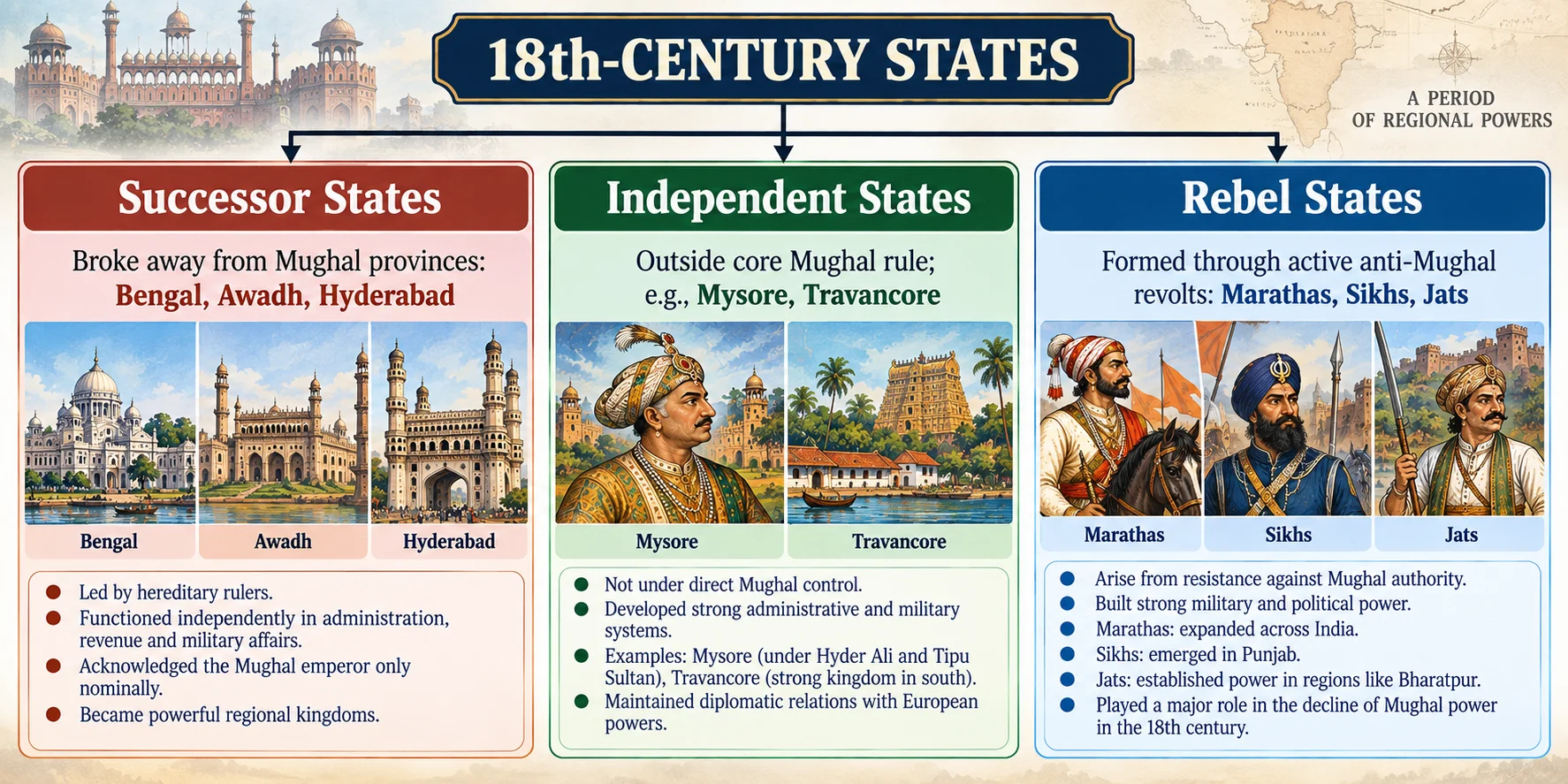
As the central authority of Delhi dissolved, powerful provincial governors (Subahdars) and rebellious regional groups declared de facto independence, establishing distinct successor states and warrior realms across the subcontinent.
| Autonomous State | Founder / Chief Ruler | Year & Key Historical Landmark |
|---|---|---|
| Hyderabad (Asaf Jahi Dynasty) | Nizam-ul-Mulk (Chin Qilich Khan) | 1724 CE; Defeated Mubariz Khan at Battle of Shakar Kheda |
| Bengal | Murshid Quli Khan | 1717 CE; Transferred capital from Dhaka to Murshidabad |
| Awadh (Oudh) | Saadat Khan (Burhan-ul-Mulk) | 1722 CE; Succeeded by Safdarjung |
| Mysore | Hyder Ali & Tipu Sultan | 1761 CE; Modernized army; rocket artillery, Jacobin Club member |
| Sikh Commonwealth (Misls) | Maharaja Ranjit Singh (Sukerchakia Misl) | 1799 CE; Unified 12 Misls, established capital at Lahore |
| Rajput States (Amber/Jaipur) | Sawai Jai Singh II | Founded Jaipur; built 5 astronomical observatories (Jantar Mantar) |
The thematic summary map below categorizes these regional powers based on their origin—successor states, rebellious polities, and independent kingdoms.
5. Quick Examination Facts
| Topic / Event | Key Exam Fact |
|---|---|
| Coronation of Chhatrapati Shivaji | 1674 CE at Raigad Fort (Title: Chhatrapati) |
| Treaty of Purandar Signed In | 1665 CE (Shivaji Maharaj and Raja Jai Singh I) |
| Council of Eight Ministers (Shivaji) | Ashta Pradhan |
| Chauth and Sardeshmukhi Tax Rates | Chauth = 25% (1/4th), Sardeshmukhi = 10% (1/10th) |
| Peshwa of the Battle of Palkhed | Baji Rao I (Defeated Nizam-ul-Mulk in 1728) |
| Third Battle of Panipat | January 14, 1761 CE (Marathas vs Ahmad Shah Abdali) |
| Known as “Kingmakers” of Later Mughals | Sayyid Brothers (Abdullah Khan and Hussain Ali) |
| British Golden Farman Issued By | Farrukhsiyar (1717 CE) |
| Battle of Karnal & Plunder of Koh-i-Noor | 1739 CE (Nadir Shah defeated Muhammad Shah Rangeela) |
| Founder of Autonomous Hyderabad State | Nizam-ul-Mulk / Chin Qilich Khan (1724 CE) |
| Founder of Autonomous Bengal State | Murshid Quli Khan (1717 CE) |
| Diwani Rights Granted to British In | 1765 CE (Treaty of Allahabad by Shah Alam II) |
| Astronomical Observatories (Jantar Mantar) Built By | Sawai Jai Singh II (Delhi, Jaipur, Ujjain, Varanasi, Mathura) |
| Unification of Sikh Misls | Maharaja Ranjit Singh (Sukerchakia Misl, 1799 CE) |
6. Conclusion
The 18th century was not merely an era of Mughal twilight, but a dynamic period of political decentralization and regional state formation. While the Marathas came closest to replacing the Mughal paramountcy across northern and central India, the catastrophic outcome of Panipat (1761) and internal factionalism within the regional confederacies created an administrative void. This fragmented landscape ultimately enabled the British East India Company to step into the power vacuum and establish colonial hegemony over India.
The Maratha Empire
Practice Quiz • 15 MCQs