Introduction to Economics: Basic Concepts, Principles, and Scope
What is Economics?
At its core, Economics is the study of how individuals, businesses, governments, and societies make choices when allocating limited resources to satisfy unlimited human wants. Every human society faces a fundamental reality: while human desire for goods, services, and comfort is virtually limitless, the resources required to produce them—land, labor, physical equipment, and time—are strictly finite.
Economics provides the analytical framework to understand how these choices are made, how markets coordinate human behavior, and how policy interventions influence material well-being.
Historical Evolution of Economic Definitions
The definition of economics has evolved significantly over time, reflecting changes in societal priorities and analytical methods. Economists generally classify these definitions into four distinct historical schools of thought:
1. Wealth Definition (Adam Smith)
In his seminal work, An Inquiry into the Nature and Causes of the Wealth of Nations (1776), Adam Smith—widely regarded as the Father of Modern Economics—defined economics simply as the science of wealth. He focused on how nations produce, accumulate, and increase their physical wealth through specialization and market exchange.
2. Welfare Definition (Alfred Marshall)
In Principles of Economics (1890), Alfred Marshall shifted the focus from material wealth to human welfare. He described economics as “a study of mankind in the ordinary business of life,” emphasizing how humans obtain and use material requisites to achieve well-being.
3. Scarcity Definition (Lionel Robbins)
In 1932, Lionel Robbins published An Essay on the Nature and Significance of Economic Science, providing the modern analytical foundation for the discipline. He defined economics as:
“The science which studies human behavior as a relationship between ends and scarce means which have alternative uses.”
Robbins highlighted three universal conditions:
- Human wants (ends) are unlimited.
- Resources (means) to satisfy these wants are limited.
- Resources have alternative uses (e.g., land can be used for farming, housing, or industrial factories).
4. Growth and Development Definition (Paul Samuelson)
Nobel laureate Paul Samuelson expanded the definition to include time and dynamic change, defining economics as the study of how societies choose to use scarce productive resources over time to produce commodities and distribute them for consumption among various people and groups.
Core Economic Principles
Understanding economics requires mastering a few foundational concepts that explain decision-making:
1. Scarcity and Choice
Scarcity is the fundamental economic problem. Because resources are scarce, choices must be made. Choosing more of one thing inevitably means having less of something else.
2. Opportunity Cost
When a choice is made, an alternative option is sacrificed. Opportunity Cost is defined as the value of the next best alternative forgone when making a decision.
For example, if a farmer uses a plot of land to grow wheat, the opportunity cost is the value of the rice or vegetables that could have been grown on that same land instead.
Opportunity Cost = Value of the Next Best Alternative Forgone
3. Marginal Decision-Making
Economic decisions are rarely all-or-nothing. Instead, consumers and producers think “at the margin,” weighing the Marginal Benefit (additional gain from one more unit) against the Marginal Cost (additional expense of producing or consuming one more unit). Rational economic agents take action if and only if:
Marginal Benefit (MB) ≥ Marginal Cost (MC)
Microeconomics vs. Macroeconomics
Economic analysis is divided into two major branches based on the scale of investigation:
| Feature | Microeconomics | Macroeconomics |
|---|---|---|
| Origin | Derived from the Greek word Mikros (meaning small) | Derived from the Greek word Makros (meaning large) |
| Focus | Individual economic units (a consumer, household, firm, or industry) | The economy as an aggregate whole |
| Core Subject | Price determination of individual goods and market demand/supply | National Income, total employment, general price level (inflation), GDP growth |
| Key Theories | Theory of Demand, Consumer Behavior, Theory of Production, Market Structures | Keynesian Economics, Fiscal Policy, Monetary Policy, Business Cycles |
| Pioneering Figure | Alfred Marshall | John Maynard Keynes (General Theory, 1936) |
Factors of Production
To produce goods and services, an economy relies on four basic inputs, known as the Factors of Production. Each factor receives a specific economic reward for its contribution to production:
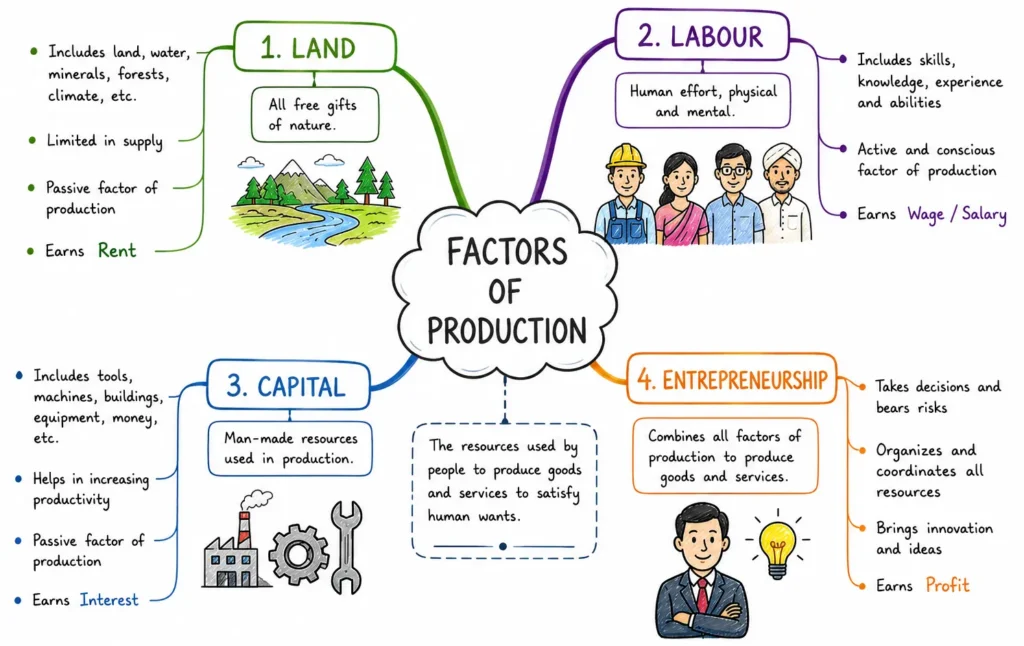
- Land: All natural resources supplied by nature (e.g., farmland, water, minerals, forests).
- Reward: Rent
- Labor: Physical and mental human effort devoted to the production process.
- Reward: Wages (or Salaries)
- Capital: Man-made durable assets used to produce other goods and services (e.g., machinery, factories, equipment, tools).
- Reward: Interest
- Entrepreneurship: The ability, initiative, and risk-bearing capacity required to organize land, labor, and capital into a productive business venture.
- Reward: Profit
The Central Problems of an Economy
Due to the problem of scarcity, every society—regardless of its political or economic structure—must answer three fundamental questions:
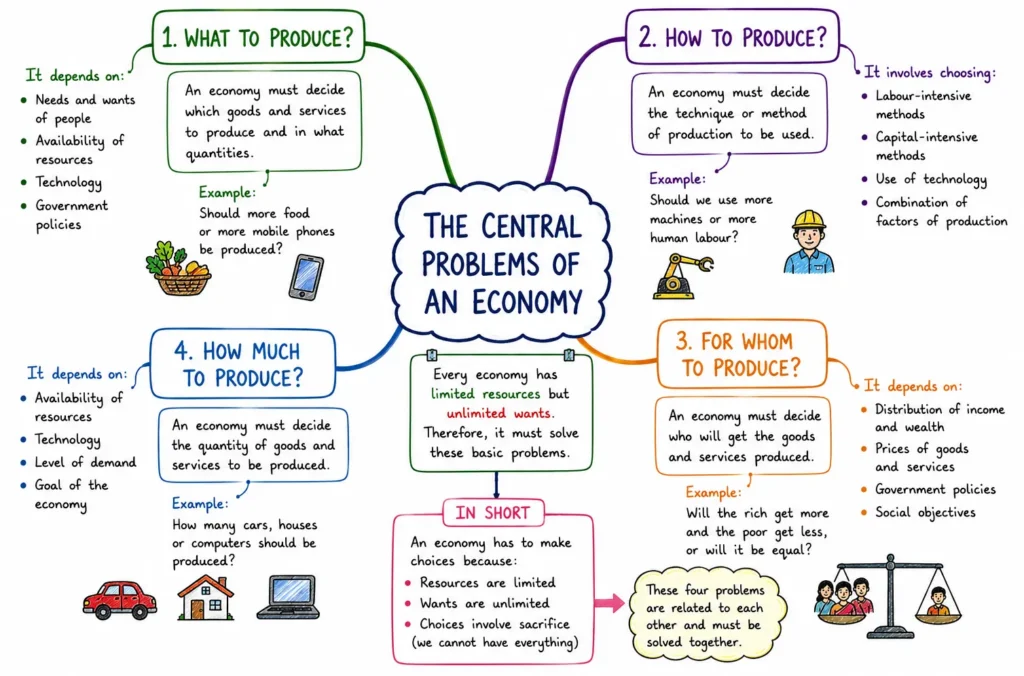
1. What to produce and in what quantities?
A society must decide which goods and services to produce with its limited resources. Should it produce more consumer goods (like clothing and food) or capital goods (like industrial machinery)? Should it prioritize healthcare or defense equipment?
2. How to produce?
This involves choosing the technical method of production. A nation can choose between:
- Labor-Intensive Techniques: Using more human labor relative to machinery (suitable for labor-abundant countries).
- Capital-Intensive Techniques: Using more advanced machinery and technology relative to human labor (suitable for capital-abundant countries).
3. For whom to produce?
This is the problem of income distribution. It determines how the total national product is divided among members of society, deciding who gets to consume the goods and services produced.
Types of Economic Systems
Economies handle the central problems differently depending on who owns the means of production and how decisions are made:
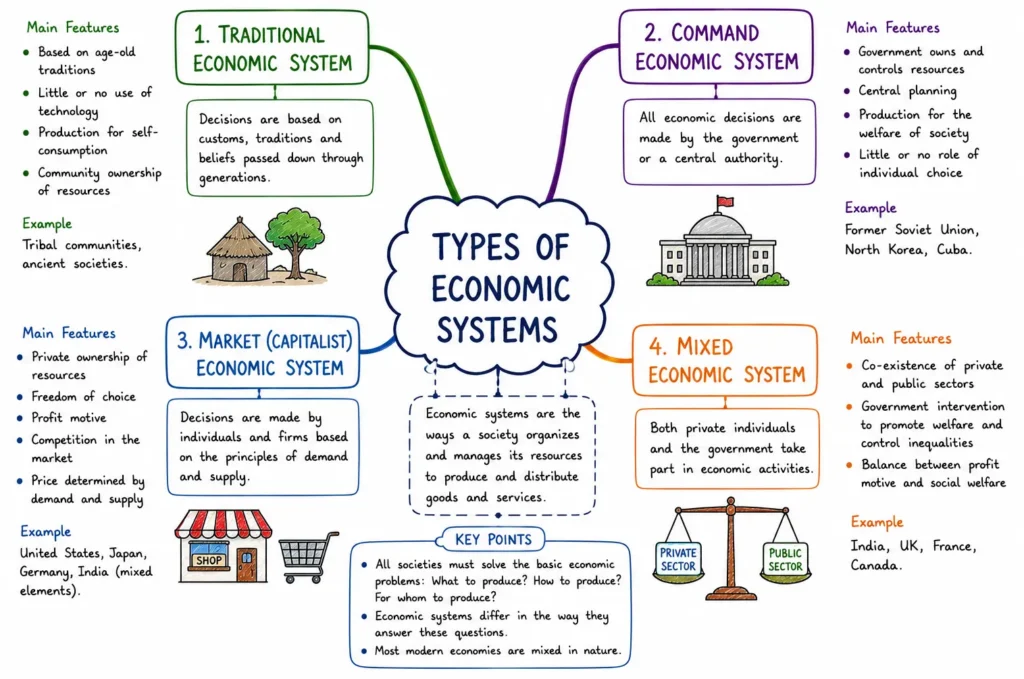
1. Market Economy (Capitalism)
In a capitalist system, resources are privately owned. Economic decisions are guided entirely by market forces of demand and supply without state intervention.
- Key Features: Private property rights, profit motive, consumer sovereignty, and market competition (laissez-faire).
- Examples: United States, United Kingdom.
2. Command Economy (Socialism)
In a socialist system, the means of production are publicly owned and controlled by the government. Economic decisions are directed by a central planning authority to maximize public welfare.
- Key Features: State ownership, central planning, emphasis on social equality, and absence of market competition.
- Historical Example: Former Soviet Union (USSR).
3. Mixed Economy
A mixed economy combines elements of both market capitalism and state socialism. Private enterprise and public sector institutions co-exist and complementary roles.
- Key Features: Co-existence of private and public sectors, state regulation of key markets, social welfare programs alongside market competition.
- Examples: India, France, Sweden.
Quick Examination Facts
| Concept | Textbook Fact |
|---|---|
| Father of Modern Economics | Adam Smith (Author of The Wealth of Nations, 1776) |
| Scarcity Definition Author | Lionel Robbins (1932) |
| Father of Macroeconomics | John Maynard Keynes (Author of General Theory, 1936) |
| Fundamental Problem of Economics | Scarcity of resources relative to unlimited human wants |
| Opportunity Cost Definition | Value of the next best alternative forgone |
| Reward for Land | Rent |
| Reward for Labor | Wages |
| Reward for Capital | Interest |
| Reward for Entrepreneurship | Profit |
| Central Problems of an Economy | What to produce, How to produce, For whom to produce |
| Labor-Intensive Technique | Production technique using more labor than capital |
| Capital-Intensive Technique | Production technique using more machinery than labor |
| India’s Economic System | Mixed Economy (Co-existence of public and private sectors) |
Conclusion
Economics is fundamentally the study of human choices under conditions of resource scarcity. By understanding how resources are categorized into land, labor, capital, and entrepreneurship, and how different economic systems address the basic questions of what, how, and for whom to produce, we gain the analytical foundation required to study individual markets (Microeconomics) as well as national economic performance and policymaking (Macroeconomics).
Introduction to Economics
Practice Quiz
| Some Important Links | |
| Download “Introduction to Economics” PDF | Click Here |