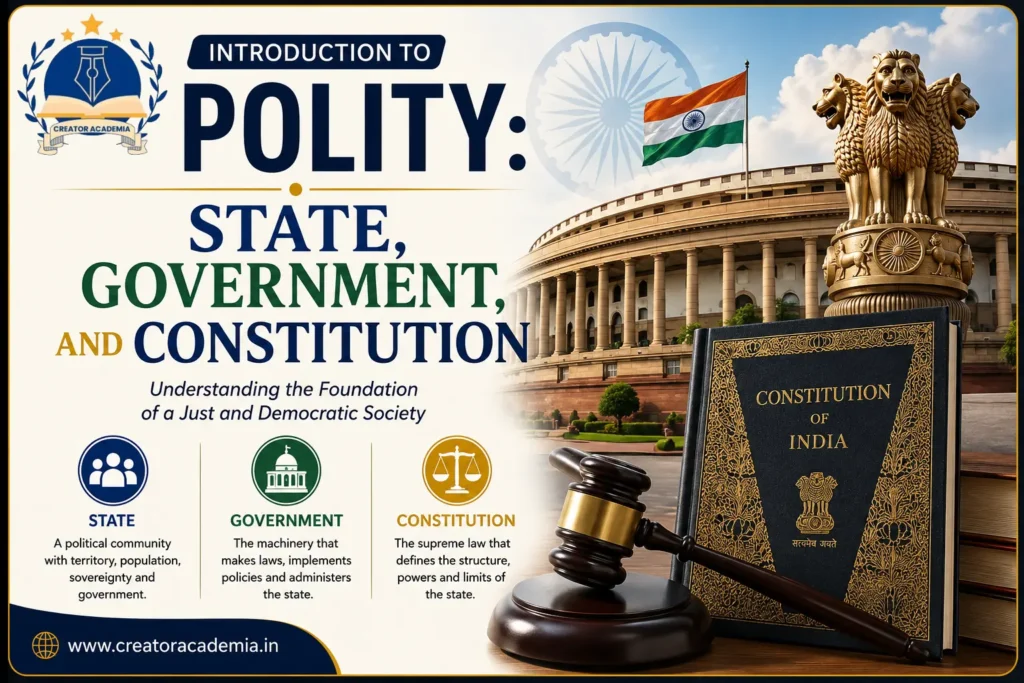
Introduction to Polity: State, Government, and Constitution
Introduction
The systematic study of a nation’s political architecture begins with the core concepts that define how power is organized, distributed, and limited in a civil society. In public law and administrative studies, the terms “State,” “Government,” and “Constitution” form the foundational framework of political organization. A frequent error in introductory studies is treating these terms as interchangeable terms. In structural terms, they represent distinct components of public administration. Before analyzing the historical evolution or the specific articles of the Indian Constitution, it is essential to master the structural definition of a State, the functional distribution of power among governmental organs, and the legal classifications of constitutions that establish the rule of law.
Meaning and Scope of Polity
The term Polity refers to any politically organized community or a specific form of political organization that governs a society. While “politics” often deals with the day-to-day competition for power and electoral dynamics, polity focuses on the institutional structures, legal boundaries, and administrative frameworks that remain stable regardless of which political party is in power. It is the permanent blueprint of a country’s governance system.
The scope of polity is comprehensive, encompassing the entire machinery used to run a sovereign nation. It is studied through several distinct operational levels:
- Institutional Architecture: The structure, composition, and interaction of the primary public bodies—such as the parliament, the cabinet secretariat, civil services, and the hierarchy of the courts.
- Distribution of Power: The methods by which authority is balanced, including horizontal distribution (between the legislature, executive, and judiciary) and vertical distribution (the federal relationship between the central government and the local provincial states).
- Legal and Rights Framework: The system of constitutional rights, statutory liberties, and directive frameworks that regulate how the state interacts with its citizens.
- Administrative Operations: The bureaucratic procedures and regulatory public mechanisms through which state policies are converted into real governance on the ground.
Defining the State and Its Elements
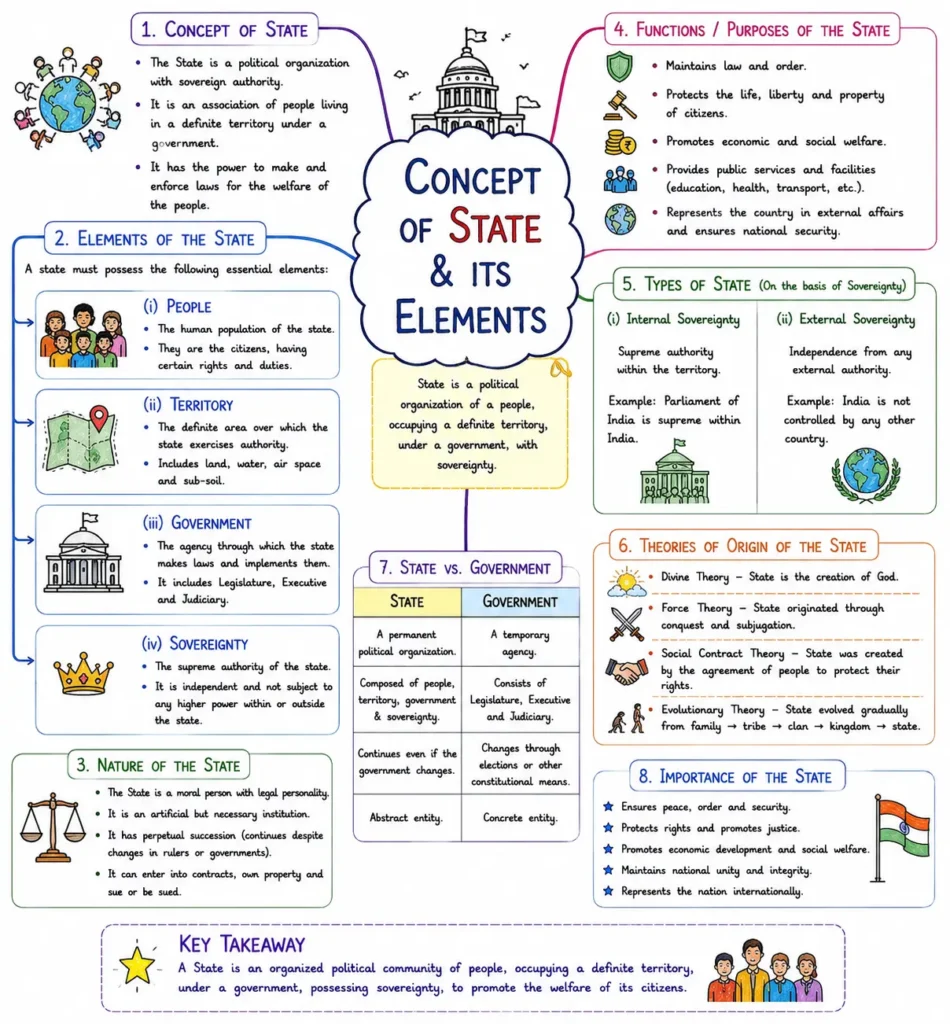
In regular conversation, the word “state” is commonly used to describe regional administrative units such as Maharashtra, Uttar Pradesh, or Bavaria. However, in political science and international law, a State denotes an independent political entity that exercises supreme authority over a defined population.
To achieve legal recognition, a political community must simultaneously satisfy four strict elements. The absence of any single element disqualifies the entity from being a State:
1. Sovereignty
Sovereignty is the most essential characteristic of a State, signifying absolute supreme power and complete independence from external control. It operates through two distinct dimensions:
- Internal Sovereignty: The State possesses exclusive legal authority to frame, execute, and enforce laws over all individuals and associations residing within its boundaries. No internal body can claim legal superiority over the State.
- External Sovereignty: The State is completely free from foreign control. It possesses the independent right to declare war, conclude peace treaties, and enter into international alliances without foreign interference.
Historical Context: Prior to August 15, 1947, British India possessed a vast population, a defined territory, and an operating administrative government. Yet, it was not legally a State because it lacked sovereignty, remaining subordinate to the British Parliament.
2. Government
The State is a relatively permanent, abstract legal concept that cannot act directly. The Government is the tangible political instrument, machinery, or agency through which the collective will of the State is formulated, expressed, and implemented. While the State remains stable, governments change regularly through democratic elections.
3. Territory
A State requires a permanent, clearly demarcated, and legally recognized Territory. A State’s territory includes three separate domains:
- Terrestrial Domain: The landmass contained within its recognized physical borders.
- Maritime Domain: The internal rivers, lakes, and territorial waters extending into the sea (historically up to 12 nautical miles from the baseline).
- Aerial Domain: The airspace resting directly above its land and maritime boundaries.
4. Population
A State is fundamentally a human institution requiring a permanent community of people living together in a civil society. While there are no fixed maximum or minimum limits on population size—contrasting small states like Vatican City with populous nations like India—the population must be stable enough to sustain an organized political order.
The Organs of Government
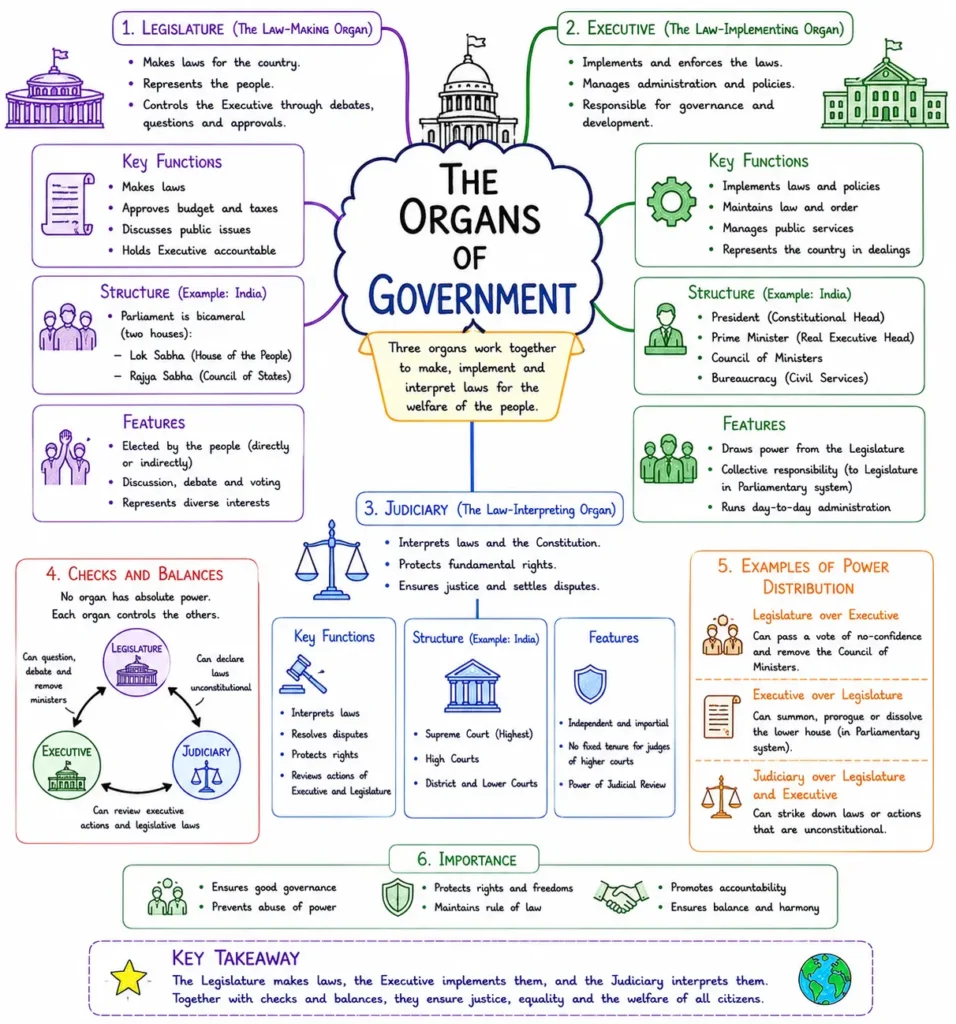
To prevent the concentration of absolute authority in a single office, modern democratic systems distribute sovereign power across three distinct functional organs. This configuration forms the basis of the Separation of Powers, balanced by a system of Checks and Balances:
1. The Legislature
The primary function of the legislature is to make, amend, or repeal laws. It acts as the representative forum where public policy is debated and converted into legal statutes.
- Structure: It can be Bicameral (consisting of two houses, like India’s Lok Sabha and Rajya Sabha, or the US Congress) or Unicameral (a single legislative house, like the parliament of New Zealand).
- Financial Oversight: The legislature maintains control over public finance, ensuring no state funds are spent without formal legislative approval.
2. The Executive
The executive organ is responsible for enforcing, implementing, and administering the laws enacted by the legislature. It manages the daily governance and external security of the State. The executive is divided into two parts:
- The Political Executive: Comprises temporary, elected representatives who hold policy-making positions for a fixed term (e.g., the Prime Minister, Chief Ministers, and the Council of Ministers).
- The Permanent Executive: Comprises non-political civil servants (bureaucrats) selected through merit-based competitive examinations. They provide specialized administrative expertise and structural continuity, remaining in office regardless of changes in the ruling political party.
3. The Judiciary
The judiciary is the independent organ tasked with interpreting the laws, resolving legal disputes, and administering justice. It ensures that both the legislature and the executive operate within constitutional limits.
- Judicial Review: In constitutional democracies like India and the United States, the judiciary possesses the power of Judicial Review. This allows courts to evaluate the constitutional validity of laws passed by the legislature and executive orders. If an act violates the constitution, the judiciary declares it null and void.
- Hierarchy: India features an integrated judicial hierarchy, meaning a single chain of courts handles both central and state laws, headed by the Supreme Court of India.
Systems of Government: Parliamentary vs. Presidential
Democratic structures organize the relationship between the legislative and executive branches using two primary models:
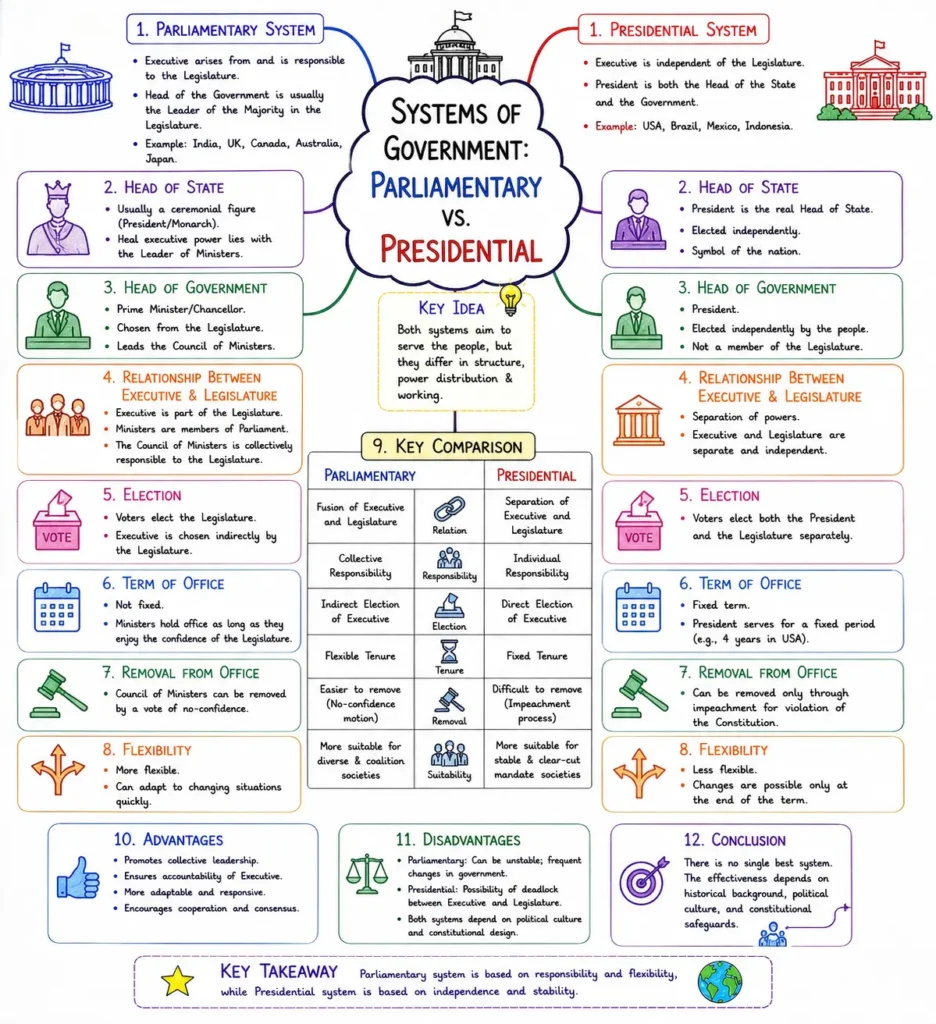
1. The Parliamentary System
- Executive-Legislative Fusion: The executive is drawn directly from the ranks of the legislature. Ministers must be members of parliament to hold power.
- Accountability: The executive is collectively responsible to the legislature. If the lower house passes a Vote of No Confidence, the government must resign.
- Dual Headship: Features a clear distinction between the Head of State (a nominal or ceremonial figure, like the President of India or the British Monarch) and the Head of Government (the real executive leader, namely the Prime Minister).
2. The Presidential System
- Strict Separation of Powers: The executive and the legislature are entirely separate branches. The President is elected independently of the legislature and cannot be removed by a standard legislative vote of no confidence.
- Single Executive Headship: The President serves simultaneously as both the Head of State and the Head of Government, wielding concentrated executive authority, as seen in the United States.
The Concept of a Constitution
A Constitution is the supreme legal document or the fundamental law of a land. All other ordinary laws enacted by the legislature must conform to its provisions; any law that violates the constitution is declared null and void by the judiciary.
Primary Functions of a Constitution
- It defines the basic composition, powers, and functions of the three organs of government.
- It regulates the relationship between the government and its citizens by guaranteeing fundamental rights.
- It sets institutional limits on government authority, preventing a democracy from turning into an authoritarian regime (Constitutionalism).
Structural Classification of Constitutions
Constitutions are categorized based on their structural format and the ease with which they can be amended:
- Written vs. Unwritten Constitutions:
- Written Constitution: A single, carefully codified document enacted at a specific point in time by a special body, such as a Constituent Assembly (e.g., the Constitutions of the United States and India).
- Unwritten Constitution: A constitution that is not gathered into a single codified book. Instead, it consists of a series of historical statutes, judicial precedents, common laws, and long-standing political conventions accumulated over centuries (e.g., the Constitution of the United Kingdom).
- Rigid vs. Flexible Constitutions:
- Rigid Constitution: Requires a special, complex, and difficult legislative process (such as a two-thirds majority or ratification by provinces) to pass an amendment (e.g., the United States Constitution).
- Flexible Constitution: Can be amended easily by the legislature using the same ordinary law-making procedure used for regular statutes (e.g., the United Kingdom Constitution).
The Concept of Constitutionalism
Having a constitution does not automatically guarantee a just political system. Constitutionalism is a political philosophy that demands limited government. It establishes that the authority of government is not absolute but is strictly limited by a set of institutional checks, balances, and legal rules to prevent arbitrary rule and protect citizen liberties.
The Indian Positioning: The Constitution of India stands as a unique synthesis. Structurally, it is the longest written constitution in the world. Methodologically, it is a mixture of rigidity and flexibility; certain provisions can be amended by a simple parliamentary majority, while others require a special majority and ratification by at least half of the state legislatures. Furthermore, via the Basic Structure Doctrine, the Supreme Court has ruled that the core identity of the constitution cannot be destroyed by any parliamentary amendment.
Quick Examination Facts
| Concept Element | Key Textbook Fact |
| Four Elements of a State | Population, Territory, Government, and Sovereignty |
| Most Important Element of a State | Sovereignty (Absolute independence from external control) |
| Pre-1947 Status of India |
Possessed population, territory, and government, but lacked State status due to absence of sovereignty |
| Law-Making Body | The Legislature |
| Law-Enforcement Body | The Executive |
| Law-Interpreting Body | The Judiciary |
| Power of Judicial Review | Judicial authority to strike down unconstitutional legislative acts and executive orders |
| Parliamentary System Characteristic | Executive is drawn from and collectively responsible to the legislature |
| Presidential System Characteristic | Strict separation of executive and legislative branches |
| Supreme Law of the Land | The Constitution |
| Example of Written & Rigid Constitution | United States Constitution |
| Example of Unwritten & Flexible Constitution | United Kingdom Constitution |
| Nature of the Indian Constitution | Longest written document; unique blend of rigidity and flexibility |
| Permanent Executive Component | Merit-selected, non-political bureaucrats providing administrative continuity (Civil servants and bureaucrats) |
| Political Executive Component | Elected Ministers and Heads of Government |
| Constitutionalism | Political philosophy of limited government and institutional checks |
Conclusion
The political architecture of a nation relies on the clear separation of institutional powers. The State provides the sovereign, territorial framework; the Government operates through three balanced organs—the legislature to create rules, the executive to run administration, and the judiciary to safeguard justice—and the Constitution acts as the supreme rulebook that creates, guides, and limits these institutions. A firm grasp of these structural elements is required before analyzing the historical background and evolution of the Indian Constitution.
Introduction to Polity
Practice Quiz
| Some Important Links | |
| Download “Introduction to Polity” PDF | Click Here |