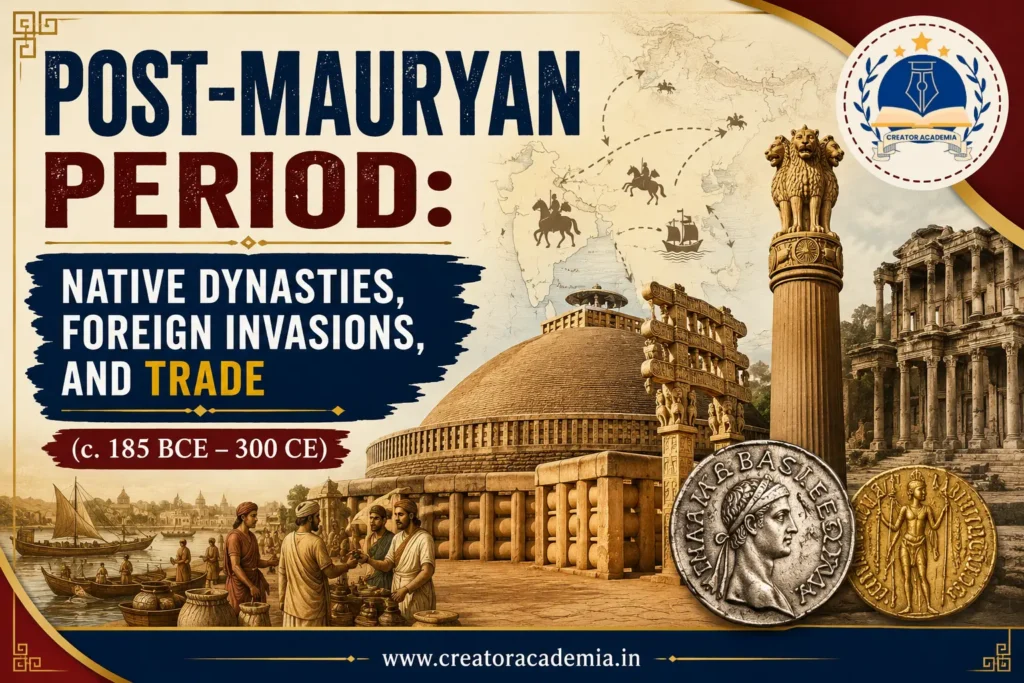
Post-Mauryan Period: Native Dynasties, Foreign Invasions, and Trade (c. 185 BCE – 300 CE)
Introduction
The fall of the Mauryan Empire in 185 BCE following the assassination of Emperor Brihadratha by his commander Pushyamitra Shunga marked the end of pan-Indian political centralization for over five centuries. The period from c. 185 BCE to 300 CE is known as the Post-Mauryan Period or the Age of Small Kingdoms.
Far from being an era of dark stagnation, this period witnessed vibrant cultural synthesis, booming long-distance maritime and overland trade (the Silk Route), major artistic breakthroughs (Gandhara, Mathura, and Amaravati schools), and the rise of powerful regional dynasties alongside Central Asian rulers who assimilated into Indian society.
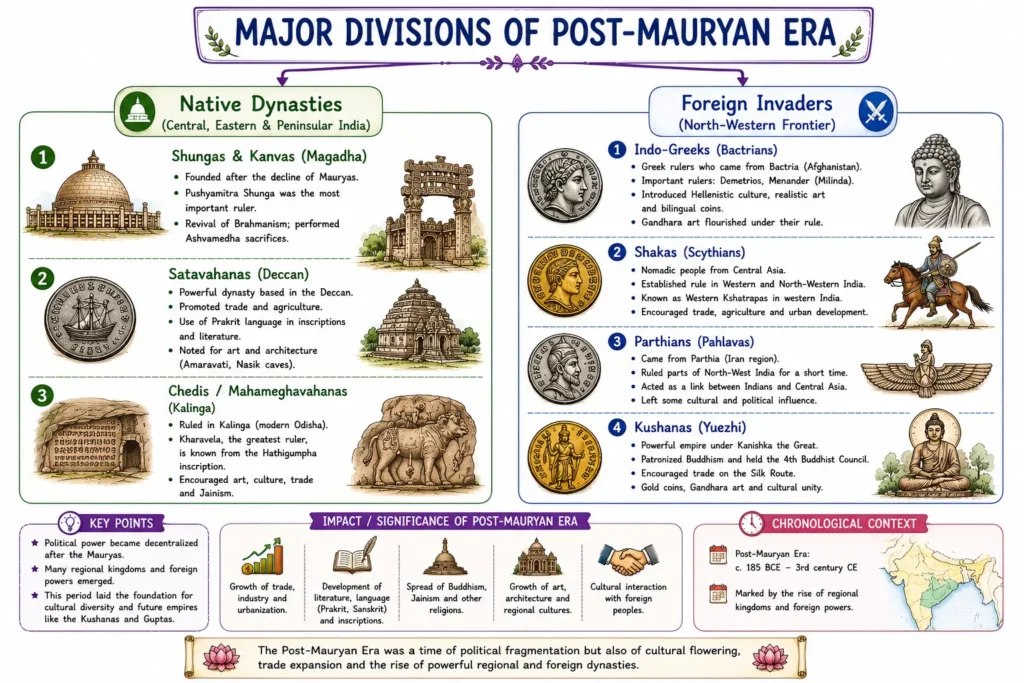
1. Native Dynasties of Post-Mauryan India
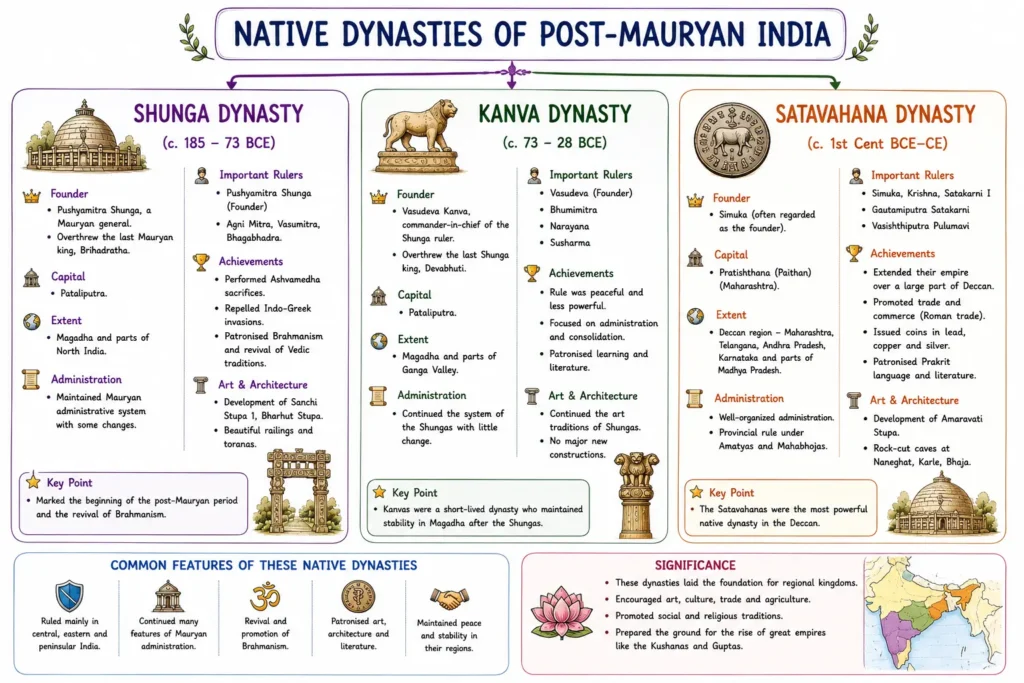
A. The Shunga Dynasty (c. 185 – 73 BCE)
- Origin & Founder: Founded by Pushyamitra Shunga, a Brahmin commander-in-chief who overthrew the last Mauryan ruler Brihadratha during a military parade in 185 BCE.
- Capital: Pataliputra, with Vidisha (Madhya Pradesh) serving as an important secondary political center.
- Brahmanical Revival: Pushyamitra performed two Ashvamedha (horse) sacrifices to assert imperial sovereignty. The celebrated grammarian Patanjali (author of the Mahabhasya) was his court priest.
- Foreign Resistance: Successfully repulsed invasions by the Indo-Greeks (Yavanas).
- Art Patronage: Despite early Buddhist texts accusing Pushyamitra of persecuting monks, the Shunga era saw significant additions to Buddhist monuments—including the gateway railings at Bharhut Stupa and the enlargement of the Great Stupa at Sanchi.
- Heliodorus Pillar Inscription (Vidisha): Erected by Heliodorus, a Greek ambassador sent by King Antialcidas of Taxila to the court of Shunga ruler Bhagabhadra. The inscription records Heliodorus’s conversion to Vasudeva (Vaishnavism), calling himself a Bhagavata.
B. The Kanva Dynasty (c. 73 – 28 BCE)
- Founded by Vasudeva Kanva after assassinating Devabhuti, the last hedonistic Shunga ruler.
- A short-lived Brahmin dynasty of only four kings operating out of Magadha, eventually overthrown by the Satavahanas of the Deccan.
C. The Satavahana Dynasty (c. 1st Century BCE – 3rd Century CE)
The Satavahanas (also known as the Andhras in Puranic texts) established a powerful empire spanning the Deccan region between the Godavari and Krishna river valleys.
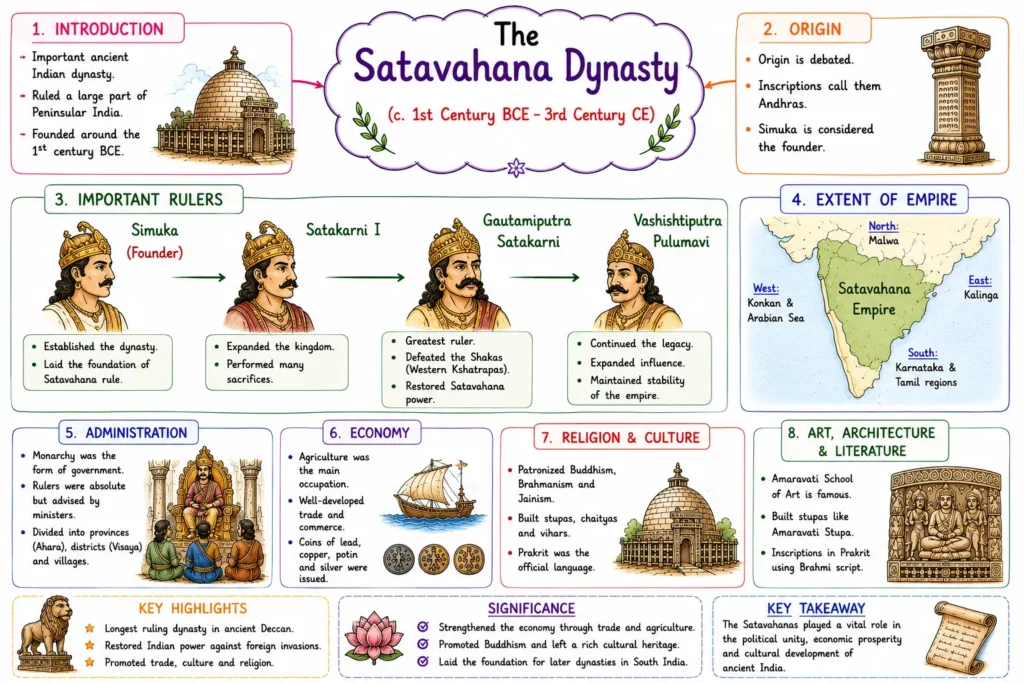
- Founder: Simuka established Satavahana rule, with capitals at Pratisthana (Paithan) in Maharashtra and Amaravati in Andhra Pradesh.
- Satakarni I: Performed Rajasuya and Ashvamedha sacrifices; extended control over Western Malwa and Narmada valley.
- Gautamiputra Satakarni (c. 106 – 130 CE): The greatest Satavahana monarch. Restored dynastic prestige by defeating the Shaka ruler Nahapana (Western Kshatrapas).
- Described in the Nasik Prasasti Inscription (issued by his mother Gautami Balashri) as Ekabrahmana (peerless Brahmin) and Kshatriya-dapa-mana-madana (destroyer of Kshatriya pride).
- Key Features of Satavahana Rule:
- Matronymics: Kings used mother’s names as prefixes (e.g., Gautamiputra, Vashishtiputra), reflecting high social status of women, though throne succession remained patrilineal.
- Land Grants (Agrahara): First Indian dynasty to issue tax-free land grants to Brahmins and Buddhist monks (recorded in the Naneghat Inscription of Queen Nayanika).
- Coinage: Issued coins made of Lead, Potin (an alloy of copper, zinc, tin, and lead), Copper, and Silver.
- Architecture: Constructed spectacular rock-cut Buddhist chaityas and viharas at Karle, Bhaja, Kanheri, and monumental stupas at Amaravati and Nagarjunakonda.
D. The Chedi (Mahameghavahana) Dynasty of Kalinga
- Rose to prominence in Kalinga (Odisha) during the 1st century BCE.
- King Kharavela: The most famous ruler of Kalinga, a staunch patron of Jainism.
- Hathigumpha Inscription (Udayagiri Hills, Odisha): A 17-line undated inscription in Prakrit (Brahmi script) providing a regnal year-by-year account of Kharavela’s military conquests, public welfare works, canal constructions, and patronage of Jain ascetics.
2. Foreign Invasions from Central Asia
Due to weak defenses on the northwestern frontier after the collapse of the Mauryas, several Central Asian nomadic and Hellenistic tribes invaded India in succession:
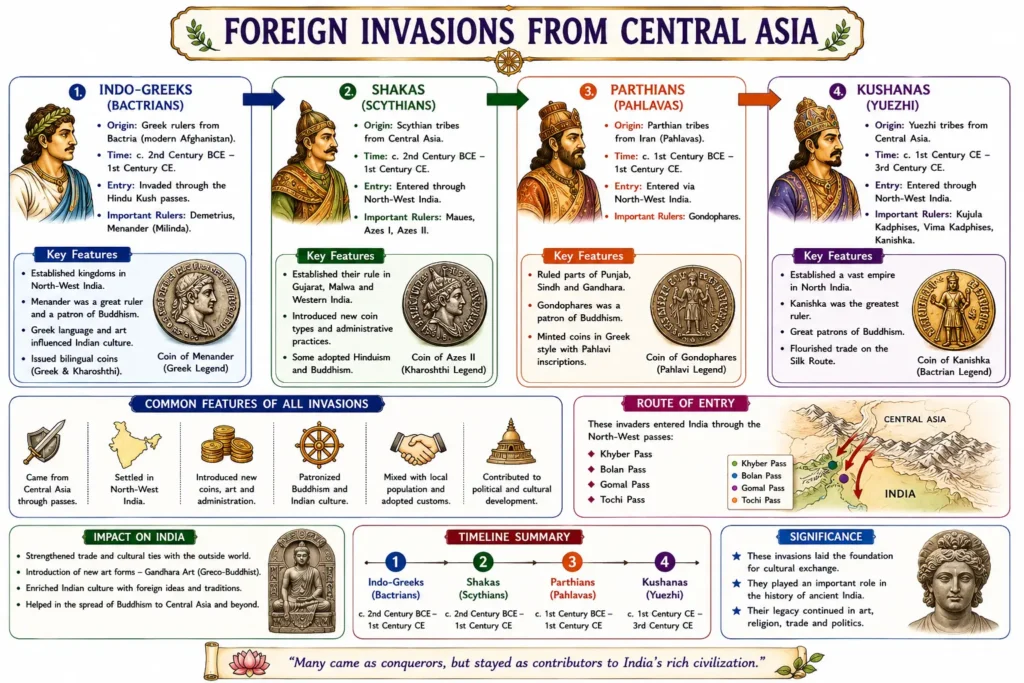
| Foreign Group | Key Ruler | Capital / Center | Major Contribution / Historical Landmark |
| Indo-Greeks | Menander (Milinda) | Sakala (Sialkot, Pakistan) | • First to issue gold coins with royal portraits and legends in India. • Introduced Hellenistic art (Gandhara Art). |
| Shakas (Scythians) | Rudradaman I | Ujjain (Western Kshatrapas) | • Junagadh Rock Inscription (First major inscription in chaste Classical Sanskrit). • Repaired Sudarshana Lake in Kathiawar. |
| Parthians | Gondophernes | Taxila | • Christian apostle St. Thomas visited his court in 1st century CE to spread Christianity. |
| Kushanas | Kanishka I | Purushapura (Peshawar) & Mathura | • Started Saka Era (78 CE). • Convened 4th Buddhist Council in Kashmir. • Controlled the trans-continental Silk Route. |
A. The Indo-Greeks (Bactrian Greeks)
- Demetrius I: First Greek ruler to invade India around 190 BCE, occupying Punjab and Afghanistan.
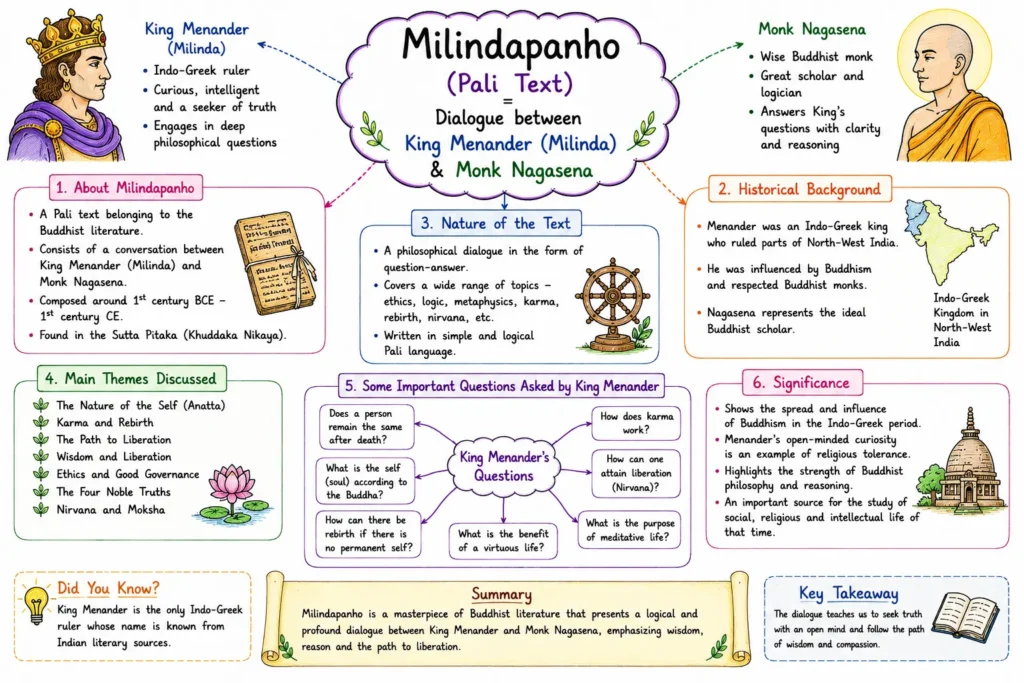
- Menander I (c. 165 – 145 BCE): Known as Milinda in Indian texts. Converted to Buddhism under the guidance of the Buddhist philosopher Nagasena (Nagarguna).
- Their philosophical dialogue on Buddhist doctrines is recorded in the famous Pali text Milindapanho (“Questions of King Milinda”).
- Key Legacy: First to introduce gold coins in India bearing portraits of kings and bilingual legends (Greek and Kharosthi). Introduced Hellenistic astronomy and dramatic theater techniques (Yavanika = curtain).
B. The Shakas (Scythians)
- Nomadic tribes from Central Asia who entered India through the Bolan Pass, replacing the Indo-Greeks. Divided into five branches with centers at Taxila, Mathura, Western India, and Upper Deccan.
- Rudradaman I (c. 130 – 150 CE): Most famous ruler of the Western Kshatrapas (Ujjain branch).
- Defeated the Satavahanas twice in battle.
- Junagadh Rock Inscription: Issued in 150 CE, notable for being the first long inscription written in pure Classical Sanskrit. It details the history of the Sudarshana Lake reservoir (originally built under Chandragupta Maurya and completed under Ashoka), which Rudradaman repaired at his own expense without levying emergency taxes.
C. The Kushanas (Yuezhi Tribe)
The Kushanas were a branch of the Yuezhi nomadic confederation from Central Asia. They replaced the Shakas and Parthians to build a vast empire stretching from the Oxus River in Central Asia to Varanasi in the Gangetic basin.
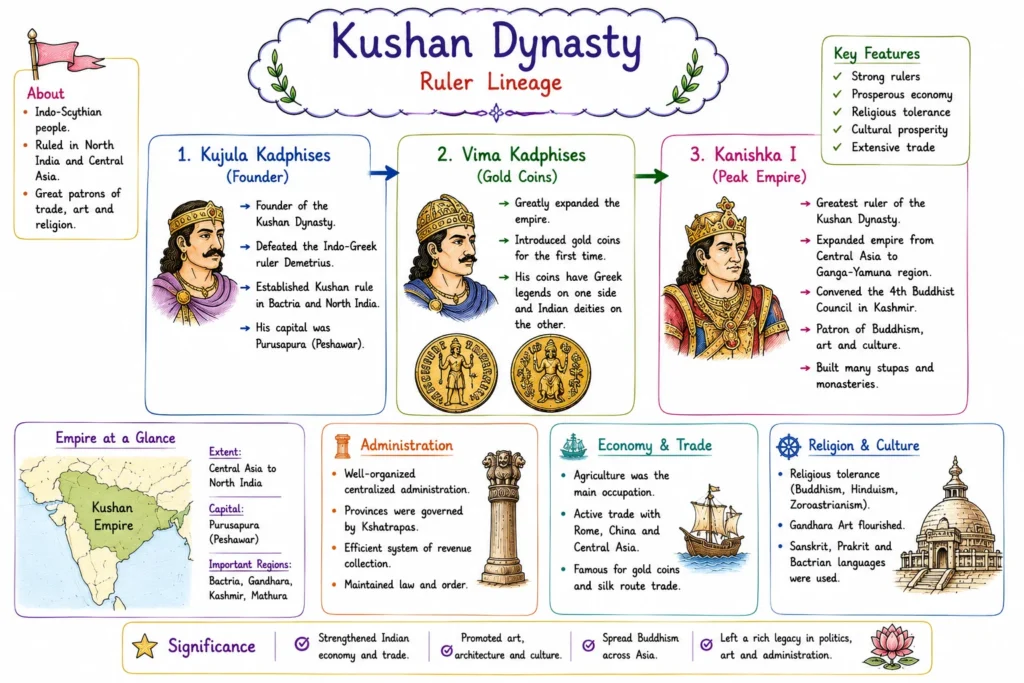
- Kujula Kadphises: Founded Kushana power in India; issued copper coins.
- Vima Kadphises: Issued the first large-scale gold coinage in India featuring Lord Shiva and Nandi symbols.
- Kanishka I (c. 78 – 105 CE): The greatest Kushana monarch.
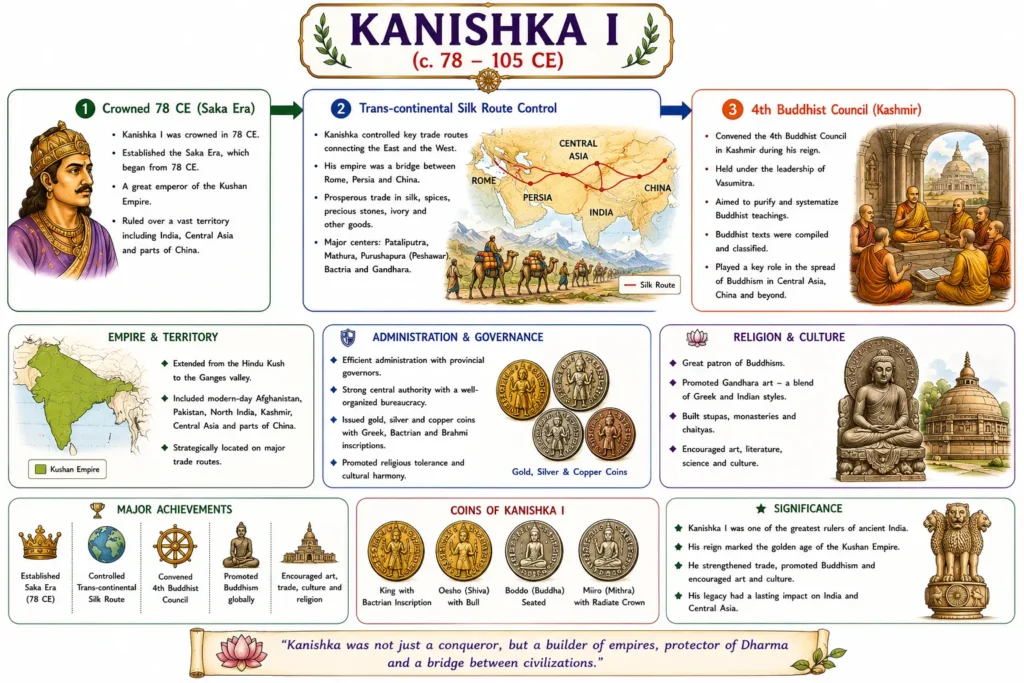
- Saka Era (78 CE): Kanishka’s ascension year (78 CE) marks the beginning of the Saka Era, adopted by the Government of India as the official Civil National Calendar in 1957.
- Patronage of Buddhism: Called “Second Ashoka”. Convened the 4th Buddhist Council at Kundalavana (Kashmir) presided over by Vasumitra with Asvaghosa as vice-president. The council finalized the schism into Hinayana and Mahayana schools.
- Court Scholars: Court adorned by eminent scholars:
- Asvaghosa: Author of Buddhacharita (biography of Buddha), Sutralankara, and Saundarananda.
- Nagarjuna: Formulated the Madhyamaka philosophy (Doctrine of Emptiness / Sunyavada); called “Indian Einstein”.
- Charaka: Celebrated physician; author of Charaka Samhita (foundational text of Ayurveda).
- Vasumitra: Author of Mahavibhasa Sastra (encyclopedia of Buddhist philosophy).
- Control of Silk Route: Controlled the famous overland trade route connecting China with the Roman Empire through Central Asia, generating huge customs revenues.
3. Post-Mauryan Economy, Trade, and Crafts
The Post-Mauryan period represents the golden age of ancient Indian urbanism, craft specialization, and international commerce.
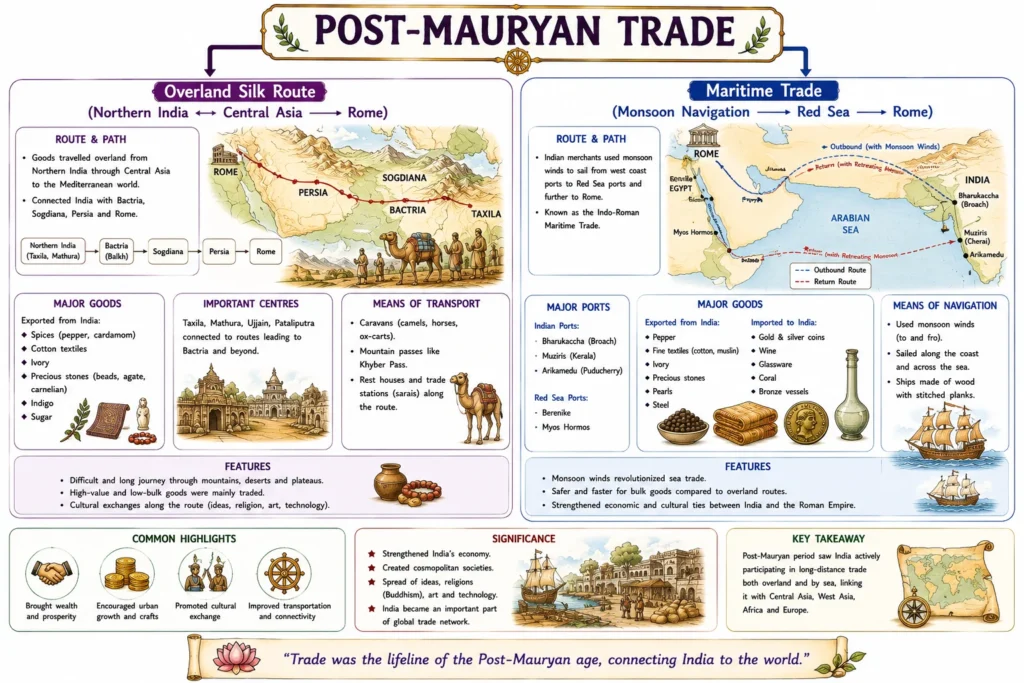
A. Guild System (Shrenis)
- Artisans and merchants organized themselves into powerful autonomous professional guilds called Shrenis.
- Guild heads were called Sresthin or Jetthaka.
- Guilds acted as bankers, accepting public deposits at interest and issuing loans. They possessed their own judicial powers (Sreni-dharma) and issued private token coins.
B. Indo-Roman Trade
- Monsoon Navigation Discovery: Around 45 CE, Greek navigator Hippalus discovered the direct monsoon winds across the Arabian Sea, revolutionizing direct sea voyages between Egypt/Rome and Western Indian ports.
- Major Trade Ports:
- Barygaza (Bharuch / Bharukachchha, Gujarat): Principal port on the western coast.
- Arikamedu (Poduke, near Puducherry): Major Indo-Roman trading station on the eastern coast. Excavations revealed Roman amphorae wine jars, Arretine ware pottery, and Roman gold coins.
- Muziris (Pattanam, Kerala): Key pepper port on the Malabar coast.
- Exports from India: Black pepper (“Black Gold” or Yavanapriya), spices, silk, muslin, ivory, pearls, and precious stones.
- Imports into India: Roman gold and silver coins, wine, coral, topaz, and glass.
- Pliny’s Lament: Roman historian Pliny the Elder in his work Naturalis Historia lamented the immense drain of Roman gold to India (50 million sesterces annually) in exchange for luxury goods.
4. Schools of Art and Sculpture
Three distinct schools of art developed during the Post-Mauryan era, each with unique stylistic and material characteristics:
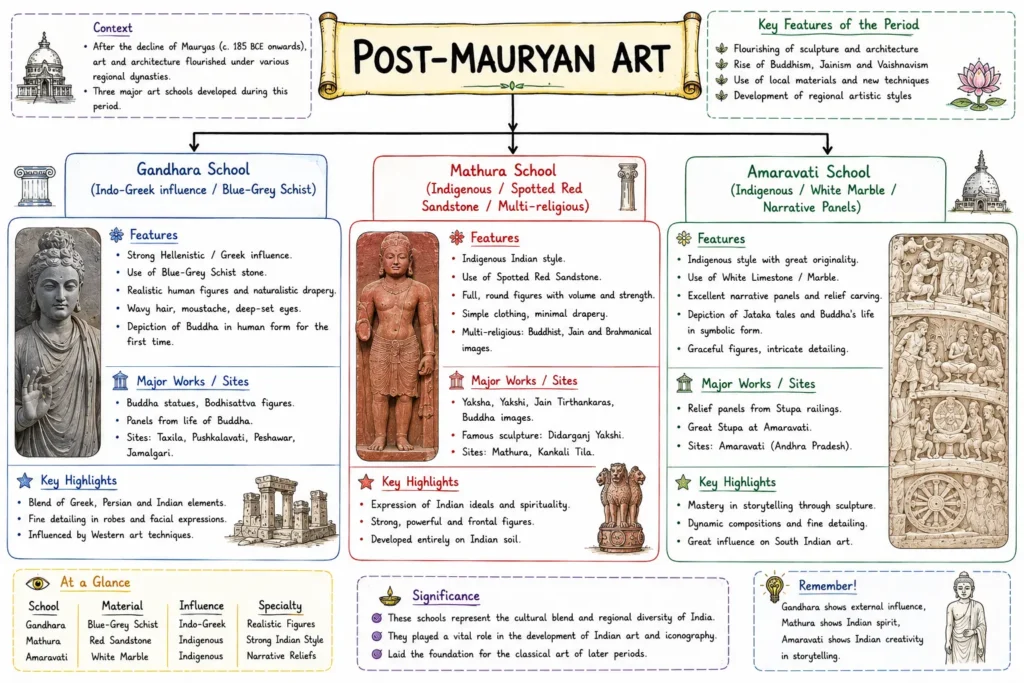
| Parameter | Gandhara School of Art | Mathura School of Art | Amaravati School of Art |
| Geographical Area | North-West Frontier (Taxila, Peshawar, Jalalabad) | Mathura (Uttar Pradesh) | Krishna-Godavari Basin (Andhra Pradesh) |
| Foreign Influence | Strong Indo-Greek / Hellenistic influence (Greco-Roman) | Purely Indigenous development | Purely Indigenous development |
| Material Used | Blue-Grey Schist stone and stucco plaster | Spotted Red Sandstone | White Marble |
| Religious Focus | Exclusively Buddhist | Multi-religious (Buddhism, Jainism, Hinduism) | Exclusively Buddhist |
| Key Features | • Buddha styled like Greek God Apollo • Wavy hair, muscular physique, heavy drapery pleats • Expression of calm contemplation |
• Deliberate robust physique • Shaven head, smiling face, tight drapery • First human images of Buddha and Hindu Deities |
• Focus on narrative art (episodes from Buddha’s life & Jataka tales) • Dynamic figures in action poses |
Quick Examination Facts
| Feature / Term | Key Exam Fact |
| Founder of Shunga Dynasty | Pushyamitra Shunga (185 BCE, killed Brihadratha) |
| Grammarian at Pushyamitra’s Court | Patanjali (Author of Mahabhasya) |
| Heliodorus Pillar Location & Deity | Besnagar / Vidisha (Dedicated to Lord Vasudeva) |
| First Dynasty to Issue Tax-Free Land Grants | Satavahana Dynasty (Recorded in Naneghat Inscription) |
| Coin Metals Used by Satavahanas | Lead, Potin, Copper, Silver |
| Greatest Satavahana Ruler | Gautamiputra Satakarni (Nasik Prasasti by Gautami Balashri) |
| Hathigumpha Inscription Author & Site | King Kharavela of Kalinga (Udayagiri Hills, Odisha) |
| First Rulers to Issue Gold Coins in India | Indo-Greeks (Bactrians) |
| Text Containing Menander-Nagasena Debate | Milindapanho (“Questions of King Milinda”) |
| First Inscription in Pure Classical Sanskrit | Junagadh Rock Inscription of Shaka King Rudradaman-I (150 CE) |
| Saka Era Commenced In | 78 CE by Kushana King Kanishka-I |
| President of 4th Buddhist Council | Vasumitra (Vice-President: Asvaghosa; held in Kashmir) |
| Court Physician of Kanishka | Charaka (Author of Charaka Samhita) |
| Primary Material in Gandhara Art | Blue-Grey Schist stone |
| Primary Material in Mathura Art | Spotted Red Sandstone |
| Roman Term for Black Pepper | Yavanapriya (“Dear to the Greeks/Romans”) |
Conclusion
The Post-Mauryan Period laid the framework for India’s integration into global trade networks and cultural assimilation. Foreign invaders like the Indo-Greeks and Kushanas were assimilated into Indian society, adopting Indian religions (Buddhism and Vaishnavism) and enriching Indian astronomy, coinage, and art. Concurrently, native dynasties like the Satavahanas consolidated regional administration, pioneered land grant systems, and established vibrant maritime links with the Mediterranean world. This economic prosperity and artistic synthesis set the foundation for the “Golden Age” of the Gupta Empire.
Post-Mauryan Period
Practice Quiz
| Some Important Links | |
| Download “Post-Mauryan Period” PDF | Click Here |