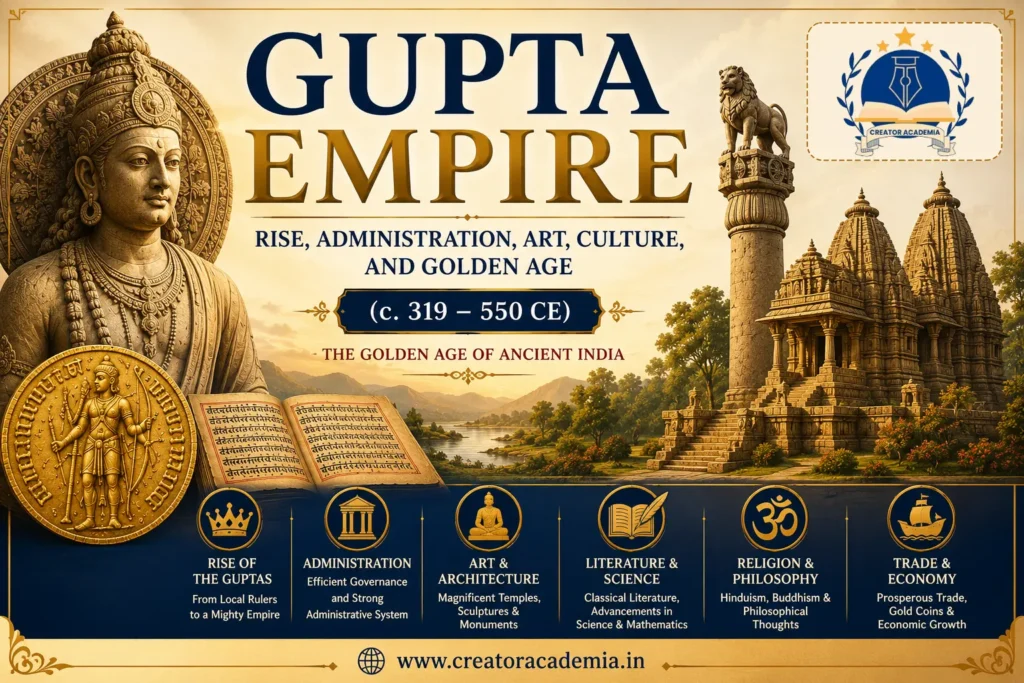
Gupta Empire: Rise, Administration, Art, Culture, and Golden Age (c. 319 – 550 CE)
Introduction
The rise of the Gupta Empire in the early 4th century CE brought an end to nearly two centuries of political fragmentation following the fall of the Kushanas and Satavahanas. Under the leadership of powerful monarchs, the Guptas unified a vast part of Northern, Central, and Western India.
This era is traditionally characterized as the “Golden Age of India” due to unprecedented achievements in Classical Sanskrit literature, mathematics, astronomy, stone temple architecture, metallic metallurgy, and economic prosperity.
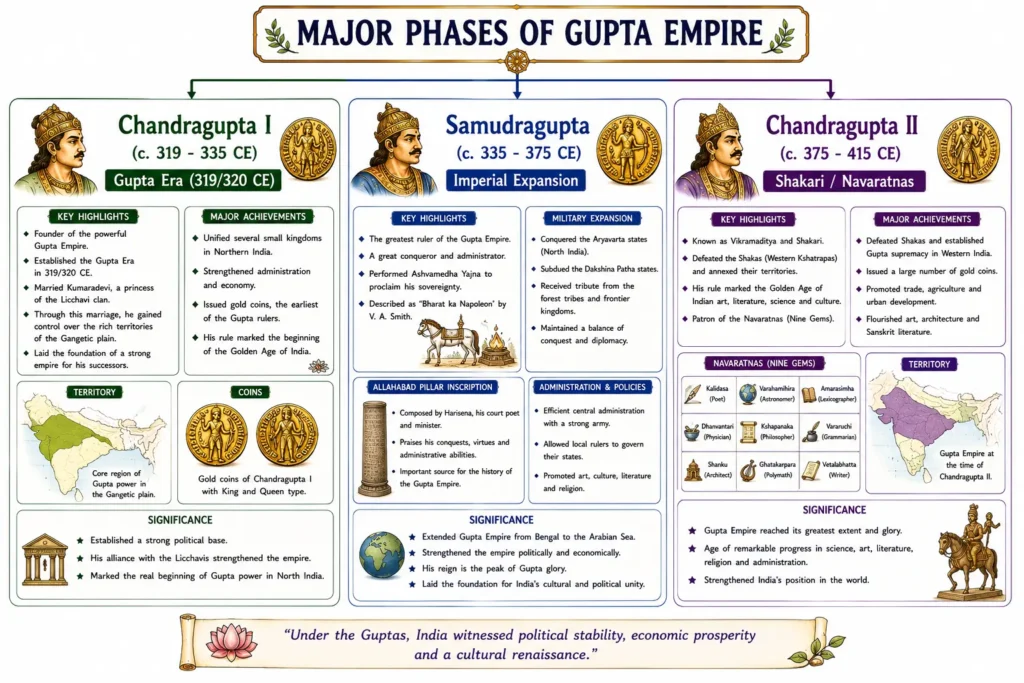
1. Dynastic Lineage and Major Rulers
A. Early Ancestors & Chandragupta I (c. 319 – 335 CE)
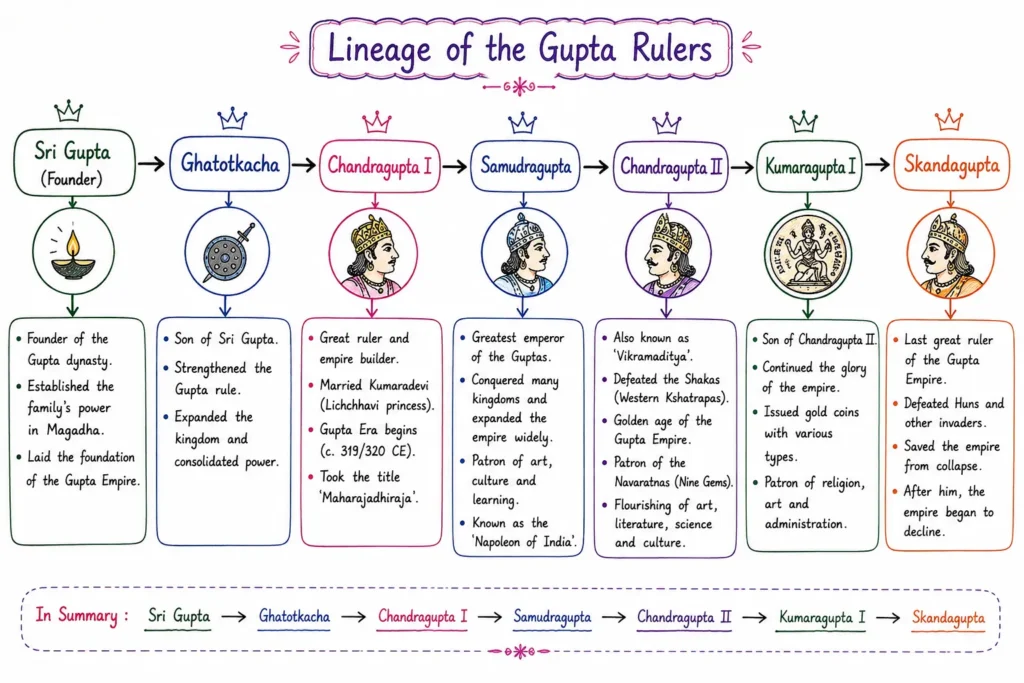
- Origin: Sri Gupta founded the dynasty around the late 3rd century CE, followed by his son Ghatotkacha. Both held the modest title of Maharaja.
- Real Founder: Chandragupta I is considered the real founder of the Gupta imperial power.
- Gupta Era (319/320 CE): He assumed the title Maharajadhiraja (“King of Kings”) and initiated the Gupta Era starting in 319–320 CE.
- Matrimonial Alliance: Married Kumaradevi, a princess of the powerful Lichchhavi clan of Vaishali, which enhanced the political prestige and territorial clout of the Guptas. He issued gold coins (Chandragupta-Kumaradevi type) depicting both rulers.
B. Samudragupta (c. 335 – 375 CE): “The Napoleon of India”
Samudragupta was one of the greatest conquerors and military strategists in ancient world history. Historian V. A. Smith called him the “Napoleon of India” due to his extensive military campaigns without suffering a single defeat.
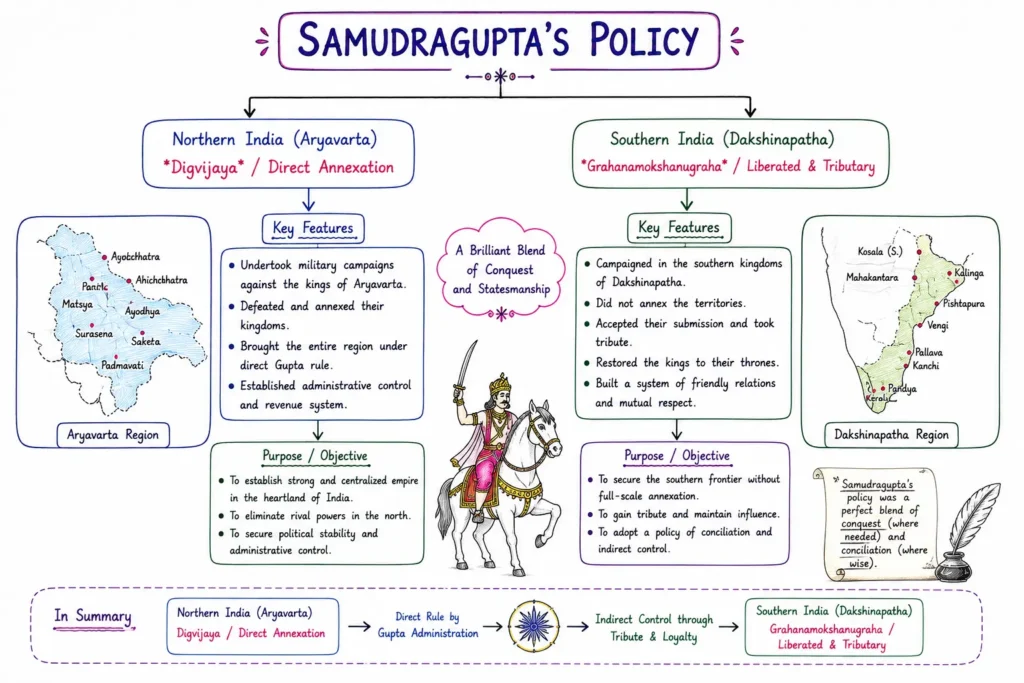
- Prayag Prashasti (Allahabad Pillar Inscription): Composed in chaste Classical Sanskrit (Champu style—mix of prose and poetry) by his court poet Harisena. It records Samudragupta’s conquests across four geographical zones:
- Aryavarta (North India): Defeated and directly annexed 9 Naga and North Indian rulers (Digvijaya).
- Dakshinapatha (South India): Defeated 12 southern rulers (including King Vishnugopa of Kanchi) but reinstated them as tributary vassals after accepting homage (Grahanamokshanugraha policy).
- Atavika Kingdoms: Subdued forest kingdoms of Central India.
- Frontier & Foreign Rulers: Tributary alliances with Assam, Nepal, Shakas, and Kushanas.
- Asvamedha Yajna: Performed the horse sacrifice to celebrate imperial supremacy, issuing special Asvamedha-type gold coins.
- Patron of Arts: Accomplished musician and poet; titled Kaviraja (“King of Poets”). Coins depict him playing the Veena (lute).
- Diplomacy: Granted permission to King Meghavarman of Sri Lanka to construct a Buddhist monastery at Bodh Gaya.
C. Chandragupta II “Vikramaditya” (c. 375 – 415 CE)
- Expansion & Marriage Alliances: Married princess Kuberanaga (Naga dynasty) and married his daughter Prabhavatigupta to King Rudrasena II of the powerful Vakataka Dynasty in the Deccan.
- Conquest of Western India: Defeated the Shaka ruler Rudrasimha III, ending 300 years of Western Kshatrapa rule in Malwa and Kathiawar peninsula. Assumed titles Shakari (“Destroyer of Shakas”) and Vikramaditya. Issued the first silver coins (Rupaka) in Gupta history to celebrate this victory.
- Visit of Faxian (Fa-Hien): Chinese Buddhist pilgrim Faxian visited India during his reign (c. 399 – 411 CE) to collect Buddhist scriptures. He described the society as prosperous, peaceful, non-violent, and noted the absence of capital punishment.
- The Navaratnas (Nine Gems): His court at Ujjain was adorned by nine eminent scholars:
- Kalidasa (Dramatist/Poet)
- Amarasimha (Lexicographer – Amarakosha)
- Varahamihira (Astronomer/Mathematician)
- Dhanvantari (Physician)
- Sanku (Architect)
- Vararuchi (Grammarian)
- Kahapanaka (Astrologer)
- Vetalbhatta (Magician/Courtier)
- Harisena (Poet/Minister)
- Mehrauli Iron Pillar (Delhi): Inscribed with praises of a king named “Chandra” (identified as Chandragupta II), famous for its rust-resistant metallurgical composition after 1,600+ years.
D. Kumaragupta I (c. 415 – 455 CE)
- Founder of Nalanda University: Founded the world-famous Nalanda Mahavihara (University) in Bihar, which became an international hub for Mahayana Buddhist learning.
- Titles: Assumed titles like Mahendraditya and Shakraditya. Performed Asvamedha sacrifices.
- Late Invasions: Faced the first wave of Huna (White Huns) invasions from Central Asia toward the end of his reign.
E. Skandagupta (c. 455 – 467 CE)
- Repulsing Huna Attacks: The last great Gupta monarch. Successfully repulsed the fierce invasion of the Hunas, saving North India from devastation (recorded in the Bhitari Pillar Inscription, Ghazipur).
- Junagadh Inscription: Records the repair of the dam on Sudarshana Lake in Kathiawar by his provincial governor Parnadatta and his son Chakrapalita.
2. Gupta Administrative Structure and Economy
A. Administrative Machinery
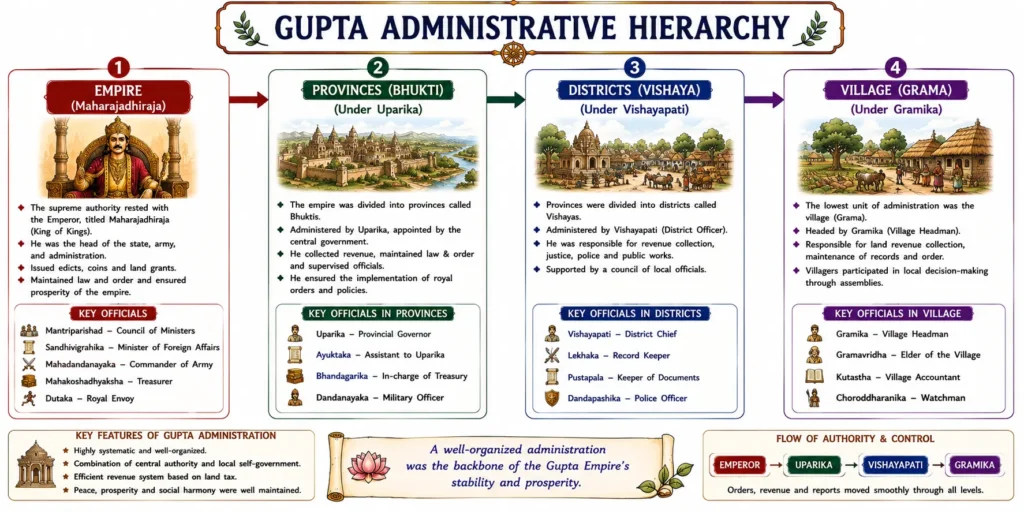
- Decentralized Bureaucracy: Unlike the centralized Mauryan administration, the Gupta system allowed greater autonomy to provincial governors (Uparikas) and district heads (Vishayapatis).
- Administrative Units:
- Bhukti / Desha (Province): Headed by Uparika.
- Vishaya (District): Headed by Vishayapati, assisted by a council of local representatives (including Nagara-Sresthin or chief merchant, Sarthavaha or caravan leader, Prathama-Kulika or chief artisan, and Prathama-Kayastha or chief scribe).
- Grama (Village): Lowest unit administered by Gramika or Gramadhyaksha with village elders (Panchamandali).
- Land Grants (Agrahara): Systematic expansion of tax-free land grants to Brahmins (Agrahara grants) and temples, which planted the seeds of Feudalism in India.
B. Economy and Trade
- Gold Coins (Dinaras): The Guptas issued the largest number of gold coins (Dinaras) in ancient India, showcasing artistic elegance, though purity decreased in later reigns.
- Land Revenue: Agriculture was the primary source of state revenue. Land tax (Bhaga) was typically 1/6th to 1/4th of the total agricultural produce. Other taxes included Bali, Kara, and Vishti (forced unpaid labor).
- Ports and Maritime Trade:
- West Coast Ports: Barygaza (Bharuch), Kalyan, and Sopara.
- East Coast Ports: Tamralipti (Bengal), trading with Sri Lanka, Myanmar, and Southeast Asia.
3. The “Golden Age”: Literature, Science, and Art
A. Classical Sanskrit Literature
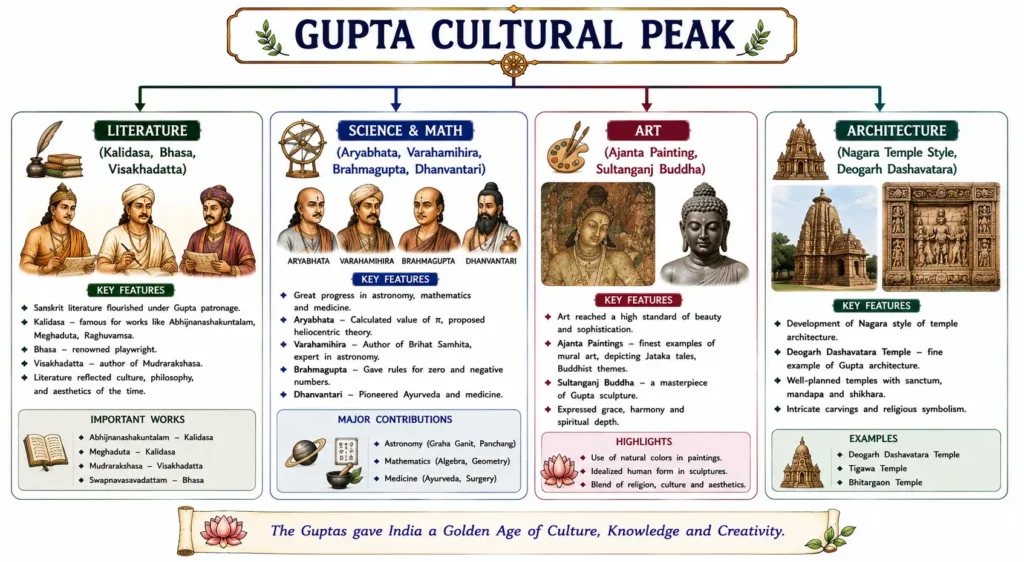
The Gupta era marks the zenith of Classical Sanskrit drama and poetry:
- Kalidasa:
- Dramas: Abhijnanashakuntalam (story of Shakuntala and Dushyanta), Malavikagnimitram, Vikramorvasiyam.
- Epics / Poems: Raghuvamsham, Kumarasambhavam, Meghadutam, Ritusamharam.
- Visakhadatta: Authored Mudrarakshasa (Mauryan rise) and Devichandraguptam (story of Chandragupta II defeating Shakas).
- Shudraka: Authored Mrichchhakatika (“The Little Clay Cart”), depicting urban social life.
- Bhasa: Authored Svapnavasavadattam.
- Vishnu Sharma: Compiled the famous fable collection Panchatantra.
- Amarasimha: Authored Amarakosha (Sanskrit dictionary).
B. Science, Mathematics, and Astronomy
- Aryabhata: Celebrated mathematician and astronomer. Authored Aryabhatiya (499 CE) and Surya Siddhanta.
- Formulated the concept of Zero (0) and the positional place-value decimal system.
- Calculated the value of Pi (π) accurately to 3.1416.
- Stated that the Earth is spherical, rotates on its own axis, and explained solar and lunar eclipses scientifically.
- Varahamihira: Authored Pancha Siddhantika (5 astronomical systems), Brihat Samhita (encyclopedia of natural science), and Brihat Jataka.
- Brahmagupta: Authored Brahmasphutasiddhanta; declared that all objects fall toward Earth due to natural attraction (anticipating gravity).
- Dhanvantari & Vagbhata: Renowned physicians. Vagbhata authored Ashtanga Hridaya (Ayurvedic treatise).
- Susruta Samhita Revision: Surgical techniques were refined during this period.
C. Art, Sculpture, and Temple Architecture
- Origins of Structural Hindu Temples: The Gupta era marks the birth of free-standing structural stone temples in the Nagara Style, characterized by a square sanctum (Garbhagriha) and a tower (Shikhara).
- Dashavatara Temple at Deogarh (UP): Earliest temple featuring a Shikhara and fine relief carvings of Lord Vishnu.
- Bhitargaon Brick Temple (Kanpur, UP): Masterpiece of ancient brick architecture.
- Metallurgy & Sculpture:
- Sultanganj Buddha: 7.5-foot-tall copper statue of Buddha weighing over half a ton (now in Birmingham Museum).
- Sarnath Seated Buddha: Carved in Chunar sandstone, depicting Buddha in Dharmachakra Pravartana Mudra.
- Ajanta Caves (Maharashtra): Cave numbers 16, 17, and 19 belong to the Gupta period, featuring world-famous fresco cave paintings (e.g., Dying Princess).
4. Decline of the Gupta Empire
Following Skandagupta’s death (c. 467 CE), the empire rapidly fragmented due to:
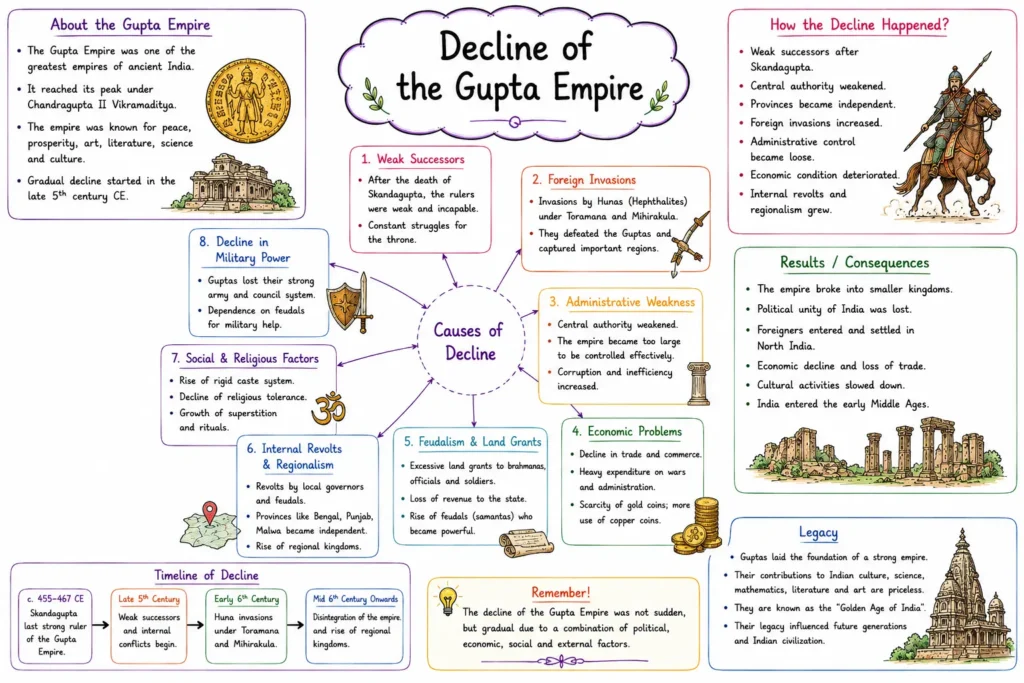
- Repeated Huna Invasions: Continuous attacks by Central Asian Huna leaders (Toramana and Mihirakula) shattered the economic and military backbone of North India.
- Rise of Feudal Vassals: Autonomous provincial governors (Maukharis of Kannauj, Maitrakas of Vallabhi, and Pushyabhutis of Thanesar) asserted independence.
- Loss of Western Trade: Conquest of Western India by Shakas/Hunas disrupted lucrative Mediterranean trade revenues.
- Internal Succession Disputes: Epigraphic records show internal rivalry among weak later Guptas (Purugupta, Narasimhagupta, Bhanugupta).
Quick Examination Facts
| Feature / Term | Key Exam Fact |
| Real Founder of Gupta Empire | Chandragupta I (319 – 320 CE, started Gupta Era) |
| Author of Prayag Prashasti | Harisena (Court poet of Samudragupta; written in Sanskrit) |
| “Napoleon of India” Title Given To | Samudragupta (by historian V. A. Smith) |
| Samudragupta’s Musical Instrument | Veena (Lute, depicted on his gold coins) |
| Chinese Traveler during Chandragupta II | Faxian (Fa-Hien; 399 – 411 CE) |
| Titles of Chandragupta II | Vikramaditya, Shakari (Destroyer of Shakas) |
| Founder of Nalanda University | Kumaragupta I (Mahendraditya) |
| Ruler who Repulsed Huna Invasions | Skandagupta (Recorded in Bhitari Inscription) |
| First Metal Used for Gupta Silver Coins | Rupaka (Issued first by Chandragupta II) |
| Name of Gupta Gold Coins | Dinaras |
| Author of Abhijnanashakuntalam | Kalidasa (One of the Navaratnas) |
| Concept of Zero & Calculation of Pi | Aryabhata (Author of Aryabhatiya, 499 CE) |
| Earliest Nagara Temple with Shikhara | Dashavatara Temple at Deogarh (Madhya Pradesh/UP border) |
| First Inscriptional Evidence of Sati | Eran Stone Inscription of Bhanugupta (510 CE) |
Conclusion
The Gupta Period consolidated North India politically while setting unprecedented standards in art, literature, mathematics, and metallurgy. The mathematical formulations of Aryabhata, the literary masterpieces of Kalidasa, the architectural birth of Nagara-style stone temples, and the creation of Nalanda University left an indelible mark on Indian civilization. Though internal feudal fragmentation and Huna invasions brought down the imperial structure by the mid-6th century, the cultural legacy of the “Golden Age” endured through the post-Gupta era.
Gupta Empire
Practice Quiz
| Some Important Links | |
| Download “Gupta Empire” PDF | Click Here |