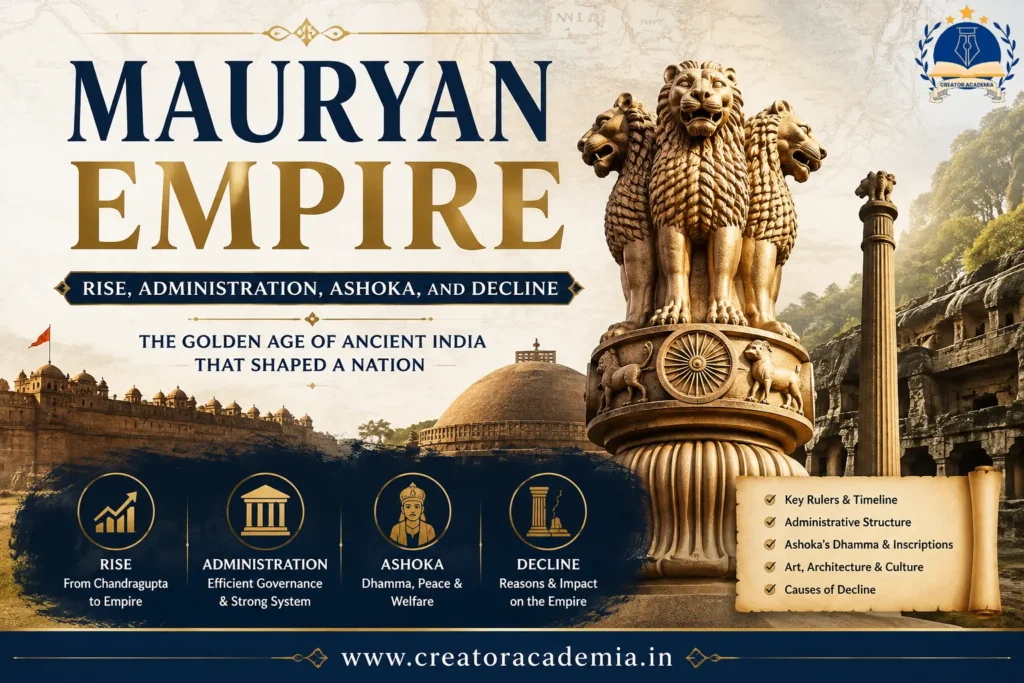
Mauryan Empire: Rise, Administration, Ashoka, and Decline
Introduction
The establishment of the Mauryan Empire (c. 322 – 185 BCE) marks a watershed moment in ancient Indian history. For the first time, almost the entire Indian subcontinent—stretching from Afghanistan in the northwest to Karnataka in the south, and from Bengal in the east to Kathiawar in the west—was unified under a single centralized imperial administration.
Founded by Chandragupta Maurya with the strategic guidance of his mentor Chanakya (Kautilya), the Mauryan Empire replaced the tyrannical Nanda Dynasty and successfully resisted Seleucid expansion, establishing India as a formidable global power in the ancient world.
1. Key Historical Sources of the Mauryan Period
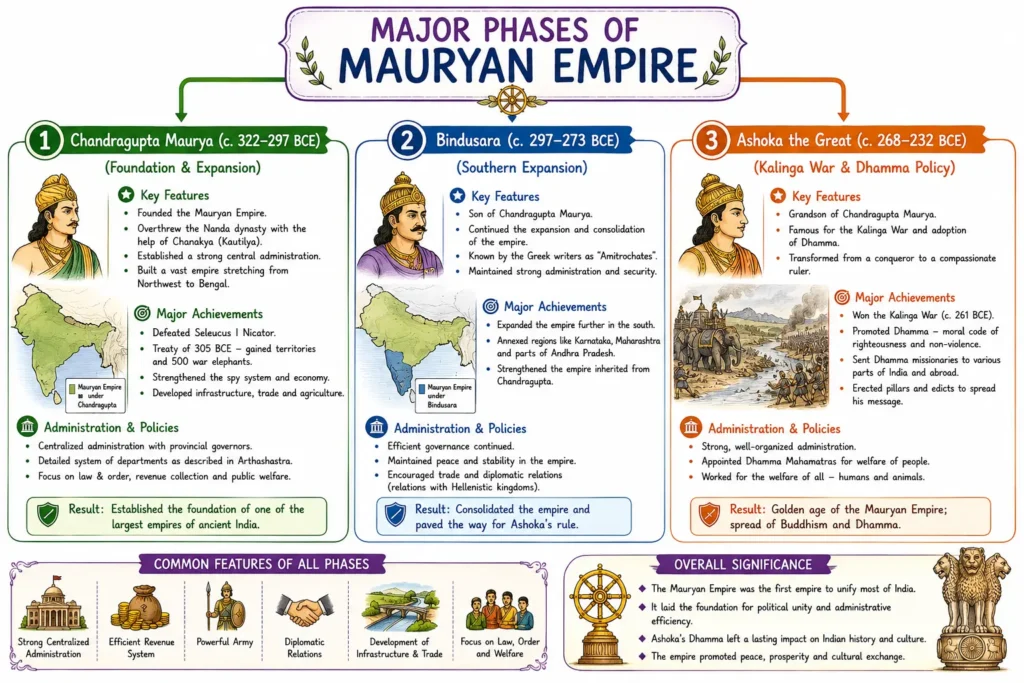
Reconstructing Mauryan history relies on a rich combination of literary, epigraphic, and archaeological sources:
| Source | Author / Origin | Key Historical Contribution |
| Arthashastra | Kautilya (Chanakya / Vishnugupta) | A comprehensive treatise on statecraft, economic policy, military strategy, and administrative machinery (Saptanga Theory). |
| Indica | Megasthenes (Greek Ambassador) | Account of Mauryan capital Pataliputra, 7-fold social division, military board, and administrative committees (preserved in fragments by Strabo, Arrian, Pliny). |
| Mudrarakshasa | Visakhadatta (5th century CE play) | Drama depicting Chanakya’s political maneuvers and Chandragupta’s overthrow of the Nanda dynasty. |
| Ashokan Edicts | Emperor Ashoka | Over 33 inscriptions carved on rocks and pillars using Brahmi, Kharosthi, Aramaic, and Greek scripts. |
| Buddhist Chronicles | Mahavamsa, Dipavamsa, Divyavadana | Details Ashoka’s conversion to Buddhism, his patronage of the 3rd Buddhist Council, and diplomatic missions. |
2. Dynastic Lineage and Major Rulers
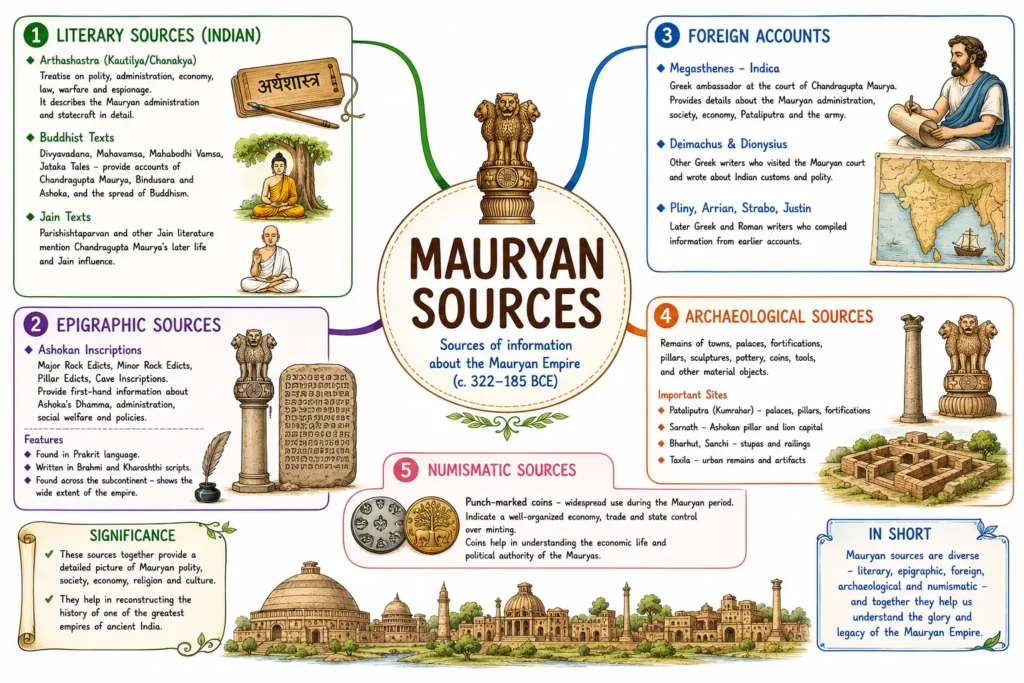
A. Chandragupta Maurya (c. 322 – 297 BCE)
- Rise to Power: Overthrew the last Nanda ruler, Dhana Nanda, in 322 BCE with the assistance of Chanakya, establishing the Mauryan Dynasty at Pataliputra.
- Defeat of Seleucus Nicator (305 BCE): Defeated Alexander’s Greek successor, Seleucus I Nicator. A peace treaty ceded eastern Afghanistan, Balochistan, and regions west of the Indus (Aria, Arachosia, Gedrosia, Paropamisadae) to Chandragupta in exchange for 500 war elephants.
- Diplomatic Relations: Seleucus sent Megasthenes as an ambassador to the court at Pataliputra.
- Abdication and Jainism: In his later years, Chandragupta embraced Jainism under the influence of Jain saint Bhadrabahu. He abdicated the throne in favor of his son Bindusara and traveled to Sravanabelagola (Karnataka), where he performed the holy ritual of starvation unto death (Sallekhana or Santhara).
B. Bindusara (c. 297 – 273 BCE)
- Titles: Known to the Greeks as Amitrochates (derived from Sanskrit Amitraghata—”Slayer of Foes”).
- Empire Expansion: Extended Mauryan dominance deep into the Deccan peninsula down to Mysore.
- Foreign Contacts: Maintained friendly diplomatic relations with Antiochus I (Syrian ruler), requesting sweet wine, dried figs, and a philosopher. Antiochus sent the ambassador Deimachus.
- Religious Patronage: Patronized the Ajivika sect (founder: Makkhali Gosala).
3. Ashoka the Great (c. 268 – 232 BCE) and His Policy of Dhamma
Ashoka is regarded as one of the greatest rulers in world history. Following a four-year succession struggle after Bindusara’s death, he was formally crowned around 268 BCE.
A. The Kalinga War (261 BCE) and Its Impact
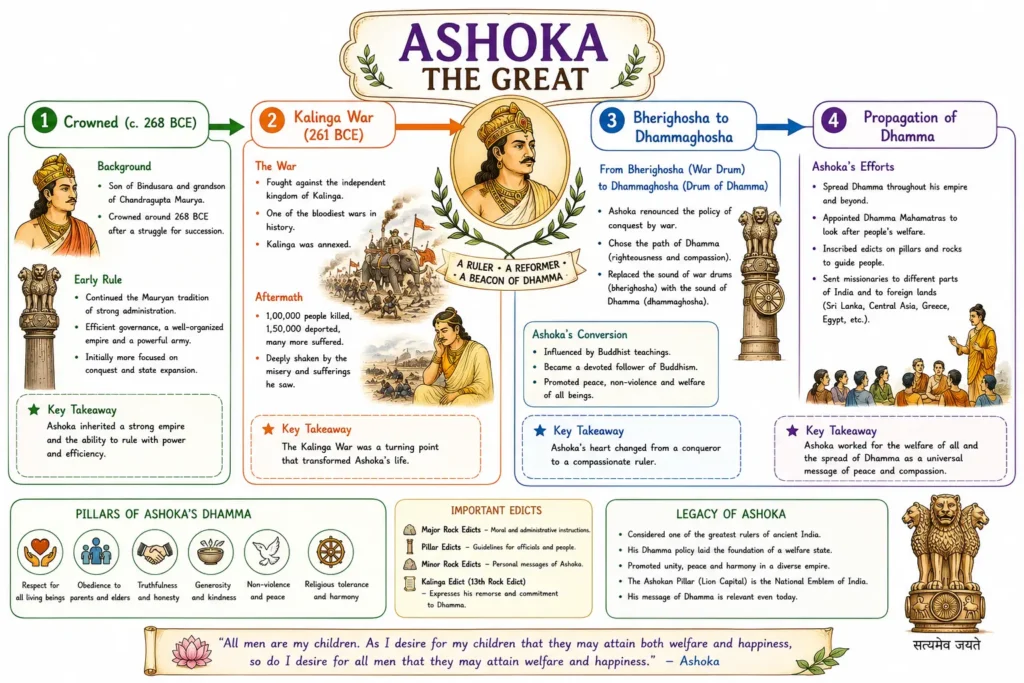
- Fought in the 8th year of Ashoka’s reign (mentioned in Major Rock Edict XIII).
- Kalinga (modern coastal Odisha) was strategically vital for controlling land and sea routes to South India and Southeast Asia.
- The war resulted in massive casualties (100,000 slain, 150,000 captured, and many more perished). Moved by the immense destruction and human suffering, Ashoka renounced warfare forever.
- Replaced the policy of territorial conquest (Bherighosha—sound of war drums) with cultural and spiritual conquest (Dhammaghosha—sound of righteousness).
B. Conversion to Buddhism and Policy of Dhamma
- Converted to Buddhism under the influence of the monk Upagupta (or Nigrodha).
- Ashoka’s Dhamma: A broad ethical code of conduct rather than a rigid religious dogma. It emphasized:
- Respect for parents, elders, and teachers (Ahimsa).
- Compassion towards servants, slaves, and animals.
- Religious tolerance toward all sects (Major Rock Edict XII).
- Truthfulness, non-violence, and social harmony.
- Dhamma Mahamattas: Appointed special officers called Dhamma Mahamattas in the 14th year of his reign to spread Dhamma, audit moral conduct, and ensure welfare across the empire.
- Third Buddhist Council (250 BCE): Sponsored the council at Pataliputra, presided over by Moggaliputta Tissa. Sent Buddhist missions abroad, including his son Mahendra and daughter Sanghamitra to Sri Lanka (Ceylon).
C. Ashokan Inscriptions and Edicts
Ashoka was the first Indian monarch to address his subjects directly through rock and pillar inscriptions.
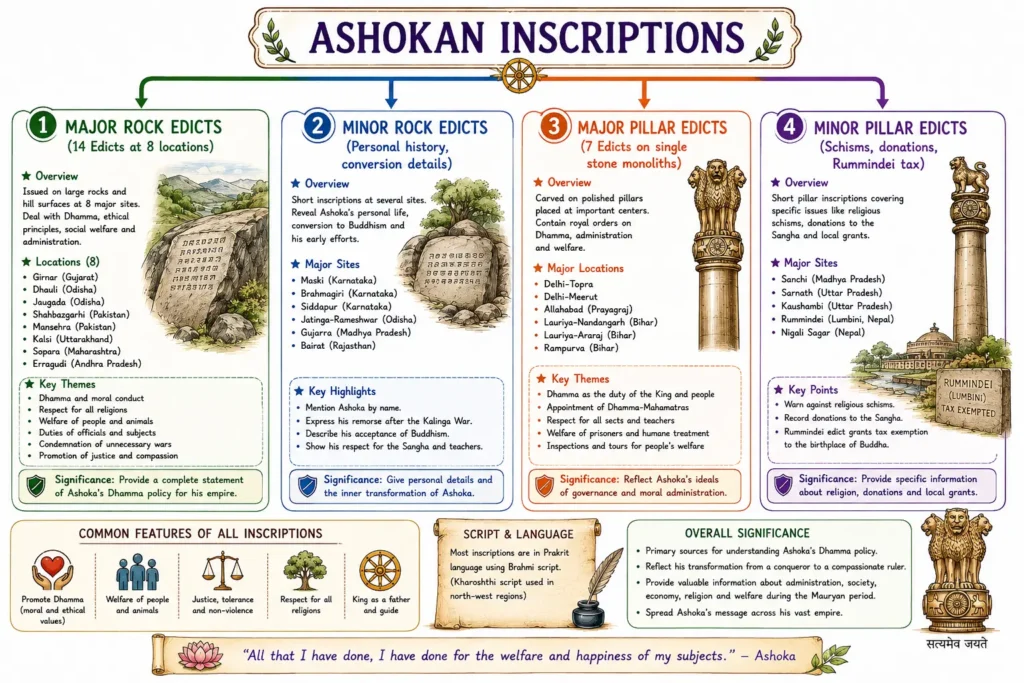
- Decipherment: First deciphered in 1837 by James Prinsep, an officer of the Calcutta Mint.
- Languages & Scripts: Written mostly in Prakrit (using Brahmi script across most of India). In the northwest, Kharosthi script (written right-to-left) was used. In Afghanistan, Aramaic and Greek scripts were employed.
- Royal Titles: Referred to himself in edicts as Devanampiya (“Beloved of the Gods”) and Piyadasi (“Of Pleasing Appearance”). The Maski and Gujjara rock edicts explicitly mention the name Ashoka.
- Rummindei Pillar Inscription (Nepal): Commemorates Ashoka’s visit to Buddha’s birthplace in Lumbini and records the reduction of land revenue (Bhaga) from 1/6th to 1/8th.
4. Mauryan Administration
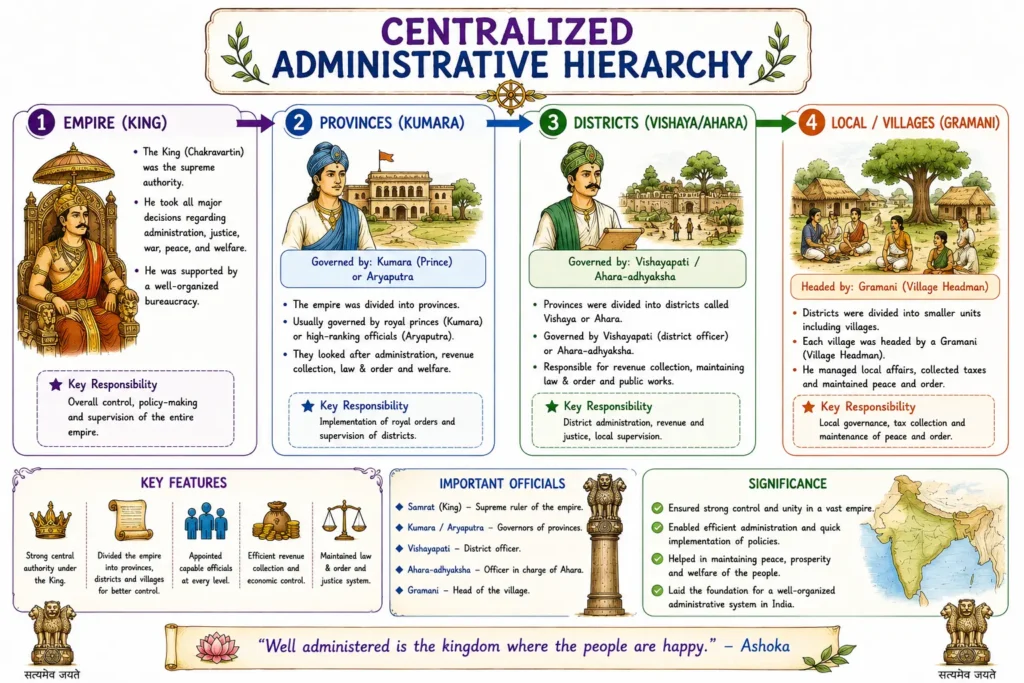
The Mauryan Empire established a highly elaborate, centralized, and hierarchical administrative system.
A. Central Administration
- The King: The absolute supreme head of executive, legislative, judicial, and military authority.
- Mantriparishad: An advisory council of ministers assisting the king. High-ranking officials included:
- Purohita: Chief Priest.
- Senapati: Commander-in-Chief of the Armed Forces.
- Yuvaraja: Crown Prince.
- Samaharta: Chief Collector of Revenue (overseeing tax collection and expenditure).
- Sannidhata: Chief Treasury Officer and Royal Storehouse Keeper.
- Adhyakshas (Departmental Heads): Kautilya’s Arthashastra mentions 27 departmental heads (Adhyakshas), e.g., Panyadhyaksha (Commerce), Akaradhyaksha (Mines), Sitadhyaksha (Agriculture), and Lakshanadhyaksha (Mint).
B. Provincial and Local Administration
The empire was divided into five major administrative provinces:
| Province | Capital | Administrative Head |
| Uttarapatha (Northern Province) | Taxila | Kumara or Aryaputra (Royal Prince) |
| Avantiratha (Western Province) | Ujjain | Kumara |
| Dakshinapatha (Southern Province) | Suvarnagiri | Kumara |
| Kalinga (Eastern Province) | Tosali | Kumara |
| Prachya (Central Province / Heartlands) | Pataliputra | Direct Rule under the King |
- District Level (Vishaya or Ahara): Administered by Rajukas (assisted by Yuktas and Pradesikas), who handled tax collection and judicial duties.
- Village Level (Grama): The smallest unit of administration, headed by the Gramani.
C. Espionage and Judicial System
- Gudhapurushas (Secret Agents): An extensive intelligence network reported directly to the king. Classified into Sansthan (stationary agents) and Sancharan (wandering agents).
- Judicial Courts:
- Dharmasthiya: Civil courts dealing with property, marriage, and contract disputes.
- Kantakasodhana: Criminal courts dealing with serious offenses, theft, and treason.
5. Mauryan Art and Architecture
Mauryan art represents a major transition from wood to polished stone architecture in ancient India.
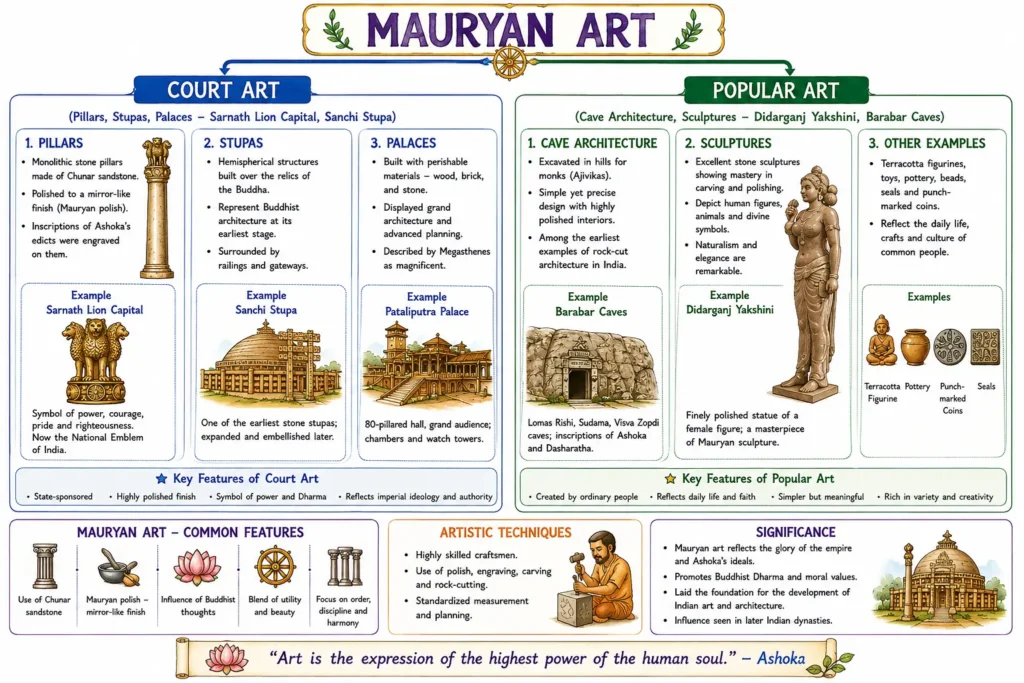
- Stone Pillars: Monolithic sandstone pillars (quarried from Chunar near Varanasi) featuring a high-gloss surface polish (Mauryan Polish). The Sarnath Lion Capital (featuring four back-to-back lions, a horse, bull, elephant, lion, and the Dharmachakra) was adopted as India’s National Emblem.
- Stupas: Built to house Buddha’s sacred relics. The foundational core of the famous Great Stupa at Sanchi (Madhya Pradesh) was constructed during Ashoka’s reign.
- Cave Architecture: Rock-cut caves in the Barabar and Nagarjuni Hills (near Gaya, Bihar) were excavated by Ashoka and his grandson Dasharatha for Ajivika monks (e.g., Lomas Rishi Cave).
- Stone Sculptures: The life-size sandstone figure of Didarganj Yakshini (Patna) showcases exquisite polish and realistic craftsmanship.
6. Causes of the Decline of the Mauryan Empire
Following Ashoka’s death in 232 BCE, the empire fractured and declined within 50 years due to several factors:
- Weak Successors: Ashoka’s successors (Dasharatha, Samprati, Brihadratha) were incompetent and unable to maintain central control over distant provinces.
- Partition of the Empire: The empire was split into Western and Eastern halves, eroding political strength.
- Financial Strain: The maintenance of a massive bureaucracy, standing army, and extensive state subsidies strained the royal treasury.
- Oppressive Provincial Rule: Local governors (Kumaras) in distant frontiers abused authority, leading to revolts.
- The Final Blow (185 BCE): The last Mauryan ruler, Brihadratha, was assassinated during a military parade by his own Brahmin commander-in-chief, Pushyamitra Shunga, who established the Shunga Dynasty.
Quick Examination Facts
| Feature / Term | Key Exam Fact |
| Founder of Mauryan Empire | Chandragupta Maurya (322 BCE, with Chanakya’s help) |
| Greek Ambassador to Pataliputra | Megasthenes (Author of Indica, sent by Seleucus Nicator) |
| Chandragupta’s Death Place & Method | Sravanabelagola, Karnataka (Sallekhana / Santhara starvation) |
| Bindusara’s Greek Title | Amitrochates (“Slayer of Foes”) |
| Kalinga War Edict & Year | Major Rock Edict XIII (261 BCE) |
| Ashokan Inscriptions Deciphered By | James Prinsep (1837) |
| Script used in most Ashokan Edicts | Brahmi (Kharosthi used in North-West) |
| Chief Revenue Collector Officer | Samaharta |
| Chief Treasurer Officer | Sannidhata |
| Secret Espionage System Term | Gudhapurushas |
| Third Buddhist Council Host & President | Ashoka at Pataliputra (250 BCE); President: Moggaliputta Tissa |
| National Emblem Origin | Sarnath Lion Capital of Ashoka |
| Last Mauryan Ruler & Overthrower | Brihadratha (Assassinated in 185 BCE by Pushyamitra Shunga) |
Conclusion
The Mauryan Empire laid the administrative, political, and cultural foundation for imperial governance in India. Through Chanakya’s political strategy, Chandragupta’s conquests, and Ashoka’s ethical administration, the empire transformed regional rule into pan-subcontinental statehood. Ashoka’s rock and pillar edicts, artistic monuments, and peaceful propagation of Dhamma remain enduring symbols of ancient Indian governance and moral philosophy.
Mauryan Empire
Practice Quiz
| Some Important Links | |
| Download “Mauryan Empire” PDF | Click Here |