Mahajanapadas and the Rise of Magadha: 16 Monarchies, Foreign Invasions & Political Unification
Introduction
The 6th century BCE was a crucial turning point in ancient Indian history. Along with intellectual and religious movements like Buddhism and Jainism, this era witnessed a significant political shift: the transition from pastoral tribal settlements (Janas) to large territorial states called Janapadas and Mahajanapadas (“Great Realms”).
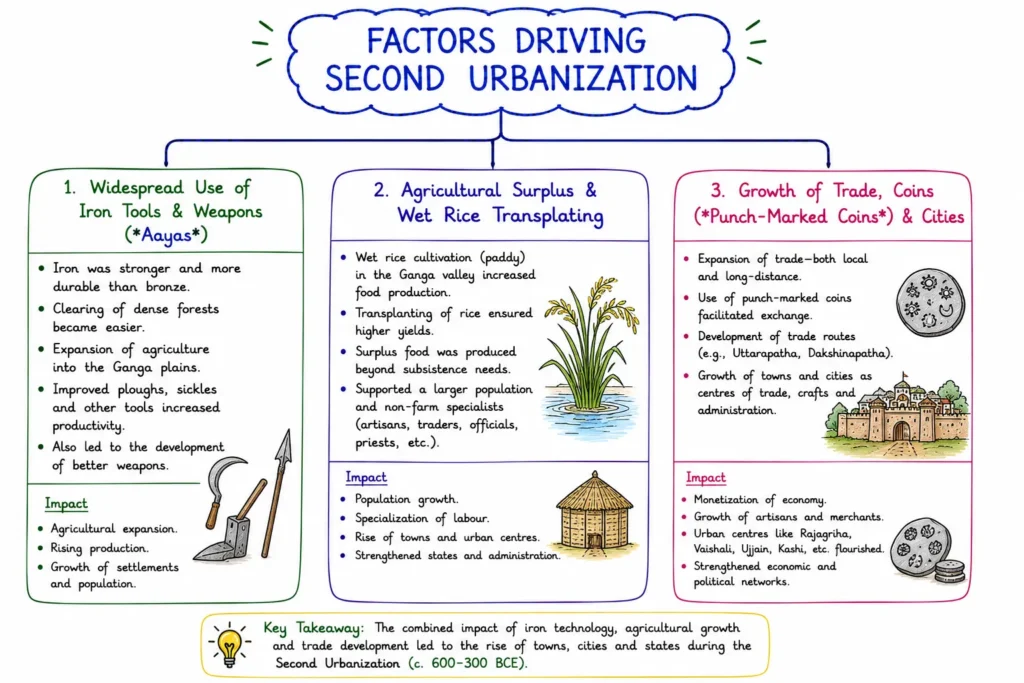
Fueled by the widespread adoption of iron technology in the Gangetic Basin (Second Urbanization), agricultural surpluses expanded, population centers grew, and central tax revenues consolidated—paving the way for regional empires.
1. The 16 Mahajanapadas (Sodasa Mahajanapadas)
Buddhist scriptures (Anguttara Nikaya, Mahavastu) and Jain canonical texts (Bhagavati Sutra) provide lists of 16 prominent territorial kingdoms (Mahajanapadas) that flourished across Northern and Central India around 600 BCE.
| Mahajanapada | Capital City | Modern Location | Type of Governance & Key Characteristics |
|---|---|---|---|
| Magadha | Rajagriha / Pataliputra | Patna and Gaya, Bihar | Monarchy; emerged as the most powerful empire in ancient India. |
| Kosala | Sravasti / Ayodhya | Eastern Uttar Pradesh | Monarchy; ruled by King Prasenajit, a contemporary of Buddha. |
| Vatsa | Kausambi | Allahabad, Uttar Pradesh | Monarchy; ruled by King Udayana; crucial trade center on the Yamuna. |
| Avanti | Ujjain / Mahishmati | Malwa region, Madhya Pradesh | Monarchy; ruled by King Pradyota (Chanda Pradyota); fierce rival of Magadha. |
| Vajji | Vaishali | North Bihar | Gana-Sangha (Confederacy of 8 clans including Lichchhavis). |
| Malla | Kushinagar / Pava | Gorakhpur region, Uttar Pradesh | Gana-Sangha; site of Buddha’s and Mahavira’s death (Parinirvana). |
| Anga | Champa | Bhagalpur and Munger, Bihar | Monarchy; famous river port center; annexed early by Bimbisara. |
| Kasi | Varanasi | Varanasi, Uttar Pradesh | Monarchy; powerful initial kingdom famed for cotton textiles. |
| Chedi | Suktimati / Sotthivati | Bundelkhand region, UP/MP | Monarchy; mentioned in the Mahabharata (King Shishupala). |
| Kuru | Indraprastha | Meerut – Delhi region | Monarchy / Republic shift; famous legendary capital of the Pandavas. |
| Panchala | Ahichchhatra / Kampilya | Rohilkhand, Western Uttar Pradesh | Divided into Northern and Southern capitals; transitioned to republic. |
| Matsya | Viratanagara | Jaipur, Alwar, and Bharatpur, Rajasthan | Monarchy; located near modern Rajasthan. |
| Surasena | Mathura | Mathura, Uttar Pradesh | Monarchy; center of Krishna worship; King Avantiputra was a Buddhist disciple. |
| Assaka / Ashmaka | Potali / Podana | Banks of the Godavari River, Maharashtra | Only Mahajanapada located south of the Vindhya Range. |
| Gandhara | Taxila | Rawalpindi / Peshawar, Pakistan | Monarchy; famous international center for higher learning and trade. |
| Kamboja | Poonch / Rajauri | Kashmir / Pamir region, NWFP | Monarchy / Oligarchy; famous for fine horse breeds and cavalry. |
2. Rise of Magadha: Causes of Territorial Dominance
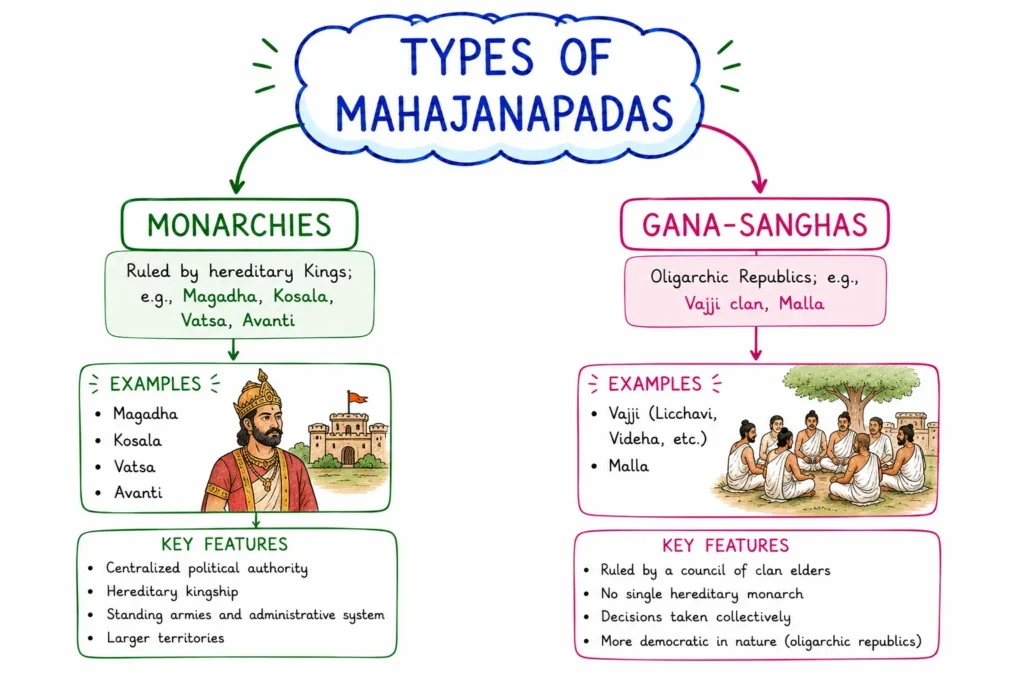
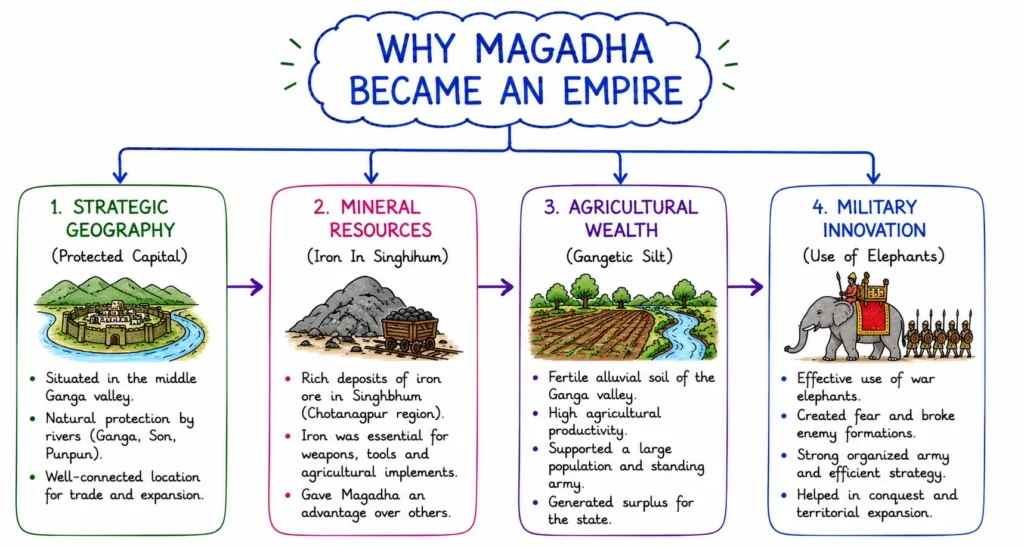
Out of the 16 states, four major monarchies—Magadha, Kosala, Vatsa, and Avanti—competed for imperial supremacy. Ultimately, Magadha triumphed over all rivals to establish India’s first centralized empire due to distinct geographical, economic, and strategic advantages:
- Strategic Geographical Capital Locations:
- Rajagriha (Old Capital): Surrounded by five natural hills, acting as an impregnable natural fortress (Girivraja).
- Pataliputra (New Capital): Located at the confluence of the Ganga, Son, Gandak, and Ghaghara rivers, serving as a true “Water Fort” (Jaladurga) and commercial trade nexus.
- Abundant Iron Ore Reserves: Access to rich iron ore deposits in the Singhbhum / Chota Nagpur region allowed Magadhan rulers to forge heavy agricultural plows and superior iron weaponry.
- Fertile Alluvial Soil: Situated in the heart of the Gangetic Basin, high agricultural productivity yielded massive tax revenue (Bhaga) to maintain standing armies.
- First to Deploy Elephants in War: Dense nearby forests provided wild elephants, which Magadha incorporated into its military lineup to smash enemy fortifications and infantry lines.
- Unorthodox Social Outlook: Magadhan society was less constrained by orthodox Brahmanical rituals, enabling rapid assimilation of diverse communities and open military innovation.
3. Dynastic History of Magadha
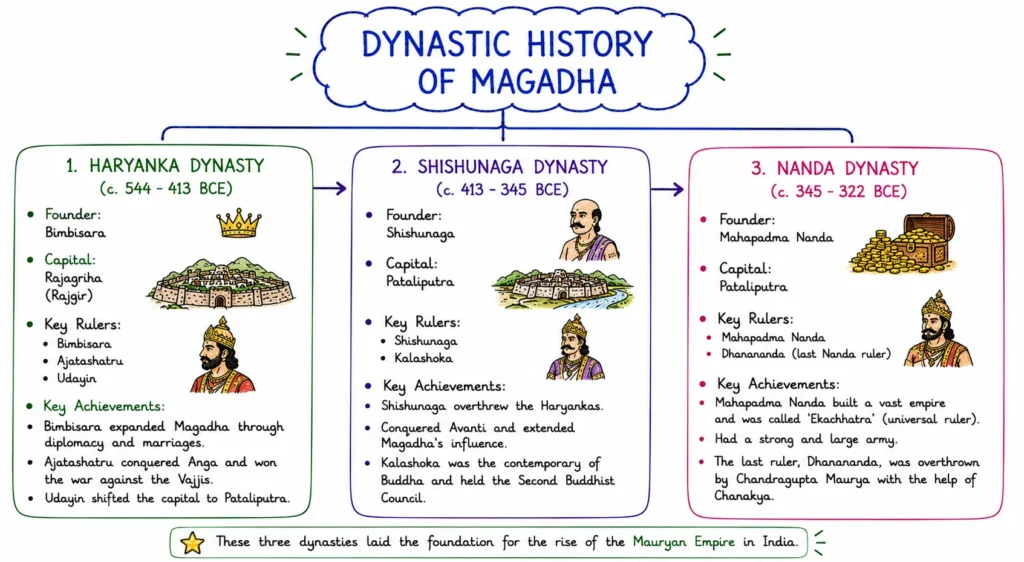
A. The Haryanka Dynasty (c. 544 – 413 BCE)
- Bimbisara (c. 544 – 492 BCE): Founder of Magadhan imperial power. Contemporary of Buddha and Mahavira. Employed a three-pronged policy of matrimonial alliances (married Kosala princess Mahakosala, Lichchhavi princess Chellana, and Madra princess Khema), military conquests (annexed Anga), and diplomatic relations (sent royal physician Jivaka to cure Avanti’s King Pradyota).
- Ajatashatru (c. 492 – 460 BCE): Son of Bimbisara (whom he imprisoned and killed). Used innovative siege weapons like Rathamusala (scythed chariot) and Mahashilakantaka (engine for hurling large stones) to defeat the Vajji confederacy after a 16-year war. Built the fortification of Rajagriha and patronized the 1st Buddhist Council (483 BCE).
- Udayin (c. 460 – 444 BCE): Son of Ajatashatru. Shifted the capital of Magadha from Rajagriha to Pataliputra due to its strategic position at the confluence of the Ganga and Son rivers.
B. The Shishunaga Dynasty (c. 413 – 345 BCE)
- Shishunaga: Originally a minister (Amatya); overthrew the corrupt Haryanka rulers. Permanently destroyed the power of Magadha’s long-time rival Avanti and annexed it. Temporarily shifted the capital to Vaishali.
- Kalasoka (Kakavarna): Re-shifted the capital back to Pataliputra. Convened the 2nd Buddhist Council at Vaishali in 383 BCE.
C. The Nanda Dynasty (c. 345 – 322 BCE)
- Mahapadma Nanda: Founder of the dynasty; considered India’s first non-Kshatriya ruler (Shudra origin). Known by titles like Ekarat (sole sovereign), Sarvakshatrantaka (destroyer of all Kshatriyas), and Ugrasena (owner of a huge army). Annexed Kalinga and conquered vast territories across North India.
- Dhana Nanda: The last Nanda ruler. Noted for possessing a colossal standing army (200,000 infantry, 20,000 cavalry, 2,000 chariots, and 3,000 war elephants). Exacted oppressive taxes, making him deeply unpopular. Overthrown by Chandragupta Maurya with the help of Chanakya (Kautilya) in 322 BCE, establishing the Mauryan Empire.
4. Foreign Invasions in North-West India
While Magadha was expanding across the Gangetic Plains, the northwestern frontier of India (Punjab, Gandhara) lacked central authority and fell victim to foreign powers.
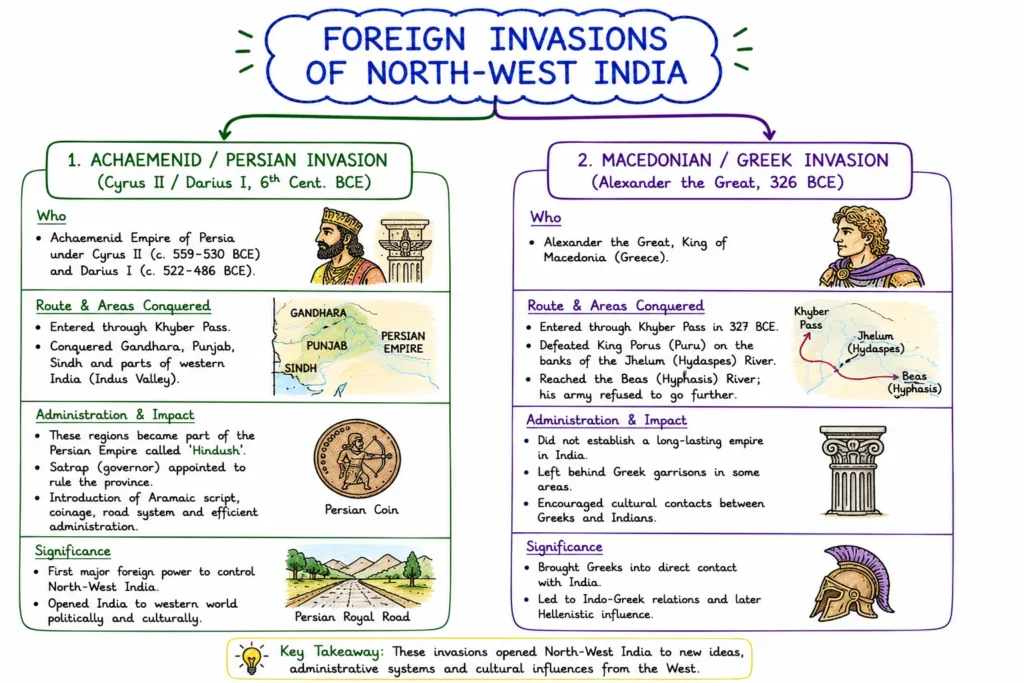
A. The Persian (Achaemenid) Invasion
- Cyrus II (558 – 530 BCE): First foreign conqueror to penetrate the Indian borderland; destroyed Kapisa (north of Kabul).
- Darius I (522 – 486 BCE): Annexed Punjab and Sindh around 518 BCE. The Indian territories formed the 20th Satrapy (province) of the Persian Empire, contributing an immense annual tribute of 360 talents of gold dust.
- Impact of Persian Rule:
- Kharosthi Script: Introduced the Kharosthi script (derived from Aramaic), written from right-to-left, used in Ashokan edicts in the northwest.
- Monumental Art: Influenced Mauryan stone architecture, bell-shaped capitals, and polished stone pillars.
B. The Macedonian / Greek Invasion (Alexander the Great)
In 326 BCE, Alexander the Great of Macedon invaded North-West India after defeating the Persian Achaemenid Empire.
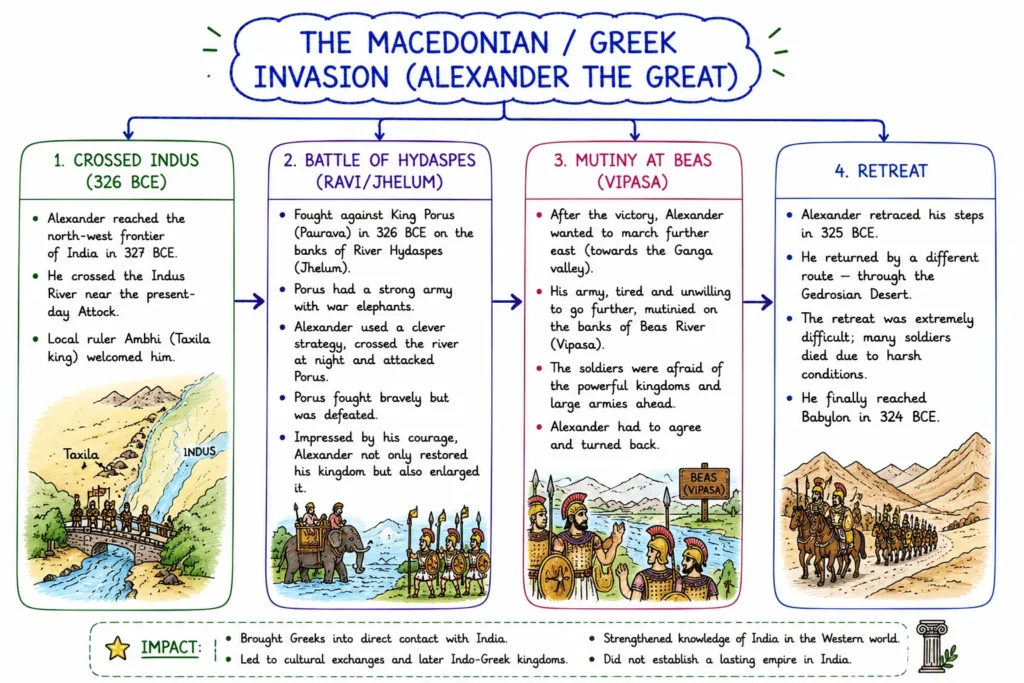
- Battle of the Hydaspes (326 BCE): Fought on the banks of the Jhelum river (Hydaspes in Greek). King Porus (Puru) of the Paurava kingdom fought courageously against Alexander. Impressed by Porus’s bravery, Alexander restored his kingdom and made him an ally.
- Mutiny at River Beas (Hyphasis): Alexander’s battle-weary troops refused to advance further east due to tropical heat, home-sickness, and fear of the formidable army of the Nanda Empire waiting across the Gangetic plain.
- Retreat and Death: Alexander was forced to retreat, leaving his conquered territories divided among his Greek governors (Satraps like Seleucus Nicator). He died at Babylon in 323 BCE at age 32.
- Impact of Alexander’s Invasion:
- Established direct contact between Europe and Ancient India, opening four distinct land and sea trade routes.
- Paved the way for political unification in North India by destroying petty warring tribal states in the northwest.
- Led to the emergence of the Gandhara School of Art through the blend of Indo-Greek cultural elements.
Quick Examination Facts
| Feature / Event | Key Exam Fact |
|---|---|
| Number of Mahajanapadas | 16 (Mentioned in Anguttara Nikaya and Bhagavati Sutra) |
| Only Southern Mahajanapada | Assaka / Ashmaka (On the banks of River Godavari) |
| Capital of Magadha Shift to Pataliputra | Done by King Udayin (Haryanka Dynasty) |
| First Non-Kshatriya Ruler | Mahapadma Nanda (Titles: Ekarat, Sarvakshatrantaka) |
| Magadhan Military Secret Weapon | Deployment of war elephants and stone-throwing siege weapons (Mahashilakantaka) |
| Lichchhavi Capital | Vaishali (Part of the Vajji Gana-Sangha confederacy) |
| First Foreign Invasion of India | Achaemenid / Persian Invasion by Cyrus II and Darius I |
| Persian Script Introduced in NW India | Kharosthi Script (Written right-to-left) |
| Battle of Hydaspes Year & Location | 326 BCE on the banks of River Jhelum (Alexander vs. Porus) |
| River where Alexander’s army mutinied | River Beas (Hyphasis) |
| Royal Physician sent to Avanti | Jivaka (Sent by Bimbisara) |
| Last Ruler of Nanda Dynasty | Dhana Nanda (Overthrown by Chandragupta Maurya in 322 BCE) |
Conclusion
The era of the Mahajanapadas marked the birth of territorial statehood, urban growth, and centralized imperial power in ancient India. Magadha’s conquest of neighboring states under the Haryanka, Shishunaga, and Nanda dynasties unified the central heartland, while foreign invasions in the northwest connected Indian trade to Western markets. The fall of the tyrannical Nanda Dynasty set the stage for Chandragupta Maurya and Chanakya to unite India into its first pan-subcontinental empire—the Mauryan Empire.
Mahajanapadas and Rise of Magadha
Practice Quiz
| Some Important Links | |
| Download “Mahajanapadas and Rise of Magadha” PDF | Click Here |