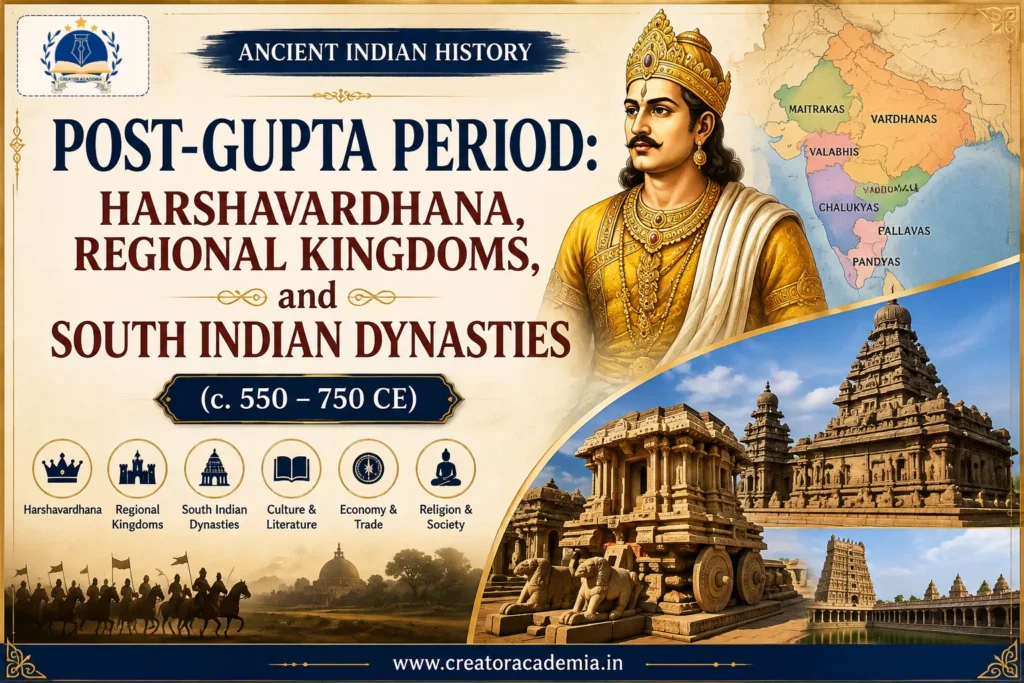
Post-Gupta Period: Harshavardhana, Regional Kingdoms, and South Indian Dynasties (c. 550 – 750 CE)
While Emperor Harshavardhana of the Pushyabhuti dynasty briefly consolidated Northern India into a unified empire from his capital at Kannauj, Southern India experienced a glorious golden age under the ruling dynasties of the Chalukyas of Badami and the Pallavas of Kanchi, alongside the foundational cultural legacy of the Sangam Age.
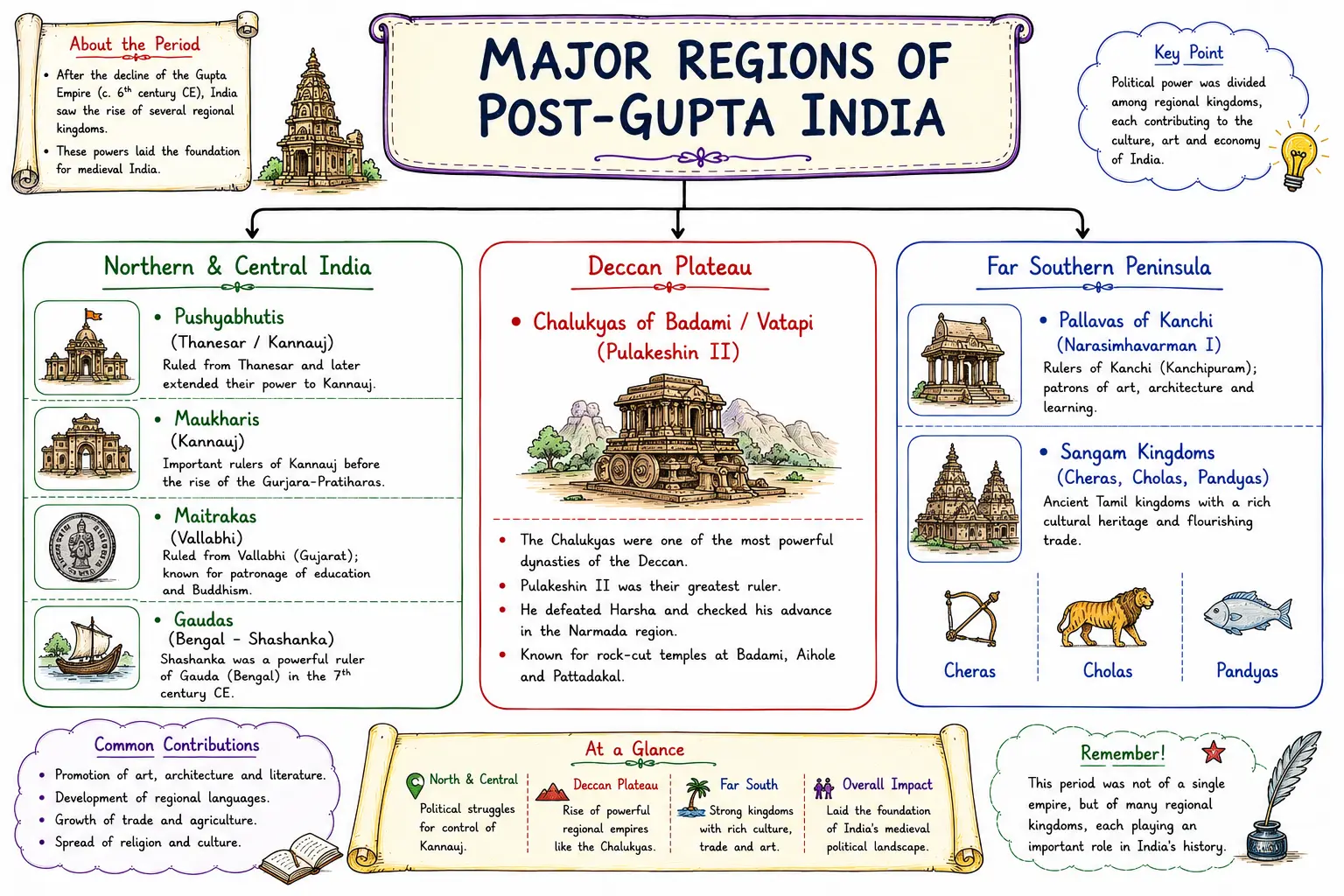
To understand the political fragmentation and territorial shifts of this era, the thematic roadmap below outlines the major regional powers spanning Northern and Central India, the Deccan Plateau, and the far southern peninsula.
1. The Pushyabhuti (Vardhana) Dynasty & Harshavardhana (c. 606 – 647 CE)
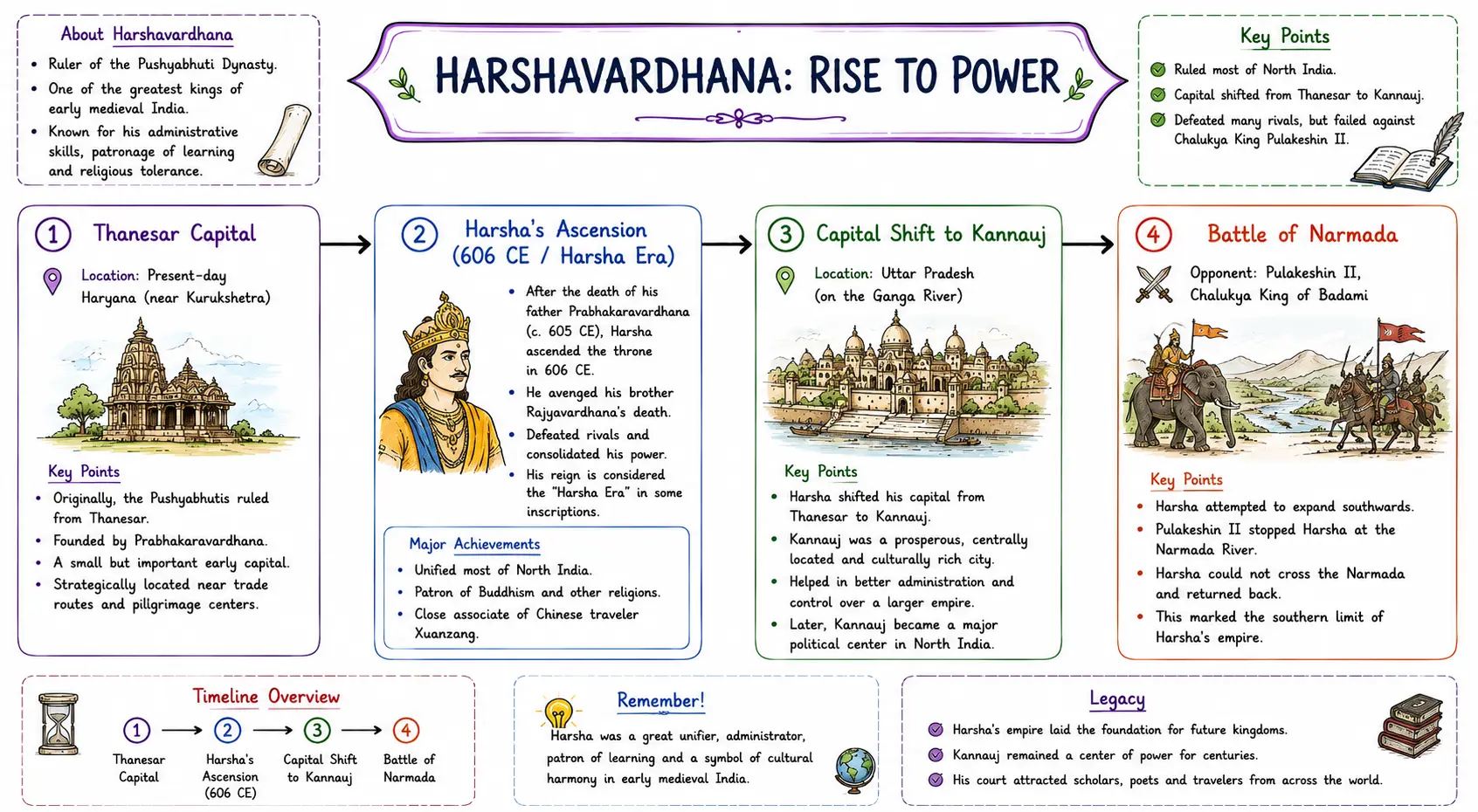
The Pushyabhuti dynasty was founded at Thanesar (modern Kurukshetra, Haryana) by Pushyabhuti. The kingdom rose to imperial prominence under Prabhakaravardhana and his illustrious son, Harshavardhana (Harsha). The visual timeline below summarizes Harsha’s ascension, consolidation of authority, and geopolitical trajectory.
A. Rise of Harsha and Capital Shift to Kannauj
- Ascension (606 CE): Following the assassination of his elder brother Rajyavardhana by King Shashanka of Gauda (Bengal), Harsha ascended the throne at age 16 in 606 CE, marking the beginning of the Harsha Era.
- Unification of Thanesar & Kannauj: Harsha’s sister Rajyashri was married to King Grihavarman of the Maukhari Dynasty of Kannauj. After Grihavarman was killed by Devagupta of Malwa, Harsha saved Rajyashri, merged the kingdoms of Thanesar and Kannauj, and shifted his capital to Kannauj, turning it into the political nerve center of North India.
B. Extent of Empire & Military Campaigns
- Imperial Extent: Harsha unified North India, assuming the title Sakalottarapathanatha (“Lord of the Entire Northern Country”).
- Battle of the Narmada River (c. 618 – 634 CE): Harsha attempted to expand into the Deccan plateau but suffered his only major military defeat at the hands of the Chalukya Emperor Pulakeshin II on the banks of the Narmada River (recorded in Pulakeshin’s Aihole Inscription).
C. Religious Assemblies & Patronage
- Religious Evolution: Originally a devout worshipper of Shiva and Surya, Harsha embraced Mahayana Buddhism under the influence of his sister Rajyashri and the Chinese pilgrim Xuanzang (Hiuen Tsang).
- Kannauj Assembly (643 CE): A grand religious assembly organized to honor Xuanzang and promote Mahayana doctrines.
- Prayag Assembly (Maha Moksha Parishad): Held every five years at the confluence of the Ganga and Yamuna (Prayagraj). Harsha famously distributed his accumulated royal wealth among ascetics, monks, and the poor.
D. Literary Achievements & Court Scholars
- Harsha as Author: Authored three celebrated Classical Sanskrit plays:
- Ratnavali
- Priyadarsika
- Nagananda (Buddhist theme)
- Banabhatta: Harsha’s celebrated court poet who authored:
- Harshacharita (Biographical account of Harsha)
- Kadambari (World’s earliest romantic novel)
- Visit of Xuanzang (Hiuen Tsang): Traveled across India between 629 and 645 CE. Documented social life, Nalanda University under Chancellor Silabhadra, and Harsha’s administration in his famous travelogue Si-Yu-Ki (“Record of the Western Regions”).
2. Other Key North Indian Regional Kingdoms
Beyond Kannauj, several regional kingdoms held sway across Northern and Western India, forming strategic alliances or rivalries that influenced regional stability.
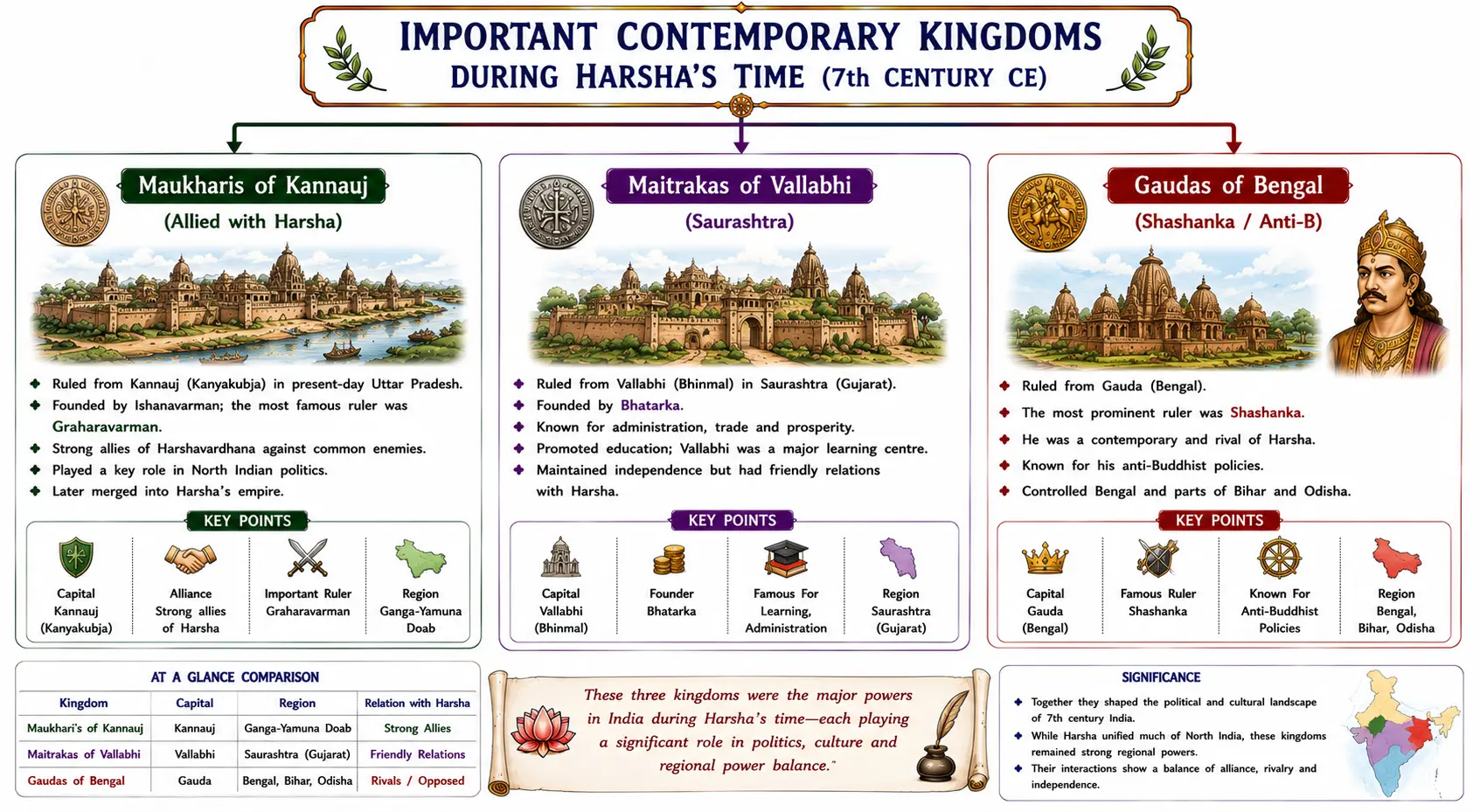
- Maukharis of Kannauj: Held the central Gangetic plains. King Ishanavarman defended against Huna incursions. Later unified with Harsha’s kingdom through matrimonial and political alliance.
- Maitrakas of Vallabhi (Gujarat): Established by Bhatarka. Vallabhi emerged as a world-renowned center for international maritime trade and Buddhist learning (second only to Nalanda).
- Gaudas of Bengal: Ruled by Shashanka, a staunch Shaivite king who cut down the sacred Bodhi Tree at Bodh Gaya and killed Rajyavardhana.
3. The Southern Powers: Chalukyas of Badami and Pallavas of Kanchi
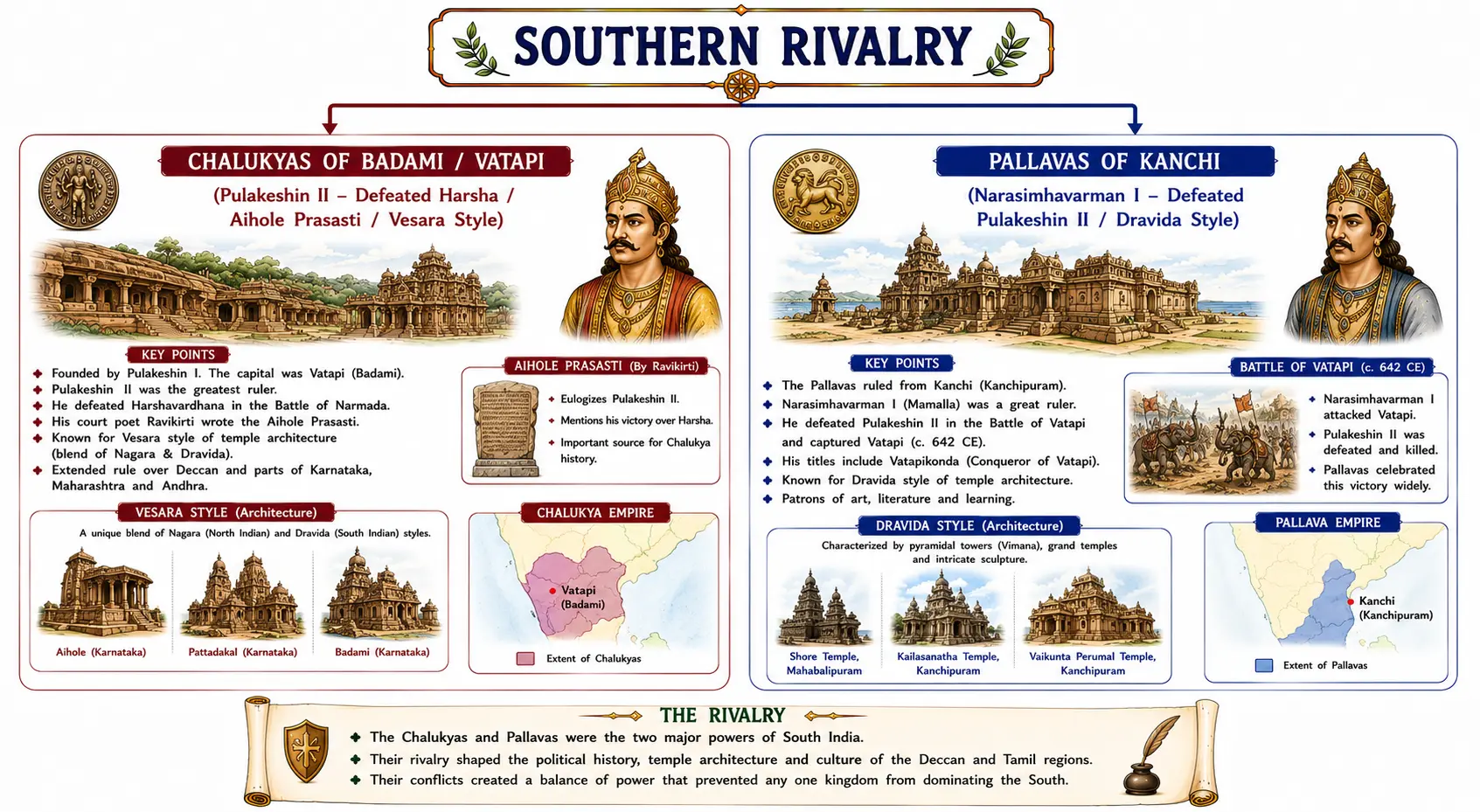
While Harsha ruled the North, Southern India was dominated by two powerful rival empires: the Chalukyas of Badami in the Deccan and the Pallavas of Kanchi in the Far South. Their perennial contest over the fertile Krishna-Tungabhadra doab shaped the political history and architectural landscape of peninsular India.
A. The Chalukyas of Badami (Vatapi) (c. 543 – 753 CE)
- Founder: Pulakeshin I established the dynasty with the capital at Vatapi (Badami, Karnataka).
- Pulakeshin II (c. 609 – 642 CE): The greatest Chalukya monarch.
- Defeated Harshavardhana at the Narmada River.
- Aihole Prasasti (Inscription): Composed in Sanskrit by his court poet Ravikirti, describing Pulakeshin II’s military triumphs.
- Sent an embassy to the court of Persian King Khosrow II.
- Architecture: Developed the Vesara Style of temple architecture (a synthesis of Nagara and Dravida styles) at Aihole (“Cradle of Indian Temple Architecture”), Badami, and Pattadakal (e.g., Virupaksha Temple).
B. The Pallavas of Kanchi (c. 4th – 9th Century CE)
- Capital: Kanchipuram (Kanchi), Tamil Nadu.
- Mahendravarman I (c. 600 – 630 CE): Author of the satirical Sanskrit play Mattavilasa Prahasana. Pioneer of rock-cut cave temples in Tamil Nadu.
- Narasimhavarman I “Mamalla” (c. 630 – 668 CE):
- Avenged his father’s defeat by invading Badami, killing Pulakeshin II, and assuming the title Vatapikonda (“Conqueror of Vatapi”).
- Founded the coastal port city of Mamallapuram (Mahabalipuram).
- Dravida Temple Architecture Pioneers:
- Monolithic Pancha Rathas (Five Chariots) and relief carvings (Arjuna’s Penance) at Mahabalipuram.
- Structural Temples: Shore Temple at Mahabalipuram and Kailasanathar Temple at Kanchi (built by Narasimhavarman II / Rajasimha).
4. The Sangam Age in South India (c. 3rd Century BCE – 3rd Century CE)
The Sangam Age refers to the golden era of Tamil literature and history in Deep South India (South of the Krishna River), named after the assemblies (Sangams) of Tamil poets held under the patronage of the Pandya kings at Madurai. The synthesis below highlights the three premier dynasties, their maritime trade networks, and royal emblems.
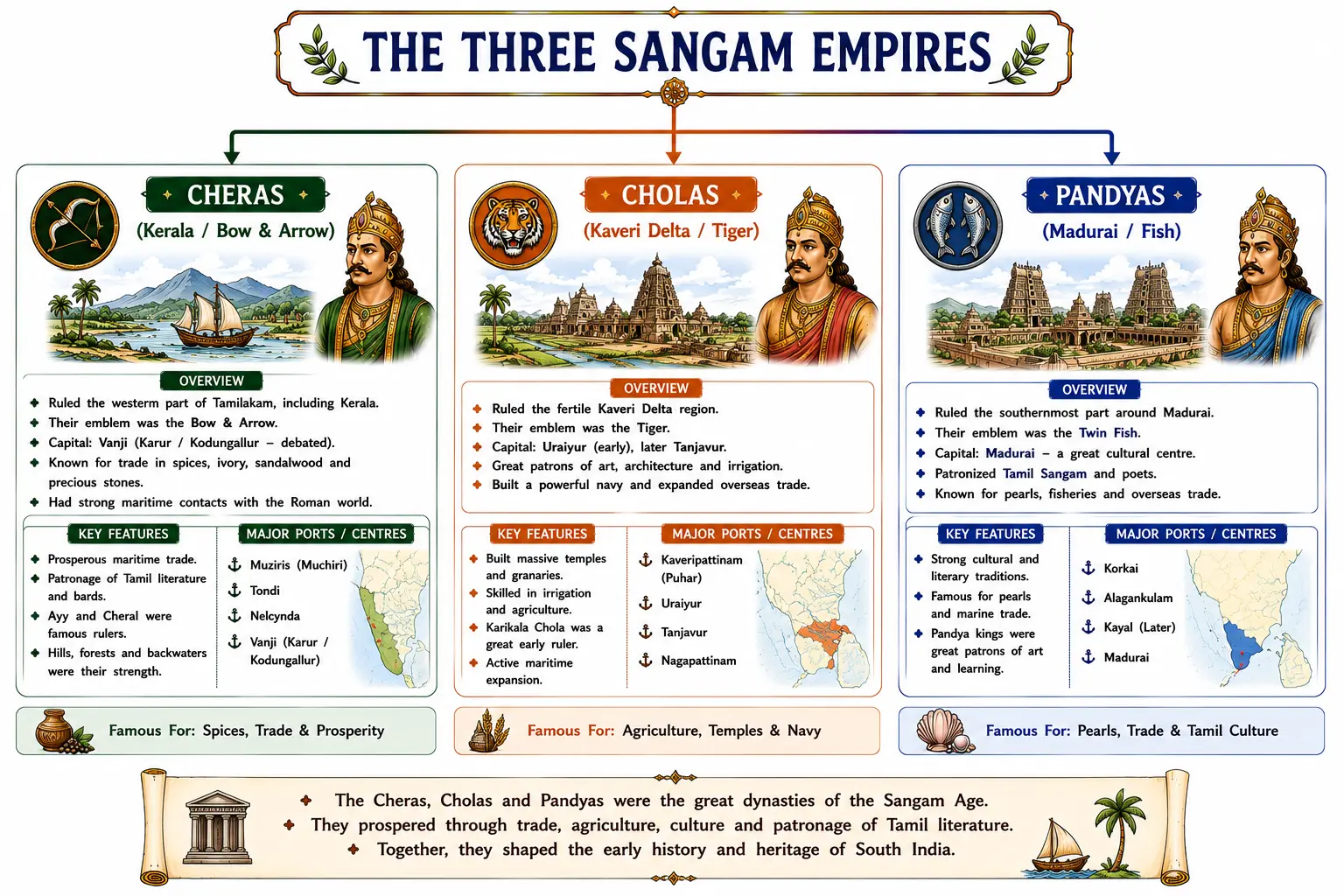
| Kingdom | Capital | Royal Emblem | Key Ruler / Contribution |
|---|---|---|---|
| Cheras | Vanji / Karur | Bow and Arrow | Senguttuvan (Red Chera): Founded the Pattini cult (worship of Kannagi as the ideal, chaste wife). |
| Cholas | Uraiyur / Puhar (Kaveripattinam) | Tiger | Karikala: Constructed the famous Kallanai Dam (Grand Anicut) across River Kaveri. |
| Pandyas | Madurai | Carp / Fish | Patronized all three Tamil Sangams; world-famous for maritime trade and rich pearl fisheries at the port of Korkai. |
Key Sangam Literature Works
- Tolkappiyam (by Tolkappiyar): Earliest surviving Tamil treatise on grammar, phonetics, rhetoric, and societal norms.
- Silappadikaram (by Ilango Adigal): Revered Tamil epic recounting the tragic narrative of Kovalan, Kannagi, and Madhavi.
- Manimekalai (by Shattanar): Literary sequel to Silappadikaram, expounding Buddhist philosophical traditions.
- Tirukkural (by Thiruvalluvar): Widely recognized as the “Veda of Tamil land,” comprising timeless aphorisms and moral couplets (Kural).
5. Quick Examination Facts
| Feature / Term | Key Exam Fact |
|---|---|
| Capital of Harshavardhana | Shifted from Thanesar to Kannauj |
| Harsha Era Commenced In | 606 CE |
| Sanskrit Plays Authored by Harsha | Ratnavali, Priyadarsika, Nagananda |
| Author of Harshacharita & Kadambari | Banabhatta (Court poet of Harsha) |
| Chinese Pilgrim in Harsha’s Court | Xuanzang (Hiuen Tsang) (Travelogue: Si-Yu-Ki) |
| Ruler who Defeated Harsha at Narmada | Pulakeshin II (Chalukya King of Badami) |
| Author & Location of Aihole Prasasti | Ravikirti (Court poet of Pulakeshin II; Aihole, Karnataka) |
| Title ‘Vatapikonda’ Assumed By | Narasimhavarman I “Mamalla” (Pallava King) |
| Author of Mattavilasa Prahasana | Mahendravarman I (Pallava King) |
| Pioneers of Dravida Architecture | Pallavas of Kanchi (Shore Temple, Pancha Rathas) |
| Cradle of Indian Temple Architecture | Aihole (Karnataka) |
| Patrons of Tamil Sangams | Pandya Kings at Madurai |
| Author of Tolkappiyam | Tolkappiyar (Earliest Tamil grammar text) |
| Author of Silappadikaram | Ilango Adigal |
6. Conclusion
The Post-Gupta Period served as a vital bridge between classical ancient statehood and early medieval regional polity. While Harshavardhana’s empire marked the last major attempt at pan-North Indian unification from Kannauj, the Deccan and Southern peninsular dynasties—the Chalukyas, Pallavas, and early Sangam powers—crafted enduring achievements in Dravida and Vesara temple architecture, maritime trade, and classical Tamil literature.
Post-Gupta Period
Practice Quiz