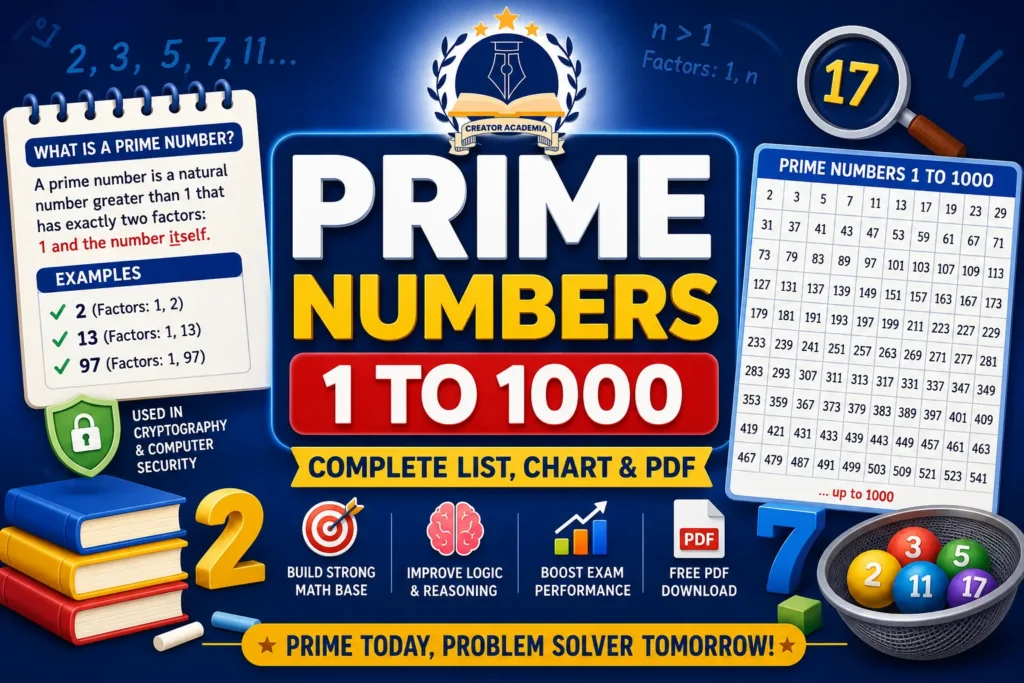
Prime Numbers 1 to 1000
Prime numbers are the fundamental building blocks of mathematics. Understanding prime numbers is essential for solving complex problems in number theory, algebra, and even modern-day computer security.
For example:
- 2 (Factors: 1, 2)
- 13 (Factors: 1, 13)
- 97 (Factors: 1, 97)
In this post, we will provide a comprehensive list, chart, and PDF of prime numbers from 1 to 1000 to help you with your studies and competitive exams.
What is a Prime Number?
A prime number is a natural number greater than 1 that has exactly two factors: 1 and the number itself. In other words, it cannot be divided evenly by any other numbers.
In short: A number is prime if it is only divisible by 1 and itself.
Example:
- 5 is prime because only 1
×5 = 5. - 7 is prime because only 1
×7 = 7. - 9 is NOT prime because it can be divided by 3 (3
×3 = 9).
List of Prime Numbers from 1 to 100
There are exactly 25 prime numbers between 1 and 100:
2, 3, 5, 7, 11, 13, 17, 19, 23, 29, 31, 37, 41, 43, 47, 53, 59, 61, 67, 71, 73, 79, 83, 89, 97.
1 to 1000 Prime Numbers List
This table lists the prime numbers from 1 to 1000.
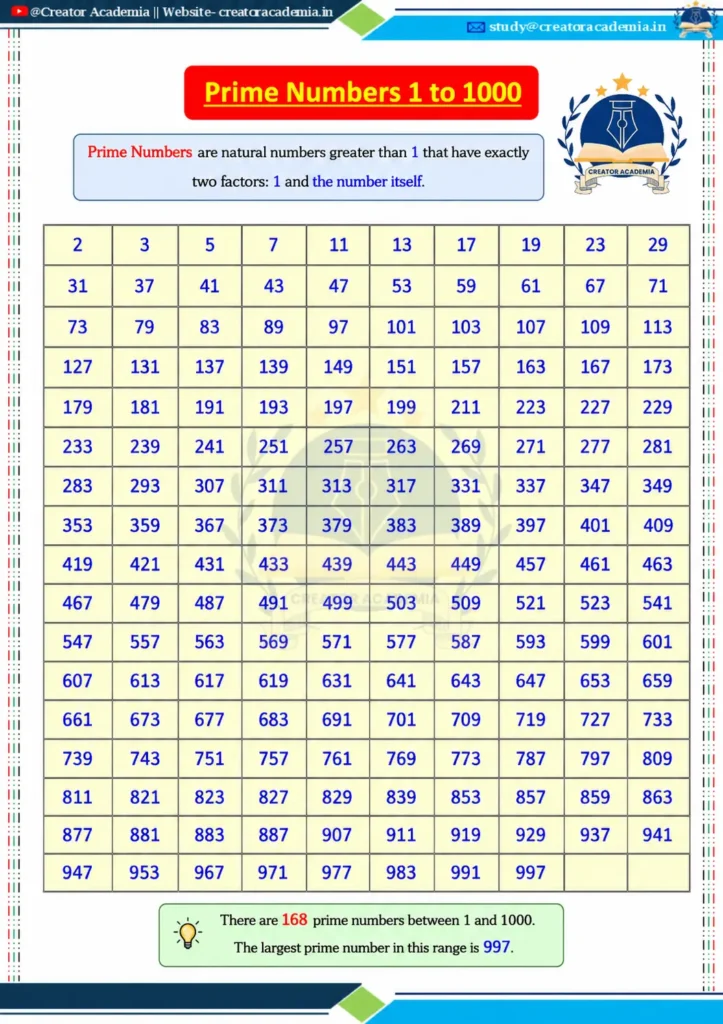
Download the PDF of Prime Numbers 1 to 1000 from the link given below.
Prime Numbers 1 to 1000 Chart
Below is a summarized count of prime numbers in different ranges up to 1000:
| Range | Number of Primes |
| 1 – 100 | 25 |
| 101 – 200 | 21 |
| 201 – 300 | 16 |
| 301 – 400 | 16 |
| 401 – 500 | 17 |
| 501 – 600 | 14 |
| 601 – 700 | 16 |
| 701 – 800 | 14 |
| 801 – 900 | 15 |
| 901 – 1000 | 14 |
| Total (1–1000) | 168 Primes |
Why Should You Learn Prime Numbers 1 to 1000?
Whether you are a school student or preparing for competitive exams like SSC, Banking, UPSC, or NTSE, prime numbers are a recurring topic.
Benefits of Learning Prime Numbers:
- Fast Calculations: Helps in simplifying fractions and finding L.C.M. and H.C.F.
- Number Series: Many exam questions on “Missing Numbers” are based on prime number patterns.
- Cryptography: Prime numbers are the basis of modern data encryption and cybersecurity.
- Mathematical Logic: Strengthens your understanding of divisibility rules.
Tips to Identify Prime Numbers Easily
- Check the Last Digit: Except for 2 and 5, all prime numbers end in 1, 3, 7, or 9.
- Sum of Digits Rule: If the sum of the digits of a number is divisible by 3, the number is not prime (except for 3 itself).
- The 6k ± 1 Rule: Every prime number greater than 3 can be written in the form of 6n + 1 or 6n
−1. - Practice Sieve of Eratosthenes: This is the most efficient visual method to find all primes up to a certain limit.
Short Tricks to Remember Prime Numbers
Here are some tricks to help you identify primes quickly:
1. The Only Even Prime
👉 Trick: 2 is the only even prime number. Every other even number is divisible by 2, making it composite.
2. The Ending with 5 Rule
👉 Trick: No prime number greater than 5 ends in 5 or 0. (e.g., 15, 25, 35 are all divisible by 5).
3. How to check if a number (up to 100) is Prime
👉 Trick: Check if the number is divisible by 2, 3, 5, or 7. If it is not divisible by any of these four, and is not 1, it is a prime number!
Example:
- Is 91 prime? It’s not divisible by 2, 3, or 5. But 91 ÷ 7 = 13. So, 91 is NOT prime.
- Is 89 prime? Not divisible by 2, 3, 5, or 7. So, 89 is Prime.
Some Fun Facts About Prime Numbers
- Number 1 is neither prime nor composite.
- Twin Primes: These are pairs of primes that differ by 2 (e.g., 3 & 5, 11 & 13, 17 & 19).
- Infinite Primes: There is no “largest” prime number; they go on forever!
- Nature’s Primes: Certain species of Cicadas stay underground for 13 or 17 years (both prime numbers) to avoid predators.
Uses of Prime Numbers in Real Life
- Cybersecurity: RSA encryption uses the product of two very large prime numbers to secure your bank transactions and messages.
- Computer Science: Prime numbers are used in “Hash Tables” to organize data efficiently.
- Architecture: Used in creating balanced and aesthetic proportions in design.
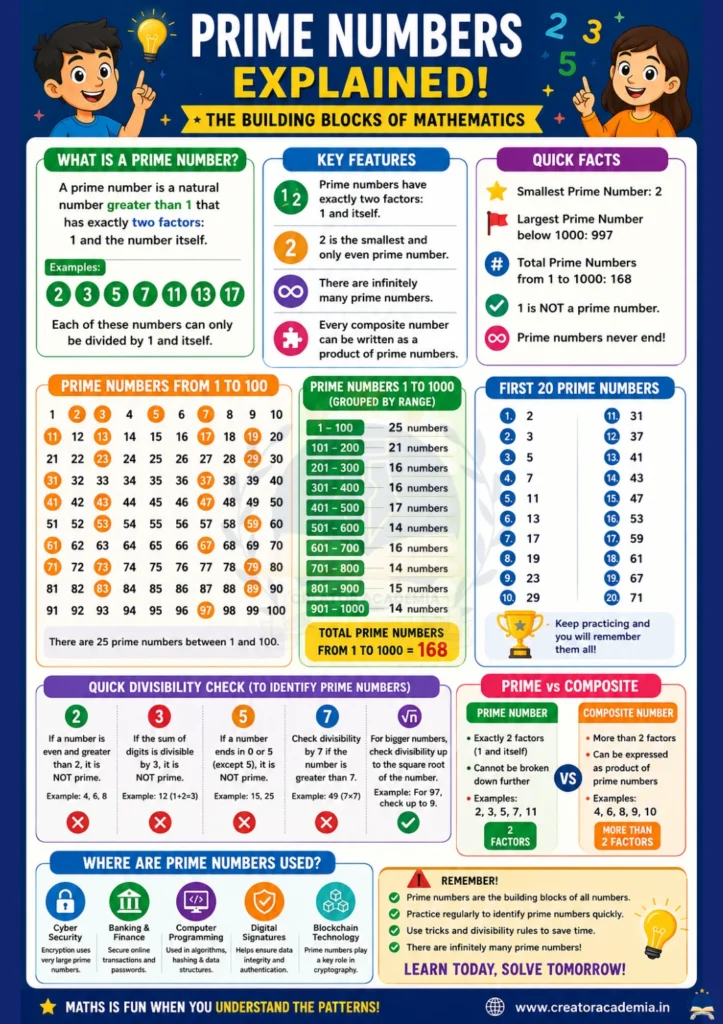
Final Tips
- Memorize 1 to 100: Knowing the first 25 primes by heart will save you massive time in exams.
- Daily Quiz: Try to list primes in blocks of 10 (e.g., “What are the primes between 40 and 50?”).
- Use Flashcards: Write the number on one side and “Prime/Composite” on the other.
Conclusion
Mastering prime numbers from 1 to 1000 provides a strong foundation for higher mathematics. By practicing regularly and using the shortcuts mentioned above, you can identify primes in seconds. Start learning today to boost your speed and accuracy in math!
Quick Facts About Prime Numbers
| Question | Answer |
|---|---|
| Smallest Prime Number | 2 |
| Largest Prime Number below 1000 | 997 |
| Total Prime Numbers up to 1000 | 168 |
| Is 1 Prime? | No |
| Is 2 Prime? | Yes |
| Is Every Odd Number Prime? | No |
| Are There Infinite Prime Numbers? | Yes |
| Only Even Prime Number | 2 |
| Some Important Links | |
| Download Prime Numbers 1 to 1000 PDF | Click Here |
| Download 1 to 30 Cube Roots List (Perfect Cubes) PDF | Click Here |
| Download 1 to 30 Square Roots List (Perfect Squares) PDF | Click Here |
| Download 1 to 50 Cubes PDF | Click Here |