Introduction to Science: Meaning, Branches, and Scientific Method
Introduction
Human curiosity about the natural world is the foundation of all scientific discovery. From early humans observing the changing seasons to modern scientists studying subatomic particles, the desire to understand how the universe functions has driven continuous inquiry.
Science is not merely a collection of facts, formulas, or dynamic theories; it is a systematic and organized enterprise that builds and organizes knowledge in the form of testable explanations and predictions about the universe.
Meaning and Etymology of Science
The word Science is derived from the Latin word scientia, which means “knowledge” or “to know.” However, not all knowledge is scientific. Information acquired through random opinion, superstition, or unverified belief does not qualify as science.
For knowledge to be considered scientific, it must be:
- Systematic: Organized through structured study, inquiry, and classification.
- Empirical: Based on direct observation, physical evidence, and experimentation rather than mere intuition or speculation.
- Testable & Reproducible: Capable of being tested through experiments that yield consistent results when repeated by independent researchers.
- Falsifiable: Formulated in a way that allows it to be proven false if contradictory evidence is discovered.
Major Branches of Science
To study the vast natural and physical universe efficiently, science is categorized into several primary branches based on the subject matter under investigation.
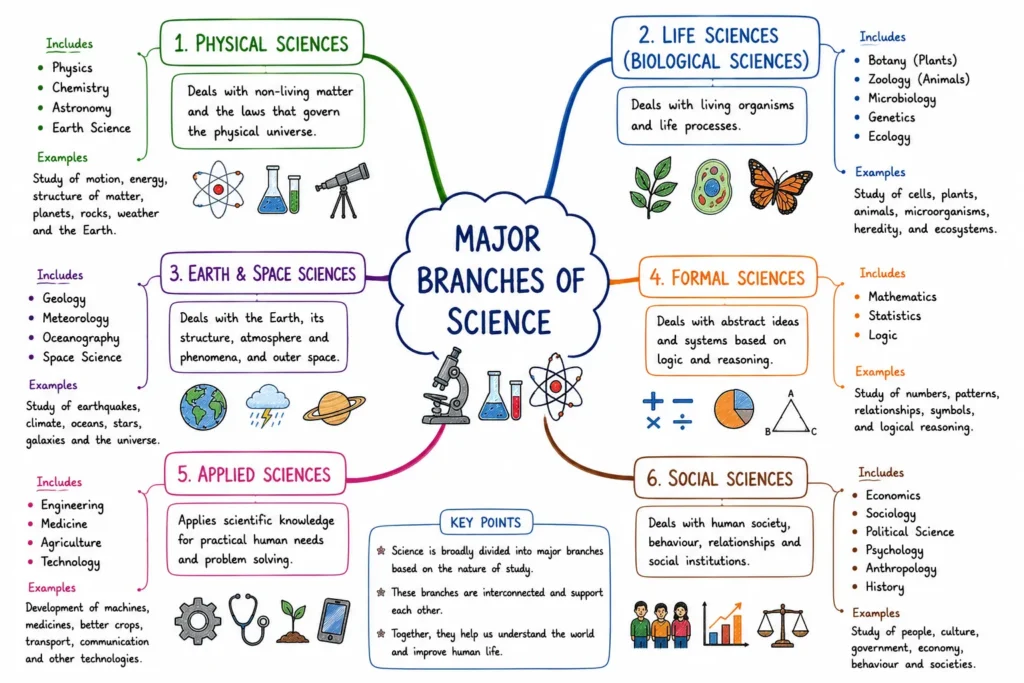
1. Natural Sciences
Natural sciences study the physical world, its phenomena, and the laws governing nature. They are broadly divided into two domains:
A. Physical Sciences
- Physics: The study of matter, energy, motion, force, and the fundamental laws that govern the physical universe.
- Chemistry: The study of the composition, structure, properties, and reactions of substances and matter.
- Earth & Space Sciences: Includes Geology (study of Earth’s structure and rocks), Meteorology (study of atmosphere and weather), and Astronomy (study of celestial bodies and the universe).
B. Life Sciences (Biological Sciences)
- Biology: The study of living organisms, their structure, growth, evolution, function, and distribution.
- Botany: The specialized study of plants.
- Zoology: The specialized study of animals.
- Microbiology: The study of microscopic organisms like bacteria, viruses, and fungi.
2. Formal Sciences
Formal sciences deal with abstract concepts, quantitative reasoning, and symbolic logic. Unlike natural sciences, they do not rely on empirical observations of the physical world but provide the language and analytical tools used by all other sciences.
- Computer Science
- Mathematics
- Logic
- Statistics
3. Applied Sciences
Applied sciences use existing scientific knowledge to develop practical applications, technology, inventions, and real-world solutions.
- Agriculture: Applying biological principles to improve crop yield and soil quality.
- Engineering: Applying physics and mathematics to build machinery, bridges, and electronics.
- Medicine & Health Sciences: Applying biology and chemistry to diagnose, treat, and prevent disease.
The Scientific Method
The Scientific Method is the standardized, step-by-step procedure used by scientists to investigate phenomena, acquire new knowledge, or correct and integrate previous knowledge. It relies on empirical evidence and rigorous testing to minimize personal bias.
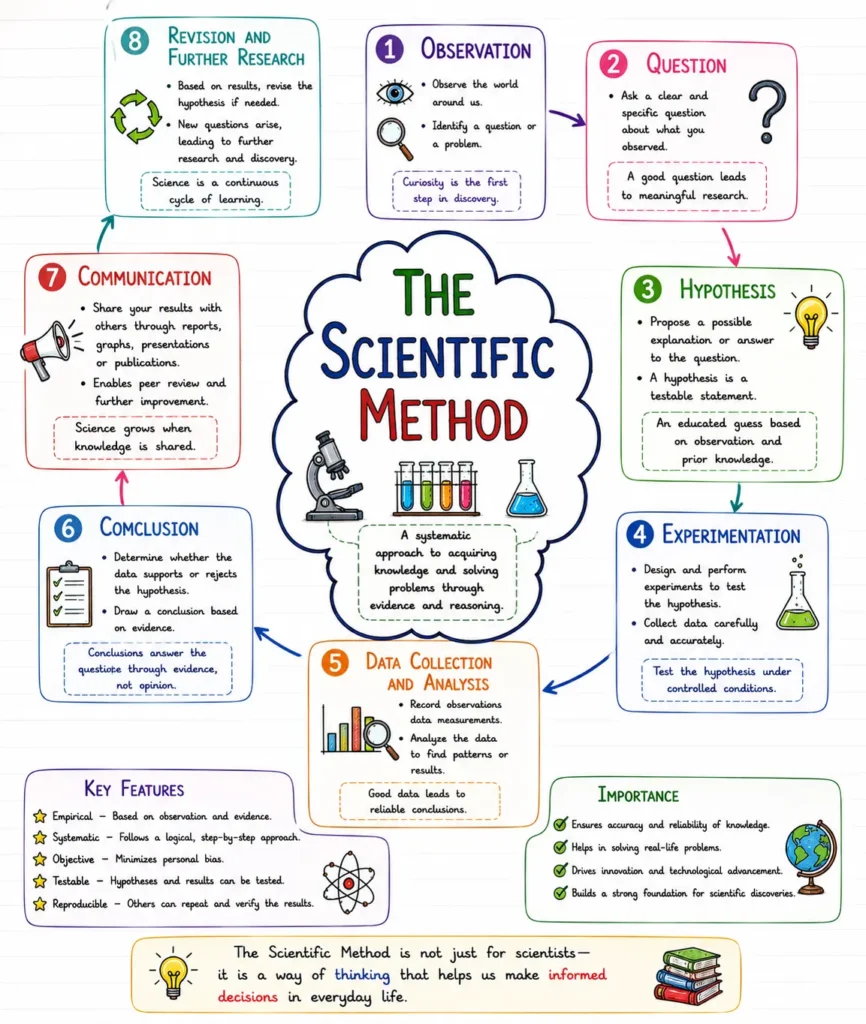
Key Steps of the Scientific Method
- Peer Review & Publication: Sharing findings with the scientific community for independent verification and critique.
- Observation & Questioning: Identifying a phenomenon or problem in nature and asking a specific question about why or how it occurs.
- Formulating a Hypothesis: Creating a tentative, testable, and falsifiable explanation for the observed phenomenon based on existing knowledge.
- Experimentation & Testing: Designing and conducting controlled experiments to test whether the hypothesis is valid. Variables are carefully monitored:
- Independent Variable: The factor intentionally changed or manipulated by the scientist.
- Dependent Variable: The factor measured to see the outcome or response.
- Controlled Variables: Factors kept constant throughout the experiment to ensure a fair test.
- Data Collection & Analysis: Recording experimental measurements, observations, and data accurately using statistical tools.
- Drawing Conclusions: Evaluating the data to determine whether it supports or refutes the original hypothesis.
Distinguishing Scientific Terms: Hypothesis, Theory, and Law
In everyday conversation, words like “theory” and “law” are often used loosely. However, in scientific terminology, they have precise meanings:
| Scientific Term | Definition | Key Characteristics | Example |
|---|---|---|---|
| Hypothesis | An educated, testable prediction or tentative explanation. | Unproven; subject to ongoing experimental testing. | “If plants receive more sunlight, then they will grow faster.” |
| Scientific Law | A statement describing WHAT happens in nature under specific conditions. | Describes observable phenomena; often expressed mathematically. | Newton’s Law of Universal Gravitation: |
| Scientific Theory | A comprehensive, well-tested explanation of WHY or HOW natural phenomena occur. | Supported by extensive empirical evidence; never “upgraded” into a law. | Theory of Evolution, Germ Theory of Disease, Cell Theory. |
Crucial Distinction: A scientific law describes what happens, whereas a scientific theory explains why or how it happens. A theory does not become a law simply by gathering more evidence; both serve distinct roles in scientific understanding.
Quick Examination Facts
| Concept / Fact | Key Exam Fact |
|---|---|
| Etymology of ‘Science’ | Derived from Latin scientia, meaning “knowledge” or “to know.” |
| Empirical Knowledge | Knowledge gained through direct observation and experimentation. |
| Independent Variable | The variable changed or manipulated by the experimenter. |
| Dependent Variable | The variable measured to observe the effect of changing the independent variable. |
| Controlled Variable | Variables kept strictly constant to ensure a fair test. |
| Father of Modern Science | Galileo Galilei (pioneered observational astronomy and the empirical scientific method). |
| Scientific Law | Describes what happens in nature (often via mathematical equations). |
| Scientific Theory | Explains why or how natural phenomena occur based on extensive evidence. |
| Falsifiability | The property that a scientific statement or hypothesis can be proven wrong by an experiment. |
| Formal Sciences | Branches dealing with logic and mathematics rather than physical observation. |
Conclusion
Science is an evolving body of knowledge governed by systematic inquiry, empirical evidence, and critical analysis. By classifying natural phenomena into distinct branches—such as physical, life, and formal sciences—and adhering to the scientific method, researchers can uncover the laws that govern the universe. Understanding these basic principles provides the foundation required to study specific branches of general science, including physics, chemistry, and biological systems.
Introduction to Science
Practice Quiz
| Some Important Links | |
| Download “Introduction to Science” PDF | Click Here |