National Income Accounting: Concepts, Aggregates, and Measurement
Introduction
National Income Accounting is the macroeconomic framework used to measure the total economic activity of a nation over a specific period, usually a financial year. Just as a business prepares financial statements to evaluate its performance, a country tracks production, income, and expenditure to assess economic health, guide government policies, and compare living standards across time and regions.
To analyze national income effectively, we must first understand how money and goods circulate through an economy, how different economic aggregates are calculated, and how total output is measured.
The Circular Flow of Income
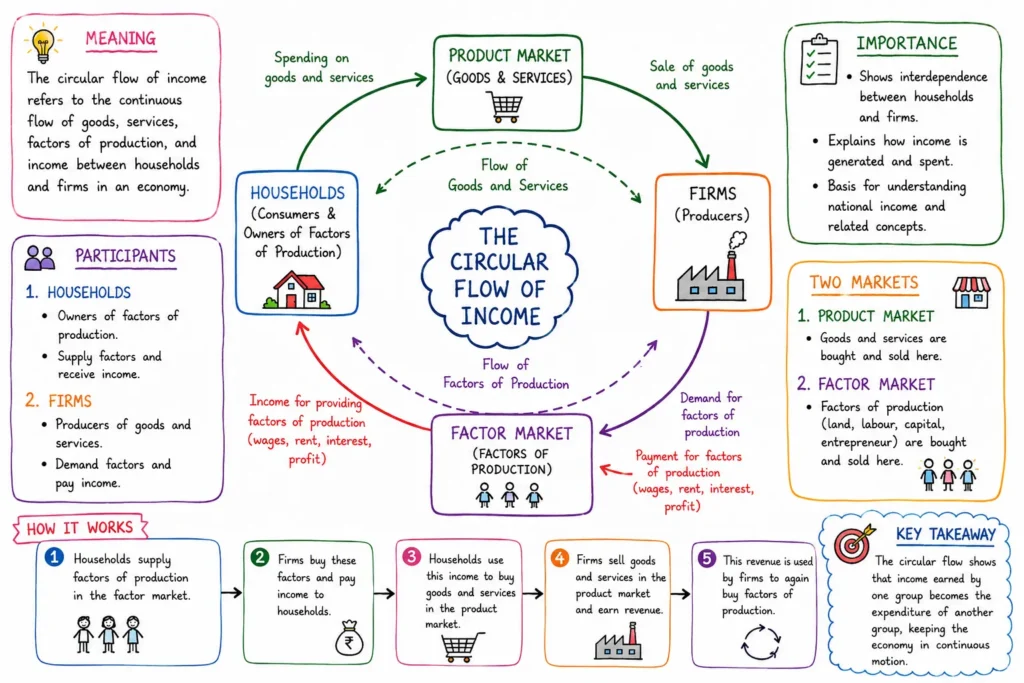
The foundation of national income accounting rests on the concept that every economic expenditure by one entity becomes income for another. In a simplified two-sector economy consisting only of Households and Firms, the circular flow of income operates through two primary streams:
- Real Flow: Households supply factors of production (land, labor, capital, and entrepreneurship) to firms. In return, firms produce and deliver finished goods and services to households.
- Money Flow: Firms pay households factor income (rent, wages, interest, and profit) for their services. Households then spend this money to buy goods and services from firms.
Because total spending on goods equals total revenue earned by firms, which in turn equals total factor payments made to households:
Total Production = Total Income = Total Expenditure
This identity forms the basis for the three different methods used to calculate National Income.
Core Aggregates of National Income
To measure an economy’s total output, economists rely on specific metrics known as national income aggregates. These metrics differ based on geographic boundaries, foreign income, and depreciation.
1. Gross Domestic Product (GDP)
Gross Domestic Product is the total monetary value of all final goods and services produced within the domestic territory of a country during a given financial year.
GDP = C + I + G + (X – M)
- Where C = Private Consumption, I = Investment, G = Government Spending, X = Exports, and M = Imports.
2. Gross National Product (GNP)
Gross National Product measures the total output produced by a nation’s residents, regardless of whether the production takes place inside the country or abroad. It is obtained by adding Net Factor Income from Abroad (NFIA) to GDP.
GNP = GDP + NFIA
- NFIA = Factor income earned by residents abroad – Factor income earned by non-residents domestically.
3. Net Domestic Product (NDP) and Net National Product (NNP)
Capital assets (machinery, equipment, buildings) suffer wear and tear over time during the production process. This reduction in value is called Depreciation (or Consumption of Fixed Capital).
Subtracting depreciation from gross metrics gives net metrics:
NDP = GDP – Depreciation
NNP = GNP – Depreciation
Market Price vs. Factor Cost
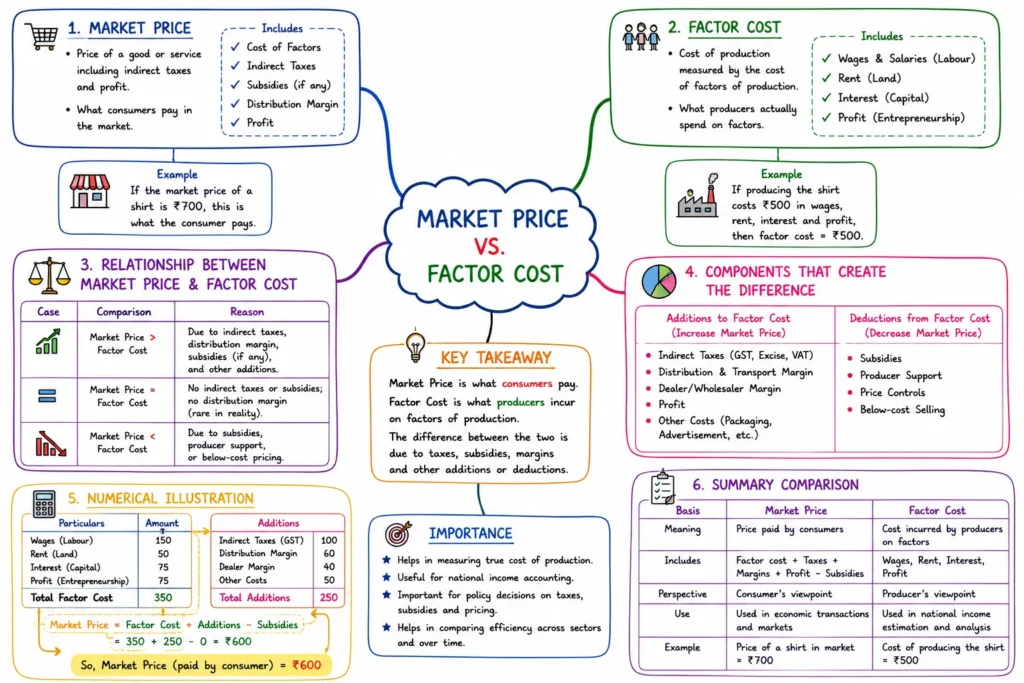
National income aggregates can be measured either at Factor Cost (FC) or at Market Price (MP):
- Factor Cost (FC): The total cost of production inputs paid to the factors of production (land, labor, capital, entrepreneurship). It reflects the true production cost before government intervention.
- Market Price (MP): The price at which goods and services are sold to final consumers in the market. It includes Net Indirect Taxes (NIT).
Market Price = Factor Cost + Net Indirect Taxes
Net Indirect Taxes (NIT) = Indirect Taxes (e.g., GST) – Subsidies
Official National Income: In economic terms, Net National Product at Factor Cost (NNPFC) is recognized as the official National Income (Y) of a country.
National Income (Y) = NNPFC = NNPMP – Indirect Taxes + Subsidies
Nominal GDP, Real GDP, and the GDP Deflator
Because GDP is calculated in monetary values, inflation can artificially distort production estimates over time. To address this, economists distinguish between Nominal and Real GDP:
- Nominal GDP: Measured using current market prices of the current year. Changes in Nominal GDP reflect changes in both actual output volume and prices.
- Real GDP: Measured using constant prices from a selected base year. Real GDP isolates actual physical output by removing the effects of price inflation. It is the reliable indicator of economic growth.
GDP Deflator
The GDP Deflator is a comprehensive price index that measures the level of inflation across all goods and services produced in an economy:
Methods of Calculating National Income
There are three distinct methodologies for calculating National Income, corresponding to the three stages of the circular flow:
1. Value Added Method (Production Method)
This method measures the total net value added by all producing units within the domestic territory during a financial year. It avoids double counting by focusing only on value added at each stage of production rather than raw total output.
Value Added = Value of Output – Intermediate Consumption
2. Income Method
This method calculates National Income by adding up all factor incomes earned by residents of a country for their productive services during a year:
National Income (Y) = Compensation of Employees (Wages) + Operating Surplus (Rent + Interest + Profit) + Mixed Income of Self-Employed
- Mixed Income: Income earned by self-employed individuals (e.g., small shopkeepers, farmers, doctors) where labor income cannot be easily separated from capital or entrepreneurial income.
3. Expenditure Method
This method calculates National Income by measuring total final expenditure incurred on goods and services within the domestic economy:
GDPMP = C + I + G + (X – M)
- C: Private Final Consumption Expenditure
- I: Gross Domestic Capital Formation (Investment)
- G: Government Final Consumption Expenditure
- (X – M): Net Exports (Exports minus Imports)
Personal Income and Personal Disposable Income
While National Income measures the total income earned by factors of production, individual households do not receive or spend this entire amount due to taxes, corporate retentions, and government welfare transfers.
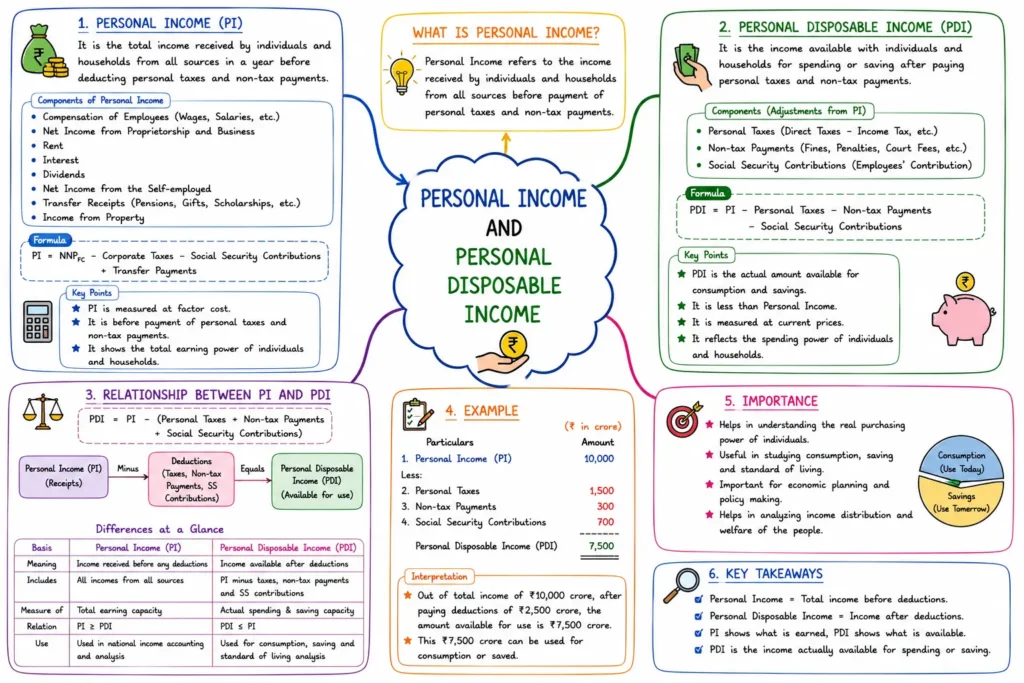
1. Personal Income (PI):
The actual total income received by individuals and households from all sources before paying direct taxes.
Personal Income = National Income – Undistributed Corporate Profits – Corporate Taxes – Social Security Contributions + Transfer Payments
(Transfer Payments: Money received without providing productive services, such as pensions, unemployment benefits, or student scholarships).
2. Personal Disposable Income (PDI):
The actual income available to households for consumption expenditure and personal savings after paying direct taxes.
Personal Disposable Income = Personal Income – Direct Personal Taxes (e.g., Income Tax) – Non-Tax Payments (Fines/Fees)
Limitations of GDP as an Indicator of Welfare
Although GDP is widely used to evaluate an economy’s growth, it is not a complete measure of social well-being or quality of life due to several structural limitations:
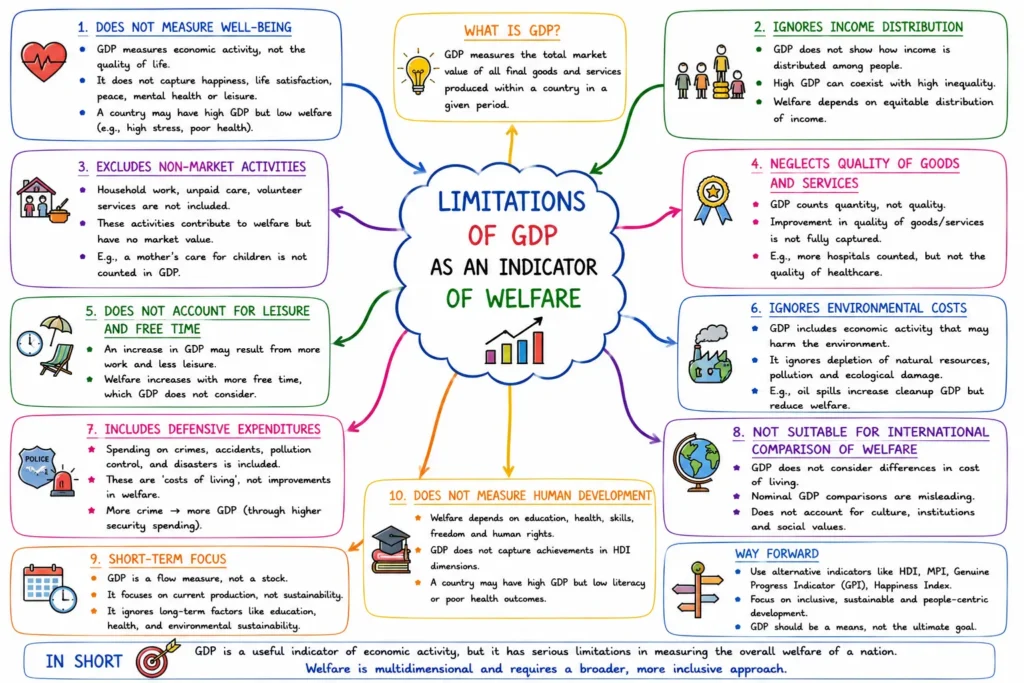
- Non-Monetary Transactions Excluded: Domestic work, caregiving, kitchen gardening, and informal community labor are not traded in markets, so they are excluded from GDP calculations despite adding real social value.
- Distribution of Income Ignored: An increase in GDP does not indicate whether income is distributed equitably or concentrated among a small wealthy minority.
- Externalities: Economic activities often produce unintended side effects (externalities) that are ignored in GDP:
- Negative Externalities: Industrial pollution, environmental degradation, and resource depletion lower living quality but are not deducted from GDP.
- Positive Externalities: Private parks or public education create social benefits that are not fully captured in GDP metrics.
- Composition of Output: GDP measures total value regardless of output type. Spending on war munitions or post-disaster cleanup increases GDP the same way spending on schools or hospitals does.
Quick Examination Facts
| Metric / Concept | Key Textbook Fact |
|---|---|
| Official Definition of National Income | Net National Product at Factor Cost (NNPFC) |
| Formula for GDP | GDP = C + I + G + (X – M) |
| Formula for GNP | GNP = GDP + Net Factor Income from Abroad (NFIA) |
| Formula for Net Metrics | Net = Gross – Depreciation |
| Formula for Market Price | Market Price = Factor Cost + Net Indirect Taxes (NIT) |
| Net Indirect Taxes (NIT) | Indirect Taxes – Subsidies |
| Real GDP Basis | Constant base-year prices (removes inflation effects) |
| Nominal GDP Basis | Current market prices (includes inflation effects) |
| GDP Deflator Formula | GDP Deflator=(Nominal GDPReal GDP)×100 |
| Value Added Formula | Value of Output – Intermediate Consumption |
| Transfer Payments Example | Pensions, scholarships, unemployment aid (Excluded from National Income) |
| Personal Disposable Income | Personal Income – Direct Income Taxes |
| Primary Limitation of GDP | Excludes non-monetary work, ignores income inequality, and omits environmental externalities |
Conclusion
National Income Accounting provides the quantitative foundation for macroeconomics. By tracking circular economic flows and measuring aggregates like GDP, GNP, and NNP through production, income, and expenditure approaches, policy makers can assess economic performance, adjust monetary and fiscal strategies, and manage economic trends. Understanding the distinction between Real and Nominal values, as well as the inherent limitations of GDP as a welfare indicator, allows for a balanced analysis of national economic growth.
National Income Accounting
Practice Quiz
| Some Important Links | |
| Download “Introduction to Economics” PDF | Click Here |