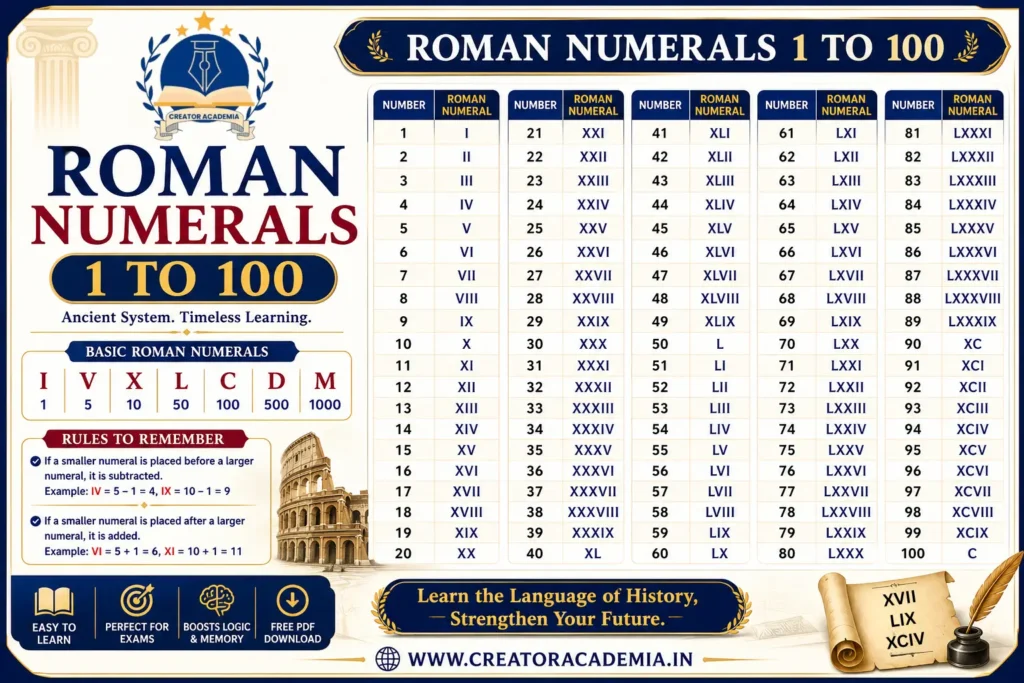
Roman Numerals 1 to 100
Roman numerals are an ancient system of numerical notation used by the Romans and still widely seen today. From the faces of elegant clocks to the titles of book chapters and the numbering of sporting events like the Olympics, Roman numerals are a part of our daily lives.
For example:
- V = 5
- X = 10
- L = 50
In this post, we will provide an easy-to-read list and chart of Roman Numerals from 1 to 100, along with the rules you need to master them and a downloadable PDF.
What is a Roman Numerals?
The Roman numeral system uses specific letters from the Latin alphabet to represent values. To write numbers from 1 to 100, you only need to know these five basic symbols:
| Symbol | Value |
| I | 1 |
| V | 5 |
| X | 10 |
| L | 50 |
| C | 100 |
Roman Numerals 1 to 100 Chart
Here is the list of key Roman Numerals from 1 to 100:
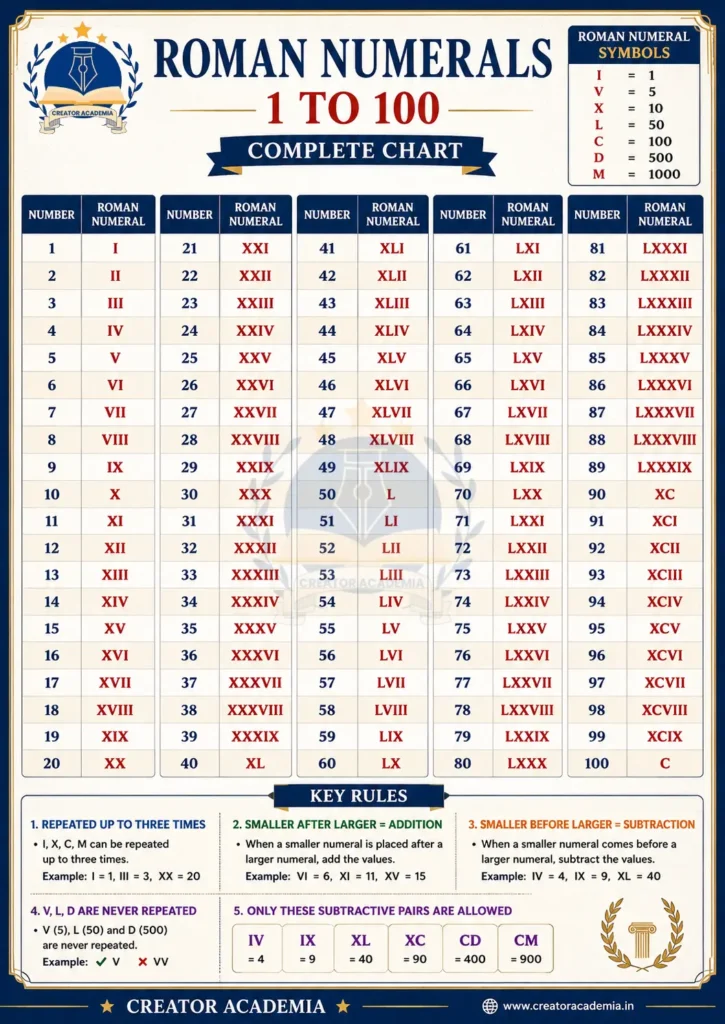
Download the PDF of printable chart to help you memorize Roman numerals anywhere, anytime from the link given below.
Why Should You Learn Roman Numerals 1 to 100?
Learning Roman numerals is very helpful for school students and those appearing for competitive exams like SSC, Bank, and Railways.
Benefits of Learning Roman Numerals:
- Logical Thinking: Understanding the addition and subtraction rules boosts mental math.
- Competitive Exams: Questions on “Analogy” and “Series” often use Roman numerals.
- Reading Clocks: Many classic analog clocks use Roman numerals for hours.
- History & Literature: Helps in understanding historical dates, outlines, and prefaces of books.
Basic Rules for Writing Roman Numerals
Follow these simple rules to write any number correctly:
- Rule of Three: You can repeat a symbol (I, X, C) up to three times in a row (e.g., 3 is III, 30 is XXX).
- Addition: If a smaller value is placed after a larger one, add them (e.g., XII = 10 + 2 = 12).
- Subtraction: If a smaller value is placed before a larger one, subtract it (e.g., IV = 5 – 1 = 4; XC = 100 – 10 = 90).
- Fixed Symbols: Symbols V and L are never repeated or used for subtraction.
Short Tricks to Remember Roman Numerals Quickly
Use these shortcuts to avoid confusion:
1. The “IX” and “IV” Pattern
👉 Trick: Remember that numbers ending in 4 and 9 always involve subtraction.
- 4 = IV (5-1)
- 9 = IX (10-1)
- 40 = XL (50-10)
- 90 = XC (100-10)
2. The Milestone Method
👉 Trick: Focus on the main milestones: 10 (X), 50 (L), and 100 (C). Once you know these, you just need to add or subtract “X” or “I” to get the surrounding numbers.
3. Break it Down
👉 Trick: To write 78, break it into 70 + 8.
- 70 = LXX
- 8 = VIII
- Result = LXXVIII
Some Fun Facts About Roman Numerals
- No Zero: The Romans did not have a symbol or concept for the number zero.
- Clock Face Mystery: On many clocks, 4 is written as IIII instead of IV. This is often done for aesthetic symmetry with the VIII on the other side.
- Super Bowls: The NFL uses Roman numerals for every Super Bowl (except Super Bowl 50) to maintain a sense of tradition and importance.
Uses of Roman Numerals in Real Life
- Clocks and Watches: Hours are often marked I to XII.
- Outlines: Used for main headings in essays or legal documents.
- Sequels: Used in movies and video games (e.g., Final Fantasy VII, Rocky IV).
- Buildings: Year of construction is often engraved in Roman numerals on cornerstones.
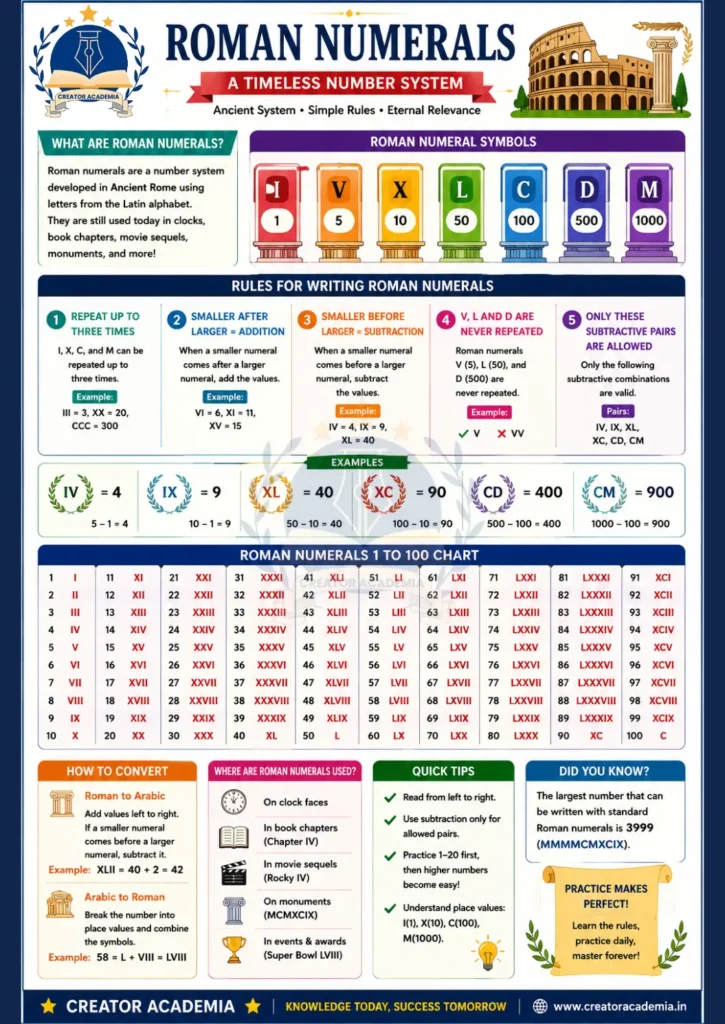
Rules for Writing Roman Numerals
Understanding the rules is the key to reading and writing Roman numerals correctly.
Rule 1: Repeat a Symbol Up to Three Times
The symbols I, X, C, and M can be repeated up to three times.
Examples:
- II = 2
- III = 3
- XX = 20
- XXX = 30
Rule 2: Smaller Value After Larger Value = Addition
When a smaller numeral comes after a larger numeral, the values are added.
Examples:
- VI = 6
- VII = 7
- VIII = 8
- XI = 11
- XV = 15
Rule 3: Smaller Value Before Larger Value = Subtraction
When a smaller numeral comes before a larger numeral, the smaller value is subtracted.
Examples:
- IV = 4
- IX = 9
- XL = 40
- XC = 90
Rule 4: V, L and D Are Never Repeated
The symbols:
- V (5)
- L (50)
- D (500)
cannot be repeated.
Examples:
✔ V
❌ VV
✔ L
❌ LL
Rule 5: Only Certain Subtractive Combinations Are Allowed
The valid subtractive combinations are:
| Roman Numeral | Value |
|---|---|
| IV | 4 |
| IX | 9 |
| XL | 40 |
| XC | 90 |
| CD | 400 |
| CM | 900 |
Final Tips
- Practice Writing: Try writing your age, your house number, or today’s date in Roman numerals.
- Flashcards: Create cards with the number on one side and the numeral on the other.
- Daily Check: Spend 5 minutes looking at the Roman numeral chart every morning.
Conclusion
Mastering Roman numerals 1 to 100 is a simple yet rewarding skill. It helps you think differently about numbers and prepares you for various academic challenges. Start with the basics (I, V, X, L, C) and soon you’ll be reading and writing them like a pro!
Quick Facts About Roman Numerals
| Question | Answer |
| How many basic symbols are there? | 7 (I, V, X, L, C, D, M) |
| Smallest Roman Numeral | I (Value = 1) |
| Is there a symbol for Zero (0)? | No |
| Maximum times a symbol can repeat | 3 times (e.g., III, XXX) |
| Symbols that are NEVER repeated | V, L, and D |
| Symbol for 50 | L |
| Symbol for 100 | C |
| Symbol for 500 | D |
| Symbol for 1000 | M |
| Are Roman Numerals case-sensitive? | No (Usually Uppercase) |
| System used for IV (4) and IX (9) | Subtractive System |
| Some Important Links | |
| Download Roman Numerals 1 to 100 PDF | Click Here |
| Download Composite Numbers 1 to 1000 PDF | Click Here |
| Download Prime Numbers 1 to 1000 PDF | Click Here |
| Download 1 to 30 Cube Roots List (Perfect Cubes) PDF | Click Here |
| Download 1 to 30 Square Roots List (Perfect Squares) PDF | Click Here |