Divisibility Rules from 2 to 20
Divisibility rules are essential mental shortcuts in mathematics. They allow you to determine whether a number is divisible by another without performing the actual long division. Mastering these rules is a game-changer for speed and accuracy in math.
For example:
- Is 128 divisible by 2? Yes, because it ends in 8.
- Is 153 divisible by 3? Yes, because 1+5+3=9 (which is divisible by 3).
In this post, we provide a complete chart of divisibility rules from 1 to 20, along with easy short tricks and a downloadable PDF for your study desk.
What is a Divisibility Rule?
A divisibility rule is a shorthand way of determining whether a given integer is divisible by a fixed divisor without performing division, usually by examining its digits.
In short: Divisibility Rule = A shortcut to find factors and multiples quickly.
Complete Divisibility Rules Table (1 to 20)
| Divisor | Rule / Condition |
| 1 | Every number is divisible by 1. |
| 2 | The last digit is even (0, 2, 4, 6, or 8). |
| 3 | The sum of the digits is divisible by 3. |
| 4 | The last two digits are divisible by 4. |
| 5 | The last digit is either 0 or 5. |
| 6 | The number is divisible by both 2 and 3. |
| 7 | Double the last digit and subtract it from the rest. The result must be 0 or divisible by 7. |
| 8 | The last three digits are divisible by 8. |
| 9 | The sum of the digits is divisible by 9. |
| 10 | The number ends in 0. |
| 11 | The difference between the sum of digits at odd places and even places is 0 or divisible by 11. |
| 12 | The number is divisible by both 3 and 4. |
| 13 | Multiply the last digit by 4 and add it to the rest. The result must be divisible by 13. |
| 14 | The number is divisible by both 2 and 7. |
| 15 | The number is divisible by both 3 and 5. |
| 16 | The last four digits are divisible by 16. |
| 17 | Multiply the last digit by 5 and subtract it from the rest. The result must be divisible by 17. |
| 18 | The number is even and divisible by 9. |
| 19 | Multiply the last digit by 2 and add it to the rest. The result must be divisible by 19. |
| 20 | The number ends in 00, 20, 40, 60, or 80. |
Divisibility Rules 1 to 20 Chart
Here is the list of key Divisibility Rules from 1 to 20:
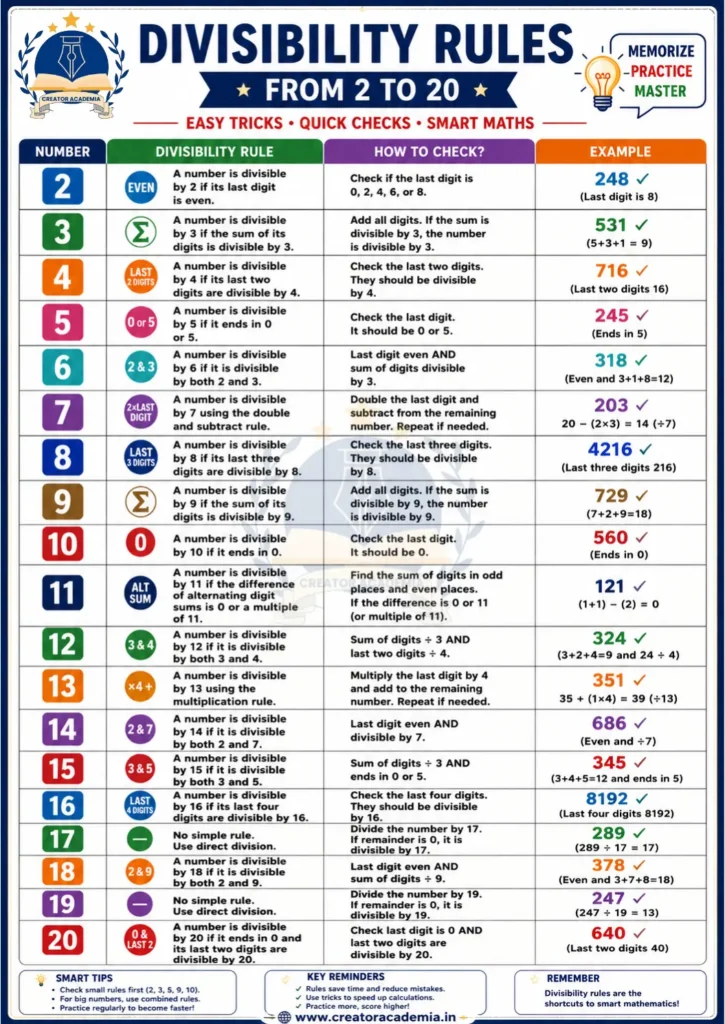
Download the PDF of printable chart to help you memorize Divisibility Rules from 2-20 anywhere, anytime from the link given below.
Why Should You Learn Divisibility Rules?
Today, competitive exams like SSC, Banking, CAT, and Railways require lightning-fast calculations.
Benefits of Learning Divisibility Rules:
- Time Management: Solve simplification and number system problems in seconds.
- Prime Factorization: Quickly break down large numbers into their factors.
- Data Interpretation: Helps in simplifying ratios and percentages in DI sets.
- Simplifying Fractions: Easily find the lowest terms of any fraction.
Basic Rules for Writing Roman Numerals
Follow these simple rules to write any number correctly:
- Rule of Three: You can repeat a symbol (I, X, C) up to three times in a row (e.g., 3 is III, 30 is XXX).
- Addition: If a smaller value is placed after a larger one, add them (e.g., XII = 10 + 2 = 12).
- Subtraction: If a smaller value is placed before a larger one, subtract it (e.g., IV = 5 – 1 = 4; XC = 100 – 10 = 90).
- Fixed Symbols: Symbols V and L are never repeated or used for subtraction.
Short Tricks to Remember Divisibility Rules Quickly
1. The Power of 2 Group (2, 4, 8, 16)
👉 Trick: Look at the end of the number.
- 2: Last 1 digit.
- 4: Last 2 digits.
- 8: Last 3 digits.
- 16: Last 4 digits.
2. The Sum of Digits Group (3 and 9)
👉 Trick: Just add the digits.
- For 3, the sum must be in the table of 3.
- For 9, the sum must be in the table of 9.
- Example: 729 → 7+2+9=18. Divisible by both 3 and 9!
3. The Composite Rule (6, 12, 14, 15)
👉 Trick: If a number is divisible by two co-prime factors, it is divisible by their product.
- 6 = 2 × 3
- 12 = 3 × 4
- 15 = 3 × 5
4. The 7, 11, and 13 Trick
👉 Trick: For larger numbers, group digits in threes from right to left and find the alternating sum. If the result is divisible by 7, 11, or 13, the whole number is too.
Some Fun Facts About Divisibility
- Number 0: Zero is divisible by every number (except zero itself).
- Number 1: 1 is not divisible by any number other than itself.
- Perfect Rule for 7: The rule for 7 is often considered the “hardest,” but the subtraction method makes it simple for smaller numbers.
Uses of Divisibility Rules in Real Life
- Budgeting: Checking if a total amount can be split evenly among a group of people.
- Logistics: Determining how many items can fit into boxes of a certain size.
- Coding: Used in computer algorithms to check for parity and data validation.
- Cooking: Scaling recipes up or down by finding common denominators.
Common Mistakes Students Make
Understanding the rules is the key to reading and writing Roman numerals correctly.
Mistake 1
Checking the entire number instead of only the last two digits for divisibility by 4.
✔ Correct:
For 1,516, check 16, not 1516.
Mistake 2
Forgetting that 6 requires divisibility by both 2 and 3.
Many students only check one rule.
Mistake 3
Thinking every number ending in 5 is divisible by 15.
Wrong.
It must satisfy both:
- Divisible by 3
- Divisible by 5
Mistake 4
Using the divisibility rule of 3 for 9.
Remember:
For 9, the digit sum must be a multiple of 9, not just 3.
Mistake 5
Ignoring the alternating sum rule for 11.
Always calculate:
(Odd-position digit sum) − (Even-position digit sum)
Final Tips
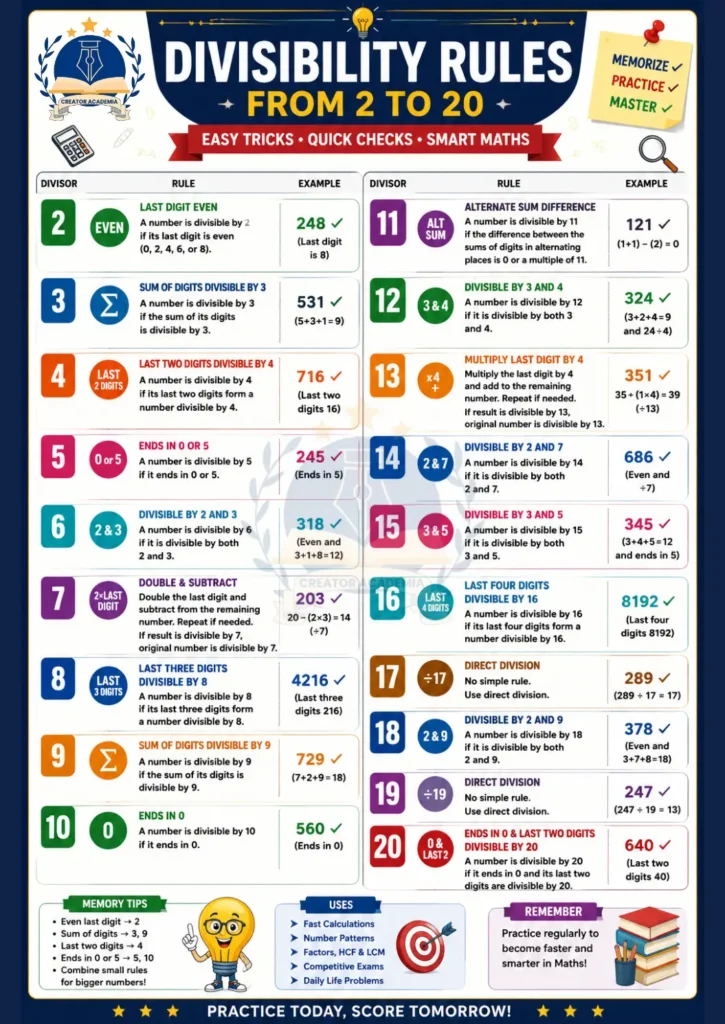
- Practice Daily: Pick 5 random large numbers every morning and test them against rules for 3, 4, 7, and 11.
- Combine Rules: To check for 18, check if it’s even (Rule for 2) and if the sum of digits is divisible by 9.
- Use Elimination: In MCQs, use these rules to eliminate wrong options instantly.
Conclusion
Mastering Divisibility Rules from 1 to 20 is like having a superpower in a math exam. It eliminates the need for messy scratch work and builds your confidence with numbers. Start practicing these rules today and watch your calculation speed double!
Quick Facts About Divisibility Rules
| Question / Category | Answer / Fact |
| Easiest Rules to Master | Rules for 2, 5, and 10 (based on the last digit). |
| Rules based on Sum of Digits | Rules for 3 and 9. |
| Rules based on Last Digits | Rules for 2 (last 1), 4 (last 2), 8 (last 3), and 16 (last 4). |
| The “Hardest” Rule | Rule for 7 is generally considered the most complex to perform mentally. |
| Divisibility of Zero (0) | Zero is divisible by every number (except itself). |
| Universal Divisor | Every integer is divisible by 1. |
| Composite Number Rule | To check 6, 12, or 15, the number must satisfy the rules of its co-prime factors. |
| The Alternating Sum Rule | This unique method is used specifically for the Rule of 11. |
| Smallest number divisible by 1-10 | 2,520 is the smallest number divisible by all numbers from 1 to 10. |
| Rule for 5 vs 10 | Numbers divisible by 10 are always divisible by 5, but not vice versa. |
| Some Important Links | |
| Download Divisibility Rules 2 to 20 PDF | Click Here |
| Download Roman Numerals 1 to 100 PDF | Click Here |
| Download Composite Numbers 1 to 1000 PDF | Click Here |
| Download Prime Numbers 1 to 1000 PDF | Click Here |
| Download 1 to 30 Cube Roots List (Perfect Cubes) PDF | Click Here |