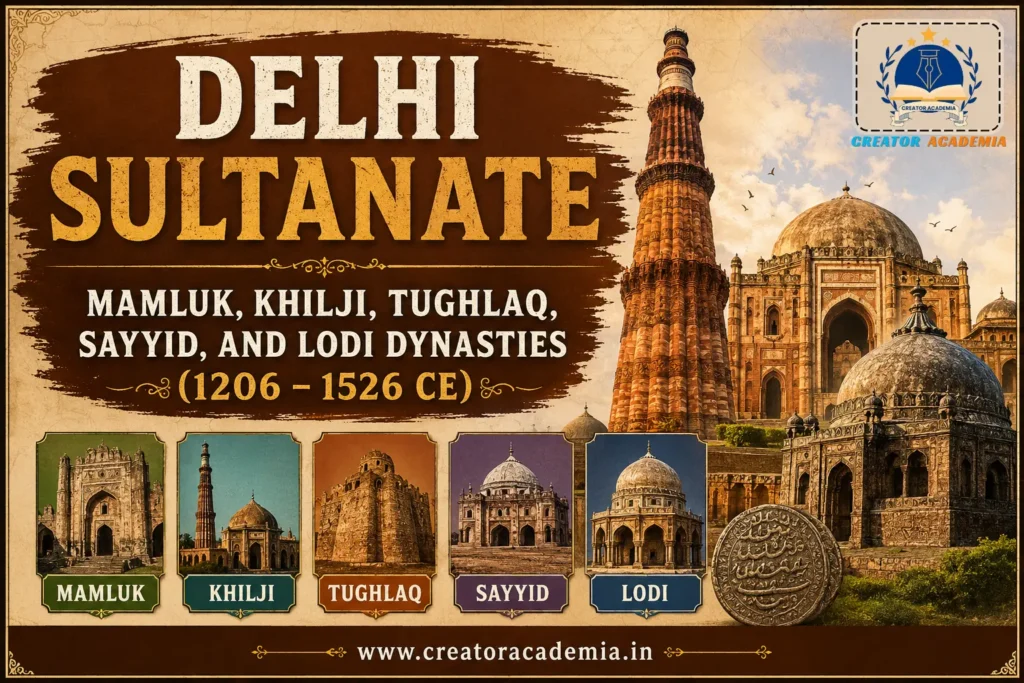
Delhi Sultanate: Mamluk, Khilji, Tughlaq, Sayyid, and Lodi Dynasties (1206 – 1526 CE)
Founded following the military victories of Muhammad Ghori and his Turkish general Qutbuddin Aibak, the Delhi Sultanate integrated Persian administrative institutions with Indian traditions, giving rise to a composite Indo-Islamic culture.
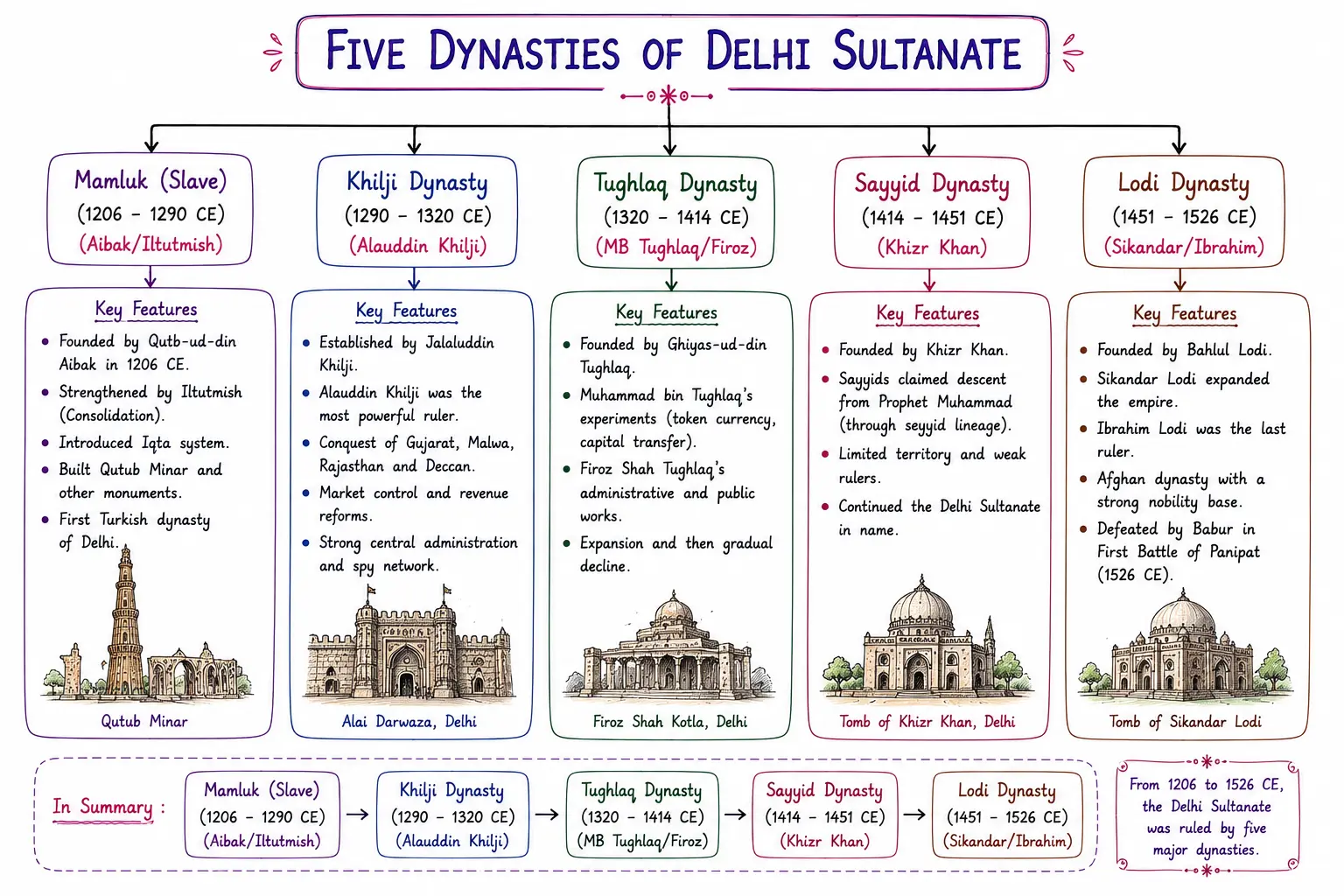
The chronological chart below presents an executive overview of the five ruling dynasties of the Delhi Sultanate, highlighting their hallmark architectural monuments, central ruling figures, and core administrative legacy.
1. The Mamluk (Slave) Dynasty (1206 – 1290 CE)
The word Mamluk literally means “owned” or “slave” in Arabic. The rulers of this dynasty were either military slaves or descendants of slaves who rose to sovereignty through merit, statecraft, and martial prowess.
The infographic below maps the evolutionary reign of the four cornerstone Mamluk monarchs who laid the territorial foundation and institutional framework of the Delhi Sultanate.
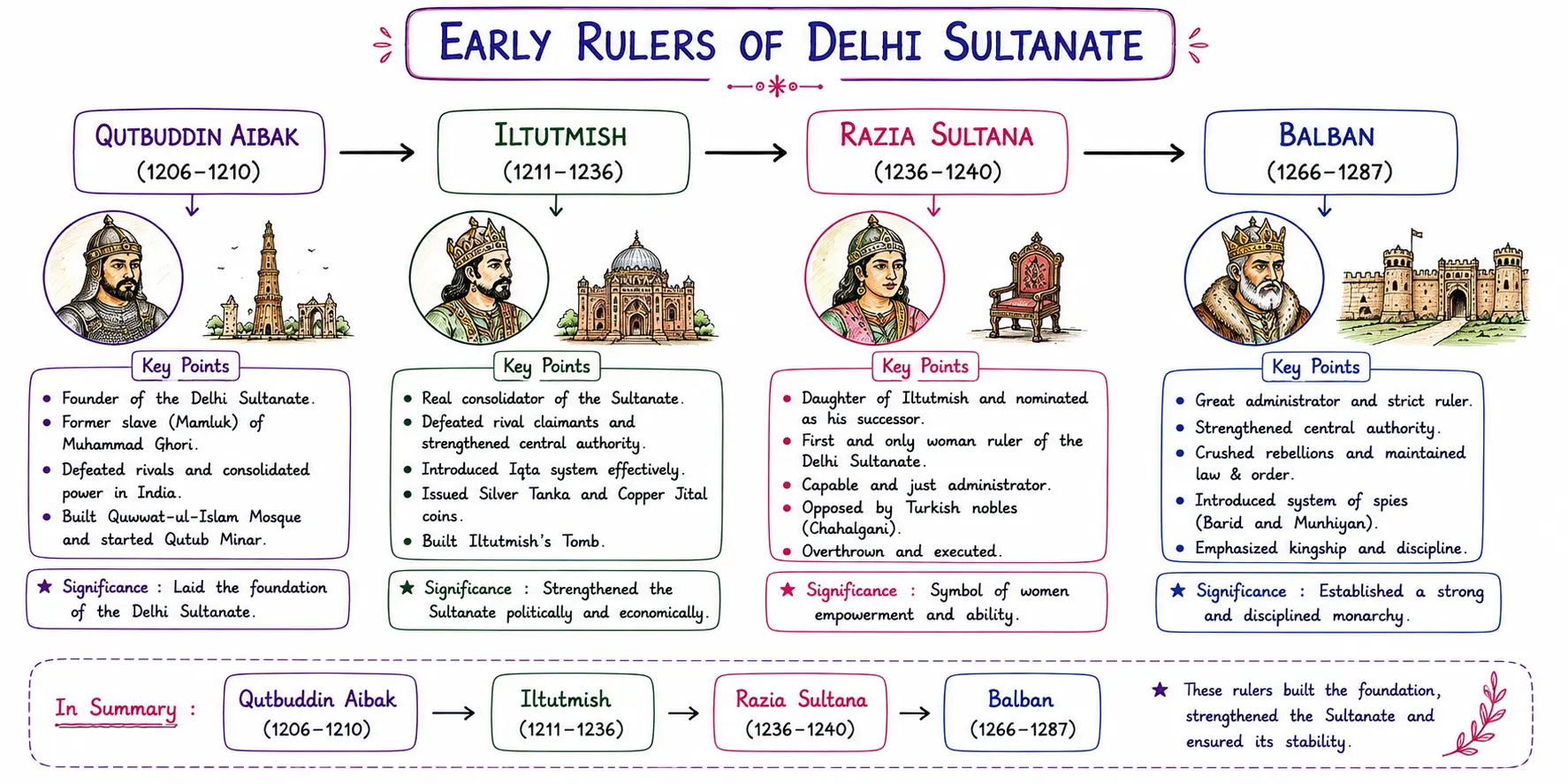
A. Qutbuddin Aibak (1206 – 1210 CE)
- Founder: Established the dynasty after Muhammad Ghori’s death (1206 CE). Ruled from Lahore.
- Titles & Generosity: Known as Lakhbaksh (“Giver of Lakhs”) due to his immense generosity.
- Architecture:
- Initiated the construction of the iconic Qutb Minar in Delhi (dedicated to Sufi saint Khwaja Qutbuddin Bakhtiyar Kaki).
- Built Quwwat-ul-Islam Mosque (Delhi) and Adhai Din Ka Jhonpra (Ajmer).
- Death: Died in 1210 CE while playing Chaugan (early form of Polo) after falling from a horse.
B. Shamsuddin Iltutmish (1211 – 1236 CE)
- Real Founder: Considered the real consolidator of the Delhi Sultanate. Shifted the imperial capital from Lahore to Delhi.
- Administrative Innovations:
- Turkan-i-Chahalgani (The Forty): Created a powerful council of 40 loyal Turkish military slaves to assist in state administration.
- Iqta System: Introduced the Iqta system—dividing the empire into land grants (Iqtas) assigned to military officers (Iqtadars / Muqtis) for collecting revenue and maintaining troops.
- Coinage: Introduced two standard coins: the silver Tanka (175 grains) and the copper Jital.
- Mongol Threat: Successfully averted the Mongol invasion led by Genghis Khan by refusing political asylum to Jalaluddin Mangabarni (the Shah of Khwarazm).
- Completion of Qutb Minar: Completed the construction of the Qutb Minar structure. Received formal investiture (Mansur) from the Abbasid Caliph of Baghdad (1229 CE).
C. Razia Sultana (1236 – 1240 CE)
- First Female Ruler: Nominated by Iltutmish as his successor over his incompetent sons. She became the first and only female Muslim ruler of medieval Delhi.
- Defying Orthodoxy: Rejected the veil (Purdah), dressed in male attire (Kaba and Kulah), and held open court.
- Opposition & Fall: Appointed an Abyssinian slave, Jamaluddin Yaqut, to the high post of Master of the Royal Horses (Amir-i-Akhur), angering the Turkish nobility (Chahalgani). Defeated and imprisoned by Altunia (Governor of Bhatinda), whom she later married. Both were killed near Kaithal (1240 CE) by bandits.
D. Ghiyasuddin Balban (1266 – 1287 CE)
- Restoration of Crown Authority: Strengthened central authority after decades of noble factionalism.
- Destruction of the Forty: Destroyed the influence of Turkan-i-Chahalgani.
- Policy of “Blood and Iron”: Implemented a ruthless policy to crush rebels, bandits, and Mewati raiders around Delhi.
- Divine Right Theory of Kingship: Proclaimed the monarch as Niyabat-i-Khudai (“Deputy of God”) and Zil-i-Ilahi (“Shadow of God on Earth”).
- Court Etiquette: Introduced strict Persian court rituals:
- Sijda: Prostration before the Sultan.
- Paibos: Kissing the feet of the monarch.
- Nauroz: Celebrated the Persian New Year festival annually.
- Military Department: Created a specialized military department called Diwan-i-Arz headed by Ariz-i-Mamalik to check Mongol incursions.
2. The Khilji Dynasty (1290 – 1320 CE)
The Khilji Revolution ended the monopoly of the Turkish aristocracy and introduced aggressive imperial expansion into Peninsular South India.
The following genealogical and regnal overview captures the rise, imperial zenith, and abrupt succession struggles of the major Khilji monarchs.
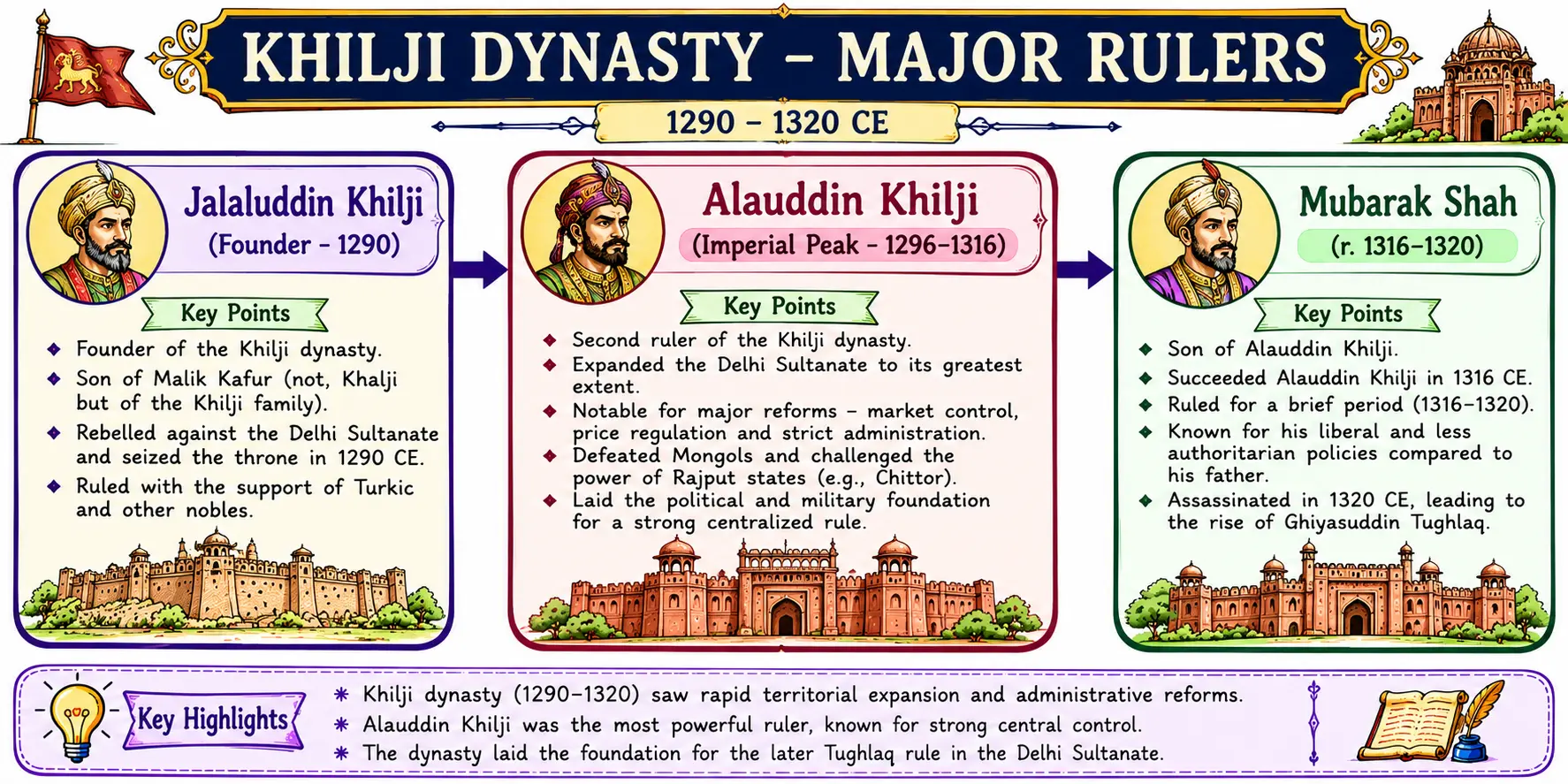
A. Jalaluddin Khilji (1290 – 1296 CE)
- Founder: Overthrew the weak Mamluk successors, establishing the Khilji dynasty at age 70. Adopted a benevolent and lenient administrative policy.
- Assassination: Treacherously assassinated by his ambitious nephew and son-in-law, Alauddin Khilji, at Kara (Prayagraj) in 1296 CE.
B. Alauddin Khilji (1296 – 1316 CE)
Alauddin was a ruthless military genius and administrator who assumed the title Sikandar-i-Sani (“Second Alexander”). His rule rested upon four integrated pillars of statecraft: market regulations, agrarian assessment, a standing army, and architectural patronage.
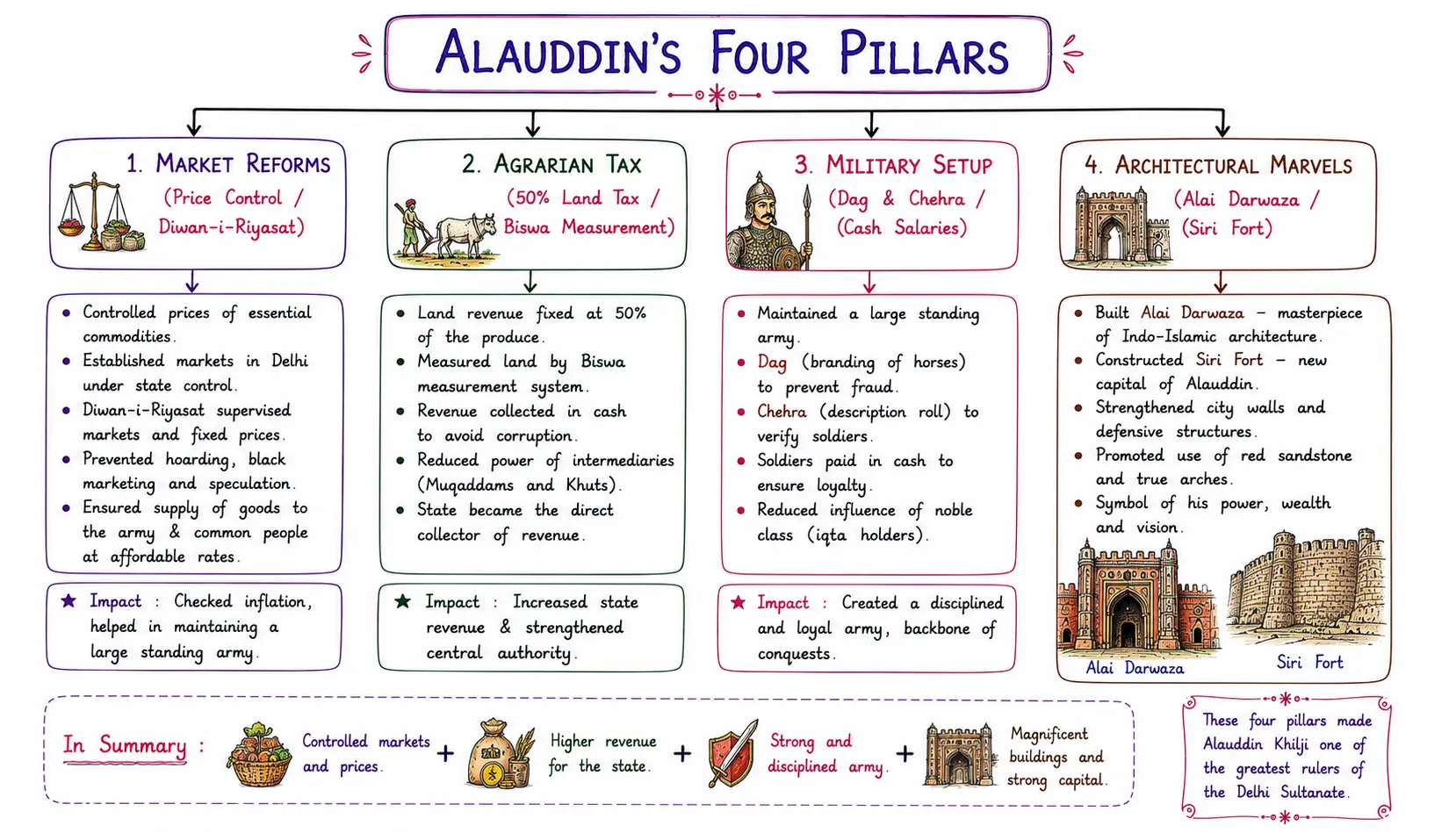
- Agrarian & Revenue Reforms:
- Direct Measurement (Paimaish): First Sultan to measure land using a standard unit (Biswa) for revenue assessment.
- High Tax Rate: Raised land revenue (Kharaj) to 50% (1/2) of total produce.
- Abolition of Intermediaries: Eliminated local hereditary tax collectors (Khuts, Muqaddams, Chaudharies) and imposed direct taxes: Ghari (house tax) and Charai (pasture tax).
- Market Control System (Price Regulation):
- Fixed the prices of all essential commodities (grains, cloth, horses, slaves) in Delhi.
- Established three distinct markets in Delhi supervised by Diwan-i-Riyasat and controlled by a high officer called Shahna-i-Mandi.
- Strict intelligence agents (Munhiyans) reported hoarding or fraudulent weights.
- Military Reforms:
- Maintained the first large permanent standing army paid directly in cash (Naqad) from the royal treasury.
- Introduced Dag (branding of army horses) and Chehra / Huliya (descriptive roll system for soldiers) to prevent corruption.
- Imperial Conquests:
- Northern Expansion: Annexed Gujarat (1299), Ranthambore (1301), Chittor (1303—the story of Rani Padmini written by Malik Muhammad Jayasi in Padmavat), and Malwa (1305).
- Southern Expeditions: Sent his brilliant general Malik Kafur (Hazar Dinari) to conquer the Deccan and South Indian kingdoms: Yadavas of Devagiri, Kakatiyas of Warangal, Hoysalas of Dwarasamudra, and Pandyas of Madurai.
- Architecture: Built the magnificent Alai Darwaza (gateway to Qutb complex featuring the true arch), Siri Fort, Hauz Khas, and Jamait Khana Mosque.
3. The Tughlaq Dynasty (1320 – 1414 CE)
The Tughlaqs ruled for the longest period among all Sultanate dynasties, marked by ambitious administrative experiments, grand public works, and subsequent territorial fragmentation.
The visual matrix below contrasts the architectural initiatives and governance doctrines of the three foremost Tughlaq monarchs.
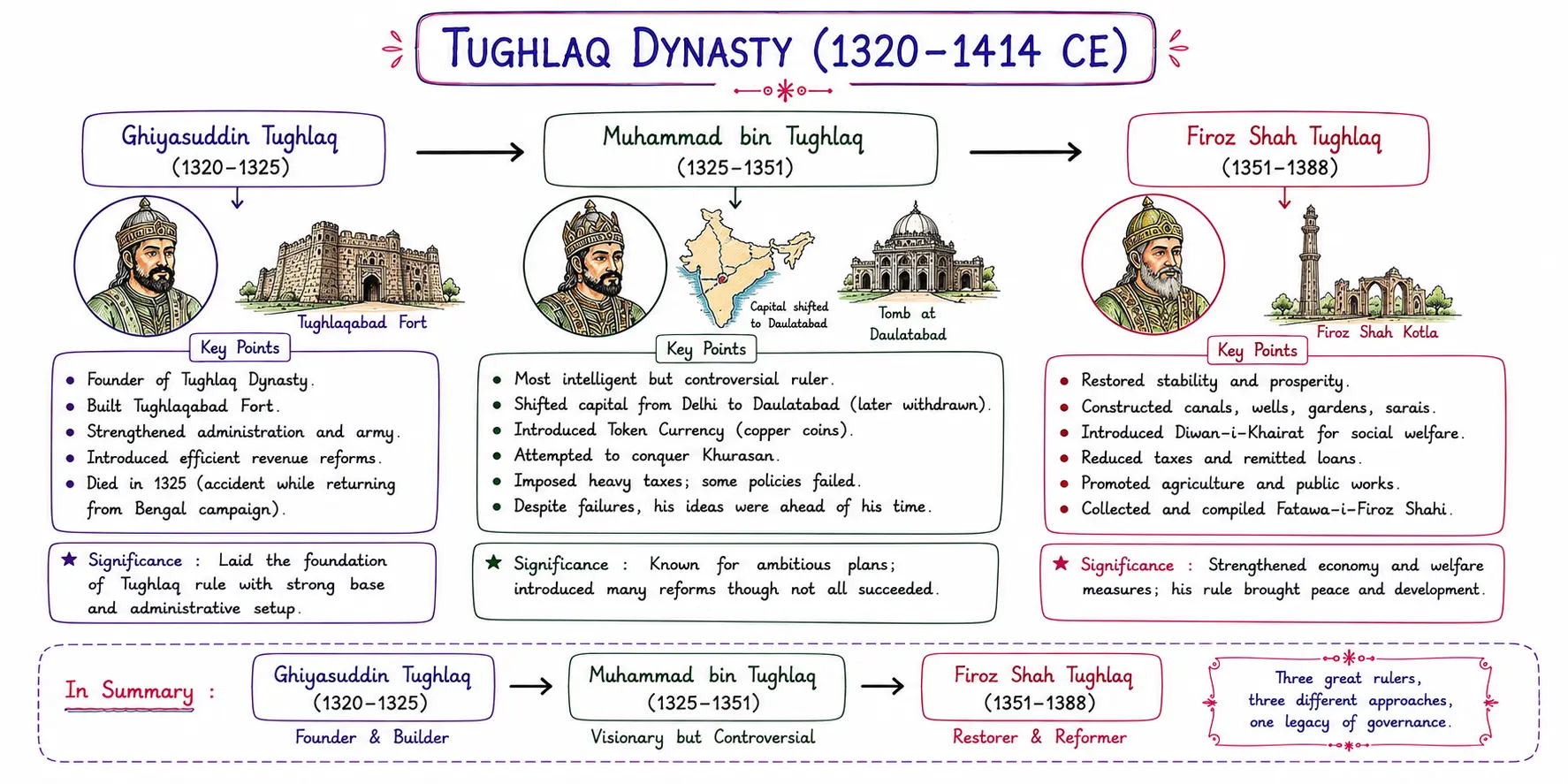
A. Ghiyasuddin Tughlaq (1320 – 1325 CE)
- Founder: Originally Ghazi Malik; established the Tughlaq dynasty and built the fortified city of Tughlaqabad.
- Irrigation Pioneer: First Sultan to construct irrigation canals to support agriculture.
B. Muhammad bin Tughlaq (1325 – 1351 CE)
Known in history as a visionary polymath ahead of his time, whose radical administrative experiments failed due to lack of practical implementation. Historian Barani called him a “mixture of opposites”.
The visual flowchart below highlights the objectives, operational blunders, and historical outcomes of Muhammad bin Tughlaq’s five controversial state projects.
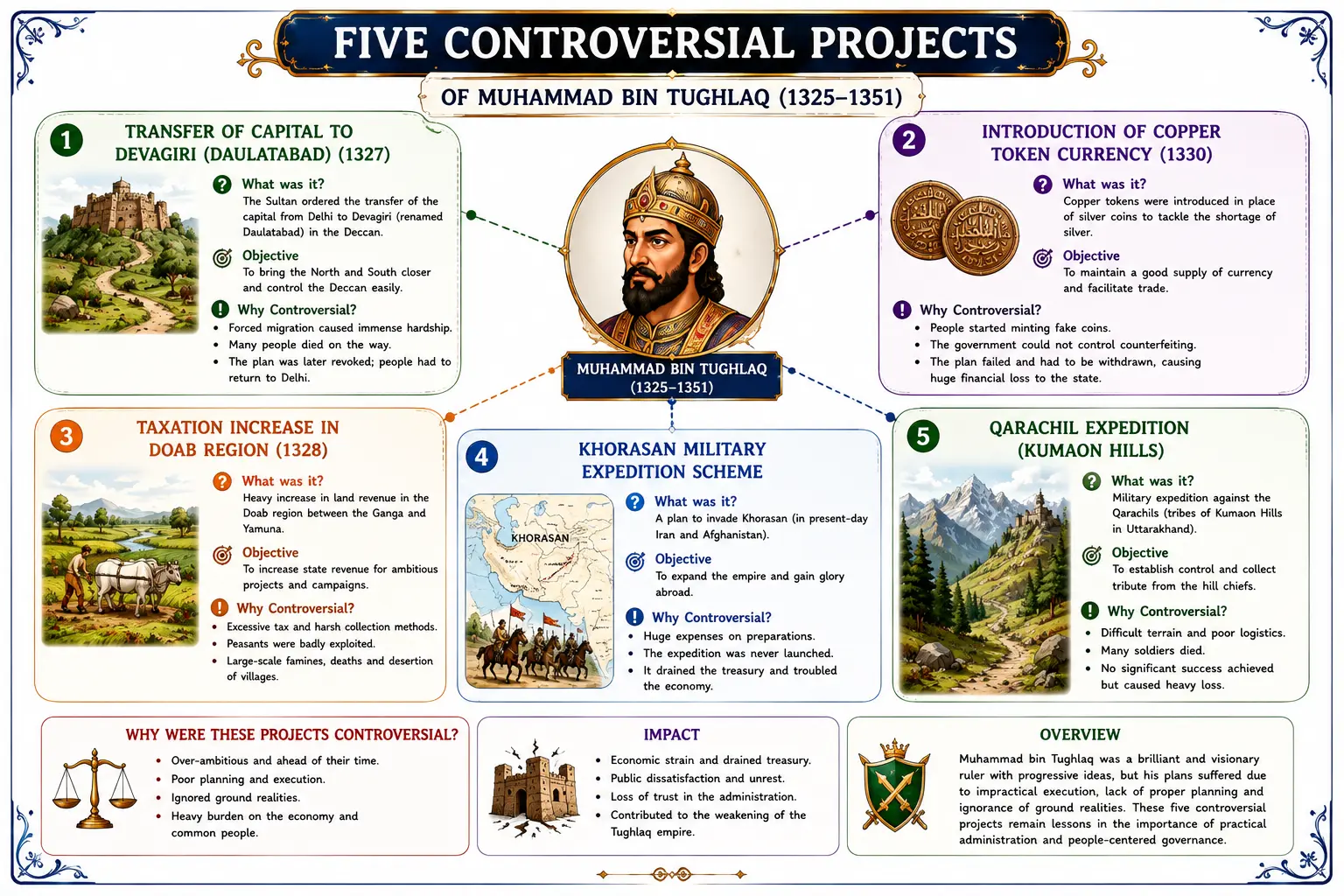
- Transfer of Capital (1327 CE): Shifted the imperial capital from Delhi to Devagiri (renamed Daulatabad) in the Deccan to centralize administration and withstand Mongol attacks. Ordered the complete forced evacuation of Delhi’s population. Due to immense hardship and lack of water in the south, he ordered a return shift back to Delhi.
- Token Currency (1330 CE): Issued copper and brass coins (Token Currency) with the same face value as silver Tankas. Failure to maintain state control over minting resulted in widespread forging of coins by households, crashing the economy. He eventually bought back all forged token coins with genuine silver from the treasury.
- Doab Tax Hike (1328 CE): Increased agricultural taxes in the fertile Ganga-Yamuna Doab during a severe famine, driving peasants to revolt.
- Agricultural Reforms: Realizing his mistake, he established a specialized Department of Agriculture called Diwan-i-Kohi. Granted interest-free crop loans (Sondhar / Taccavi) to farmers.
- Visit of Ibn Battuta: Famous Moroccan traveler Ibn Battuta arrived in India in 1333 CE. MB Tughlaq appointed him as the Chief Qazi of Delhi for eight years. Battuta documented his travels in his celebrated travelogue Rihla.
- Revolts and Disintegration: Rebellions erupted across the peninsula, giving birth to two independent southern empires: the Vijayanagara Empire (1336 CE) and the Bahmani Sultanate (1347 CE).
C. Firoz Shah Tughlaq (1351 – 1388 CE)
- Welfare State Administration: Adopted a conciliatory policy toward the nobility and the Ulema, restoring the hereditary principle for Iqtas and army posts.
- Public Works & Canals: Constructed extensive irrigation canals connecting the Yamuna and Sutlej rivers (e.g., Western Yamuna Canal). Built new cities: Firozabad (Delhi), Hisar, Jaunpur, and Fatehabad.
- Taxation System: Revised taxation to align strictly with Islamic Sharia law, levying only four taxes:
- Kharaj: Land tax (1/10th of produce).
- Zakat: 2.5% charity tax on wealthy Muslims.
- Kham: 1/5th share of war booty.
- Jizya: Tax on non-Muslim subjects (extended Jizya to Brahmins for the first time).
- Imposed an irrigation tax called Haqq-i-Sharb (10% of yield).
- Department of Welfare:
- Diwan-i-Khairat: Department for charitable aid to poor families, widows, and orphans.
- Diwan-i-Bandagan: Dedicated department for royal slaves (maintained over 180,000 slaves).
- Dar-ul-Shafa: Free charitable hospitals in Delhi.
- Ashokan Pillars Shift: Brought two Ashokan monolithic pillars from Topra (Haryana) and Meerut (UP) and re-erected them in Delhi.
D. Invasion of Timur (1398 CE)
In 1398 CE, the Central Asian Turkish conqueror Timur (Tamerlane) invaded India during the reign of the weak last Tughlaq ruler, Nasiruddin Mahmud. Timur sacked and plundered Delhi, dealing a fatal blow to the Tughlaq dynasty.
4. Sayyid Dynasty (1414 – 1451 CE) & Lodi Dynasty (1451 – 1526 CE)
The final century of the Sultanate witnessed the decentralization of Turkish control and the advent of Afghan tribal statehood under the Lodis. The visual timeline below follows this final sequence leading up to the Battle of Panipat.
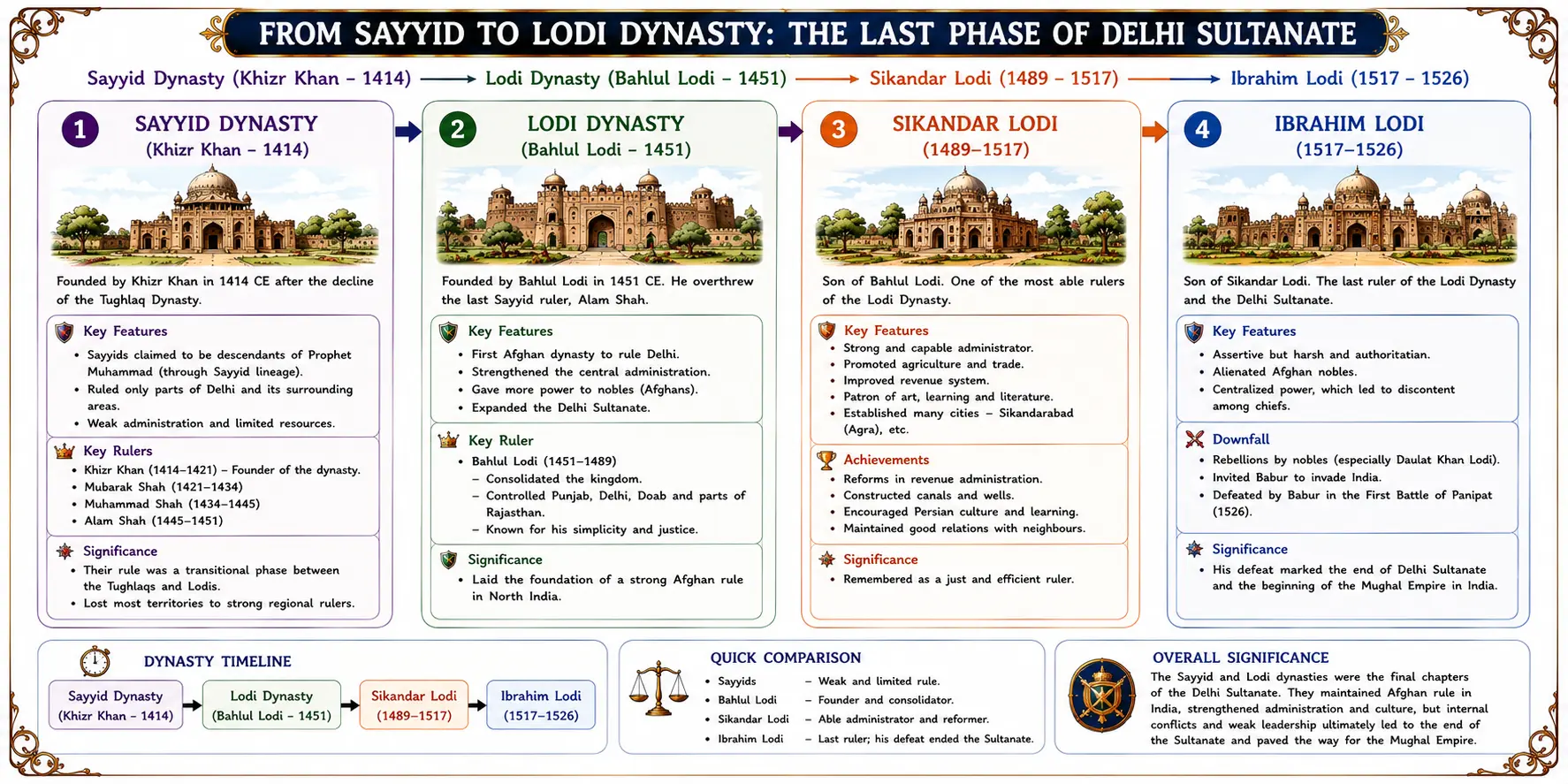
A. The Sayyid Dynasty (1414 – 1451 CE)
- Founder: Khizr Khan, who was appointed Governor of Multan by Timur.
- They claimed direct descent from the Prophet Muhammad.
- A short-lived dynasty of four rulers with limited territorial control beyond the surroundings of Delhi, eventually stepping down in favor of the Lodis.
B. The Lodi Dynasty (1451 – 1526 CE)
The Lodis were the first Afghan dynasty to rule over Northern India.
- Bahlul Lodi (1451 – 1489 CE): Founder of the Lodi dynasty. Re-established control over North India and annexed the Sharqi Kingdom of Jaunpur.
- Sikandar Lodi (1489 – 1517 CE): The greatest Lodi monarch.
- Founding of Agra (1504 CE): Founded the city of Agra in 1504 CE and shifted his imperial capital there in 1506 CE.
- Gaz-i-Sikandari: Introduced a standardized measurement unit for land assessment called Gaz-i-Sikandari (32 digits).
- A passionate poet who composed Sanskrit and Persian verses under the pen-name Gulrukhi.
- Ibrahim Lodi (1517 – 1526 CE):
- The last Sultan of Delhi. Arrogant and autocratic, he alienated Afghan nobles like Daulat Khan Lodi (Governor of Punjab), who invited Babur (ruler of Kabul) to invade India.
- First Battle of Panipat (April 21, 1526 CE): Babur defeated and killed Ibrahim Lodi on the battlefield using field artillery (Tulughma system). This marked the end of the Delhi Sultanate and established the Mughal Empire in India.
5. Administration, Economy, and Architecture
The administration of the Delhi Sultanate operated under an absolute monarchy supported by specialized imperial secretariats and high officials. The structural chart below outlines the distribution of civil, fiscal, and military portfolios.
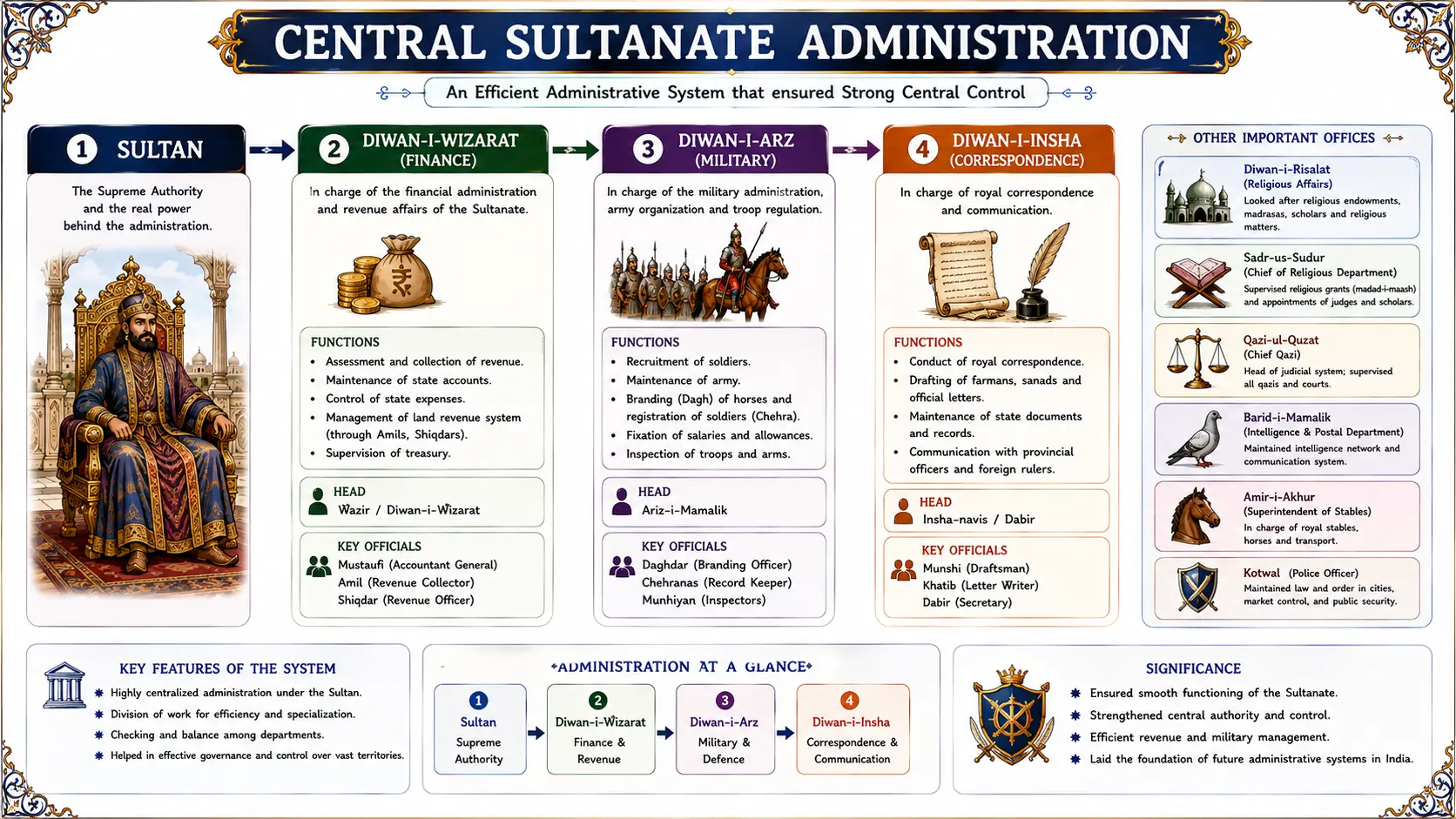
A. Central Departments
| Department Name | Functional Role | Head Official |
|---|---|---|
| Diwan-i-Wizarat | Finance & Revenue Department | Wazir (Prime Minister) |
| Diwan-i-Arz | Military Department | Ariz-i-Mamalik |
| Diwan-i-Insha | Royal Correspondence & Records | Dabir-i-Khas |
| Diwan-i-Rasalat | Foreign Affairs & Religious Endowments | Sadr-us-Sudur |
| Diwan-i-Riyasat | Market Regulation & Trade Control | Shahna-i-Mandi |
| Diwan-i-Kohi | Agricultural Development (MB Tughlaq) | Amir-i-Kohi |
| Diwan-i-Khairat | Charity & Public Welfare (Firoz Tughlaq) | Administered by Court Officers |
B. Indo-Islamic Architecture
The Delhi Sultanate introduced distinct structural innovations from Central Asia and Persia:
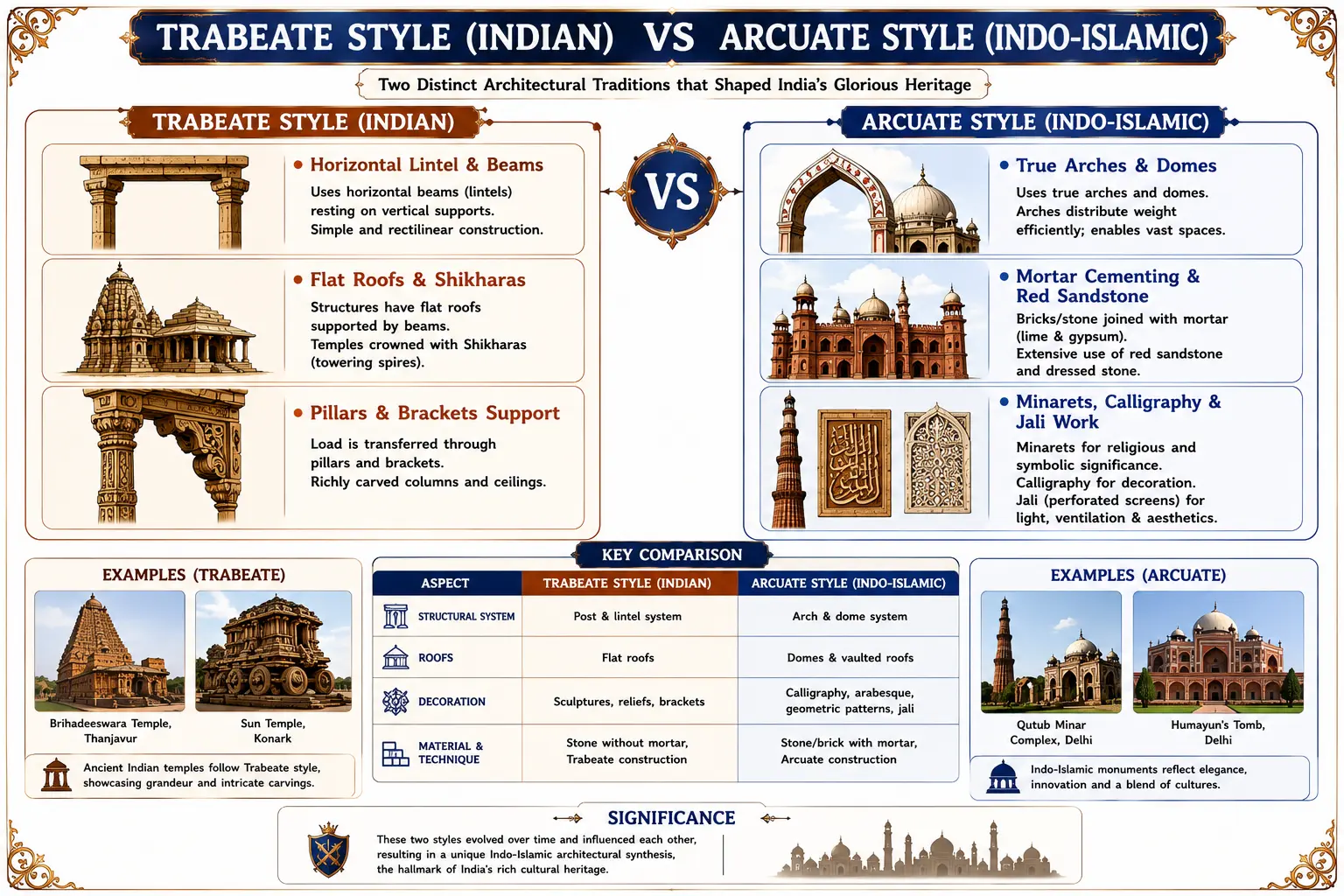
- Key Architectural Features: The True Arch (Arcuate style), True Dome, Minarets, and geometric stone lattice carvings (Jali work), replacing the traditional Indian lintel-and-beam (Trabeate) system.
- Prominent Structures:
- Qutb Minar Complex (Delhi): Started by Aibak, completed by Iltutmish, repaired by Firoz Tughlaq.
- Alai Darwaza (Delhi): Built by Alauddin Khilji; early example of a true horseshoe arch and red sandstone with white marble inlay.
- Tughlaqabad Fort: Sloping thick stone walls (Satter) built by Ghiyasuddin Tughlaq.
- Lodi Gardens (Delhi): Octagonal and square tombs built on elevated platforms (e.g., Sikandar Lodi’s Tomb).
The comparative infographic below contrasts the traditional Indian Trabeate structural style with the imported Arcuate engineering principles popularized during the Delhi Sultanate.
6. Quick Examination Facts
| Topic / Event | Key Exam Fact |
|---|---|
| Real Founder of Delhi Sultanate | Shamsuddin Iltutmish (Shifted capital to Delhi) |
| First and Only Female Ruler of Delhi | Razia Sultana (1236 – 1240 CE) |
| Destroyer of Turkan-i-Chahalgani | Ghiyasuddin Balban |
| Court Etiquette ‘Sijda’ & ‘Paibos’ Creator | Ghiyasuddin Balban |
| Sultan who Assumed Title ‘Sikandar-i-Sani’ | Alauddin Khilji |
| Branding Horses (Dag) & Rolls (Chehra) | Introduced by Alauddin Khilji |
| First Sultan to Measure Land via Biswa | Alauddin Khilji |
| Moroccan Traveler in MB Tughlaq’s Court | Ibn Battuta (Author of Rihla) |
| Department of Agriculture ‘Diwan-i-Kohi’ | Created by Muhammad bin Tughlaq |
| Jizya Imposed on Brahmins By | Firoz Shah Tughlaq |
| Department for Slaves ‘Diwan-i-Bandagan’ | Created by Firoz Shah Tughlaq |
| Timur’s Invasion of Delhi Year | 1398 CE (During Nasiruddin Mahmud’s reign) |
| Founder of Agra City (1504 CE) | Sikandar Lodi |
| First Battle of Panipat Date | April 21, 1526 CE (Babur defeated Ibrahim Lodi) |
7. Conclusion
The Delhi Sultanate era served as a political and administrative bridge between early medieval regional polities and the consolidated empire of the Mughals. Through centralized administration, agricultural reforms, taxation, and market regulations, the Sultanate brought political stability to North India. Simultaneously, the synthesis of Islamic and Indian traditions gave birth to the Indo-Islamic architectural style, rich Sufi-Bhakti literary movements, and dynamic urban centers that transformed the subcontinent.
Delhi Sultanate
Practice Quiz • 15 MCQs