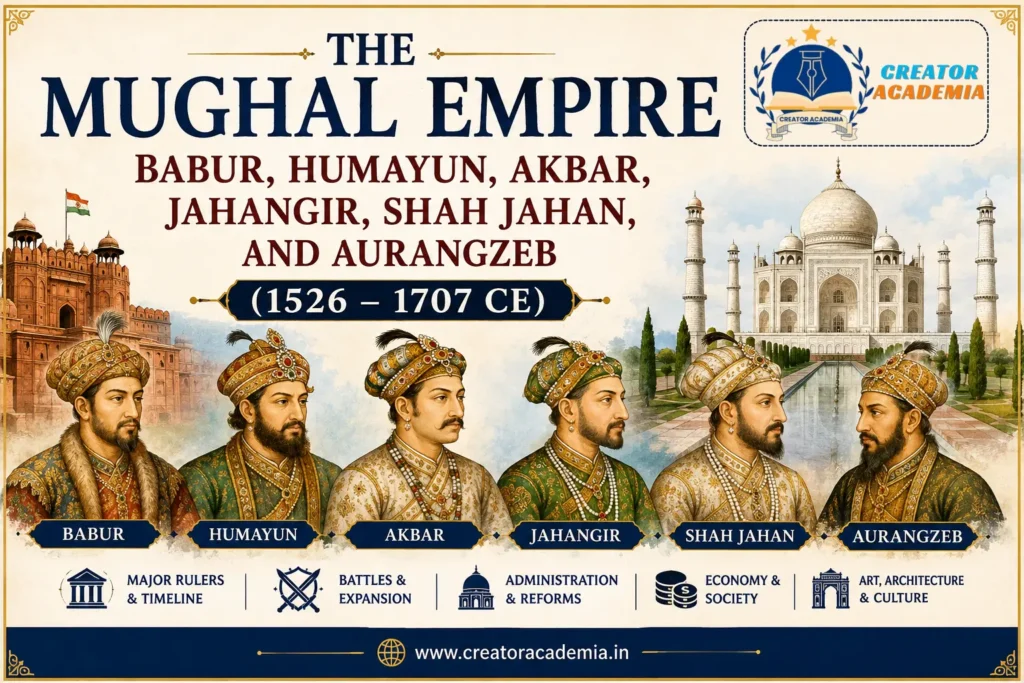
The Mughal Empire: Babur, Humayun, Akbar, Jahangir, Shah Jahan, and Aurangzeb (1526 – 1707 CE)
Fusing Central Asian, Persian, and indigenous Indian administrative traditions, the Mughals created a centralized bureaucratic machinery, pioneered revolutionary land revenue and military structures, and patronized monumental architecture and artistic traditions that define India’s cultural heritage.
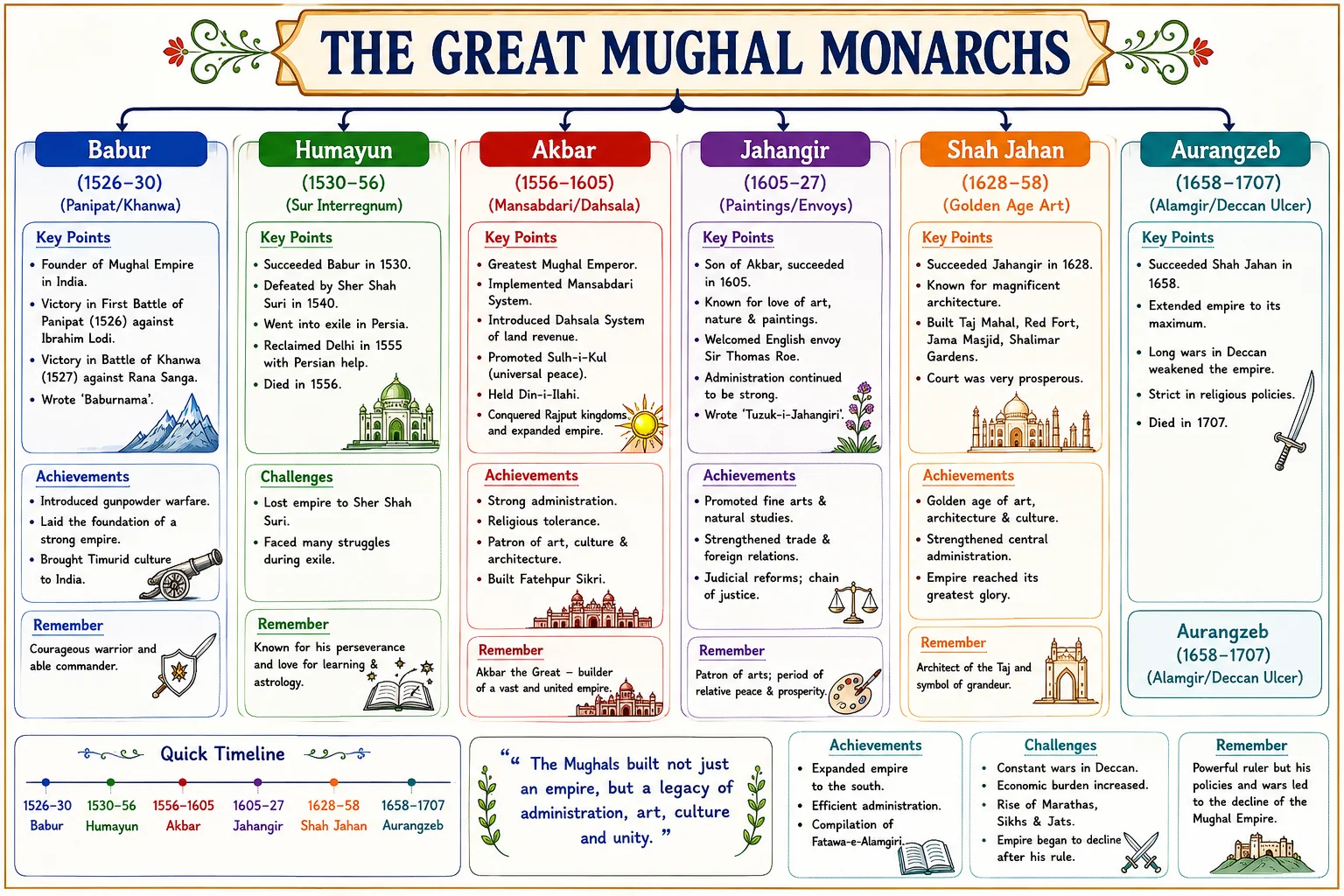
The timeline below provides a chronological view of the six Great Mughal sovereigns who shaped the subcontinent’s territorial boundaries, administrative institutions, and cultural zenith from 1526 to 1707 CE.
1. Foundation and Consolidation: Babur and Humayun
The early phase of the empire was defined by military conquests under Babur and sudden instability under Humayun, who faced relentless Afghan resistance before reclaiming Delhi. The diagram below captures the key dynamics of this founding era.
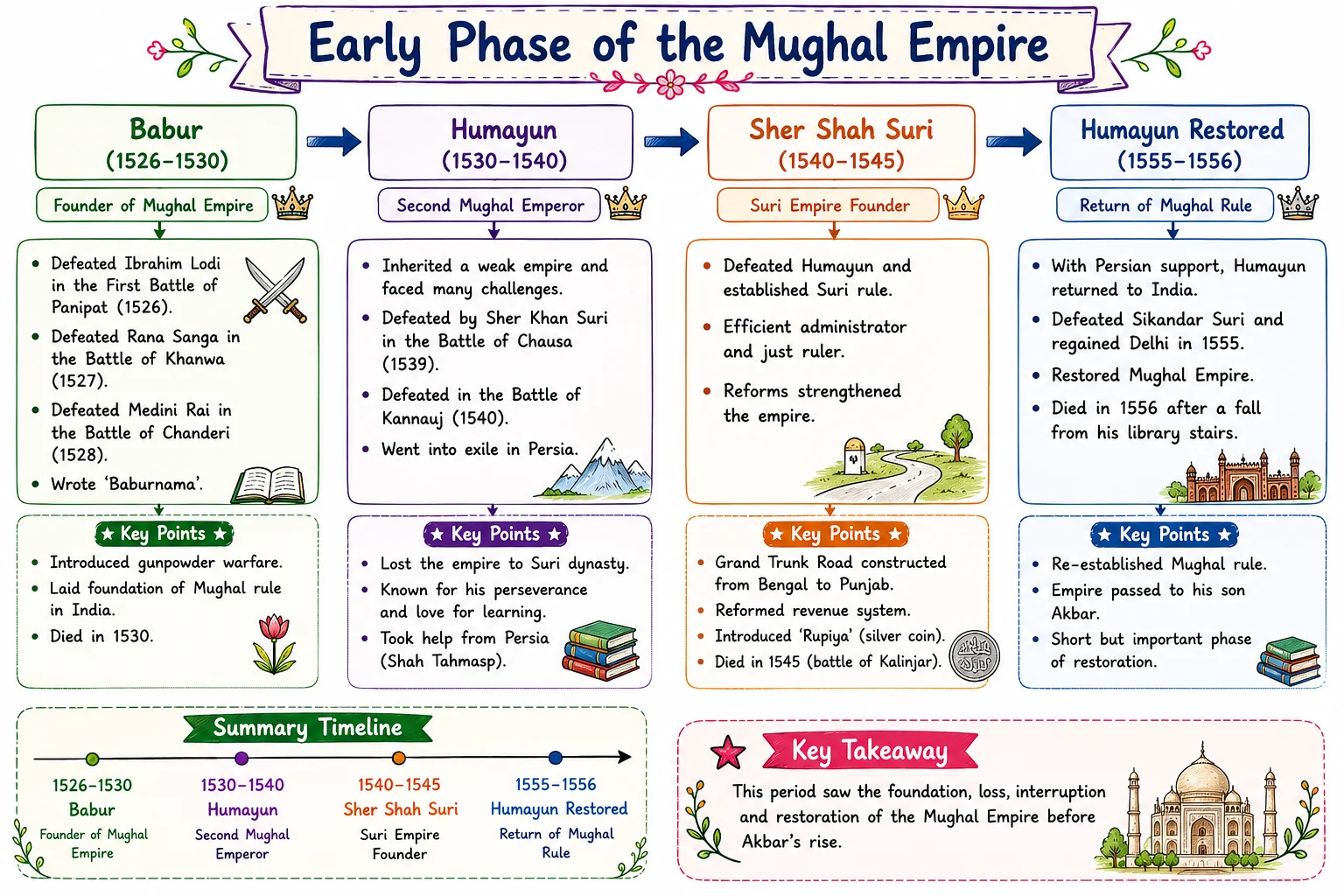
A. Zahiruddin Muhammad Babur (1526 – 1530 CE)
- Founder & Lineage: Descendant of Timur on his father’s side and Genghis Khan on his mother’s side. Invited to invade India by Daulat Khan Lodi (Governor of Punjab) and Rana Sanga of Mewar against Ibrahim Lodi.
- Key Battles:
- First Battle of Panipat (April 21, 1526 CE): Defeated Ibrahim Lodi using advanced field artillery, cannons, and the Tulughma tactical flanking system.
- Battle of Khanwa (1527 CE): Defeated Rana Sanga of Mewar; assumed the title Ghazi and declared the battle a Jihad.
- Battle of Chanderi (1528 CE): Defeated Medini Rai of Chanderi.
- Battle of Ghagra (1529 CE): Defeated the joint Afghan forces under Mahmud Lodi.
- Autobiography: Authored his candid memoirs, Tuzuk-i-Baburi (Baburnama), in his mother tongue, Chagatai Turkic (later translated into Persian by Abdul Rahim Khan-i-Khana).
B. Nasiruddin Humayun (1530 – 1540 CE & 1555 – 1556 CE)
- Initial Struggles: Faced internal rivalry from his brothers (Kamran, Askari, Hindal) and external threats from Bahadur Shah of Gujarat and the Afghan leader Sher Khan (Sher Shah Suri).
- Defeats & Exile:
- Battle of Chausa (1539 CE): Defeated by Sher Shah Suri; Humayun narrowly escaped drowning in the Ganga.
- Battle of Kannauj / Bilgram (1540 CE): Decisively defeated by Sher Shah, forcing Humayun into 15 years of exile in Persia (Safavid Court of Shah Tahmasp).
- Restoration & Death: Recaptured Delhi in 1555 CE with Safavid military support. Died in 1556 CE after falling down the stairs of his library, Din Panah (Sher Mandal) in Delhi. Historian Lane-Poole remarked: “Humayun tumbled through life, and tumbled out of it.”
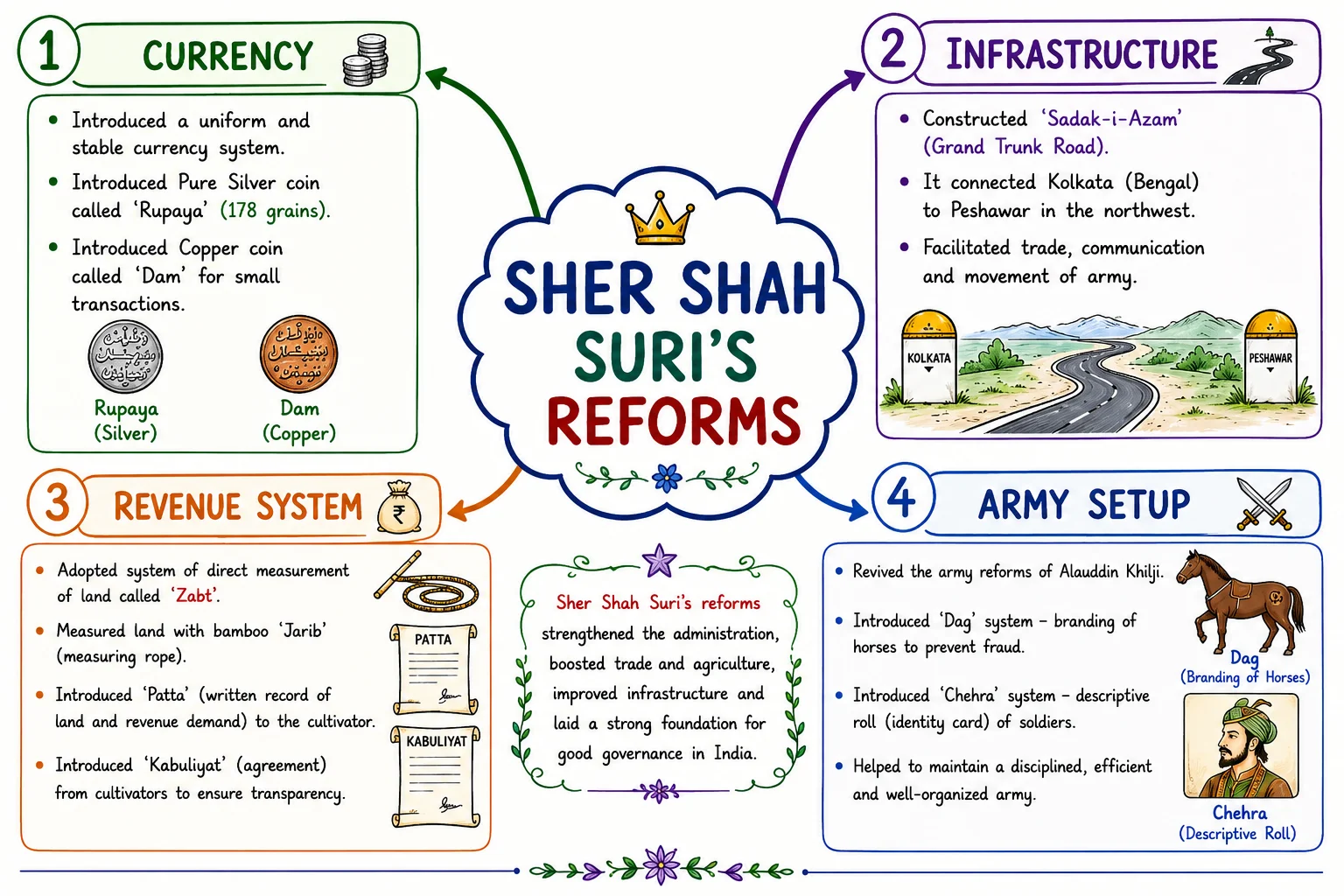
C. The Sur Interregnum: Sher Shah Suri (1540 – 1545 CE)
Founder of the Second Afghan Empire in India, Sher Shah was a brilliant administrator whose reforms provided the blueprint for Akbar’s imperial administrative machinery. His standardized currency (Rupaya), network of highway corridors (Sadak-i-Azam), and revenue mechanisms laid modern administrative roots.
2. The Golden Era of Expansion: Akbar the Great (1556 – 1605 CE)
Crowned at age 13 at Kalanaur (Punjab) under the regency of Bairam Khan, Akbar transformed a fragile kingdom into a consolidated empire resting on military strength, revenue organization, Rajput reconciliation, and syncretic cultural policy.
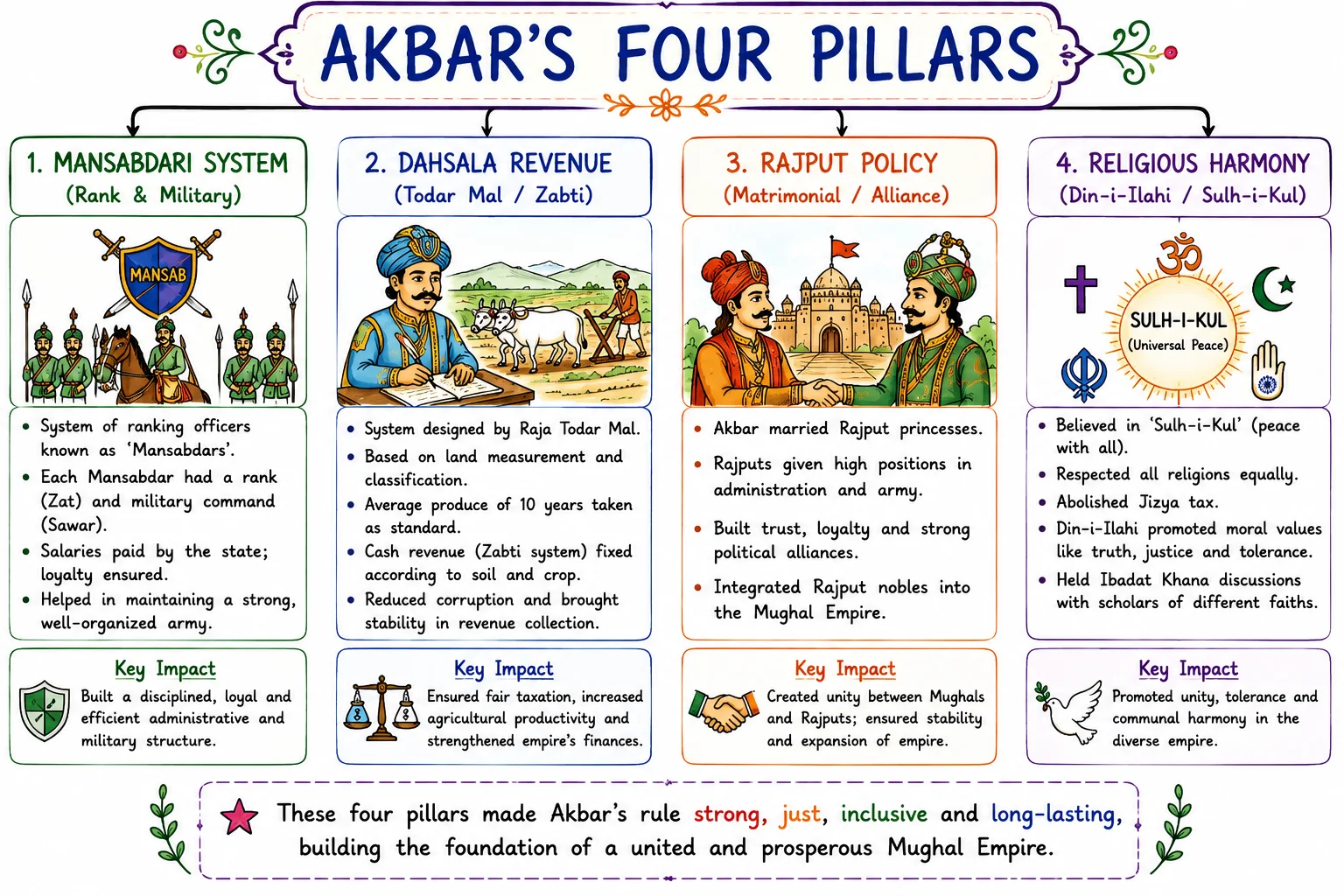
A. Military Campaigns and Consolidation
- Second Battle of Panipat (1556 CE): Bairam Khan defeated Hemu (Hemu Vikramaditya), the Hindu general of the Sur dynasty.
- Rajput Policy: Pursued a conciliatory policy of matrimonial alliances and high imperial appointments. Married Harkha Bai (Jodha Bai), princess of Amber (Jaipur). Defeated Maharana Pratap of Mewar at the famous Battle of Haldighati (1576 CE) commanded by Raja Man Singh.
- Abolition of Discriminatory Taxes: Abolished the Pilgrim Tax (1563 CE) and Jizya Tax (1564 CE) on non-Muslim subjects.
B. The Mansabdari System
An administrative-cum-military organization where every officer was assigned a specific Mansab (rank/position):
- Zat: Determined the personal status, rank, and salary of the officer.
- Sawar: Indicated the exact number of armed cavalrymen (Sawars) the officer was required to maintain for imperial service.
- Payment: Salaries were paid either in cash (Naqdi) or through revenue assignments (Jagirs).
C. Revenue System: Dahsala / Zabti System
Formulated by his finance minister, Raja Todar Mal (1580 CE):
- Assessment: Average yield and prices of crops over the preceding 10 years (1570 – 1580 CE) were calculated.
- State Demand: Fixed at one-third (1/3rd) of the average produce, payable in cash.
- Land Classification: Land was classified into four categories based on fertility:
- Polaj: Cultivated annually.
- Parauti: Left fallow briefly to recover fertility.
- Chachar: Fallow for 3–4 years.
- Banjar: Uncultivated for 5 or more years.
D. Religious Policies and Cultural Synthesis
- Ibadat Khana (1575 CE): Hall of Prayer constructed at Fatehpur Sikri for inter-faith theological discussions among scholars of Hinduism, Islam, Jainism, Zoroastrianism, and Christianity.
- Infallibility Decree (Mahzar, 1579 CE): Asserted Akbar’s supreme authority in interpreting Islamic law over orthodox Ulema.
- Din-i-Ilahi (1582 CE): An ethical order based on universal peace, tolerance, and virtue (Sulh-i-Kul—“Peace with All”). Birbal was the only Hindu noble to join it.
- Navratnas (Nine Gems): Court adorned by nine luminaries: Abul Fazl (Akbarnama, Ain-i-Akbari), Faizi, Tansen, Raja Todar Mal, Raja Man Singh, Birbal, Abdul Rahim Khan-i-Khana, Fakir Aziao-Din, and Mullah Do-Piyaza.
3. The Later Great Mughals: Jahangir, Shah Jahan, and Aurangzeb
The post-Akbar era witnessed the pinnacle of courtly luxury, architectural marvels, and territorial expansion, followed by ideological shifts and structural strain. The mind map below charts this critical transitional phase.
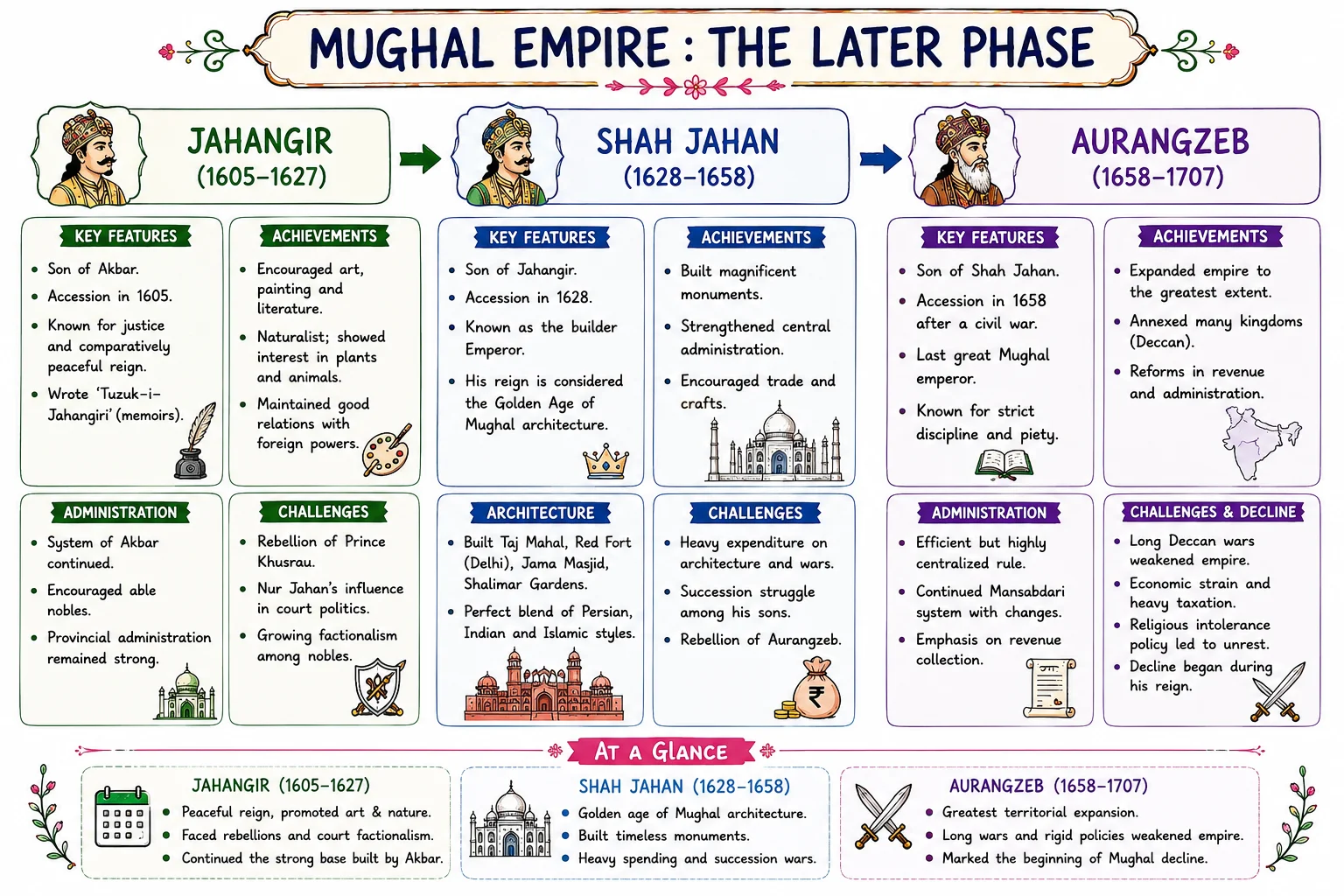
A. Jahangir (1605 – 1627 CE)
- Administration & Justice: Original name Salim. Known for his strict administration of justice, establishing the Zanjir-i-Adl (Chain of Justice) at Agra Fort.
- Rebellion & Executions: Executed the 5th Sikh Guru, Guru Arjan Dev, for supporting his rebellious son Prince Khusrau.
- Nur Jahan Junta: Married Mehr-un-Nissa (titled Nur Jahan), who formed the powerful court faction (Junta) and held substantial executive power.
- European Envoys: Received British diplomatic envoys from King James I: Captain William Hawkins (1608) and Sir Thomas Roe (1615), granting commercial trading concessions to the English East India Company.
- Patronage of Art: Marked the golden age of Mughal Miniature Painting. Renowned master painters like Ustad Mansur (specialist in flora and fauna) flourished under his patronage.
B. Shah Jahan (1628 – 1658 CE)
- Golden Age of Architecture: Original name Khurram. His reign is celebrated as the pinnacle of Mughal architectural splendour.
- Territorial Expansion: Annexed Ahmednagar (1632) and forced the Deccan sultanates of Bijapur and Golconda into submission.
- Architectural Masterpieces:
- Taj Mahal (Agra): Built in memory of his wife Mumtaz Mahal using pure white Makrana marble.
- Red Fort (Lal Qila) & Jama Masjid (Delhi): Established the new imperial capital Shahjahanabad.
- Peacock Throne (Takht-i-Taus): Inlaid with precious gems and the legendary Koh-i-Noor diamond (looted by Nadir Shah in 1739).
- War of Succession (1657 – 1658 CE): A fratricidal war among his four sons (Dara Shikoh, Shuja, Aurangzeb, Murad). Aurangzeb emerged victorious after defeating Dara Shikoh at the Battle of Samugarh (1658 CE) and imprisoned Shah Jahan at Agra Fort until his death.
C. Aurangzeb ‘Alamgir’ (1658 – 1707 CE)
Aurangzeb reversed several liberal syncretic practices of his predecessors, enforcing orthodox legal codes while undertaking costly military campaigns across the Deccan plateau. The conceptual map below breaks down his domestic, religious, and military strategies.
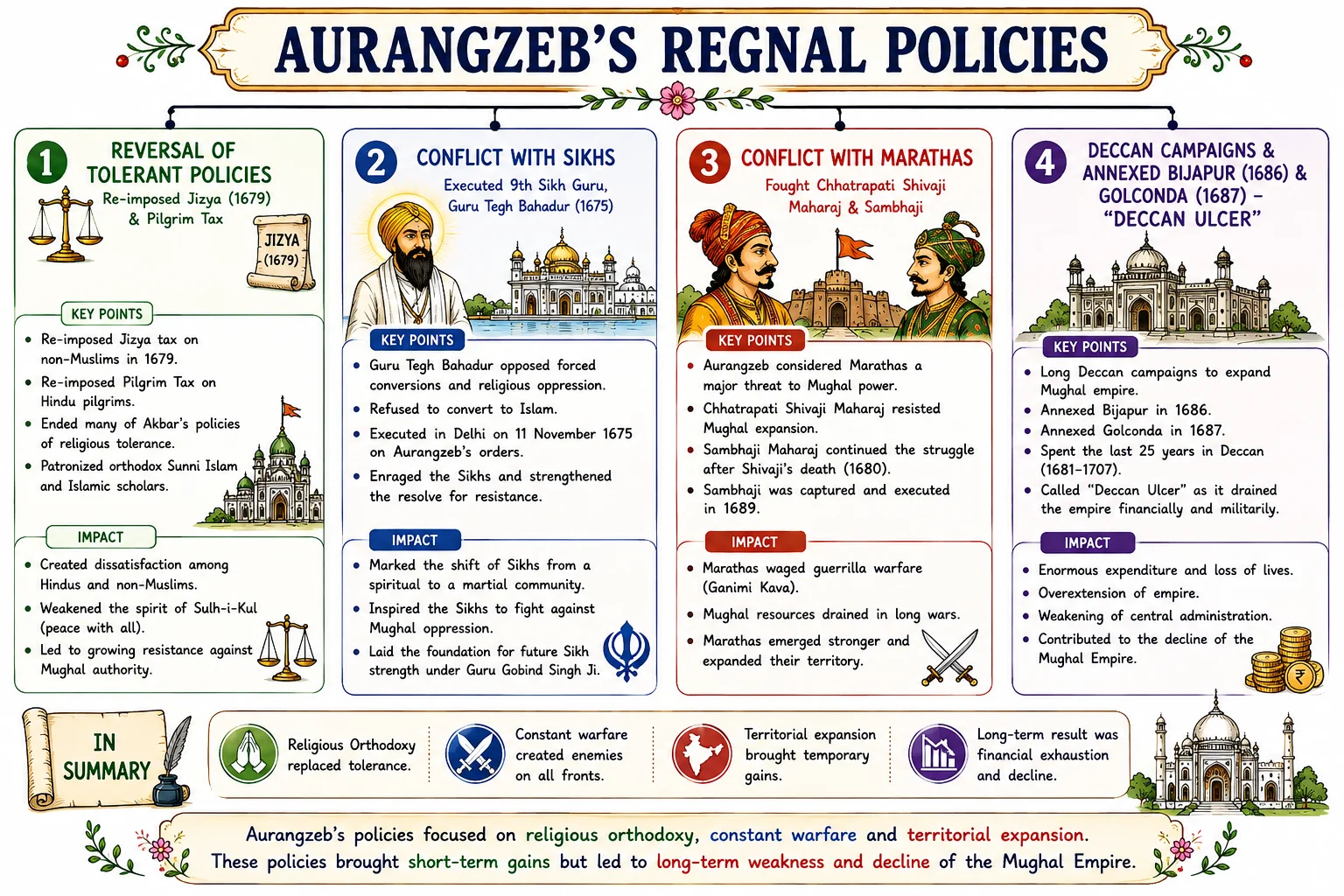
- Imperial Expansion: Assumed the title Alamgir (“Conqueror of the World”) and expanded the empire to its maximum territorial extent.
- Orthodox Policies: Discontinued court music, dance, astrology, and the celebration of Nauroz. Banned alcohol and gambling, and reimposed Jizya (1679 CE).
- Sikh & Maratha Resistance: Executed the 9th Sikh Guru, Guru Tegh Bahadur (1675 CE), for refusing religious conversion, which prompted Guru Gobind Singh to establish the Khalsa (1699 CE). Fought protracted wars against Chhatrapati Shivaji Maharaj and the Marathas.
- The Deccan Ulcer: Spent his final 25 years bogged down in military campaigns in the Deccan, which drained the imperial treasury and crippled Mughal administrative control.
4. Mughal Administration, Economy, and Architecture
The durability of the Mughal realm lay in its highly coordinated central ministerial framework and tiered provincial governance. The chart below details the official hierarchy linking the imperial capital to rural administrative subdivisions.
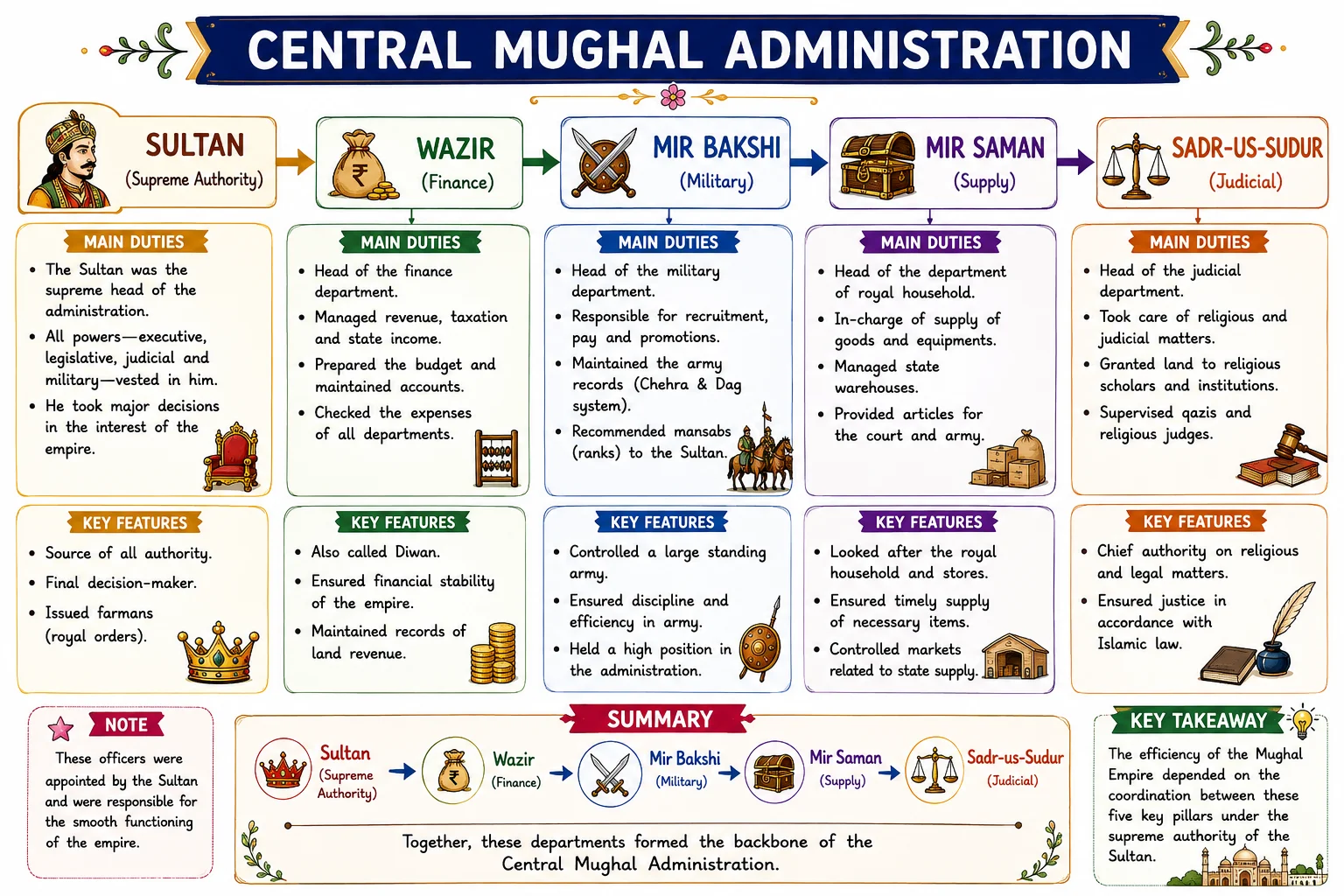
A. Central & Provincial Machinery
- Wazir / Diwan: Head of the Revenue and Finance department.
- Mir Bakshi: Head of the Military department; issued salary certificates (Sarkhat) for Mansabdars.
- Mir Saman: In charge of the royal household, stores, and state workshops (Karkhanas).
- Sadr-us-Sudur: Head of religious endowments, charity, and judicial administration (Qazi-ul-Quzat).
- Provincial Hierarchy: The empire was divided into Subas (provinces, headed by a Subahdar), subdivided into Sarkars (districts, headed by a Faujdar), and further bifurcated into Parganas (sub-districts, headed by a Shiqdar).
B. Architectural Evolution
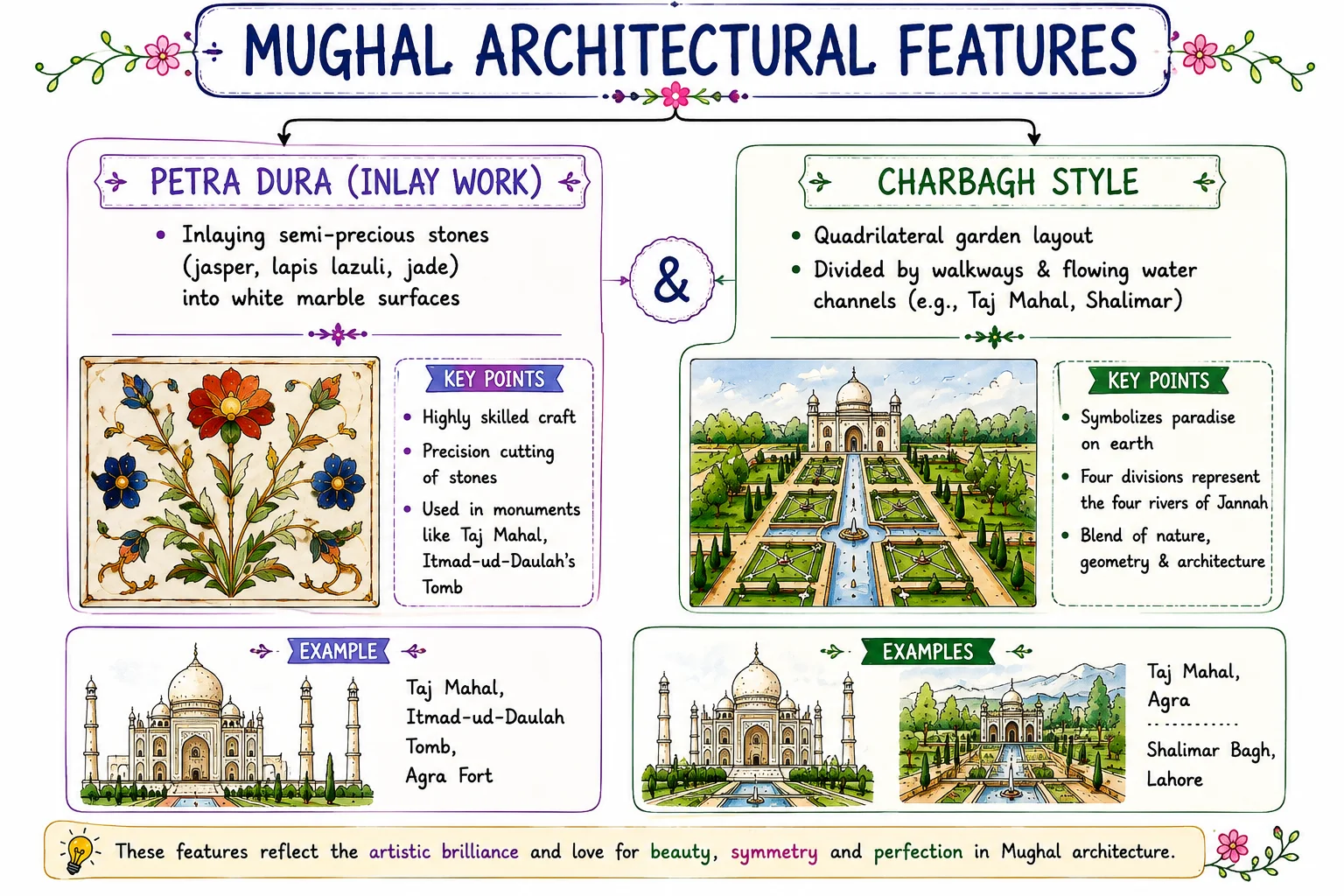
- Distinctive Features: Seamless synthesis of Persian arcuate forms and Indian trabeate styles, characterized by Bulbous Domes, slender Minarets, Pietra Dura (stone inlay work), and Charbagh (symmetrical quadrilateral gardens).
- Prominent Monuments:
- Humayun’s Tomb (Delhi): Built by Bega Begum; precursor to the Taj Mahal; introduced the double dome and Charbagh layout to India.
- Fatehpur Sikri (Agra): Commissioned by Akbar; features the Buland Darwaza (built to commemorate the Gujarat conquest), Panch Mahal, and the Tomb of Salim Chishti.
- Bibi Ka Maqbara (Aurangabad): Built by Azam Shah in memory of Dilras Banu Begum; popularly known as the “Poor Man’s Taj.”
The structural characteristics of imperial Mughal architecture—from symmetrical garden tombs to decorative stone inlay—are visually classified in the conceptual overview below.
5. Quick Examination Facts
| Topic / Event | Key Exam Fact |
|---|---|
| Founder of Mughal Empire | Zahiruddin Muhammad Babur (1526 CE) |
| First Battle of Panipat | April 21, 1526 CE (Babur defeated Ibrahim Lodi) |
| Autobiography of Babur | Tuzuk-i-Baburi (Written in Chagatai Turkic) |
| Silver Coin Introduced by Sher Shah Suri | Pure Silver Rupaya (178 grains) |
| Grand Trunk Road Built By | Sher Shah Suri (Originally named Sadak-i-Azam) |
| Second Battle of Panipat | 1556 CE (Bairam Khan/Akbar defeated Hemu) |
| Mansabdari System Introduced By | Akbar (Dual ranks: Zat and Sawar) |
| Revenue Dahsala / Zabti System Architect | Raja Todar Mal (Finance Minister of Akbar) |
| Ibadat Khana Location & Purpose | Fatehpur Sikri (1575 CE, Inter-faith religious discussions) |
| Abolition of Jizya and Pilgrim Tax | Akbar (1564 CE and 1563 CE) |
| Re-imposition of Jizya Tax | Aurangzeb (1679 CE) |
| British Envoys in Jahangir’s Court | Captain William Hawkins (1608) and Sir Thomas Roe (1615) |
| Golden Age of Mughal Architecture | Reign of Shah Jahan |
| Execution of 9th Sikh Guru Tegh Bahadur | Ordered by Aurangzeb (1675 CE) |
| Head of Mughal Military Department | Mir Bakshi |
6. Conclusion
The Mughal Empire served as a powerful unifying force that integrated the political, economic, and cultural life of the Indian subcontinent. Through administrative institutions like the Mansabdari and Zabti systems, the empire built a resilient centralized state. Simultaneously, the cultural synthesis of Indo-Persian traditions gave birth to timeless architectural monuments, refined miniature paintings, and a composite culture that laid the foundation for early modern India.
The Mughal Empire
Practice Quiz • 15 MCQs