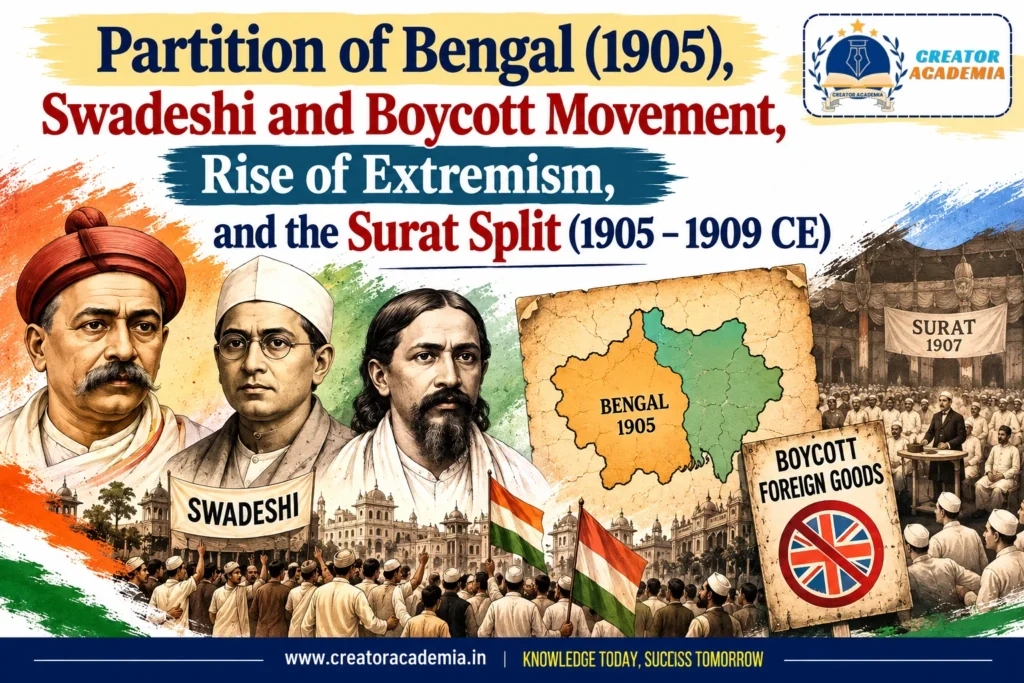
Partition of Bengal (1905), Swadeshi and Boycott Movement, Rise of Extremism, and Surat Split (1905 – 1909 CE)
When Viceroy Lord Curzon announced the Partition of Bengal in 1905, intending to crush the nerve center of Indian political consciousness, it triggered a nationwide upsurge: the Swadeshi and Boycott Movement. This historic mass agitation introduced passive resistance, indigenous self-reliance (Atmashakti), national education, and mass mobilization, setting the stage for the rise of Extremism and the eventual Surat Split of 1907.
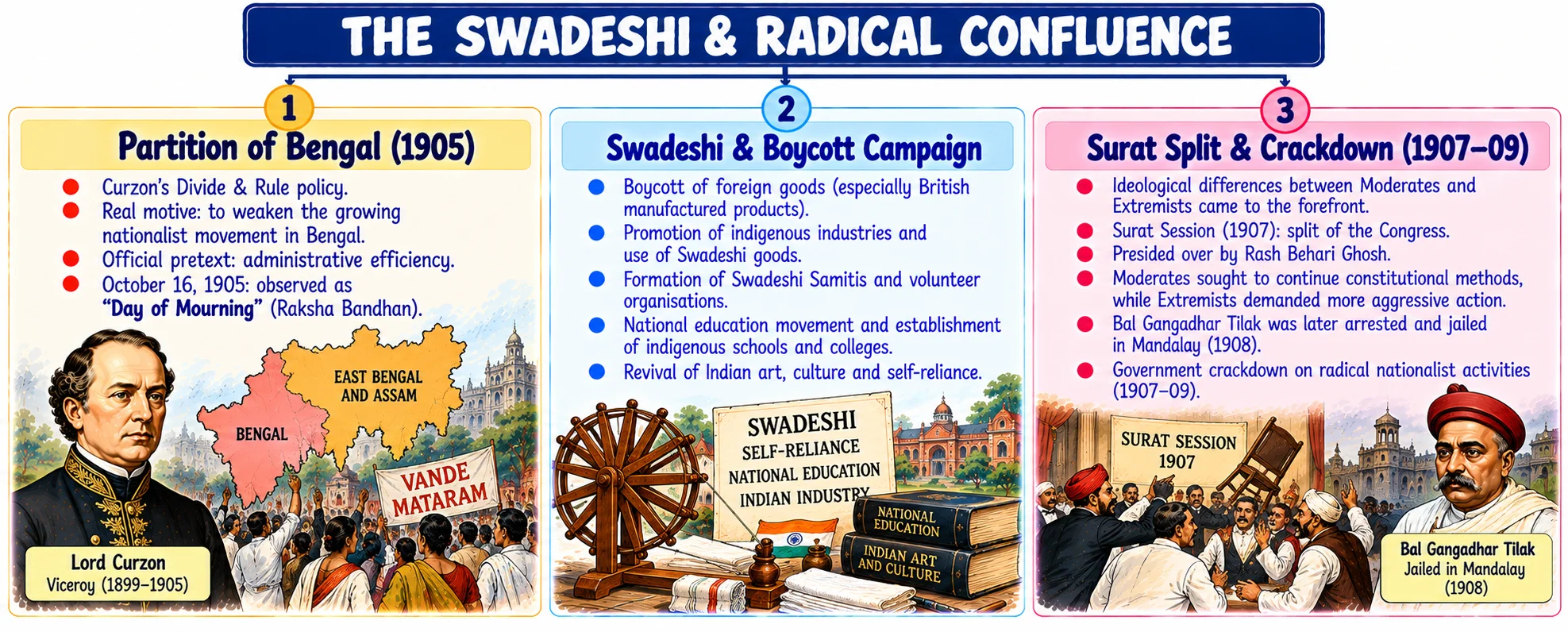 Figure 1: Overview of the Swadeshi & Radical Confluence: Partition, Boycott, and Surat Split
1. The Partition of Bengal (1905 CE)
In December 1903, the British Government publicly announced plans to partition Bengal. Despite sustained press campaigns, massive petitions, and public meetings organized by Moderate leaders like Surendranath Banerjea and Krishna Kumar Mitra, Lord Curzon issued the formal order of partition in July 1905.
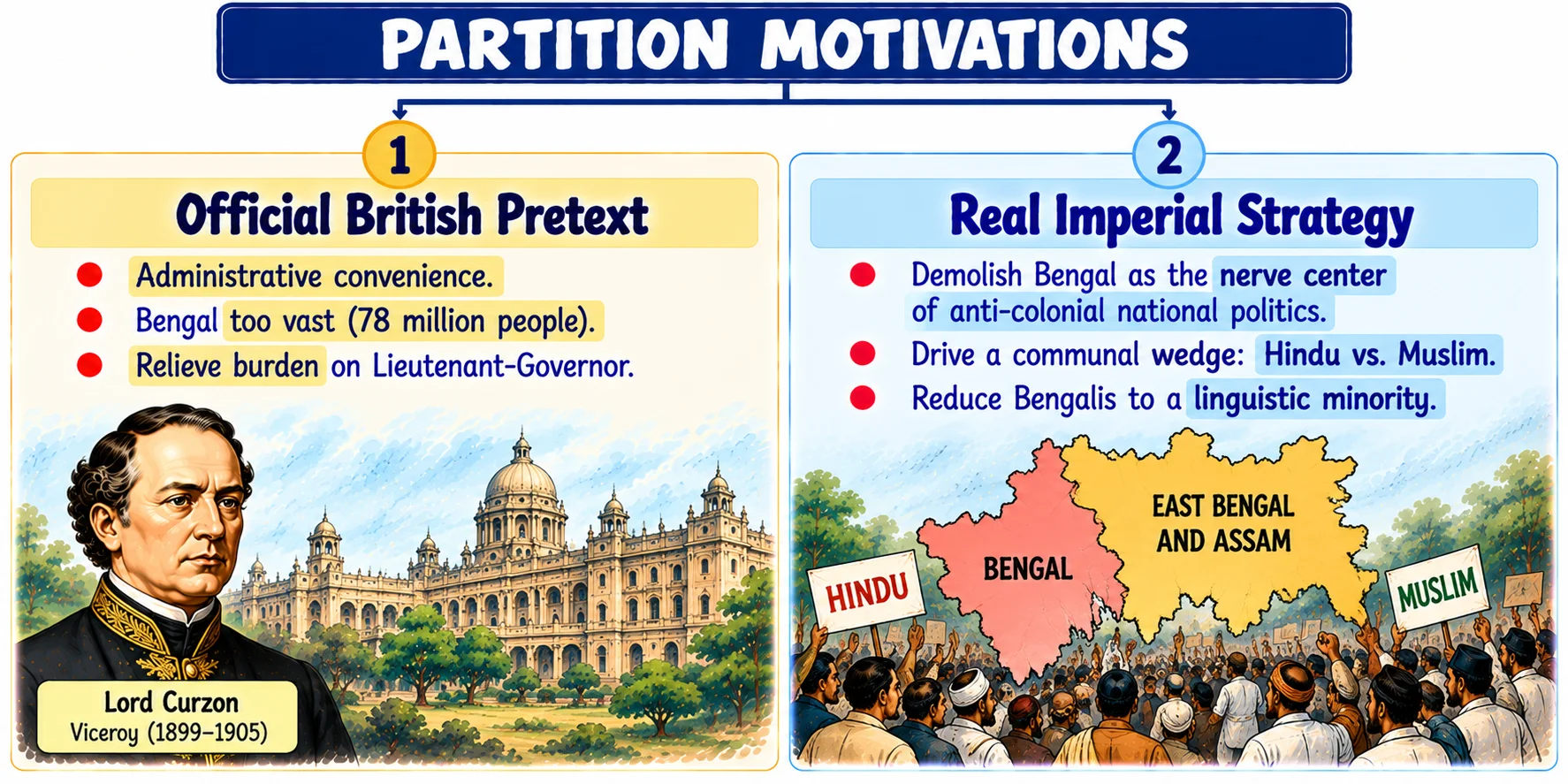 Figure 2: Official Administrative Pretext vs. Real Imperial Divide and Rule Strategy
A. The Real Motives vs. Administrative Pretext
- The Administrative Pretext: The colonial government claimed that Bengal—encompassing Bengal, Bihar, Orissa, and Assam, with a massive population of nearly 78 million—was unmanageably large for a single administrative head (Lieutenant-Governor).
- The Real Imperial Objective: The Home Secretary to the Government of India, H.H. Risley, explicitly exposed the real imperial strategy in an internal government minute (1904):
“Bengal united is a power. Bengal divided will pull several different ways… One of our main objects is to split up and thereby to weaken a solid body of opponents to our rule.”
- Demolishing the Nerve Center: The partition aimed to break Bengal’s intellectual and political leadership in Indian nationalism.
- Driving a Communal Wedge: Curzon engineered the provincial border along religious lines:
- Eastern Bengal and Assam: Capital at Dacca; population of 31 million with a Muslim majority (18 million Muslims). Curzon toured East Bengal promising Muslims that the new province would revive the grandeur of the old Muslim Nawabs of Dacca.
- Western Bengal: Capital at Calcutta; population of 54 million where Hindus formed the majority (42 million Hindus out of 54 million).
- Linguistic Subordination: Reducing Bengalis to a linguistic minority within Western Bengal, where Bengali speakers (17 million) were heavily outnumbered by Hindi and Odia speakers (37 million).
B. Implementation and the Day of National Mourning
The Partition of Bengal officially came into effect on October 16, 1905. The day was observed throughout Bengal as a Day of National Mourning (Day of Hartal):
- People observed fasts, closed shops, walked barefoot to the Ganges to bathe, and sang Rabindranath Tagore’s newly composed anthem Amar Shonar Bangla (“My Golden Bengal”).
- On Rabindranath Tagore’s suggestion, the day was celebrated as Raksha Bandhan Day, where Hindus and Muslims tied yellow threads on each other’s wrists as a symbol of the unbreakable brotherhood and cultural unity of Bengal.
- Veteran nationalist leader Ananda Mohan Bose laid the foundation stone of the Federation Hall in Calcutta to signify indomitable national unity and solidarity.
2. The Swadeshi and Boycott Movement (1905 – 1908 CE)
The anti-partition movement quickly escalated from mere petitions into an all-out mass-based struggle known as the Swadeshi and Boycott Movement.
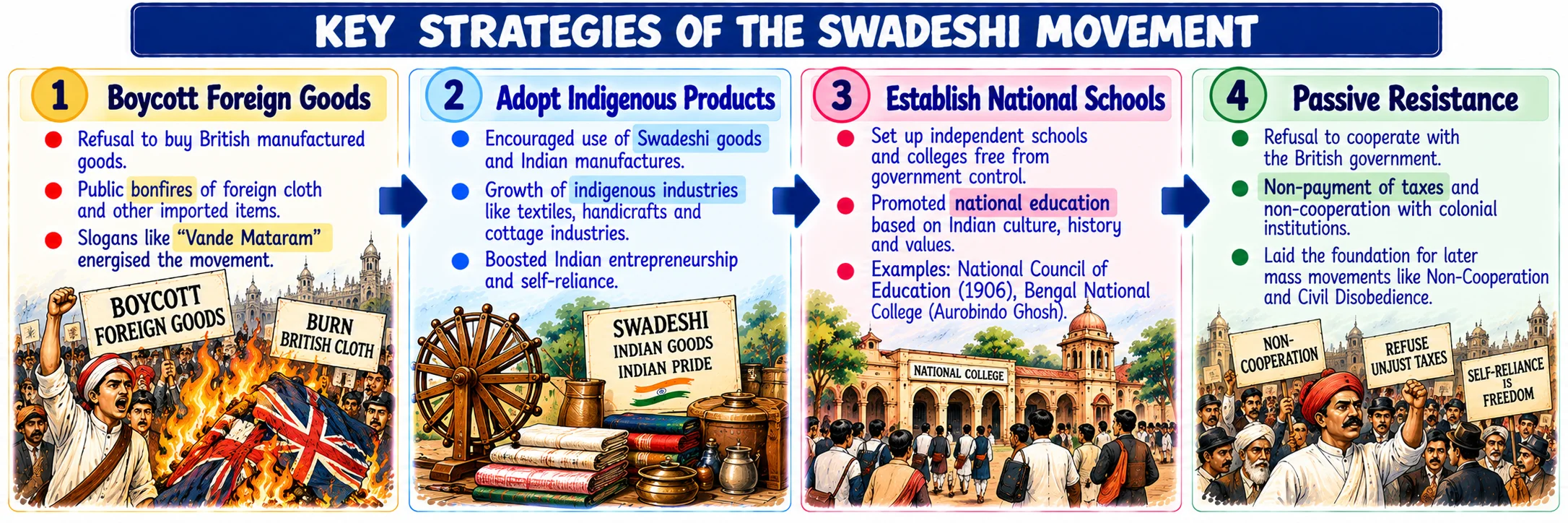 Figure 3: Four Pillars of Action: Boycott, Indigenous Industry, National Schools, and Passive Resistance
- The Formal Proclamation: On August 7, 1905, at a historic gathering in the Calcutta Town Hall, the formal Boycott Resolution was passed, officially inaugurating the Swadeshi Movement.
- Genesis of Boycott: The initial call for an economic boycott of British commodities was first proposed by Krishna Kumar Mitra in his nationalist journal Sanjivani in July 1905.
A. Methods of Agitation and Boycott
- Economic Boycott: Picketing of shops dealing in foreign cloth, Liverpool salt, and British sugar. Bonfires of British textiles were lit publicly across cities and rural market squares.
- Social Boycott: Enforcing strict social ostracism against individuals purchasing or selling foreign commodities. Washermen refused to wash imported clothes, priests declined to solemnize marriages where foreign exchange gifts were used, and cobblers refused to mend foreign footwear.
- Mobilization through Traditional Festivals: Bal Gangadhar Tilak pioneered the public use of traditional religious festivals—specifically the Ganapati Festival (1893) and Shivaji Festival (1895)—to disseminate nationalist propaganda and Swadeshi pledges beyond Bengal into Maharashtra and across India.
B. Constructive Swadeshi and Indigenous Enterprise
The movement laid profound stress on Atmashakti (creative self-reliance), asserting economic sovereignty and national self-respect through indigenous enterprises:
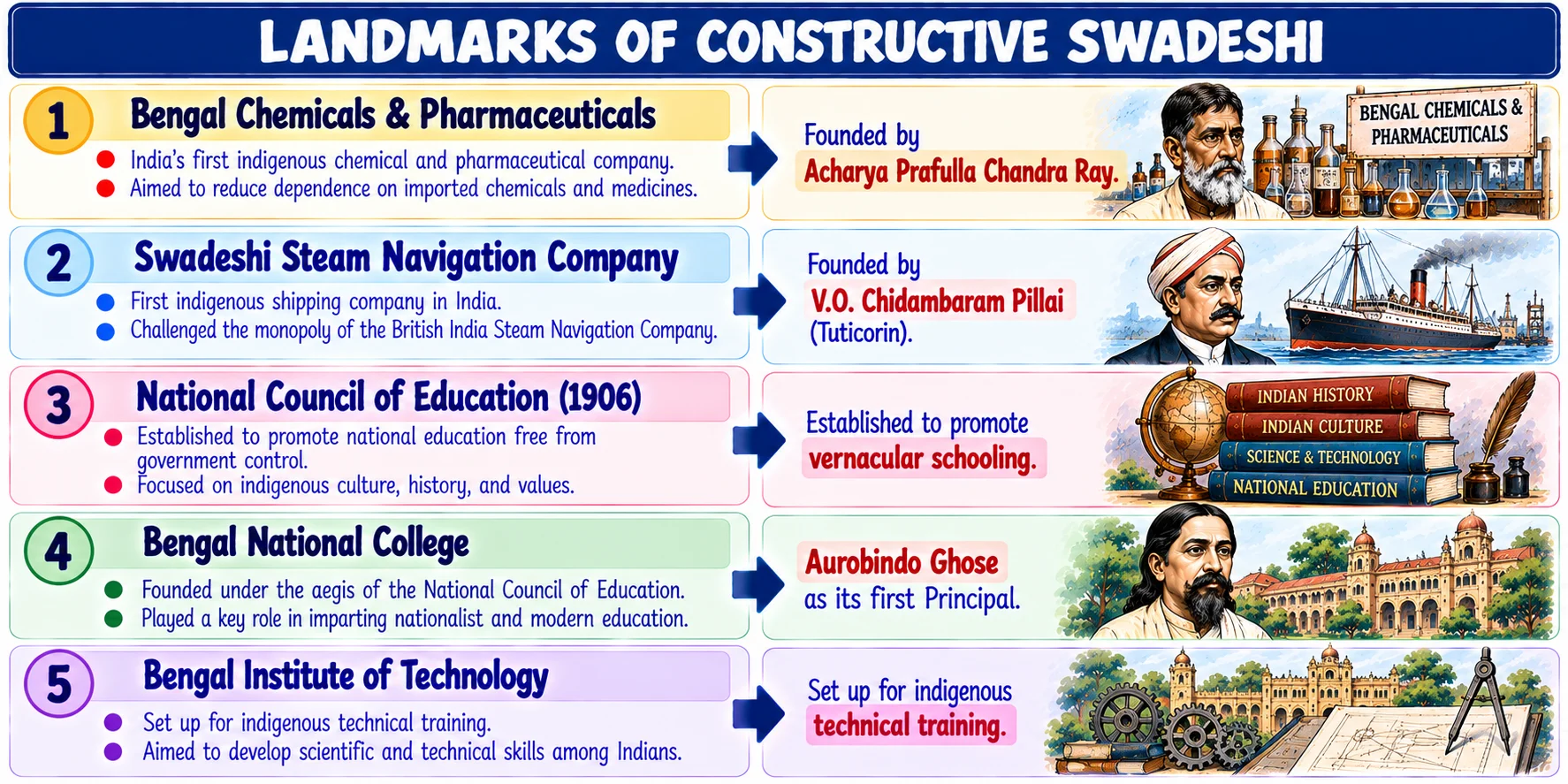 Figure 4: Leading Indigenous Industrial, Maritime, and Educational Institutions of Constructive Swadeshi
- Bengal Chemicals & Pharmaceuticals: India’s premier indigenous chemical and pharmaceutical enterprise, founded by eminent chemist Acharya Prafulla Chandra Ray to reduce reliance on imported medicines.
- Swadeshi Steam Navigation Company: Established at Tuticorin by V.O. Chidambaram Pillai to break the ruthless maritime monopoly of the British India Steam Navigation Company.
- National Council of Education (August 15, 1906): Founded to establish a national system of education—literary, scientific, and technical—managed by Indians and taught primarily through vernacular mediums.
- Bengal National College: Set up under the aegis of the National Council of Education, with Aurobindo Ghose serving as its first Principal.
- Bengal Institute of Technology: Formed to impart independent, advanced technical training to Indian students.
C. Corps of Volunteers (Samitis)
Mass mobilization was channeled through highly disciplined volunteer corps known as Samitis, which engaged in political education, famine and disease relief, physical training, and indigenous dispute resolution:
- The most prominent body was the Swadesh Bandhab Samiti, established by nationalist schoolteacher Ashwini Kumar Dutt in Barisal (East Bengal).
- Through an extensive network of 159 rural village branches, it mobilized thousands of Muslim and Hindu peasants into political action.
D. Cultural and Artistic Renaissance
- Patriotic Literature & Music: Rabindranath Tagore, Rajanikanta Sen, Dwijendralal Ray, and Mukunda Das composed moving patriotic poetry and folk ballads. Bankim Chandra Chatterjee’s hymn Vande Mataram (from his 1882 novel Anandamath) became the universal battle cry across India.
- Revival in Fine Arts: Abanindranath Tagore rebelled against Western academic realism, synthesizing classical Ajanta, Mughal, and Rajput styles. In 1905, he painted the iconic portrait of Bharat Mata, portraying the motherland as a serene ascetic goddess offering food, cloth, learning, and spiritual salvation.
- Scientific Advancements: Pioneering discoveries by Acharya Jagadish Chandra Bose in plant physiology/wireless communication and Acharya P.C. Ray in chemical sciences bolstered cultural pride and intellectual confidence.
3. Spread of the Movement Beyond Bengal
| Region | Prominent Nationalist Leaders | Key Features of Regional Mobilization |
|---|---|---|
| Bombay & Maharashtra | Bal Gangadhar Tilak & his daughter Ketkar | Expanded Ganapati & Shivaji festivals; popularized the slogan “Swaraj is my birthright and I shall have it.” |
| Punjab | Lala Lajpat Rai & Ajit Singh (founder of Bharat Mata Society) | Organized massive peasant agitations against the Colonization Bill and canal water rates under the banner of Pagri Sambhal Jatta. |
| Madras Presidency | V.O. Chidambaram Pillai, Subramania Bharati | Pioneered the Swadeshi Steam Navigation Company at Tuticorin; led the legendary Coral Mill strike in Tirunelveli. |
| Delhi | Syed Haider Raza | Spearheaded public boyotts, mass meetings, and patriotic Swadeshi study circles. |
| Andhra Districts | Bipin Chandra Pal (extensive lecture tour) | Rallied student groups and youth, popularly celebrated as the Vandemataram Movement. |
4. Moderate vs. Extremist Polarization
The Swadeshi Movement exposed sharp tactical and ideological cleavages between the conservative older leadership (Moderates) and the radical younger faction (Extremists).
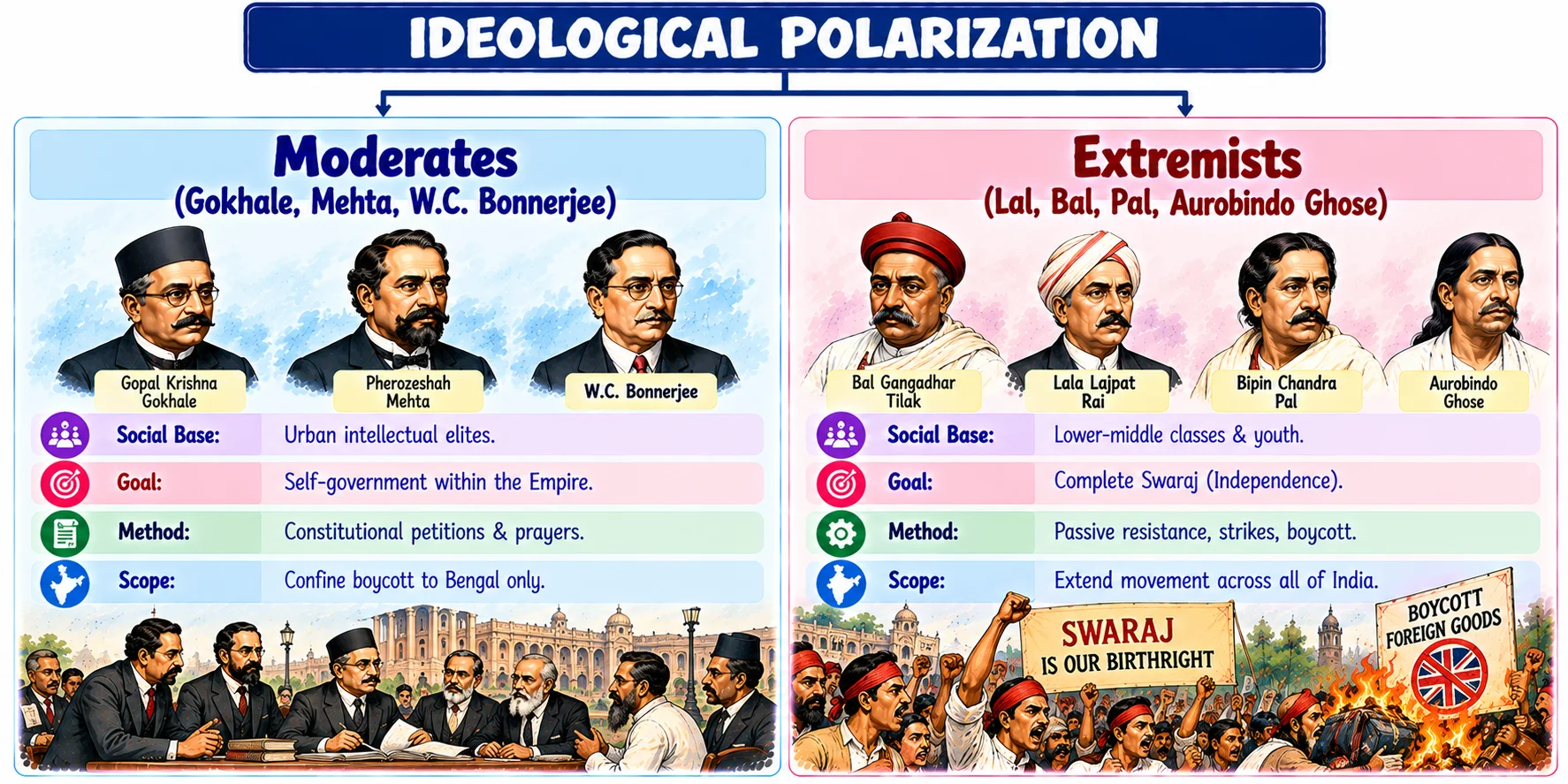 Figure 5: Fundamental Cleavages in Social Base, Goals, Methods, and Scope of Movement
A. Extremist Ideology: Lal-Bal-Pal and Aurobindo Ghose
- The Radical Vanguard: Lala Lajpat Rai (Punjab), Bal Gangadhar Tilak (Maharashtra), Bipin Chandra Pal (Bengal)—popularly remembered as Lal-Bal-Pal—along with philosopher-visionary Aurobindo Ghose, demanded an uncompromising transformation of nationalist aims.
- Redefining Swaraj: Moderates sought piecemeal legislative reforms and self-governance modeled after white colonies (like Canada). The Extremists redefined Swaraj: for Tilak, “Swaraj is my birthright and I shall have it,” while Aurobindo Ghose articulated Swaraj as absolute independence from British paramountcy.
- The Doctrine of Passive Resistance: Systematically formulated by Aurobindo Ghose in a series of articles in Bande Mataram (April 1907), outlining a coordinated strategy:
- Boycott of imported British goods and commercial manufactures.
- Boycott of colonial schools, colleges, and university degrees.
- Boycott of British law courts and establishment of people’s arbitration councils.
- Boycott of government titles, honors, and administrative civil employment.
- Non-payment of imperial taxes if state coercion and police brutalities continued.
B. The 1906 Calcutta Congress Session: A Fragile Truce
- Presidential Impasse: Ideological tension peaked at the 1906 Calcutta session. Extremists advocated for Tilak or Lala Lajpat Rai as Congress President, while Moderates strongly opposed them.
- Dadabhai Naoroji as Unifier: To forestall an imminent split, the Moderates invited the universally revered “Grand Old Man of India,” Dadabhai Naoroji, to preside.
- The Historic Proclamation: Yielding to Extremist influence, Dadabhai Naoroji declared for the first time from the official Congress dais that the supreme goal of the INC was “Swaraj” (Self-Government).
- Four Landmark Resolutions: The 1906 session officially passed four historic resolutions upholding:
- Swadeshi
- Boycott
- National Education
- Self-Government (Swaraj)
5. The Surat Split (1907 CE)
The compromise reached in Calcutta was merely a temporary truce. During 1907, irreconcilable differences flared over the interpretation and geographical scope of the four Calcutta resolutions.
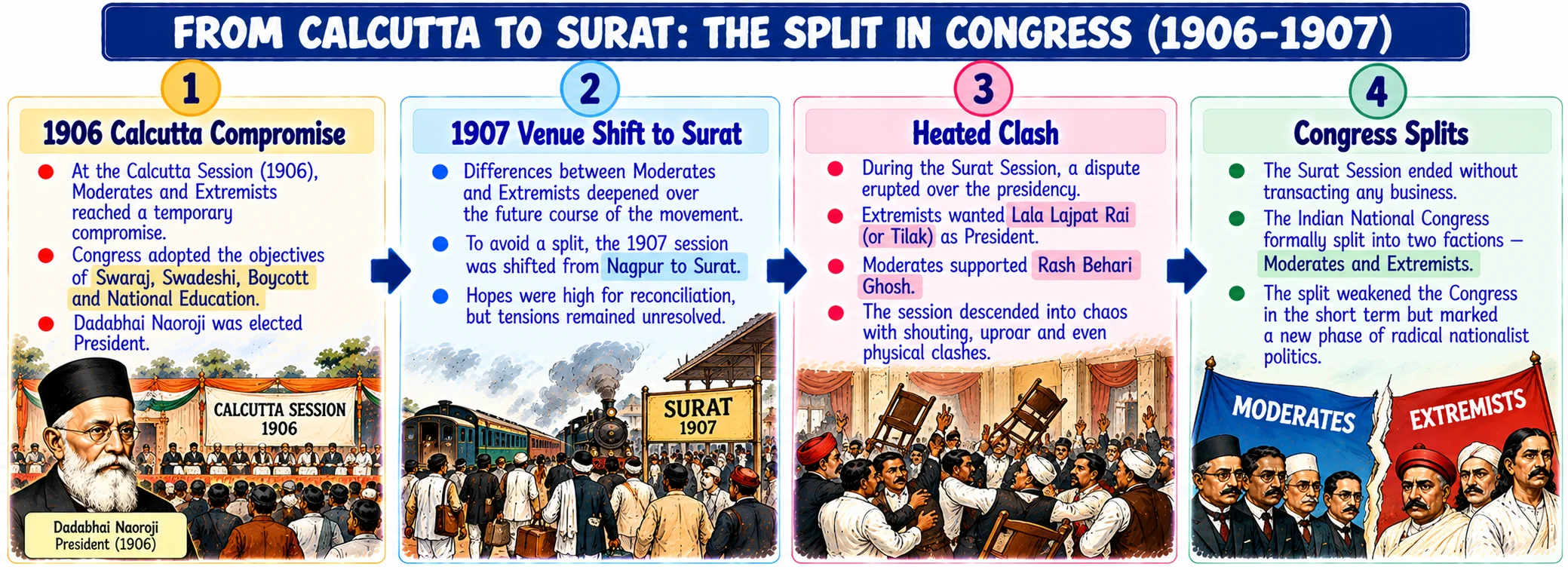 Figure 6: The Step-by-Step Trajectory Leading to the Historic Rupture at the Surat Session
- Venue Manipulation: The 1907 annual session was originally fixed at Nagpur (an Extremist stronghold). Fearing an Extremist takeover, Moderate boss Pherozeshah Mehta orchestrated a last-minute shift of the venue to Surat in his home presidency of Bombay.
- The Presidential Dispute: Under INC rules, a native of the host province could not preside, which effectively disqualified Tilak. Extremists proposed Lala Lajpat Rai, but Moderates insisted on Dr. Rash Behari Ghosh. Lala Lajpat Rai withdrew his nomination to avoid direct conflict.
- The Surat Session (December 1907): The session convened on the banks of the River Tapti. Extremists demanded a reaffirmation of the four Calcutta resolutions, suspicious that the Moderates intended to drop the Swadeshi and Boycott mandates.
- The Clash: Pandemonium erupted inside the pavilion. Verbal altercations turned violent; chairs were thrown, and a flying shoe struck Sir Pherozeshah Mehta and Surendranath Banerjea on stage. The police cleared the venue, and the session was suspended.
- Formal Expulsion: Moderates convened a closed convention, redrafted the Congress constitution requiring adherence to strictly constitutional methods, and formally expelled the Extremists from the party.
- Consequence of the Split: The split crippled the organizational momentum of the national movement. The British exploited the internal rift to isolate and crush the Extremists while providing minor constitutional concessions to the Moderates.
6. Colonial Repression and Communal Counter-Strategy
Following the split, the colonial government unleashed an iron-fisted crackdown on radical nationalist leaders and regional samitis between 1907 and 1911.
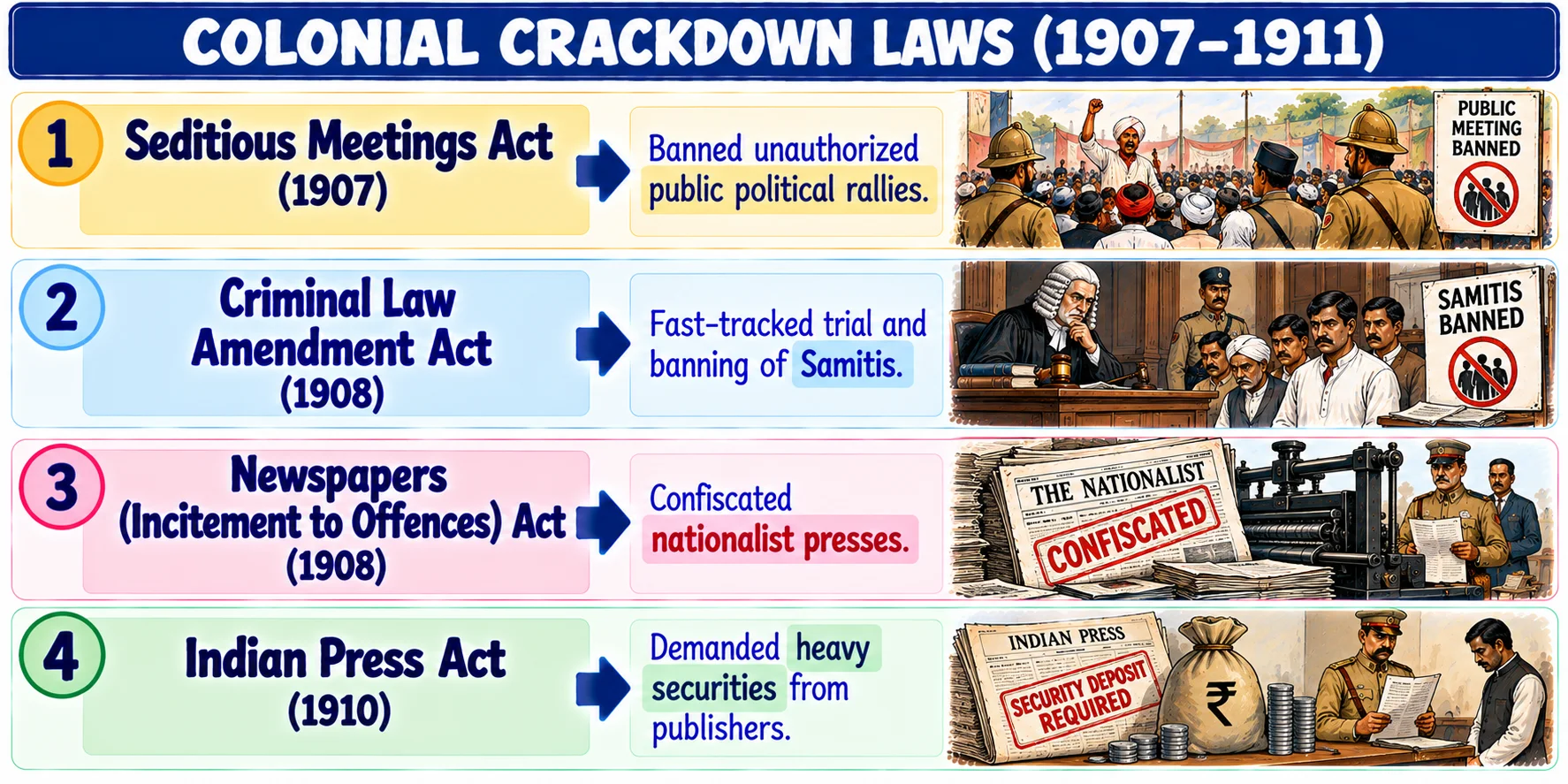 Figure 7: Draconian Colonial Enactments Deployed to Crush the Swadeshi Upsurge
- Seditious Meetings Act (1907): Prohibited public political gatherings and unauthorized rallies without magisterial sanction.
- Criminal Law Amendment Act (1908): Enabled summary trials and banned nationalist volunteer bodies and samitis.
- Newspapers (Incitement to Offences) Act (1908): Authorized magistrates to confiscate printing presses inciting public disaffection.
- Indian Press Act (1910): Empowered authorities to demand exorbitant security deposits from publishers, penalizing critical coverage.
- Imprisonment of Bal Gangadhar Tilak: In 1908, Tilak was arrested for sedition over articles in Kesari defending the Muzaffarpur revolutionaries (Khudiram Bose and Prafulla Chaki). He was sentenced to six years of solitary confinement in Mandalay Jail (Burma), where he authored his magnum opus, Gita Rahasya.
- Retreat of Radical Leadership: Bipin Chandra Pal and Lala Lajpat Rai retired temporarily from public life or went abroad. Aurobindo Ghose, acquitted in the Alipore Bomb Case (1908–09) through the defense of Chittaranjan Das, left politics in 1910 to establish a spiritual ashram at Pondicherry.
A. Formation of the All-India Muslim League (1906 CE)
- Encouraged by British officials who sponsored the Shimla Deputation to Lord Minto, conservative Muslim elites organized an independent political association.
- On December 30, 1906, the All-India Muslim League was established at Dacca under the leadership of Nawab Salimullah of Dacca, the Aga Khan III, and Nawab Mohsin-ul-Mulk.
- Its early objectives included expressing loyalty to the British Crown, checking Congress influence, supporting the Partition of Bengal, and securing separate communal political representation.
B. The Indian Councils Act of 1909 (Morley-Minto Reforms)
- Separate Electorates: Introduced separate electorates for Muslims, creating communal electorates where only Muslim voters could elect Muslim candidates. For this divisive measure, Viceroy Lord Minto is known as the “Father of Communal Electorates”.
- Council Expansion: Increased the strength of the Imperial Legislative Council from 16 to 60 members, while retaining an official British majority.
- Indian in Executive Council: Satyendra Prasad Sinha was appointed as the Law Member in the Viceroy’s Executive Council, becoming the first Indian to hold the post.
7. The Annulment of Partition: Delhi Durbar (1911 CE)
Faced with persistent revolutionary activities in Bengal and a widespread boycott of British goods, the imperial government reversed the partition in 1911.
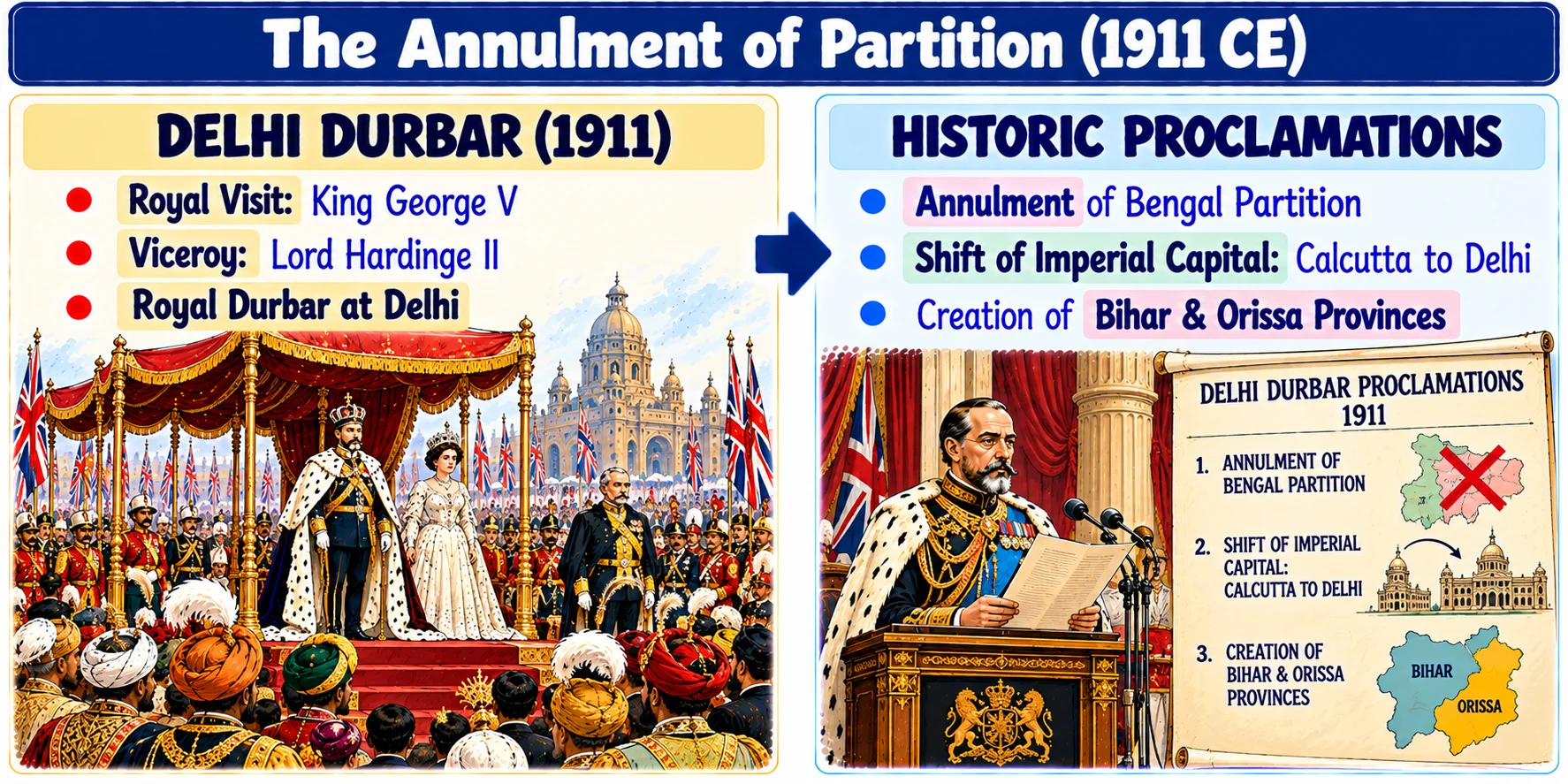 Figure 8: Imperial Announcements by King George V at the Delhi Durbar (1911 CE)
- The Royal Delhi Durbar: In December 1911, King George V and Queen Mary visited India and held a royal Coronation Durbar in Delhi during the viceroyalty of Lord Hardinge II.
- Key Royal Proclamations:
- Annulment of Partition: The 1905 partition was officially annulled, reunifying Bengal along linguistic lines.
- Shift of the Imperial Capital: The imperial capital was shifted from Calcutta to Delhi to counter Bengal’s political influence (taking effect in 1912).
- Creation of New Administrative Provinces: Bihar and Orissa were severed from Bengal to form an independent province, while Assam was reconstituted under a Chief Commissioner.
8. Quick Examination Facts
| Topic / Historical Milestone | Key Exam Fact |
|---|---|
| Viceroy who Partitioned Bengal | Lord Curzon (Announced July 1905, effective October 16, 1905) |
| Home Secretary who Authored the Bengal Minute | H.H. Risley (“Bengal united is a power; Bengal divided will pull different ways”) |
| Date Partition Came into Force | October 16, 1905 (Observed as Day of National Mourning / Raksha Bandhan) |
| Passage of the Boycott Resolution | August 7, 1905 (Calcutta Town Hall assembly) |
| First Journal to Suggest Economic Boycott | Sanjivani by Krishna Kumar Mitra (July 1905) |
| Founder of Bengal Chemicals & Pharmaceuticals | Acharya Prafulla Chandra Ray |
| Founder of Swadeshi Steam Navigation Co. | V.O. Chidambaram Pillai (Tuticorin, Tamil Nadu) |
| First Principal of Bengal National College | Aurobindo Ghose |
| Founder of Swadesh Bandhab Samiti | Ashwini Kumar Dutt (Barisal, 159 branches) |
| Artist of the Iconic “Bharat Mata” Painting | Abanindranath Tagore (1905) |
| Patriotic Anthem Composed by Rabindranath Tagore | Amar Shonar Bangla (Adopted as Bangladesh’s National Anthem in 1971) |
| INC Session Formally Declaring “Swaraj” | 1906 Calcutta Session (Presided over by Dadabhai Naoroji) |
| Four Historic Resolutions of 1906 | Swadeshi, Boycott, National Education, and Swaraj |
| Year & Venue of the Congress Split | 1907, Surat Session (Convened on the banks of River Tapti) |
| President of the Fractured 1907 Surat Session | Dr. Rash Behari Ghosh |
| Mandalay Imprisonment of Bal Gangadhar Tilak | 1908 – 1914 (6 years rigorous imprisonment; authored Gita Rahasya) |
| Founders of All-India Muslim League (1906) | Nawab Salimullah of Dacca, Aga Khan III, Nawab Mohsin-ul-Mulk |
| Statute Granting Separate Electorates for Muslims | Indian Councils Act of 1909 (Morley-Minto Reforms; Lord Minto is “Father of Communal Electorates”) |
| First Indian in Viceroy’s Executive Council | Satyendra Prasad Sinha (Appointed Law Member) |
| Year of Annulment of Bengal Partition | 1911 (Proclaimed by King George V at Delhi Durbar under Lord Hardinge II) |
| Year Imperial Capital Shifted to Delhi | Announced December 1911 (Formally inaugurated in 1912) |
9. Conclusion
The period between 1905 and 1911 transformed Indian nationalism from elite constitutional petitioning into mass political mobilization. Although the Swadeshi Movement could not prevent colonial repression or early communal polarization, it altered India’s political trajectory. It shattered the illusion of British benevolence, pioneered active economic boycotts, established indigenous institutions, and engaged students, women, and the urban working class. While the Surat Split of 1907 temporarily divided the Congress, the methods and ideological frameworks developed by Lal, Bal, Pal, and Aurobindo Ghose laid the tactical foundation for Mahatma Gandhi’s subsequent nationwide mass movements.
Partition of Bengal (1905), Swadeshi Movement and Surat Split (1905 – 1909 CE)
Practice Quiz • 15 MCQs