Historical Background of Indian Constitution
Introduction
The Indian Constitution was not drafted in isolation. Its administrative systems, federal principles, and legal traditions were shaped over nearly two centuries of British rule. The British arrived in India in 1608 as traders under the banner of the East India Company. After winning the Battle of Buxar in 1764, the Company obtained the Diwani (rights over revenue and civil justice) of Bengal, Bihar, and Orissa, marking its transition from a commercial body to a territorial power.
To understand how the modern Indian polity developed, we must study the British legislative interventions in two distinct periods:
- The Company Rule (1773–1858): The era where the British Parliament gradually brought the commercial and political affairs of the East India Company under its control.
- The Crown Rule (1858–1947): The era of direct administration by the British Crown following the Revolt of 1857.
The Company Rule (1773–1858)
During this period, the British Government passed several acts to regulate the East India Company’s administrative monopoly and centralize authority in India.
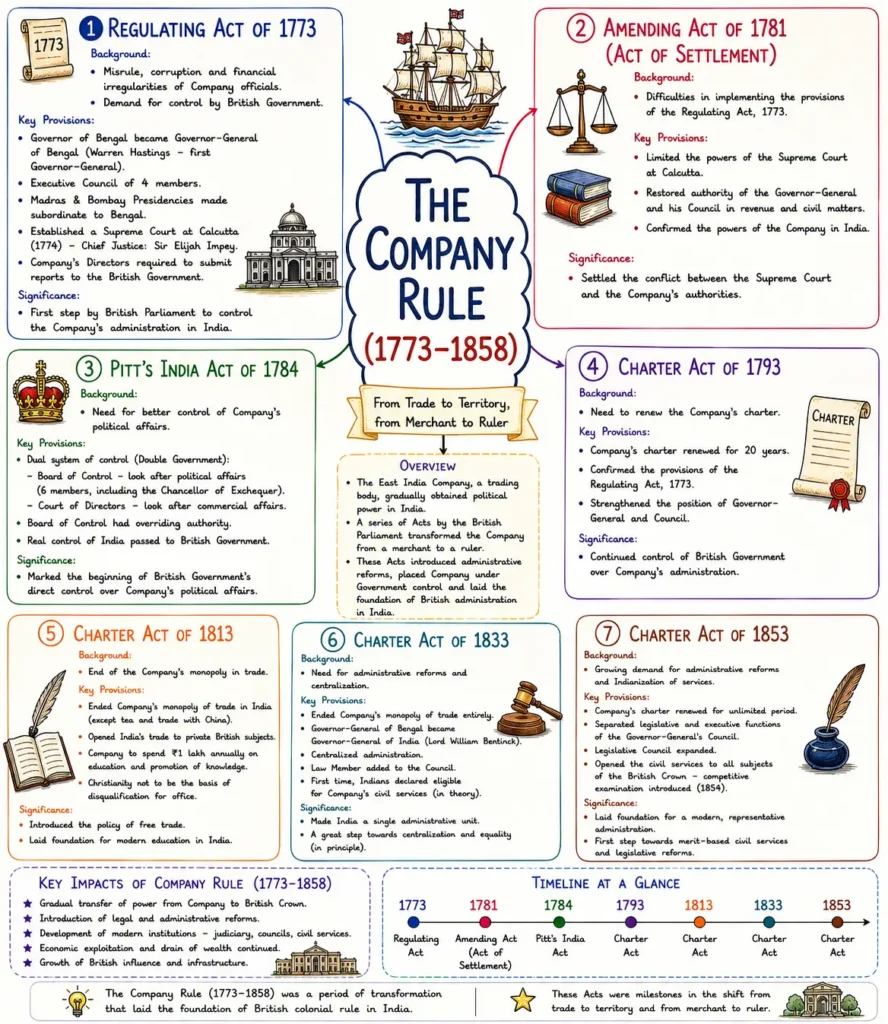
1. Regulating Act of 1773
This was the first legislative step taken by the British Parliament to control and regulate the affairs of the East India Company. It laid the foundations of central administration in India.
- Governor-General of Bengal: It changed the designation of the Governor of Bengal to the Governor-General of Bengal and created a four-member Executive Council to assist him. Lord Warren Hastings was the first Governor-General.
- Subordination of Presidencies: The Governors of Bombay and Madras Presidencies were made subordinate to the Governor-General of Bengal, ending the system where each presidency functioned independently.
- Supreme Court of Calcutta: It provided for the establishment of a Supreme Court at Calcutta (1774), comprising one Chief Justice and three other judges.
- Anti-Corruption Measures: It strictly prohibited Company servants from engaging in private trade or accepting bribes and presents from native populations.
2. Amending Act of 1781 (Act of Settlement)
Passed to resolve the jurisdictional conflicts between the newly created Supreme Court and the Governor-General-in-Council.
- Official Acts Exempted: The Governor-General and his council were exempted from the jurisdiction of the Supreme Court for actions taken in their official capacity.
- Revenue Matters: The court was deprived of jurisdiction over revenue collection and matters arising in its collection.
- Personal Laws: It mandated that the court respect the personal laws of the defendants (Hindu law for Hindus, Mohammadan law for Muslims).
3. Pitt’s India Act of 1784
This act established a system of joint governance between the British Crown and the Company, bringing Indian administration under direct parliamentary oversight.
- Double Government: It distinguished between the commercial and political functions of the Company:
- Court of Directors: Managed commercial operations.
- Board of Control: A new six-member body appointed by the Crown to supervise civil, military, and revenue affairs.
- British Possessions: The Company’s territories in India were formally called “British possessions in India” for the first time.
4. Charter Act of 1793
- Monopoly Extended: It renewed the Company’s commercial monopoly in India for another twenty years.
- Salaries from Indian Revenue: It mandated that the salaries of the Board of Control and their staff be paid directly out of Indian revenues, establishing a financial drain on the country.
5. Charter Act of 1813
This act weakened the Company’s commercial monopoly due to growing demands from merchants in Britain.
- End of Monopoly: It ended the trade monopoly of the East India Company in India. However, the Company retained its monopoly over trade in tea and trade with China.
- Crown Sovereignty: It explicitly asserted the sovereignty of the British Crown over the Company’s territorial acquisitions in India.
- Education and Missionaries: It directed the Company to spend ₹1 lakh annually on Indian education and permitted Christian missionaries to enter the country.
6. Charter Act of 1833
This act was the final legislative step toward administrative centralization in British India.
- Governor-General of India: It changed the designation of the Governor-General of Bengal to the Governor-General of India, vesting all civil, military, and financial powers in his office. Lord William Bentinck became the first Governor-General of India.
- Legislative Centralization: The Governors of Bombay and Madras were completely deprived of their legislative powers. The Governor-General of India was given exclusive law-making authority for the entirety of British India.
- End of Commercial Operations: The East India Company ceased to be a commercial body and became a purely administrative entity holding Indian territories in trust for the British Crown.
- Civil Service Attempt: It attempted to introduce an open competition for civil services, but the provision was withdrawn due to strong opposition from the Court of Directors.
7. Charter Act of 1853
This was the last of the Charter Acts. It introduced major structural reforms and laid the foundation for modern parliamentary practice in India.
- Separation of Powers: It separated the legislative and executive functions of the Governor-General’s Council.
- Indian Legislative Council: It added six new members to the council for legislative purposes, establishing a mini-parliament that followed the procedures of the British Parliament.
- Open Competition Introduced: It successfully introduced an open competitive system for recruiting civil servants, throwing the services open to Indians. The Macaulay Committee on the Indian Civil Service was appointed in 1854.
- Local Representation: For the first time, local representation was introduced in the Indian Legislative Council. Four of the six legislative members were appointed by the provincial governments of Madras, Bombay, Bengal, and Agra.
The Crown Rule (1858–1947)
Following the Revolt of 1857, the British Parliament dissolved the East India Company and transferred the administration of India directly to the British Crown.
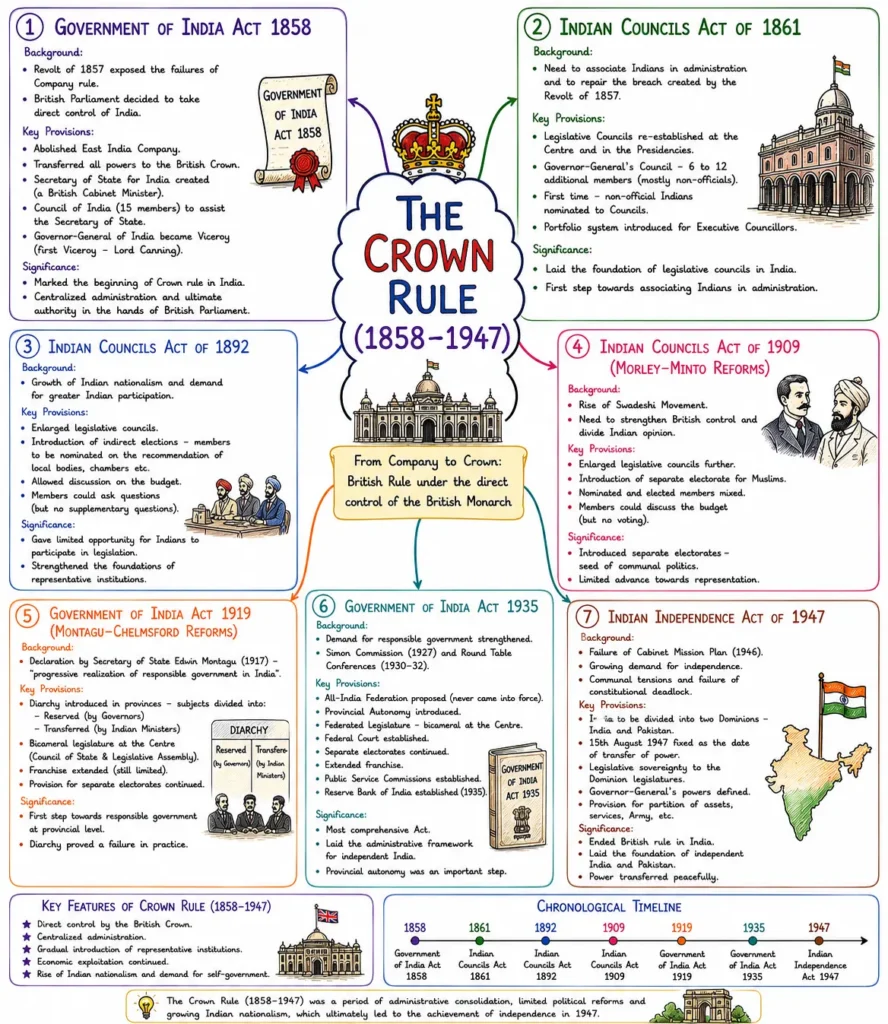
1. Government of India Act 1858
Known as the “Act for the Good Government of India,” this statute ended Company rule and brought India under the direct sovereignty of the British Crown.
- Direct Crown Rule: India was to be governed directly in the name of the British Monarch.
- Viceroy of India: The designation of Governor-General of India was changed to the Viceroy of India, who served as the direct representative of the Crown. Lord Canning became the first Viceroy of India.
- End of Double Government: It abolished the Board of Control and the Court of Directors, ending the system of dual administration.
- Secretary of State for India: It created a new cabinet-level office in London called the Secretary of State for India, vesting in him complete authority over the Indian administration. He was assisted by a 15-member advisory body called the Council of India.
2. Indian Councils Act of 1861
This act initiated the association of Indians with the legislative process and reversed the trend of extreme centralization.
- Indian Representation: It provided that the Viceroy should nominate non-official members to his expanded legislative council. In 1862, Lord Canning nominated three Indians: the Raja of Benares, the Maharaja of Patiala, and Sir Dinkar Rao.
- Decentralization Restored: It restored the legislative powers of the Bombay and Madras Presidencies, reversing the centralization policy of the 1833 Act.
- Portfolio System: It gave legal recognition to the Portfolio System introduced by Lord Canning in 1859, under which individual executive council members were placed in charge of specific administrative departments.
- Ordinance Power: It empowered the Viceroy to issue ordinances during emergencies without the consent of the legislative council, carrying the force of law for up to six months.
3. Indian Councils Act of 1892
- Council Expansion: It increased the number of non-official members in both central and provincial legislative councils, though maintaining an official majority.
- Budget Discussion: It expanded the functions of the legislative councils, giving members the right to discuss the annual financial statement (the Budget) and address questions to the executive.
- Indirect Elections: It introduced a limited, indirect element of nomination for non-official seats based on recommendations from provincial councils, universities, and district boards.
4. Indian Councils Act of 1909 (Morley-Minto Reforms)
Named after Lord Morley (Secretary of State) and Lord Minto (Viceroy), this act introduced electoral politics structured along communal lines.
- Enlargement of Councils: It significantly increased the size of the legislative councils, raising the central council’s strength from 16 to 60 members.
- Communal Representation: It introduced a system of communal representation by granting a separate electorate for Muslims. Under this system, Muslim candidates could only be elected by Muslim voters. This legalized communal divisions, earning Lord Minto the title of the Father of Communal Electorate.
- Executive Council Entry: For the first time, it permitted Indians to join the Executive Councils of the Viceroy and provincial governors. Satyendra Prasad Sinha joined the Viceroy’s Executive Council as the first Indian Law Member.
5. Government of India Act 1919 (Montagu-Chelmsford Reforms)
Named after Edwin Montagu (Secretary of State) and Lord Chelmsford (Viceroy), this act aimed to gradually introduce responsible government in India.
- Bifurcation of Subjects: It demarcated and separated the administrative domains into Central Subjects and Provincial Subjects.
- Dyarchy in Provinces: It introduced Dyarchy (double rule) in provincial administrations by dividing provincial subjects into two groups:
- Transferred Subjects: Administered by the Governor with the aid of ministers responsible to the Legislative Council (e.g., Education, Health).
- Reserved Subjects: Administered by the Governor and his Executive Council without any accountability to the legislature (e.g., Police, Finance, Land Revenue).
- Bicameralism: It replaced the Indian Legislative Council with a bicameral legislature consisting of an Upper House (Council of State) and a Lower House (Legislative Assembly).
- Direct Elections: It introduced direct elections in the country for the first time, though the franchise was highly restricted based on property, tax payments, and education.
- Public Service Commission: It provided for the establishment of a Central Public Service Commission to recruit civil servants, which was set up in 1926.
6. Government of India Act 1935
This was a massive, highly detailed document containing 321 sections and 10 schedules. It served as the primary administrative blueprint for the modern Constitution of India.
- All-India Federation: It provided for the establishment of an All-India Federation consisting of provinces and princely states as units. However, this federation never came into existence because the princely states refused to join.
- Three Legislative Lists: It divided power between the center and the provinces through three distinct lists:
- Federal List (for the center, containing 59 items).
- Provincial List (for the provinces, containing 54 items).
- Concurrent List (for both, containing 36 items).
- Residuary powers were vested directly in the Viceroy.
- Provincial Autonomy: It abolished dyarchy at the provincial level and introduced Provincial Autonomy, allowing provinces to act as autonomous administrative units with governments responsible to their own legislatures.
- Dyarchy at the Center: While it abolished provincial dyarchy, it provided for the adoption of dyarchy at the central level, dividing federal subjects into Reserved and Transferred categories (though this provision never came into operation).
- Federal Court: It provided for the establishment of a Federal Court (1937) in Delhi, which later became the Supreme Court of India.
- Reserve Bank of India: It provided for the establishment of the Reserve Bank of India (RBI) in 1935 to regulate the currency and credit of the country.
7. Indian Independence Act of 1947
Based on the Mountbatten Plan of June 3, 1947, this act brought an end to British rule in India.
- End of British Sovereignty: It declared India as an independent and sovereign state from August 15, 1947.
- Partition and Dominions: It provided for the partition of British India and the creation of two independent dominions—India and Pakistan.
- Sovereign Assemblies: It abolished the offices of the Viceroy and the Secretary of State. It empowered the Constituent Assemblies of the two dominions to frame their respective constitutions and repeal any act of the British Parliament.
- Interim Administration: It provided that until new constitutions were framed, both dominions and their provinces would be governed in accordance with the Government of India Act of 1935.
Quick Examination Facts
| Act / Milestone | Core Constitutional Significance | Key Administrative Feature |
|---|---|---|
| Regulating Act 1773 | First step of parliamentary control over EIC | Created Governor-General of Bengal; Supreme Court at Calcutta |
| Pitt’s India Act 1784 | Introduced System of “Double Government” | Created Board of Control (political) & Court of Directors (commercial) |
| Charter Act 1813 | Asserted Crown sovereignty; partial end of trade monopoly | Ended trade monopoly except in tea and trade with China |
| Charter Act 1833 | Final step toward administrative centralization | Created Governor-General of India; EIC became purely administrative |
| Charter Act 1853 | Separated legislative and executive functions | Created Indian Legislative Council; introduced open civil service examinations |
| Govt of India Act 1858 | Transferred power from EIC to the British Crown | Created Viceroy of India & Secretary of State for India |
| Councils Act 1861 | Began legislative devolution & Indian representation | Portfolio System introduced; Viceroy granted Ordinance power |
| Councils Act 1909 | Introduced communal representation | Separate electorate for Muslims; Satyendra Prasad Sinha joined Executive Council |
| Govt of India Act 1919 | Introduced provincial dyarchy & bicameralism | Transferred vs Reserved subjects; Public Service Commission (1926) |
| Govt of India Act 1935 | Detailed blueprint for 1950 Constitution | Provincial Autonomy; Federal Court (1937); RBI; Three Legislative Lists |
| Independence Act 1947 | Ended British sovereignty over India | Abolished Viceroy & Secretary of State; created India and Pakistan |
Conclusion
The constitutional development of India was not a sudden historical event, but a slow, evolutionary process shaped by these British statutes. The administrative frameworks, legislative distributions, bureaucratic networks, and federal arrangements we see today are deeply rooted in these acts. The transition from the centralized corporate management of the East India Company to the structural representative experiments of the Crown Rule paved the way for local self-governance. Ultimately, it was this historical framework—specifically the highly detailed Government of India Act of 1935—that provided the core blueprint, legal terminology, and administrative machinery used by the framers to draft the modern Constitution of India.
Historical Background of Indian Constitution
Practice Quiz
| Some Important Links | |
| Download “Historical Background of Indian Constitution” PDF | Click Here |